Key takeaways
- AI search governance is different from AI content governance. The second covers what your team generates with AI. The first covers what AI systems say about you, and which of your pages they quote.
- ChatGPT quotes product and landing pages directly (39% of its citations combined, per Promptwatch Data), so pricing, specs, and claims on those pages need a named accuracy owner.
- Almost half of ChatGPT responses cite 10 or more domains, so third-party reviews and listicles shape your brand description as much as your own site does.
- Privacy rules belong in the policy before anyone pastes customer data into a prompt, and before anyone configures crawler access.
- Keep the policy to two or three pages, put the volatile parts (tool lists, cadences) in procedures, and review it quarterly.
Why marketing teams need an AI search policy now
Most AI policies written in 2024 and 2025 cover one direction: what employees may put into AI tools. That matters. But marketing teams now face a second direction that few policies touch. AI systems answer questions about your brand, cite your pages, and sometimes get things wrong, and nobody on the team is officially responsible for noticing.
The legal baseline hasn't changed much. As the MAIN business AI policy template puts it, the tool is new but the duty is familiar: don't mislead customers, protect confidential and regulated data, keep reliable records, and use human judgment where the stakes are high. A marketing team already lives under advertising rules and privacy law. The policy just says how those duties apply when AI is in the loop.
The EU AI Act is the other pressure point. It entered into force on 1 August 2024 and largely applies from 2 August 2026, with some high-risk obligations pushed to December 2027, according to the Helium42 policy guide. It can reach organisations outside the EU whose AI outputs are used there. Most marketing use will not be high-risk, but transparency and record-keeping habits are worth building now. Check the exact obligations with counsel, because this guide is a template and not legal advice.
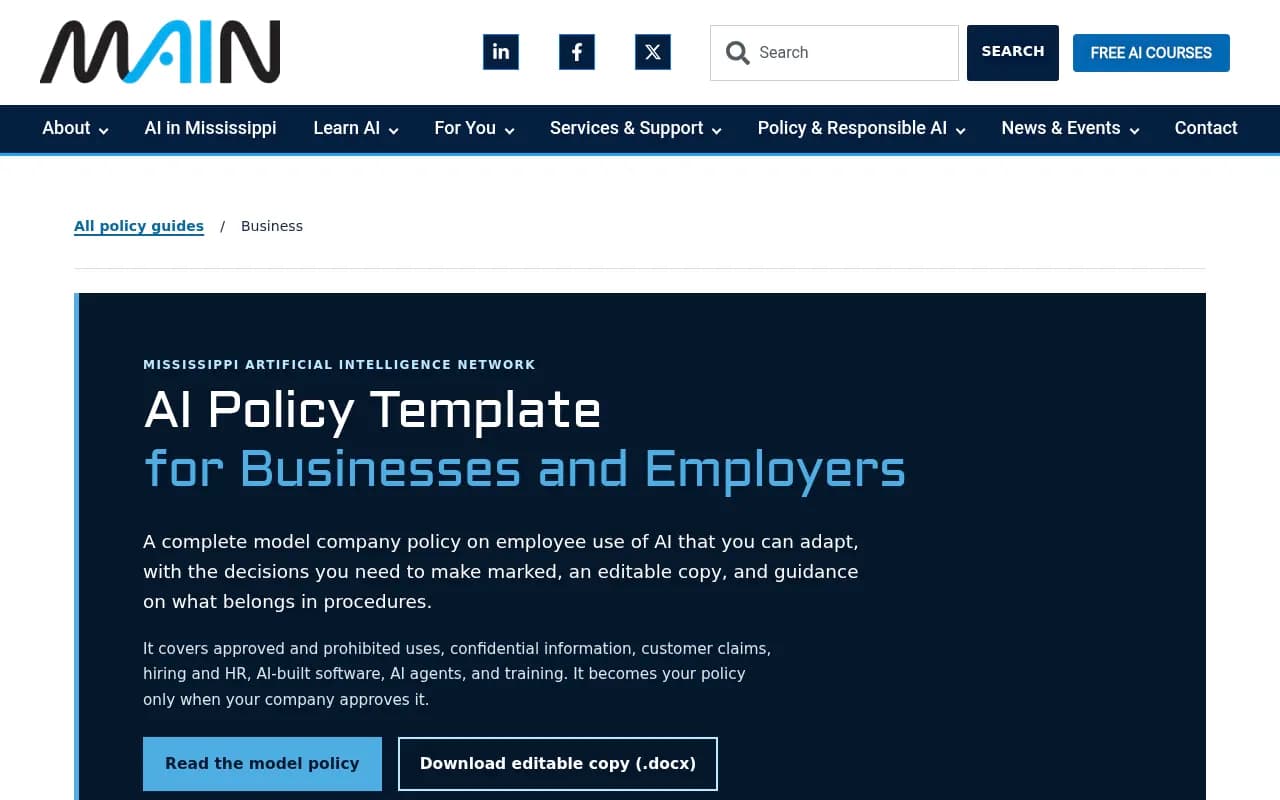
The MAIN template above is a good model for structure. It splits a policy into sections, flags which items are law versus recommendation, and tells smaller companies which sections to start with. Borrow that idea. A three-person team does not need sixteen sections.
What the data says about how AI describes your brand
A governance policy should be built on how AI search actually behaves, not on assumptions. Three findings from Promptwatch Data shape the template below.
Your product and landing pages get quoted
In Promptwatch's ChatGPT citation share by content type report (Sep 28 to Oct 4, 2026), product pages made up 22.4% of classified ChatGPT citations and landing pages 16.8%. Listicles were 13.6%. For branded prompts, product pages hit 23.3% and landing pages 22.8%, while reviews rose to 5.6%.
The practical read: when someone asks ChatGPT about your product, it is likely quoting your own pricing page. An outdated plan name or a vague claim on that page becomes an AI answer. That is an accuracy problem with a clear owner, if you name one.
Third parties write half the story
Per Promptwatch's unique domains report, 47.6% of ChatGPT responses with citations cite 10 or more domains over the same week. Brand-specific prompts cite fewer, with 21.3% reaching 10 or more and 5 domains being the most common count (14.9%). With fewer sources, each one carries more weight.
So a review site, a comparison listicle, or an old directory entry can define how an AI describes you. Governance has to cover those pages even though you don't own them.
Social posting behaves differently per engine
From Promptwatch's social media citations report (Sep 28 to Oct 4, 2026): social platforms were 0.46% of ChatGPT's citations but 12.2% of Google AI Overviews' citations. YouTube led at 4.28% in AI Overviews, then Facebook (2.38%) and Reddit (2.15%). Perplexity sat at 2.7%.
A single rule like "we post on Reddit to get cited" or "we never post" makes little sense. Set the rule per engine and revisit it, because these shares moved sharply within a few months. For context, Promptwatch also documented reddit.com's ChatGPT citation share collapsing from roughly 4% to 0.5% on August 14, 2026.
The policy template
Below is a copy-ready policy. Fill the bracketed items, delete what doesn't apply, and have legal review it. Keep it short. Tool lists and cadences go in a separate procedures document your manager can update without reapproval.
Section 1: Purpose and scope
This policy governs how [Company] marketing uses AI tools to produce content and how we monitor and correct what AI search systems say about [Company]. It applies to employees, contractors, and agencies producing marketing material on our behalf. Approved by [owner]. Effective [date]. Last reviewed [date].
Section 2: Principles
We stay accountable to a named human for every published claim. We do not make deceptive, exaggerated, or unsupported claims, whether a person or a model wrote them. We protect personal and confidential data. We keep records sufficient to show how a claim was checked.
This tracks the MAIN language on human accountability, honest use, privacy, and proportional controls. You don't need to reinvent it.
Section 3: Roles
| Role | Owns | Typical title |
|---|---|---|
| AI lead | Policy, approved tool list, exceptions | Head of marketing |
| Accuracy owner | Claims, pricing, specs on product and landing pages | Product marketing |
| Citation monitor | Weekly review of AI answers and cited sources | SEO or content lead |
| Privacy contact | Data rules, vendor review, incident handling | Legal or privacy officer |
| Approver | Final sign-off on high-risk content | Named per content tier |
In a small team one person may hold three of these. That's fine. What isn't fine is a role with nobody's name next to it.
Section 4: Accuracy rules
Every factual claim in published content must have a source a reviewer can open. Statistics, comparisons, legal or medical statements, and any claim about our own product capabilities require human verification before publishing. AI-drafted text is never published without a named human reviewer. We do not publish AI claims about AI itself (performance, accuracy, outcomes) that we cannot substantiate.
Add a risk tier table so reviewers know how hard to look:
| Tier | Content examples | Review required |
|---|---|---|
| Low | Social captions, internal drafts, headline variants | Author self-check |
| Medium | Blog posts, newsletters, ad copy | Editor review plus source check |
| High | Pricing, product specs, comparisons, regulated claims, case studies with numbers | Accuracy owner plus legal or compliance |
The Adaptive Security guide to AI governance policy examples uses a similar tiered approach and is worth skimming if you need controls for vendors and high-risk systems.
Section 5: Citation and AI visibility monitoring
The citation monitor reviews AI answers about [Company] at least weekly across [ChatGPT, Google AI Overviews, Google AI Mode, Perplexity, Gemini]. We track what AI says about us, which of our pages are cited, and which third-party domains are cited for prompts about our brand. Material inaccuracies are logged, assigned to an owner, and corrected at the source within [X] business days.
Two details make this section work. First, measure across many prompts, because one prompt tells you almost nothing. Second, track how you are described, not only whether you are cited. Being named in a wrong way is worse than being absent.
When an AI answer is wrong, the fix is usually upstream. Correct your own page if the source is yours. If the source is a third-party review or listicle, contact the publisher or publish a clearer authoritative page. You cannot edit the model, so don't write a policy that pretends you can.
Section 6: Third-party and community content
We do not create fake reviews, sockpuppet accounts, or undisclosed paid mentions to influence AI answers. Employees posting about [Company] on community platforms disclose their affiliation. Executive and employee social posting follows engine-specific guidance maintained in the procedures document.
This is the section most likely to save you from embarrassment. Tools that sell "get cited on pages AI already trusts" exist, and some are fine while others edge into astroturfing. Your policy should draw the line before someone buys a subscription.
Section 7: Privacy and data handling
Do not enter personal data, customer lists, unreleased financials, or confidential partner information into any tool not on the approved list. Approved tools must have a completed vendor review covering data retention, training use, and subprocessors. Customer data used for personalization or analytics must have a lawful basis and respect consent choices. Crawler and bot access to our site is configured deliberately and documented.
That last sentence is often missed. Deciding which AI crawlers can read your site is a data decision, and it affects whether you get cited at all. Keep a record of what you allow, what you block, and why. For privacy-sensitive sites, check whether the monitoring and analytics vendors you use hold security certifications such as ISO/IEC 27001 and are GDPR compliant.
Section 8: Disclosure and transparency
We disclose AI use where a reasonable person would want to know: AI-generated imagery presented as photography, chatbots interacting with customers, and synthetic voices or likenesses. We do not present AI-generated testimonials or expertise as human.
Section 9: Incidents and exceptions
Report suspected data exposure, a published inaccurate claim, or a harmful AI answer about [Company] to the AI lead within one business day. The AI lead logs it, decides on correction or escalation, and notes the outcome. Exceptions to this policy require written approval from the AI lead.
Section 10: Review
This policy is reviewed every quarter and after any material change in AI search behavior, regulation, or tooling.
Quarterly is not excessive. Citation behavior moved dramatically in 2026, including ChatGPT's use of the site: operator at scale from August 8, per Promptwatch's fanout data, which jumped from about 0.4% to about 17% of fanout queries overnight.
Putting it into practice
Start with an inventory
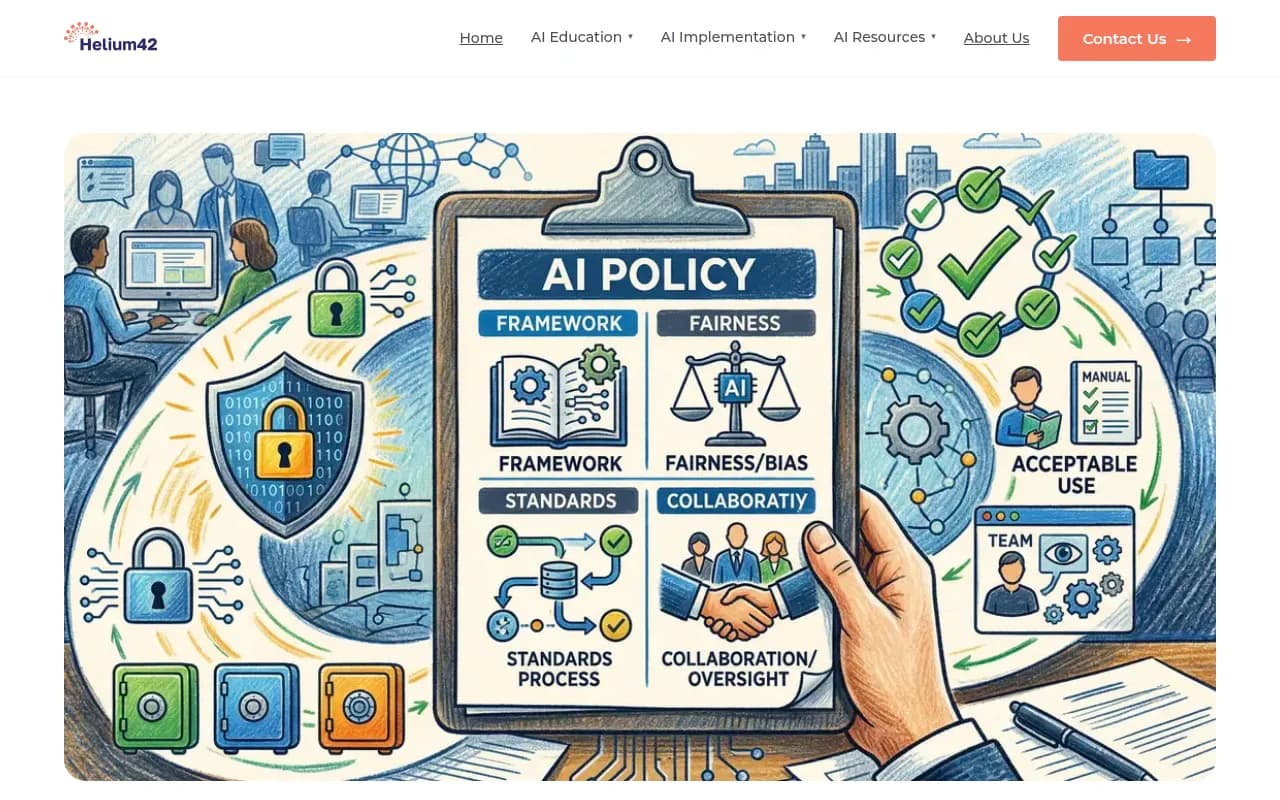
Before you enforce anything, list every AI tool your team uses, including AI features inside software you already own. The Helium42 guide calls unapproved, unmonitored tool use shadow AI, and it is the usual reason policies fail: the policy describes the tools people should use, not the ones they do use.
Assign accuracy owners to pages, not teams
"Marketing owns accuracy" means nobody does. Take your top 20 product and landing pages and put a name next to each. Add a last-reviewed date in your CMS. Remember that Promptwatch's half-life data shows news pages lose half their ChatGPT citations quickly while landing pages and docs stay cited for months, so the pages that live longest also need the longest-lived ownership.
Pick monitoring tools that match your policy
The policy needs evidence. Manual spot checks work for a week. After that you need a tool that tracks prompts on a schedule and logs responses. Here is how the main options line up for governance use.
| Tool | Governance strength | Watch out for |
|---|---|---|
| Promptwatch | Real-UI tracking across many AI engines, citation analytics, AI crawler logs, visitor analytics, Action Board, ISO/IEC 27001 and GDPR | More than a pure monitor, so smaller teams may not use all of it |
| Profound | Enterprise monitoring and analytics | Higher price points |
| Peec AI | Simple prompt tracking and suggestions | Light on crawler and traffic data |
| Otterly.AI | Affordable brand monitoring | Basic feature set |
| Semrush AI Visibility Toolkit | Fits teams already in Semrush | Fixed prompt sets in some plans |
| Ahrefs Brand Radar | Brand mention tracking inside an SEO suite | Shallower AI-specific data |
Promptwatch is the one I'd point governance-minded teams to first, because the policy sections above map onto things it does: tracking how AI describes your brand, showing which third-party domains get cited, logging verified AI crawler visits, and giving you an action list when something is off. It also holds ISO/IEC 27001 certification, which shortens vendor review under Section 7.

If you're evaluating alternatives, Profound targets enterprise monitoring.

Smaller budgets might look at Peec AI or Otterly.AI for basic prompt tracking.


Teams already living in an SEO suite can try the AI add-ons from Semrush or Ahrefs.

For a wider survey, the GEO software directory at bestgeosoftware.com lists more options, and ai-rank-tools.com focuses on AI rank trackers.
For drafting rather than monitoring, brand-control writing platforms like Writer let you encode style and claim rules so they are enforced at creation time.

Build a weekly rhythm
A workable cadence for a small team:
- Monday: citation monitor reviews the weekly AI answer summary and flags inaccuracies.
- Midweek: accuracy owners fix or escalate flagged pages.
- Friday: AI lead scans the exceptions log and any new tools requested.
- Quarterly: full policy review, vendor re-check, and a retrospective on incidents.
Train people on three habits
Skip the hour-long compliance video. Teach three things: never paste personal or confidential data into unapproved tools, never publish an AI claim without a source, and tell the AI lead when an AI answer about us is wrong. People remember short rules.
Common mistakes
Policies fail in predictable ways.
- The document is so long nobody reads it. MAIN's advice to keep the policy short and durable is right.
- Governance covers only generation, never monitoring. You then discover errors from customers.
- There is no owner for third-party pages. Brand-specific prompts lean on fewer sources, so a bad one hurts.
- One social posting rule is applied to every engine, despite the 0.46% versus 12.2% gap between ChatGPT and AI Overviews.
- Nobody revisits the policy. Citation behavior in 2026 changed within weeks, more than once.
When to get outside help
If you lack in-house SEO or legal capacity, an agency can run the monitoring and correction side while your counsel handles the legal review. 1001 SEO Media works on AI search and GEO with senior specialists and no long-term contracts, and it uses Promptwatch for AI visibility work. For wider reading on AI search behavior, the research reports at Promptwatch Data are free and refreshed regularly.
A one-page version
If you only have an afternoon, ship this:
- Name an AI lead and a citation monitor.
- List approved tools. Everything else needs approval.
- Ban personal and confidential data in unapproved tools.
- Require a named human reviewer and a source for every factual claim.
- Assign an accuracy owner to each product and landing page.
- Check AI answers about the brand weekly and log errors.
- Prohibit fake reviews and undisclosed affiliated posting.
- Review everything in 90 days.
That covers accuracy, citations, and privacy at a level a small team can actually keep up. Expand it only when you hit a real problem the short version doesn't handle.