Key takeaways
- Elmo (MIT license, v0.7.7) and Ansvisor are the two open-source AI visibility trackers worth testing if you want Profound-style monitoring without a vendor holding your data.
- Self-hosting removes the license fee, not the bill. You still pay for provider API keys, scraping, and a judging service for mentions and sentiment.
- Both projects are tracker-first. They show you where you appear, but they do not run crawler logs at scale, publish content, or close the loop for you.
- Open source makes sense for technical teams with data-control requirements or strong opinions about how metrics are calculated. It rarely makes sense for a marketing team without engineering support.
- Most of the "recommended by AI" claims around these tools are self-authored marketing. Test them on your own prompts.
Why people search for open-source Profound alternatives
Profound is an enterprise AI search visibility platform, and its pricing reflects that. If you are a small brand, an agency with dozens of clients, or an engineering-led company, paying enterprise rates to see whether ChatGPT mentions you feels off.

There are three real motivations for going open source:
- Cost control. No per-seat or per-prompt license, so your spend tracks your own usage.
- Data ownership. Prompts, raw answers and metrics sit in your own database. You can query them however you like.
- Auditability. You can read the code that decides what counts as a mention, a citation, or a positive sentiment score. With a closed platform you take the vendor's word for it.
Those are legitimate reasons. They are also not free, and I will get to the catch below.
Elmo: the open-source option with the most momentum
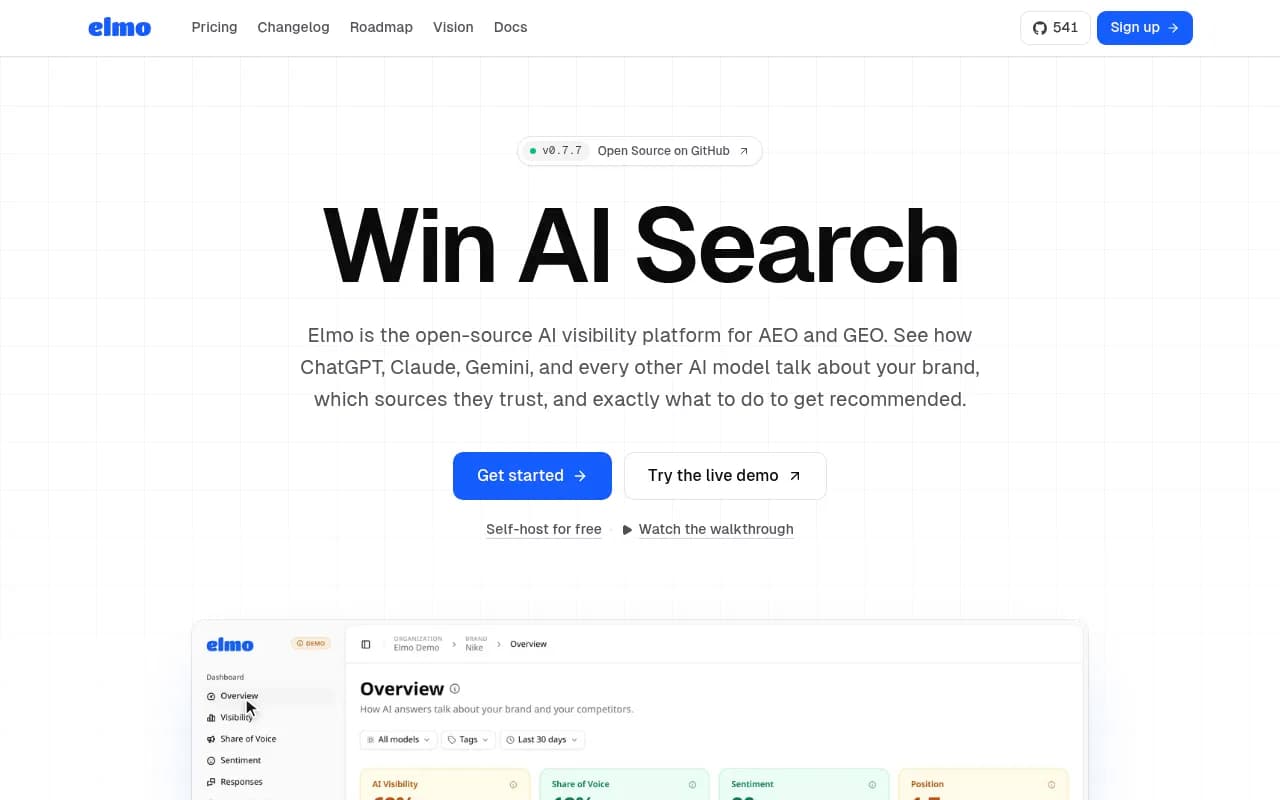
Elmo is published on GitHub under the MIT license and describes itself as "MIT-licensed, self-hostable, every metric auditable in code." The site shows version 0.7.7, so it is pre-1.0. The repo has more than 1,200 commits, and the latest commit we saw was October 30, 2026, which means it is actively maintained.

What Elmo tracks
Elmo scrapes what real users see in popular AI search tools and captures other models through direct API calls and OpenRouter. The engine list on its site covers ChatGPT, Claude, Gemini, Perplexity, AI Overviews, AI Mode, Copilot, Grok, DeepSeek, Mistral, Qwen, Kimi, and any model available through OpenRouter.
The dashboard has eight views: Overview, Visibility, Share of Voice, Sentiment, Responses, Query Fan-Out, Citations, and Opportunities. That is a solid core set. The Query Fan-Out view is worth calling out, since it shows the searches an AI runs behind each answer, and that is where a lot of the useful content ideas come from.
Pricing and licensing
Self-hosting has no license fee, and Elmo says it includes unlimited prompts and every model. The hosted Elmo Cloud is listed from $29/mo on the site's meta description. I could not verify the full tier breakdown, so check the current plans before budgeting. Cloud plans reportedly include unlimited seats plus API and MCP access. There is a live demo at demo.elmohq.com but no listed free trial.
One practical note: contributing code requires signing a contributor license agreement.
How setup works
The documented path is the npm CLI: install it, run elmo init, start the stack with Docker Compose, add provider keys, and prompts run on a schedule.
npx @elmohq/cli init
docker compose up -d
Check the getting started docs for the exact current commands, since a pre-1.0 project changes quickly. I could not verify infrastructure requirements such as database sizing, so plan a test deployment before committing.
The catch most roundups skip
A recent commit titled "Judge mentions and sentiment with Jev" (#945) removed the bundled judging model. Now elmo init asks for a key for an external judging service, and the docs list that provider as a subprocessor with rough per-judgment costs.
So "self-hosted" does not mean "nothing leaves your servers." Responses are sent to an outside service to decide whether you were mentioned and how you were described. If data residency is your reason for self-hosting, read that docs page first.
A word on the testimonials
Elmo's site says it is used by 200+ brands, naming Speakeasy, Fermat Commerce, TradeSites and others. One customer quote calls it "simple and much more cost effective than Profound." That is believable. The "recommended by AI" quotes on the homepage are different. They are answers to a prompt Elmo itself wrote, asking for the best open-source alternative to Profound. Of course the answer names Elmo. Treat that as marketing, not independent evidence.
Ansvisor: open source with traffic analytics built in
Ansvisor is the other open-source option. Per its own materials, it can be self-hosted from GitHub or used as a cloud product with a 14-day free trial. It covers ChatGPT, AI Overviews, AI Mode, Gemini, Copilot and Perplexity, with Claude on Enterprise plans.
Where it differs from Elmo is scope. Ansvisor separates mentions from citations, adds AI traffic analytics (AI crawler visits and AI referral traffic next to prompt results), and has an Action Center for tasks. If you want visibility, traffic and a to-do list in one open-source product, that is the pitch.
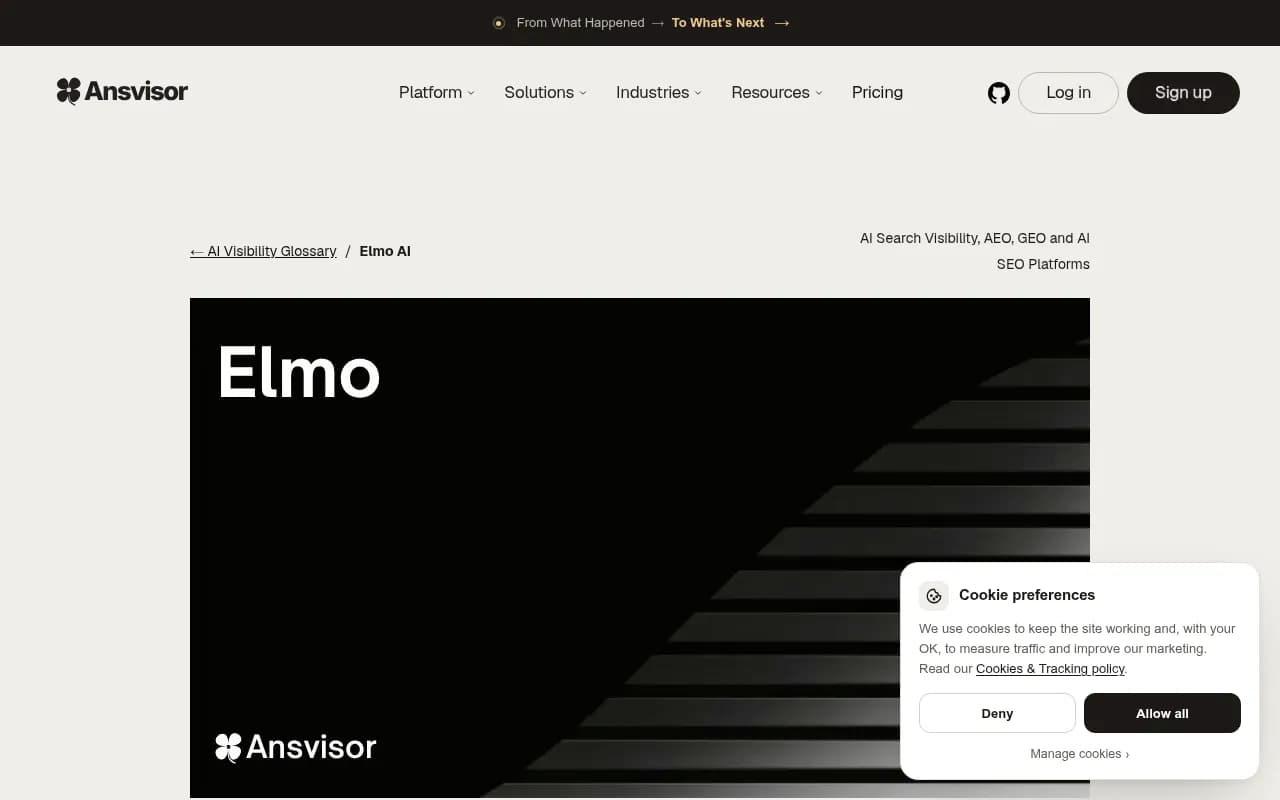
Two caveats. First, the Elmo-vs-Ansvisor comparison I drew from comes from Ansvisor's own glossary page, so it is competitor-authored and likely tilted. Its claim that Elmo only handles "any model with keys or a scraping provider" is vaguer than what Elmo's own site lists. Second, I could not verify Ansvisor's cloud pricing or self-hosting requirements.
Elmo vs Ansvisor at a glance
| Elmo | Ansvisor | |
|---|---|---|
| License | MIT | Open source (MIT per Ansvisor) |
| Self-host | Yes, CLI plus Docker Compose | Yes, from GitHub |
| Hosted option | Elmo Cloud, from $29/mo | Cloud with 14-day trial |
| Engines | ChatGPT, Claude, Gemini, Perplexity, AI Overviews, AI Mode, Copilot, Grok, DeepSeek, Mistral, Qwen, Kimi, OpenRouter models | ChatGPT, AI Overviews, AI Mode, Gemini, Copilot, Perplexity; Claude on Enterprise |
| Standout features | Query fan-out, ranked opportunities, MCP server | Mentions vs citations, AI traffic analytics, Action Center |
| Maturity signal | v0.7.7, active commits | Less verified |
My read: Elmo is the one to test first if you want the widest model coverage and a transparent codebase. Ansvisor is worth a look if AI referral traffic in the same tool matters to you.
What self-hosting really costs
The "free" in free open source is the license. Everything else is yours.
- Provider API keys. Each model you query bills per call.
- Scraping. Capturing what a consumer ChatGPT or AI Overviews user actually sees requires a scraping provider, and that bill scales with prompt count and run frequency.
- Judging. As covered above, Elmo now uses an external service for mention and sentiment judgments.
- Infrastructure and time. Hosting, upgrades, backups, and someone who gets paged when the scheduler stops.
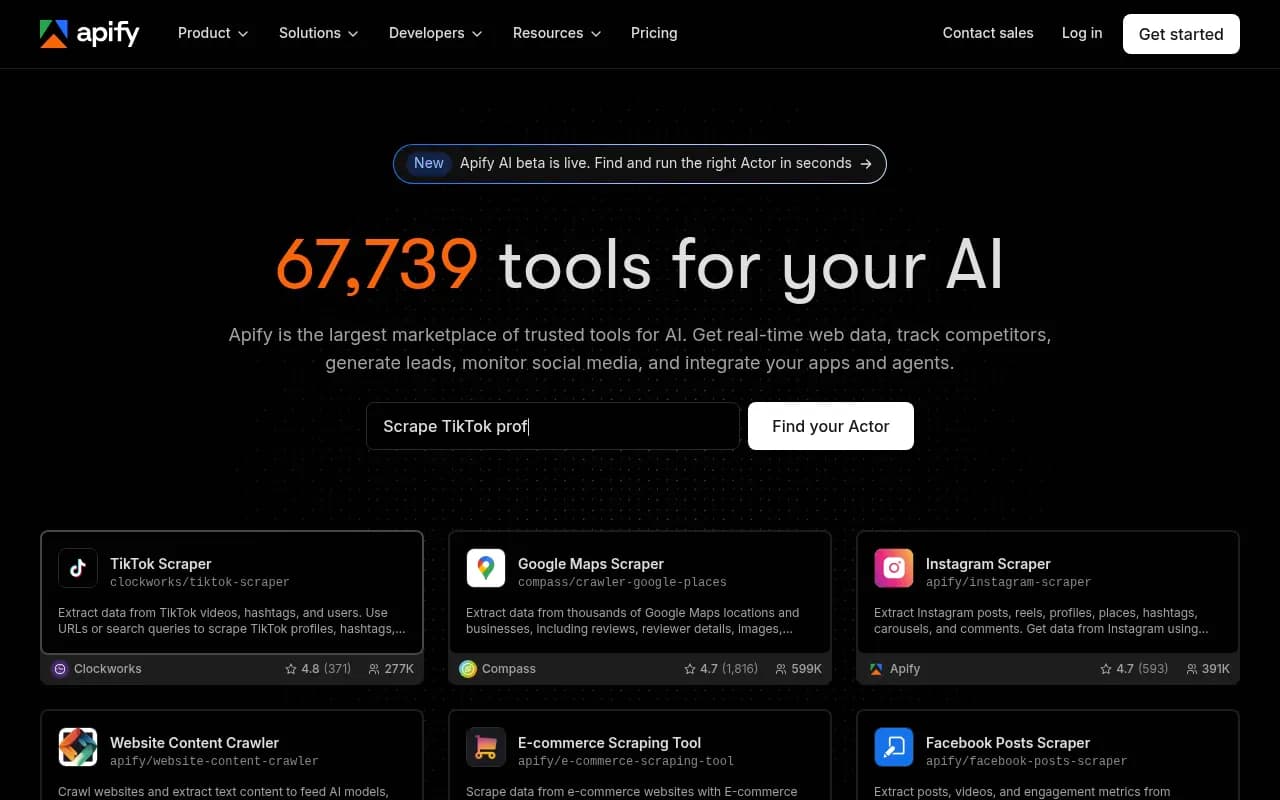
If you want to build your own collection layer, scraping infrastructure like Apify, Bright Data or Firecrawl is what teams typically reach for.


I could not find real per-prompt cost figures from either project, so run a small pilot (say 30 prompts daily for two weeks) and extrapolate from your actual bill. Also remember that self-hosted is not automatically cheaper once you include maintenance. That point comes up repeatedly in self-hosted agent comparisons, and it holds here too.
Why raw data ownership matters for AI visibility
There is a genuinely good argument for storing your own responses. Citation behavior differs by engine and changes over time. According to Promptwatch's data on average sources per response, ChatGPT cites about 5 sources per web-search answer, Google AI Overviews about 10, and Perplexity almost exactly 10, while Copilot has swung from under 2 to nearly 17 sources per response within weeks. (The page is dated September 2025 and is live data, so check current numbers.)
If you hold raw responses, you can measure that yourself and see when an engine changes behavior. Compare each engine separately and don't assume one engine's results predict another's.
Broader shifts also affect any tracker's baseline. For example, Promptwatch Data found that reddit.com's share of ChatGPT citations fell from about 4% to 0.5% on August 14, 2026, and that ChatGPT started using the site: operator at scale on August 8, 2026. A tracker with historical raw data lets you spot those breaks. For wider context, the Promptwatch Data hub has more.
When open source makes sense
Open source is a good fit if:
- You have engineers who are comfortable running Docker stacks and reading TypeScript.
- You need raw data in your own warehouse, or want custom metrics.
- You are an agency or developer-tool company that wants to build tracking into your own product or workflow.
- Your budget is small but your prompt volume is large.
It is a poor fit if:
- Nobody on your team wants to own infrastructure.
- You need crawler logs, visitor attribution, or content production tied to the visibility data.
- Your procurement team requires a vendor with certifications such as ISO/IEC 27001.
- You expect a polished 1.0 product. Elmo is at 0.7.x and moving fast.
When a managed platform is the better call
Monitoring is the easy part. The harder question is what you do after you learn you are invisible. Open-source trackers stop at insight. They tell you where you are missing and rank opportunities, but someone still has to write, publish and verify.
Promptwatch is the managed option I would point to when you want the loop closed. It tracks the real UIs of ChatGPT, Google AI Overviews, AI Mode, Gemini, Perplexity, Copilot and more, adds IP-verified AI crawler logs and visitor analytics, and then its Content Agent plans, writes and publishes content to Webflow, Framer or WordPress and tracks whether each page gets crawled and cited. It is ISO/IEC 27001 certified and GDPR compliant, which settles a lot of security reviews. Plans start with Essential at $95/month; confirm on promptwatch.com/pricing.

Other managed trackers occupy different price and depth points:
| Tool | Type | Best for |
|---|---|---|
| Elmo | Open source / cloud | Technical teams, data control |
| Ansvisor | Open source / cloud | Visibility plus AI traffic in one stack |
| Promptwatch | Managed, action-oriented | Teams who want tracking, crawler logs and content execution |
| Profound | Managed, enterprise | Large brands with enterprise budgets |
| Otterly.AI | Managed, lightweight | Affordable basic monitoring |
| Peec AI | Managed | Smaller teams wanting simple tracking |
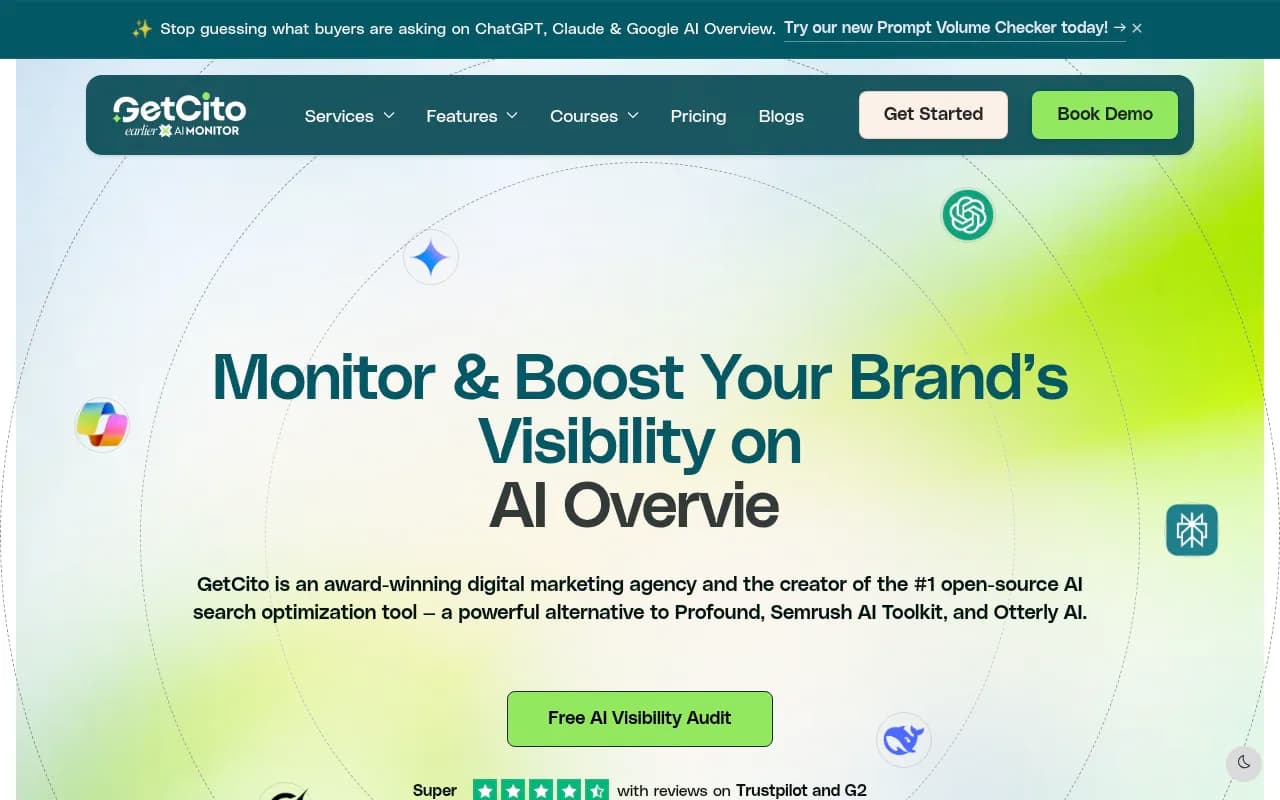
| AI Monitor | Open source | Basic brand mention tracking |


For a wider comparison, the GEO software directory at bestgeosoftware.com lists more options by category.
How to evaluate an open-source tracker in a week
- Spin up a test instance. Use the live demo first, then a local deployment with 20-30 prompts.
- Read the metric code. Look at how mentions, sentiment and citations are determined. This is the whole point of open source, so actually do it.
- Check data flows. Note every external service your self-hosted install talks to, including judging and scraping providers.
- Compare with a managed tool. Run the same prompts in a free tier or trial and see how the numbers differ. Real-UI scraping versus API calls can give different answers.
- Cost it honestly. Add API, scraping, hosting and an estimate of engineering hours.
Bottom line
Elmo is the stronger starting point among open-source AI visibility trackers: MIT license, active development, broad engine coverage and a codebase you can audit. Ansvisor is a reasonable alternative if AI traffic analytics matter. Both are legitimate Profound alternatives for technical teams. Neither removes the cost of data collection, and neither does the optimization work for you. If you have engineers and a data-control reason, self-host. If you want visibility and execution without running infrastructure, a managed platform is the faster route.
If you are weighing whether to build in-house or bring in outside help, an agency like 1001 SEO Media can set up the tracking and the content work together.