Key takeaways
- Marketers who fund AI visibility route about 24% of search or content budget there, per Fractl's July 2026 survey of 343 decision-makers (cited by PitchKitchen). Fractl is an agency surveying its own buyers, so treat it as a temperature check, not a target.
- Split the money by job, not by tool count: measure, fix access, create content, build authority. Most teams overspend on the first and underspend on the last three.
- Spend should follow the engine. ChatGPT now sends almost nothing to social platforms, while Google AI Overviews still does.
- AI referral traffic is real but still smaller than organic search. Budget it as its own line, not as a replacement for SEO.
- Start with a free baseline before you sign anything.
Why the question is harder than it looks
Every guide on this topic wants to hand you a percentage. Marketri, citing Forrester, says to reallocate at least 15% of content or digital spend. Fractl's survey says 24%. Digital Applied puts content plus SEO/AEO at 25-30% of successful 2026 budgets, according to Improvado's roundup. These numbers don't agree, and they come from sources with something to sell. I'd treat none of them as an answer. (The Forrester figure is secondhand in the Marketri piece, and I couldn't verify it against the original.)
The more useful question is what each dollar buys. PitchKitchen published its own numbers for a 29-day window ending September 29, 2026: AI engines sent 1,303 human visitors and roughly 39,700 crawler fetches. ChatGPT sent 821 of those people, Gemini 397, Claude 19, Perplexity 11, DeepSeek 4. Ordinary organic search sent 3,197 humans in the same window. That's one site, so don't generalize hard. But it shows the shape: AI referral is a genuine channel and still the smaller one, and a dashboard that counts crawler visits as reach will flatter you.

A working split, by job
Here is the split I'd start from for a mid-market team that already has a working SEO program. Adjust it after your baseline.
| Budget bucket | Share of AI search line | What it pays for | How you know it worked |
|---|---|---|---|
| Measurement and tracking | 15-20% | Prompt tracking, citation data, competitor share | You can name the prompts where you lose and the pages that get cited |
| Technical access | 10-15% | Crawler logs, site audits, fixing blocked or broken pages | AI crawlers reach your key pages without errors |
| Content on selection pages | 35-40% | Product, landing, comparison and alternatives pages, refreshes | Referred humans landing on decision pages |
| Authority and third-party mentions | 20-25% | Reviews, PR, listicle placements, community and video | More mentions on sources the engines already cite |
| Reserve | 5-10% | Mid-quarter reallocation | You can move money when one engine changes behavior |
These ratios are my judgment, not a benchmark. The logic behind them is below.
Bucket 1: measurement, kept deliberately small
You need a tracker. You don't need the most expensive one. The common mistake, flagged in Search Engine Journal's piece on restructuring teams for AI search, is hiring a GEO specialist before running a baseline. The same applies to tools: buy a tracker first, then decide what else you need.
There are two kinds of products here. Pure monitors answer "was my brand mentioned?" Platforms that also show crawler activity, traffic and content actions answer "what do I do about it?" For most teams the second kind is worth the extra money, because the budget you save on a cheap monitor gets spent anyway on the tools and hours you need to act on what it shows.
Promptwatch is the one I'd shortlist first for that reason: it tracks the real interfaces of ChatGPT, AI Overviews, Gemini, Perplexity and others, then connects to crawler logs, visitor analytics and a content agent so findings turn into actions.

Pricing at the time of writing runs from a free Explore plan (10 prompts, ChatGPT only) to Essential at $95 a month and Professional at $245 a month. Confirm current numbers at promptwatch.com/pricing.
If you only need monitoring, or you're an agency that wants a different mix, these are worth a look:




Otterly.AI and Peec AI sit at the affordable end and are fine for pure tracking. Profound targets enterprise budgets. For a wider comparison, the GEO software directory at bestgeosoftware.com lists far more options.
If you already pay for an SEO suite, check what it adds before buying separately:

The trade-off is usually fixed prompt sets and shallower AI data in exchange for one invoice.
Bucket 2: technical access, the line everyone skips
PitchKitchen's ratio of about 30 crawler fetches per human visitor is a reminder that engines read far more than they send. But if crawlers can't read you, nothing downstream matters. Search Engine Journal makes the same point: the assistants still lean on search indexes, so crawlability, speed and rankings feed the machine.
This bucket is cheap relative to its effect. It covers a site audit, checking robots.txt and CDN rules for AI bots, and reviewing crawler logs. Some trackers include logs and weekly audits in the plan price, which is one reason to prefer them over monitor-only tools. Enterprise technical teams may already own a platform for this:
If you're on a tight budget, free options work. Promptwatch publishes free tools including an Agentic Readiness Check and an AI Crawler URL Inspector, which cover the first pass at no cost. Its AI crawler traffic data also shows how much volume each bot sends, which helps you decide what to prioritize.
Bucket 3: content on pages that get cited
This is where the biggest share belongs, and the reason comes straight from citation data. In Promptwatch's ChatGPT citation share by content type report (Sep 28 to Oct 4, 2026), product pages are the most cited type at 22.4% of classified citations, followed by landing pages at 16.8%. That's about 39% of citations going to pages that describe what a company sells. Listicles get 13.6%, how-tos 8.7%, comparisons 5.9% and news 5.7%.
For commercial prompts the pattern is sharper: product pages (26.0%), landing pages (20.6%), listicles (15.0%) and comparisons (7.9%) make up almost 70% of citations. For branded prompts, reviews rise to 5.6%, more than three times their overall share.
The budget implication: stop paying for generic blog volume. Pay for product pages, landing pages, comparison and alternatives pages, and honest "who this is not for" content. PitchKitchen's own traffic backs this up, since 83% of the humans AI engines sent them landed on a comparison or selection page rather than an essay.
Content freshness matters too. Promptwatch's content half-life data shows news losing half its cited pages within about 36 days, while landing pages and docs keep most of theirs for months. So put recurring money into refreshing evergreen decision pages, and cut spend on news-style posts you hope AI will cite.
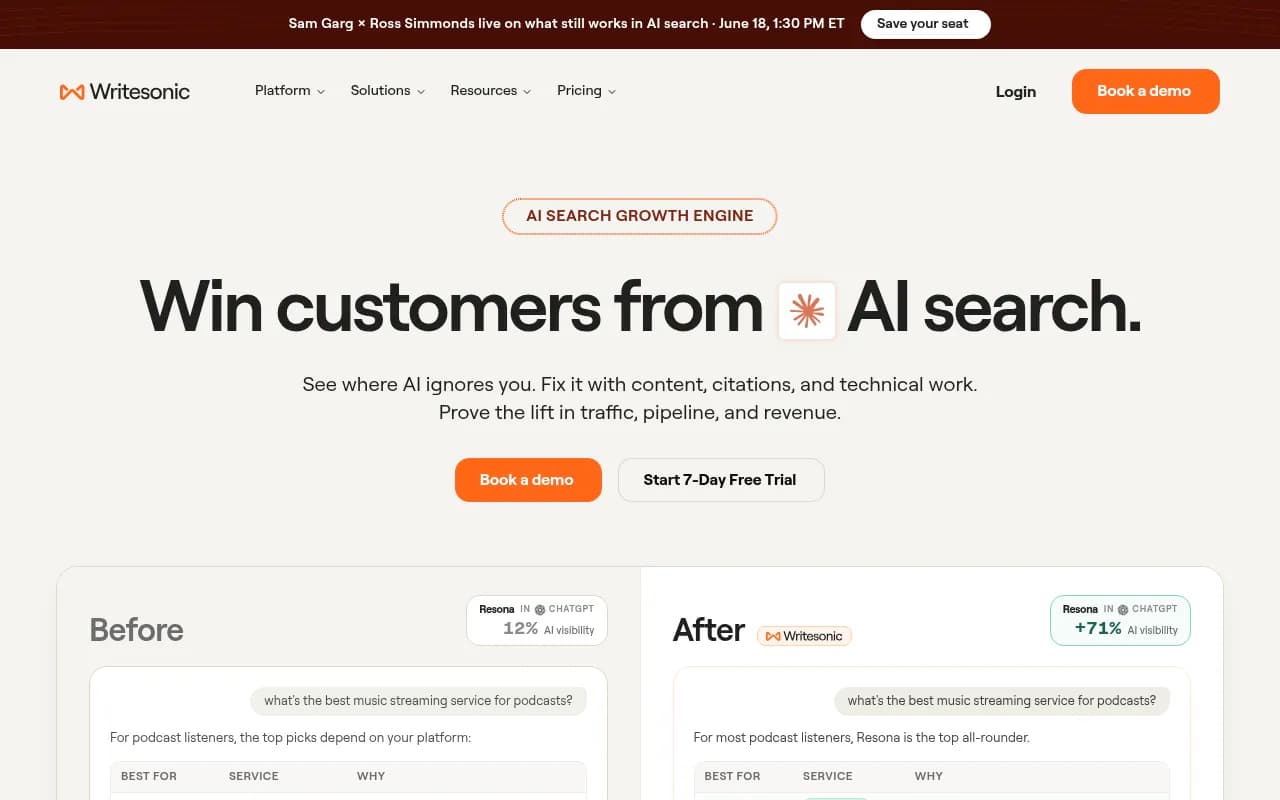
Tools that fit this bucket fall into two camps. Optimization tools score a draft against search data:


Generation and workflow tools produce volume, and you should be careful with them:
The warning from PitchKitchen is worth repeating: AI doesn't fix a weak strategy, it scales one. If your positioning isn't settled, automated volume produces a louder version of the same sameness. Some visibility platforms pair content generation with citation and gap data, which grounds the writing in prompts you actually lose. Promptwatch's Content Agent does this on its Business plan ($579 a month), publishing to WordPress, Webflow or Framer. That's the cost-effective route if you'd otherwise pay for a separate writing tool and a tracker.
Bucket 4: authority, and where the engines differ
Marketri's piece argues that AI tools weight credible third-party sources, which turns PR into infrastructure. The data supports a narrower version of that claim: where you invest depends on which engine you care about.
From Promptwatch's social media citations by AI model report (Sep 28 to Oct 4, 2026):
| Engine | Social share of citations | Top platforms |
|---|---|---|
| ChatGPT | 0.46% | LinkedIn (0.3%), Reddit (0.09%) |
| Google AI Overviews | 12.2% | YouTube (4.28%), Facebook (2.38%), Reddit (2.15%) |
| Perplexity | 2.7% | LinkedIn and Reddit (0.86% each), YouTube (0.79%) |
Reddit's share of ChatGPT citations fell from about 4% to 0.5% on August 14, 2026, per Promptwatch's Reddit citation drop report. A community budget aimed at ChatGPT is now largely wasted. The same spend still makes sense for AI Overviews and Perplexity.
So split the authority bucket by audience:
- ChatGPT-heavy audience: reviews on trusted sites, placements in "best of" listicles, press. Skip Reddit seeding.
- Google-centric audience: YouTube first, then community and review presence.
- Perplexity-heavy audience: LinkedIn and Reddit.
- Everyone: leave X out of the plan. It averages 0.04% across the three engines.
Tools that help here include outreach and PR options:


Treat Reddit-engagement tools with caution given the ChatGPT numbers above, and make sure anything you do on community platforms is disclosed and genuine. Third-party placement is also where an agency can earn its fee. If you'd rather outsource this bucket, an agency like 1001 SEO Media covers digital PR and GEO work under one contract-free retainer.
What the budget looks like at three sizes
Treat these as starting points for the AI search line only, not your whole marketing budget.
| Team | Monthly AI search line | Suggested use |
|---|---|---|
| Small (1-2 marketers) | $500-$1,500 | Mid-tier tracker, refresh 3-5 decision pages a month, one authority play |
| Mid-market (4-8) | $2,500-$7,000 | Full visibility platform, steady content on selection pages, review and PR program |
| Enterprise | $10,000+ | Platform with managed content workflows, technical audits, agency support, reserve for reallocation |
These are my estimates. They are not benchmarks from a published source, and your sales cycle and category will move them.
Three mistakes that waste the budget
Search Engine Journal lists three, and they match what I see:
- Hiring a specialist before a baseline. Run the free scan first.
- Starving classic SEO. Well-ranked pages still get read by models more often than buried ones, so pulling money from SEO to fund AI search shrinks both.
- Running AI search as a side project. Someone needs to own it, and it needs a standing slot in leadership reviews.
I'd add a fourth: judging tools by crawler counts or mention counts. Ask for referred humans and conversions instead. Improvado's research on 150 enterprises found top performers kept around 18% of budget as reserve for mid-year reallocation, against 3% for the bottom quartile. That's a good habit to borrow, since AI engine behavior shifted visibly several times this year.
A 30-day plan
- Week 1: run a free AI visibility scan and ask ChatGPT, Gemini and Perplexity what your company does. Compare the answers with how your team describes it.
- Week 2: pick a tracker. Use the 7-day free trial or free tier before committing, and check whether crawler logs and traffic attribution are included.
- Week 3: audit crawler access and list your ten highest-value decision pages.
- Week 4: set the four-bucket split, name an owner, and schedule a 90-day review with referred visitors and conversions as the scorecard.
For more tool options by category, see the AI rank tracker directory at ai-rank-tools.com. Pick the tracker, fix access, fund decision pages, and spend on authority where your target engine actually looks. That order matters more than the percentage.