Key takeaways
- Start with one pilot (one product line, one market, one set of prompts), prove it moves a number the business cares about, then scale.
- GEO touches SEO, content, PR, web engineering, legal and analytics. Without a named owner and a decision forum, it stalls between teams.
- Write the rules before you buy the platform. Run one manual cycle first, then configure tooling around a process that actually exists.
- AI citation behavior changes within weeks, so governance needs a standing review cadence, not an annual policy document.
- Measure on three levels: visibility in AI answers, whether AI crawlers can read your site, and the traffic and conversions AI sends back.
Why enterprises need governance for GEO, not just a tool
Most enterprise GEO efforts begin the same way. Someone in SEO notices the brand is missing from ChatGPT answers, buys a tracker, and shares a dashboard. Three months later the dashboard is still there and nothing else has changed. The content team did not know it was supposed to act. Web engineering never saw the crawler problem. Legal found out about an AI-generated claim from a customer.
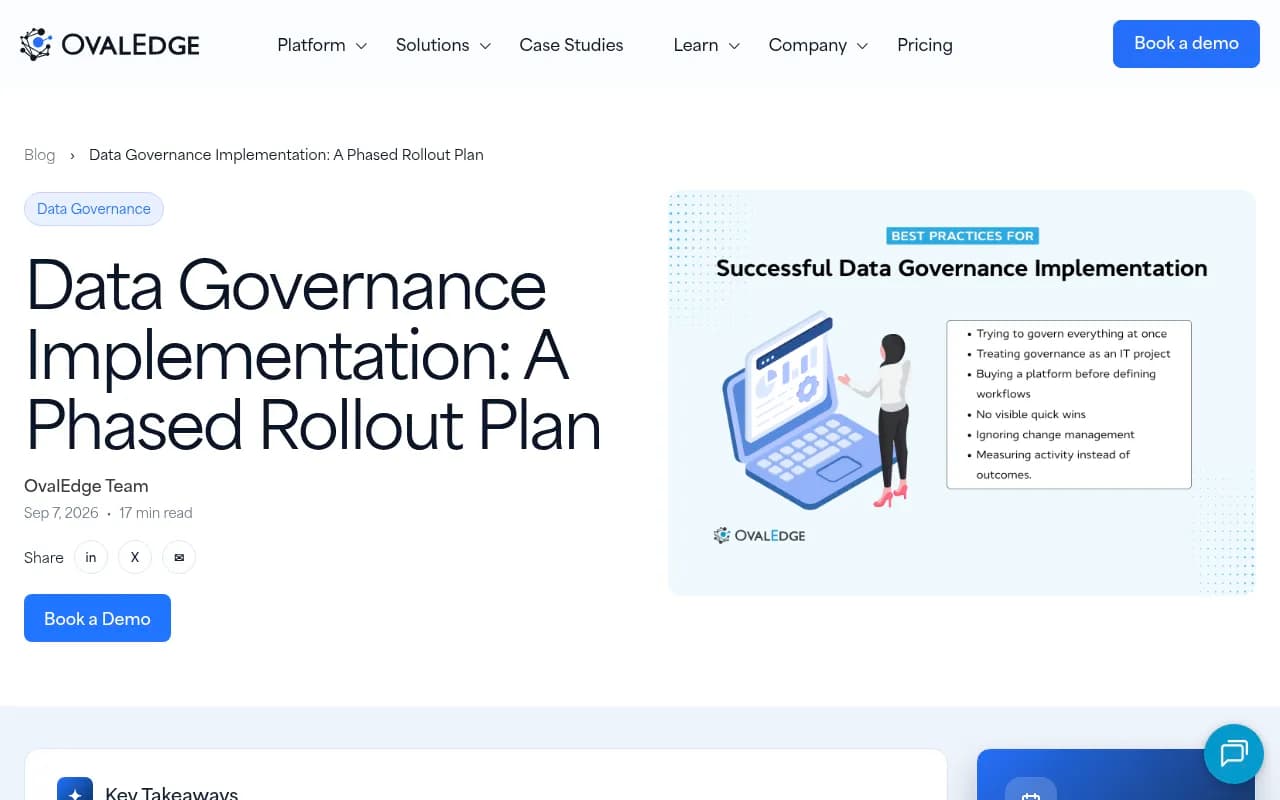
This is a governance problem, not a tooling problem. The same pattern shows up in data governance. The OvalEdge team notes that only 23% of organizations report using formal data governance or quality frameworks (via a third-party stat they cite), and that strategy documents, councils and RACI matrices do not automatically produce accountable ownership. The execution gap is where programs die.
GEO (generative engine optimization, also called AEO or AI SEO) has a few properties that make that gap worse:
- The surface you are optimizing is spread across several engines, each with its own citation habits.
- The levers sit in different departments: product pages, docs, reviews, PR, robots.txt, CDN rules.
- The ground moves fast. Promptwatch Data documented reddit.com's share of ChatGPT citations falling from about 4% to 0.5% on August 14, 2026. Any channel plan built on the old mix aged out overnight.
So the goal of an enterprise program is not a perfect strategy. It is a structure that can notice a change, decide what to do, and push the work to the right team within days.
What the data says you are governing
Before assigning roles, be clear about what the program actually controls. Promptwatch Data gives a useful first-party picture. Treat these as snapshots; the periods matter.
Content types that earn citations
In Promptwatch's analysis of ChatGPT citations by content type (Sep 28 to Oct 4, 2026), product pages took 22.4% of classified citations and landing pages 16.8%. That means roughly 39% of citations went to pages describing what a company sells. Listicles got 13.6%, how-tos 8.7%, documentation 7.5%, and FAQ pages 3.3%.
For commercial prompts the concentration is stronger: product pages 26.0%, landing pages 20.6%, listicles 15.0%, comparisons 7.9%. Those four types make up almost 70% of commercial citations. For branded prompts, reviews rise to 5.6%, about three times their overall share.
Governance implication: product and landing pages are your main citation surface, and they are usually owned by product marketing and web teams, not the blog team. Your program needs those owners in the room.
Content decays at different speeds
Promptwatch's content half-life study tracked every page ChatGPT cited on July 6, 2026 for 90 days. Landing pages and docs stayed cited longest, while news lost half its pages within 36 days. That sets your refresh cadence: evergreen commercial pages need periodic review, news-style content needs a different plan or a lower expectation.
Social and community channels differ by engine
In Promptwatch's October 2026 social citation report (Sep 28 to Oct 4), social platforms made up 0.46% of ChatGPT citations but 12.2% of Google AI Overviews citations, about 26 times as much. YouTube led AI Overviews at 4.28%. Perplexity sat at 2.7%.
Governance implication: channel strategy is set per engine and reviewed often. A single global "do more Reddit" rule would be wrong for ChatGPT and arguably fine for AI Overviews.
Crawler access is a gate, not a nice-to-have
Promptwatch's AI crawler traffic report (June 8 to September 6, 2026) found OpenAI accounted for 79.8% of IP-verified AI crawler requests in the week of Aug 31 to Sep 6, down from 94.8% in mid-June. Other operators are growing, and Meta-WebIndexer climbed from about 2% to nearly 38% of tracked crawler requests between mid-July and August 9. If a provider is large in the benchmark but near zero in your logs, you are probably blocked somewhere in robots.txt, the CDN or the WAF.
That is an engineering and security decision, which is exactly why it needs governance.
Roles: who owns what
You do not need a new department. You need clear ownership of eight jobs. In smaller organizations one person holds several of them.
| Role | Owns | Typical home |
|---|---|---|
| Executive sponsor | Budget, removing blockers, quarterly business review | CMO or VP Marketing |
| GEO program lead | Roadmap, prioritization, cadence, reporting | SEO or growth |
| Content lead | Briefs, refreshes, publishing against prompt gaps | Content or product marketing |
| Technical owner | Crawler access, site audit fixes, structured data, rendering | Web engineering or technical SEO |
| Brand and legal reviewer | Claims accuracy, regulated language, escalation of wrong AI statements | Legal, comms, compliance |
| PR and community lead | Third-party mentions, reviews, YouTube and forum presence | PR, social, community |
| Analytics owner | Visitor attribution, conversion tracking, dashboards | Analytics or data team |
| Market or product owners | Local prompts, product facts, approval of pilot scope | Regional marketing, product |
A simple RACI for the recurring jobs
| Activity | Program lead | Content | Technical | Legal | PR | Sponsor |
|---|---|---|---|---|---|---|
| Choose tracked prompts and competitors | A/R | C | I | I | C | I |
| Fix crawler blocks and site issues | A | I | R | C | I | I |
| Publish or refresh pages | A | R | C | C | I | I |
| Correct inaccurate AI claims | A | R | R | C | C | I |
| Third-party mentions and reviews | C | C | I | I | A/R | I |
| Monthly report and quarterly review | R | C | C | I | C | A |
(R = responsible, A = accountable, C = consulted, I = informed.)
One rule from the data-governance playbook applies directly: embed tasks in workflows people already use. If content editors must log into a separate tool to see GEO tasks, adoption drops. Push actions into the board, ticketing system or Slack channel where they already work.
The governance rules to write first
Keep the first version to two pages. Rules you can enforce beat a long policy nobody reads.
- Prompt set ownership. Who adds, removes and approves tracked prompts, and how often. Tie prompts to buyer personas, intent (informational, commercial, branded) and markets.
- Source of truth for facts. One approved set of product facts, positioning, pricing language and boilerplate. AI repeats what it finds, so inconsistent pages produce inconsistent answers.
- Crawler access policy. Which AI crawlers you allow, which you block, and why. Separate training crawlers from answer-time fetchers. Changes to robots.txt, CDN or WAF rules require a GEO check before release.
- Claim correction process. When AI says something wrong about the brand, who verifies it, which page is the likely source, who fixes it, and the target turnaround.
- Content standards. Required elements for citation-worthy pages: clear product description, public documentation, FAQ, comparison content, review collection.
- Regulated-industry review. For healthcare, finance or legal, define what needs sign-off before publishing. Promptwatch's healthcare citation data shows government and public health sites earn almost half of ChatGPT citations there, so expectations should be realistic.
- Review cadence. Weekly operational check, monthly report, quarterly strategy review.
Choose the pilot carefully
The single most repeated lesson from data governance rollouts is to start with one pilot domain and scale only after showing measurable value. Apply it literally.
A good pilot has:
- One product line or business unit with real revenue attached.
- One or two markets and languages.
- 30 to 60 prompts covering commercial, informational and branded intent.
- Three to five named competitors.
- Owners available in each function for at least a few hours a week.
A bad pilot is the whole company, all markets, and 500 prompts. You will collect a mountain of data and act on none of it.
The 90-day rollout plan
The structure below borrows the 30-60-90 shape common in data governance programs: learn, build, then prove.
Days 1 to 30: baseline and ownership
Goal: know where you stand, and have every role named.
- Week 1: appoint the sponsor and program lead. Agree pilot scope. Run a quick check with a free tool such as Promptwatch's free AI visibility report to see how ChatGPT, Gemini and Perplexity currently describe the brand.
- Week 2: build the prompt set from sales calls, Search Console queries, support tickets and competitor comparisons. Assign each prompt an intent and persona.
- Week 2 to 3: audit crawler access. Review robots.txt, CDN and WAF rules for every major AI provider. The Agentic Readiness Check shows which AI crawlers can read your site and which agent standards you support.
- Week 3 to 4: run the first manual cycle. Export responses, tag what AI says about you, list which pages get cited, and list the prompts where you are absent. Do this in a spreadsheet if you must. The point is to prove the process before you buy for it.
- Week 4: publish the two-page governance rules and the RACI. Get sign-off from legal.
Exit criteria: baseline visibility numbers per engine, a confirmed list of crawler issues, a ranked list of gaps, and named owners.
Days 31 to 60: fix, publish, instrument
Goal: ship the first changes and make sure you can measure them.
- Fix the technical blockers found in month one. These are usually the cheapest wins.
- Select a platform now that the process exists (see tooling below). Connect crawler logs and visitor analytics so you can see AI bot activity and AI-referred visits.
- Refresh the top commercial pages first: product pages, landing pages, comparison pages. Add FAQ and documentation where gaps exist.
- Publish against the prompts where competitors are cited and you are not.
- Start the claim correction workflow on the first inaccurate statements.
- Stand up the weekly 30-minute operating review.
Exit criteria: first batch of pages shipped and tracked, crawler issues resolved, analytics showing AI traffic, and at least a few claim corrections in flight.
Days 61 to 90: prove and decide
Goal: show the business a result and decide whether to scale.
- Compare pilot visibility, citation share and AI-referred sessions with the day-30 baseline.
- Check which published pages were crawled, cited and clicked. Pages that were not cited get refreshed or diagnosed (access problem or content problem).
- Review the channel mix per engine. If your assumptions about Reddit, YouTube or LinkedIn changed because the citation mix moved, update the plan.
- Present to the sponsor: what moved, what it cost, what the next market or product line should be.
- Decide the expansion order and publish the v2 governance rules.
Exit criteria: a one-page results summary, an approved scale plan, and a standing quarterly review on the calendar.
The plan on one page
| Phase | Focus | Key outputs |
|---|---|---|
| Days 1-30 | Baseline, ownership, access | Roles, rules, prompt set, crawler audit, manual cycle |
| Days 31-60 | Fix and publish | Technical fixes, page refreshes, tooling live, first corrections |
| Days 61-90 | Measure and scale | Results review, channel review, expansion roadmap |
Metrics and reporting
Track across three layers, and read them together. A single score hides the cause.
- Presence: visibility score, share of voice and average position per engine and per topic. Low share of voice usually means a coverage problem. Late position is a prominence problem.
- Source: which of your pages are cited, your self-citation rate, and which third-party pages are cited about you. Mentions without citations to your own domain point to a content or crawlability issue.
- Outcome: AI crawler activity, AI-referred sessions and conversions. This is what the sponsor cares about. Note that referrer data is imperfect (ChatGPT stopped sending a referrer on October 8, 2026), so agree on attribution rules, such as counting utm_source=chatgpt.com, before the first report.
Report monthly to the working group and quarterly to the sponsor. Keep the sponsor report to one page.
Tooling: buy after the first manual cycle
The tooling market is crowded, and the right pick depends on whether you need monitoring only or monitoring plus execution. For an enterprise program the checklist should include: real interface data (not just API outputs), multi-country and multi-language monitors, crawler logs, visitor analytics, role-based access and audit logs, ISO 27001 or equivalent, SSO, and an API for your BI stack.
Promptwatch covers that full loop in one product: it tracks ChatGPT, Gemini, Claude, Perplexity, Google AI Overviews and AI Mode, traces citations, ships IP-verified crawler logs, and uses the Action Board and Content Agent to turn gaps into published pages, then measures whether they got cited. It is ISO/IEC 27001 certified and GDPR compliant, and Business and Enterprise plans add an audit log, with SSO on Enterprise. Pricing starts at $95/month on Essential and $579/month on Business, so confirm current plans at promptwatch.com/pricing. A 7-day free trial is available on monthly billing.

Other platforms worth shortlisting for enterprise evaluation:


| Tool | Category | Consider it when |
|---|---|---|
| Promptwatch | AI visibility plus execution, crawler logs, analytics | You want monitoring, content creation and measurement in one loop |
| Profound | Enterprise AI visibility analytics | Monitoring depth is the priority |
| BrightEdge | Enterprise SEO with AI search intelligence | You are already standardized on it for SEO |
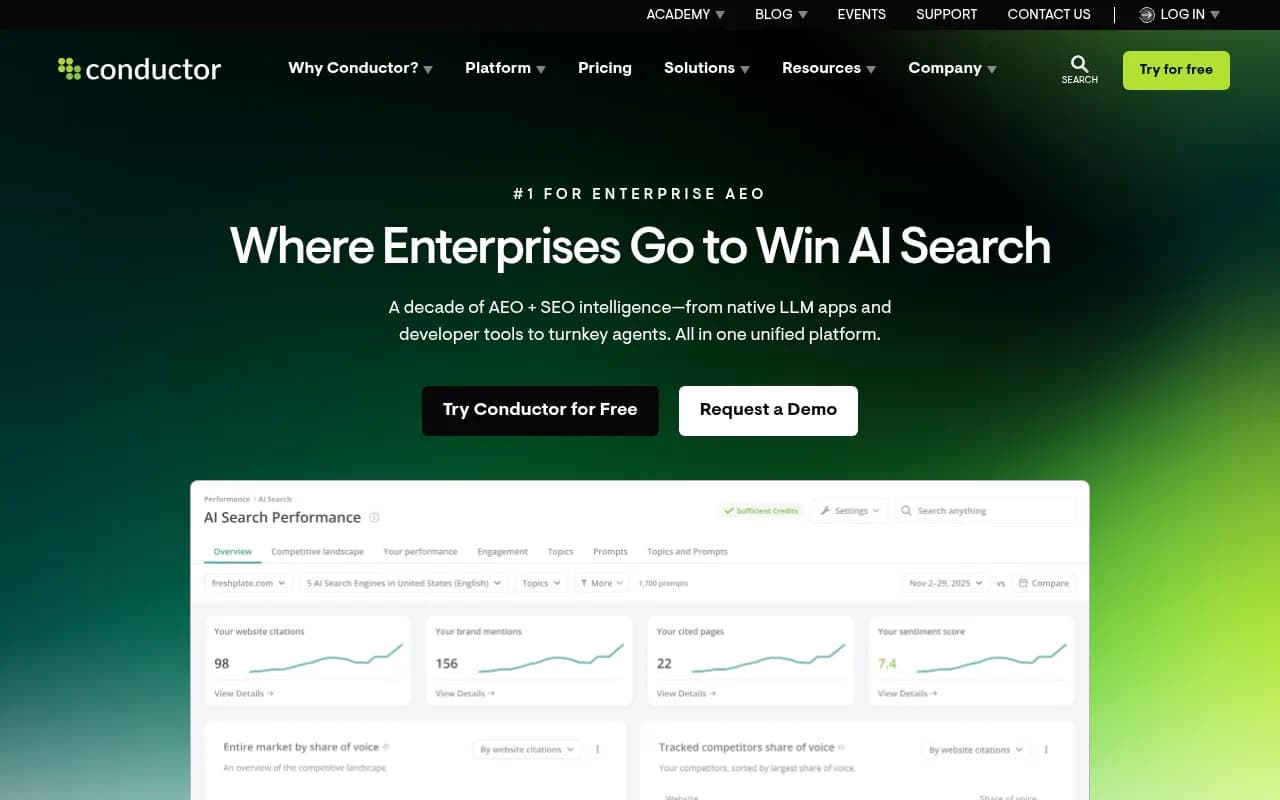
| Conductor | Organic marketing platform | Content workflow and SEO reporting live there today |
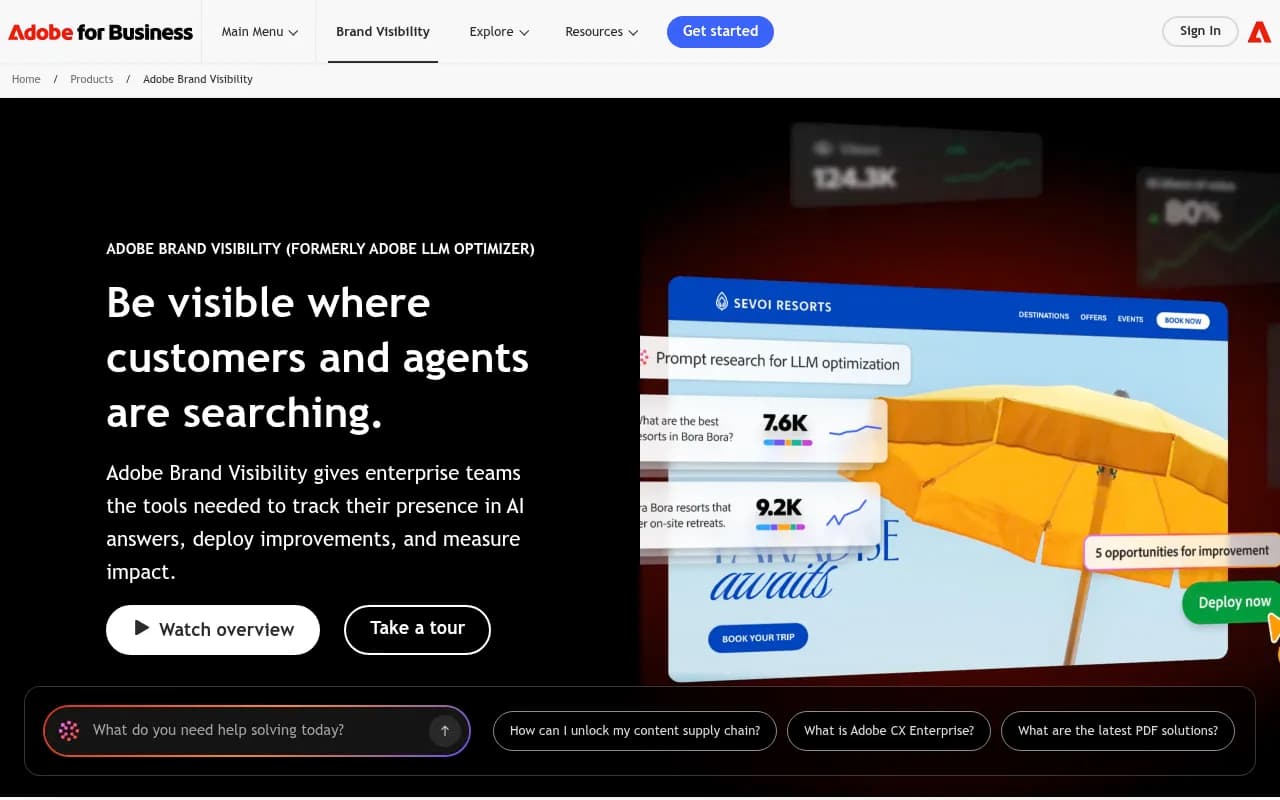
| Adobe LLM Optimizer | GEO inside Experience Cloud | Your stack is already Adobe |
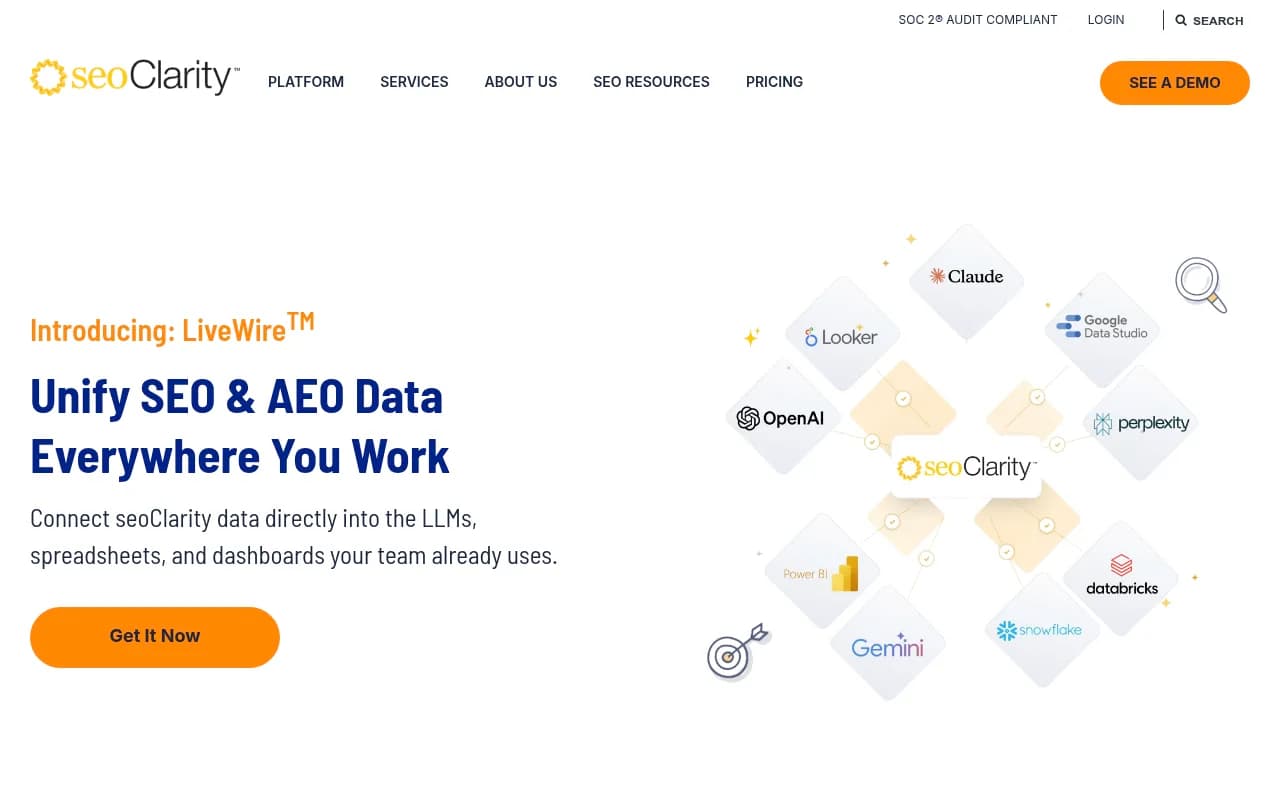
| seoClarity | Enterprise SEO and AEO | You need SEO and AEO in one suite |
If you want to browse more options, the GEO software directory at bestgeosoftware.com lists the wider field. For a head-to-head view, Promptwatch publishes its 2026 GEO platform comparison.
Run a proof of concept on your pilot scope with two finalists, using the same prompts. Judge them on whether your team actually acts on the output, not on the dashboard.
Common failure modes
- No decision forum. Data lands in a channel and nobody is empowered to prioritize. Fix: a weekly 30-minute review with authority to assign work.
- Technical team not involved. Content gets refreshed while a WAF rule blocks half the AI crawlers. Fix: crawler policy and a GEO check on infrastructure changes.
- Tool before process. You configure a platform for a workflow that does not exist yet. Fix: run the manual cycle first.
- Static strategy. The channel mix you planned in March is wrong by October. Fix: monthly review of per-engine citation patterns.
- Legal brought in late. The first wrong AI claim triggers a fire drill. Fix: agree the correction process in month one.
- Scaling too early. Rolling out to all markets before the pilot shows a result spreads thin attention across everything.
Scaling after day 90
The data-governance guidance on sustaining programs is practical: tie outcomes to business reviews, rotate fresh stakeholders into ownership roles, and expand into new use cases. For GEO that means:
- Add the next product line or market in a fixed order, reusing the same rules and templates.
- Move the review into the existing quarterly business review so it does not depend on one champion.
- Add local prompts and location-level tracking if you run stores or franchises.
- Add shopping and ads monitoring if you sell products, as those surfaces behave differently from plain answers.
- Revisit tooling once a year, not once a month.
If you want outside hands for the first quarter, an agency can run the baseline and pilot while your internal owners ramp up. 1001 SEO Media works on GEO and AI search programs and uses Promptwatch for AI visibility tracking; it is a reasonable option if you lack the in-house capacity to run the first 90 days yourself.
A starting checklist
- Name a sponsor and a program lead this week.
- Pick one pilot scope with revenue attached.
- Build 30 to 60 prompts by intent and persona.
- Audit AI crawler access across robots.txt, CDN and WAF.
- Run one manual cycle and write down what you learned.
- Publish a two-page rule set and a RACI.
- Choose tooling against your enterprise checklist, with a proof of concept.
- Refresh your top commercial pages first.
- Report to the sponsor on day 90 with a clear scale decision.
The programs that work are not the ones with the best dashboards. They are the ones where, when a citation pattern shifts on a Tuesday, somebody already knows it is their job to respond by Friday.