Key takeaways
- A "mention" (your brand named, no link) and a "citation" (a clickable source card) are two different things, and most tools report them separately. Track both.
- Citation behavior shifts overnight when AI platforms roll out model updates. Promptwatch's data shows ChatGPT's average citations per response dropped about 27% around the GPT-5.3 rollout in March 2026 and never recovered, which means a one-time audit can't tell you whether you lost visibility or the whole platform did.
- AI engines don't run one search per prompt. ChatGPT fans a single question out into several sub-queries, so checking only the literal prompt a user typed will under-count how often you actually show up.
- Reddit's share of ChatGPT citations fell from roughly 3.8% to under 1% in a single week in mid-August 2026. If you're only checking weekly or monthly, cliffs like that will look like noise instead of the real shift they are.
- You can start with a free spreadsheet method today, but daily, multi-engine tracking is what catches sudden drops before they cost you a quarter's worth of visibility.
Why this is harder than tracking rankings
Old-school SEO tracking is comforting in its simplicity: you type a keyword, you get a position number, you check it again next week. AI search doesn't work that way, and pretending it does is how brands end up confidently reporting numbers that mean almost nothing.
Here's the actual problem. When ChatGPT answers a web-search-enabled query, it typically cites around 5 sources. Google AI Overviews cites closer to 10. Perplexity sits at almost exactly 10, day after day, which makes it the most stable engine to benchmark against. Microsoft Copilot, by contrast, has swung from under 2 sources per response to nearly 17 within a few weeks. That's according to Promptwatch's average sources per response data, and it tells you something important: citation slots are scarce, and how scarce depends entirely on which engine you're asking about.
Compare that to a traditional SERP with ten blue links for every query. In AI search, you're fighting over 5 to 10 spots, and the competitor who wins one of those spots didn't just outrank you, they got picked while you got left out entirely.
Google Search Console doesn't help here either. It lumps AI Overview impressions in with standard organic results, so you can't isolate what's actually happening inside an AI-generated answer versus a regular blue link. That's the blind spot every marketing team hits eventually, and it's the reason dedicated tracking exists at all.
Mentions vs. citations: know the difference
This distinction trips up a lot of people building their first tracking process, so it's worth being precise about it.
A brand mention is when an AI names your company or product without a link. Perplexity might write "tools like [Brand] help marketers track this" with no footnote attached. That's a mention. It signals the model associates your brand with a topic, but it gives you no clickable attribution and, importantly, no way to know which of your pages (if any) informed that mention.
A citation is different: it comes with an attributed source, whether that's Perplexity's numbered footnotes, ChatGPT's inline hyperlinks, or the source chips underneath a Google AI Overview. Citations are the ones that can drive actual traffic, and they're the ones you can trace back to a specific page on your site (or, more often, a specific page on someone else's site talking about you).
That second part matters more than people expect. Across the AI search ecosystem, the large majority of citations point to third-party pages, not brand-owned domains. Reviews, comparison articles, forum threads, and news coverage get cited constantly; your own homepage, less often. If you're only monitoring your own site's rankings, you're missing where most of the actual influence is happening.
Why a single check will lie to you
Here's the part most guides skip: AI platforms change their citation behavior on their own schedule, and those changes look identical to losing visibility unless you're tracking continuously.
A concrete example. Around the GPT-5.3 rollout on March 4, 2026, average ChatGPT citations per response dropped from roughly 6.4 the week before to somewhere between 4.7 and 4.9 by late March, a drop of about 27%, and it happened across every model variant simultaneously (GPT-5.3, GPT-5.4, GPT-5-Mini). Promptwatch documented this in its ChatGPT citation drop analysis. If your brand's citation count fell during that window and you only had a before-and-after snapshot, you'd have no way to tell whether your content got worse or the platform just started citing fewer sources across the board.
The fanout problem compounds this. ChatGPT doesn't run one search per prompt, it fans a question out into several sub-queries behind the scenes. Fanout volume has actually been shrinking, from roughly 2.15 queries per response in December 2025 down to exactly 1.0 by April 2026, according to Promptwatch's query fanout tracking. And on August 8, 2026, ChatGPT started using the site: search operator at scale, jumping from about 0.4% to 17% of all fanout queries overnight (see the site operator fanout report). The practical upshot: a single tracked prompt can silently trigger different underlying searches over time, and your brand can get missed if your content doesn't cover the specific sub-angle the model is now querying, even if it covers the original question perfectly well.
Then there's channel volatility. Reddit's share of ChatGPT citations held around 3.8% for weeks, then collapsed to under 1% almost overnight on August 14, 2026, an 86% relative drop, per Promptwatch's Reddit citation tracking. Google AI Overviews and AI Mode saw a much gentler decline in the same window. If you weren't tracking daily, you'd never catch that cliff, and you'd definitely misattribute it if you noticed it a month late.
Building a tracking process, step by step
Step 1: define a real question set, not a keyword list
Start with 20 to 50 questions your actual buyers ask, phrased the way people talk to a chatbot, not the way they'd type into a search box. Length matters here: AI Overviews trigger on only about 9.5% of single-word queries but on 46.4% of queries with seven or more words. If your question set is all short head terms, you'll under-sample the queries most likely to surface an AI answer in the first place.
Include branded prompts ("is [Brand] good for X"), competitor-comparison prompts, and pure category questions where no brand is named. Each behaves differently, and lumping them together hides useful signal.
Step 2: check across engines, not just one
ChatGPT, Google AI Overviews, Google AI Mode, Perplexity, Gemini, Claude, and Copilot don't move together. Reddit citation share declined at wildly different rates across ChatGPT, AI Overviews, and AI Mode in the same week, and Copilot's source count is still swinging by a factor of eight as Microsoft reworks its retrieval system. Checking one engine and extrapolating to the rest will get you a wrong answer roughly as often as a right one.
Step 3: log daily, not weekly
This is the step people skip to save time, and it's the one that matters most for catching sudden shifts. A weekly or monthly snapshot will smooth over a single-day cliff like the August 14 Reddit drop into invisible background noise. Daily logging is what lets you separate "we lost a citation because of our content" from "the platform changed its citation behavior for everyone."
Step 4: distinguish citations from ads
Since late May 2026, ChatGPT Search has been serving ads inside search-enabled responses, and ad frequency climbed to a 20.1% 90-day average with daily spikes as high as 43.9%, per Promptwatch's ChatGPT ads tracking. Worth noting: even prompts that name your own brand can surface a competitor's paid ad in the same response. If your tracking process counts every card in a response as a "citation," you'll overstate your organic visibility and misread the competitive picture.
Step 5: reconcile your facts everywhere
When your About page, LinkedIn, G2 profile, and Capterra listing disagree on founding year, headcount, or funding, AI systems tend to just leave you out rather than risk citing something wrong. This is a cheap fix that a lot of teams skip.
The manual method (free, works today)
If you're not ready to pay for a tool, you can start with a spreadsheet:
- Open an incognito browser window to strip out personalization.
- Run each of your tracked questions and note whether an AI Overview (or ChatGPT/Perplexity answer) appears.
- Click "show more" or expand the full response to see every cited source, not just the collapsed view.
- Record only clickable link-card citations separately from plain-text brand mentions.
- Screenshot the full result, since AI-generated answers change without warning.
- Calculate your AI Share of Voice: (brand citations ÷ total AI answers triggered) x 100.
This works, but it doesn't scale past a handful of questions and it can't catch overnight shifts unless you're running it every single day, which gets tedious fast.
Choosing a dedicated tool
Once your question set grows past 20-30 prompts or you need multi-engine daily coverage, a dedicated platform earns its cost. Here's how the field breaks down.
| Tool | Engines covered | Daily tracking | Citation-level detail | Starting price |
|---|---|---|---|---|
| Otterly.AI | ChatGPT, AI Overviews, Perplexity, Copilot (Claude/Gemini as add-ons) | Yes | Mentions and citations reported separately | $29/mo |
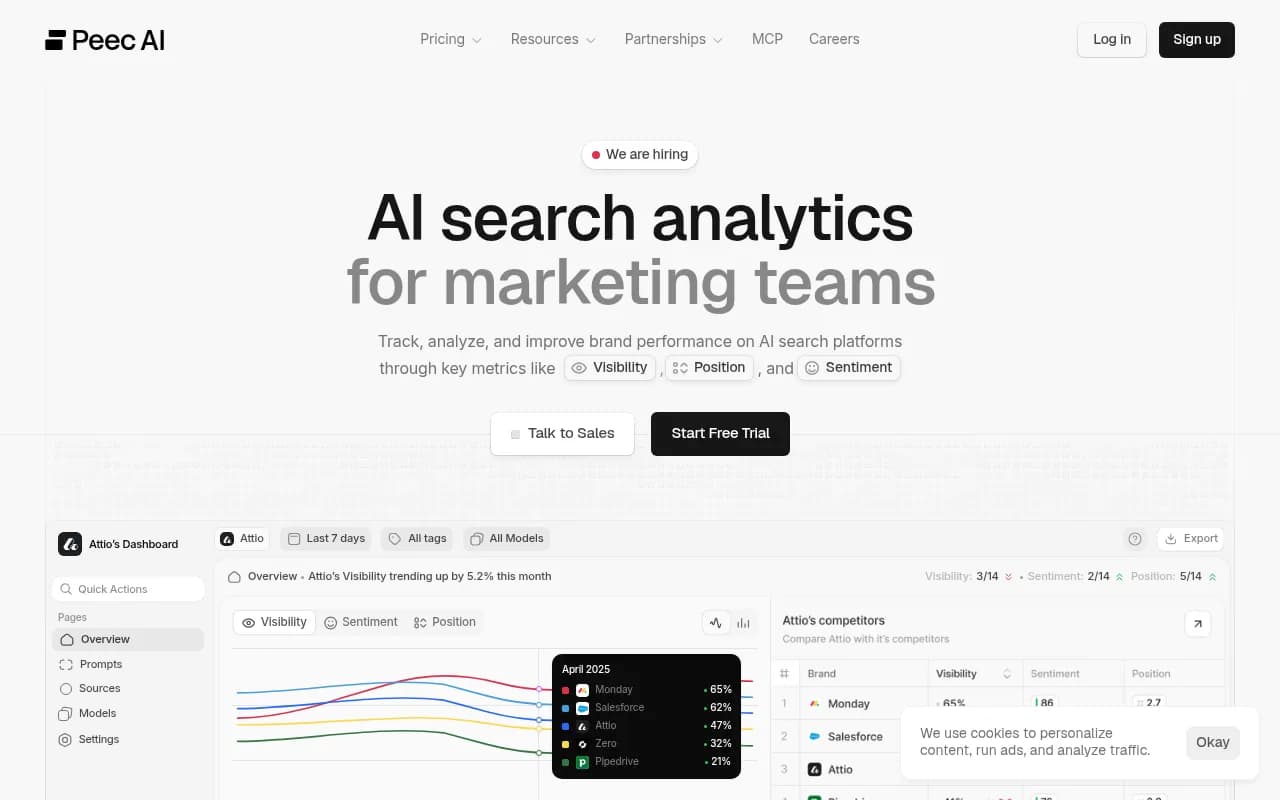
| Peec AI | Choice of 3-6 engines depending on tier | Yes | Sentiment from Pro tier up | ~$95/mo |
| Profound | ChatGPT, Perplexity, AI Overviews at Growth tier | Yes | Citation exports gated above Starter | $99-399/mo |
| Semrush AI Visibility Toolkit | ChatGPT, Gemini, AI Overviews, Perplexity | Yes | Bundled with core SEO data | ~$99/mo add-on |
| Ahrefs Brand Radar | 5+ engines incl. Claude, Meta AI | Yes | Requires base Ahrefs plan | ~$828+/mo all-in |
| Promptwatch | ChatGPT, Gemini, Claude, Perplexity, Grok, DeepSeek, Copilot, Mistral, Llama, AI Overviews, AI Mode | Yes | Crawler logs, Reddit/YouTube citations, offsite mentions | $95/mo |
Most of these tools are genuinely fine for basic mention and citation tracking. Where they tend to fall short is the layer beneath the dashboard: they'll tell you a citation dropped, but not why, or where the model is actually reading your content, or what to publish next to fix it.
Promptwatch approaches this differently. It tracks the same core metrics (prompts, citations, share of voice) across every major AI platform, but it adds the diagnostic layer most competitors skip: AI crawler logs that show exactly when ChatGPTBot, ClaudeBot, PerplexityBot, and 400+ other bots visit your pages and whether they hit errors, offsite mention tracking that catches your brand named in third-party pages AI cites even without a link back, and dedicated citation reporting for Reddit and YouTube, two channels most tools ignore entirely. When you spot a drop, Content Agents and a prioritized Unified Actions list help you actually close the gap instead of just watching the number fall.
Other tools worth knowing about depending on your setup: Otterly.AI is a solid budget entry point at $29/mo for basic multi-engine tracking, Peec AI ships an MCP server that lets you query visibility data conversationally from Claude Desktop or Cursor, and Scrunch AI is worth a look if crawler analytics matter more to you than content generation.
For a broader comparison of GEO and AI visibility platforms across price and feature depth, the directory at bestgeosoftware.com is a useful next stop.
Metrics that actually matter to report
Skip vanity numbers. Three metrics tell the real story:
- AI trigger rate: what percentage of your tracked buyer questions actually produce an AI Overview or AI-generated answer at all. If 80% of your buyer-intent questions trigger AI answers, that channel is dominating your category whether you're winning it or not.
- Citation rate: the percentage of those triggered answers that cite your brand, tracked per engine, since engines move independently.
- Competitor share of voice: the same citation rate calculated for your top three competitors on the identical question set, so you know whether a drop is you losing ground or the whole category shrinking.
A quick technical check most teams skip
If your citation numbers are inexplicably low across the board, check whether your own crawl logs actually show AI bots visiting. Provider mix shifts week to week; OpenAI's crawlers accounted for 79.8% of verified AI crawler requests in one week of September 2026, down from 94.8% just weeks earlier. If a provider dominates the industry-wide mix but shows up near zero in your own server logs, your robots.txt, CDN, or WAF rules are probably blocking it, which is an invisible and very fixable cause of missing citations.
Getting help beyond the tooling
Monitoring tells you what's happening. Fixing it, reconciling brand facts across third-party sites, building the content that actually earns citation slots, and structuring pages the way answer engines prefer, is a separate skill set. If your team needs help building that side of the strategy, 1001 SEO Media works on exactly this combination of technical SEO and generative engine optimization, with senior specialists and no long-term contracts.
Either way, the core discipline doesn't change: track daily, track every engine separately, separate mentions from citations, and never trust a single snapshot to tell you the whole story.