Key takeaways
- There is no single assistant your customers use. People split tasks: many reach for ChatGPT for coding and varied work, and Gemini for quick everyday questions, spreadsheets, and anything tied to Google.
- The three assistants pull from different sources. Promptwatch Data shows ChatGPT cited social platforms in just 0.46% of citations (Sep 28 to Oct 4, 2026), while Google AI Overviews got 12.2% from them.
- Meta AI is the least understood of the three. I couldn't find reliable data on how it sources recommendations, so treat any claim about it with suspicion, including ones in this article.
- The practical move is to measure rather than guess: track a prompt set across engines, then look at which sources each one cites for your category.
The question behind the question
When someone asks "which AI should I optimize for?", they usually want a ranking. ChatGPT first, then Gemini, then Meta AI, done. I get the appeal, but it's the wrong shape of answer.
The better question is where your specific customers ask, and what each assistant says when they do. ChatGPT and Gemini can take the exact same local question and return different businesses, different sources, and different recommendations. One shopper gets your competitor in ChatGPT and you in Gemini. Neither is wrong. They're just built on different retrieval habits.
This guide covers what people actually say about using each assistant, what the citation data shows, what we don't know about Meta AI, and how to test your own category.
How people actually use these assistants
The best evidence on real behavior is messy: forum threads, comment sections, and comparison articles. It's anecdotal, but patterns show up.
In a long r/OpenAI thread titled "Help me understand why people like Gemini so much more over Chat GPT?", the replies split in a revealing way. One commenter says people don't actually like Gemini more, and that Reddit skews toward people unhappy with ChatGPT. Others describe concrete reasons they prefer Gemini:
- It feels faster and doesn't hang as much.
- It returns a full list when asked, where ChatGPT sometimes gives three items and then asks if you want more.
- One user doing stock research said ChatGPT sometimes surfaced earnings reports up to two years old, while Gemini gave the most recent one.
- Another said they can hand Gemini a spreadsheet and get insights back, and that it "feels more like a tool."
The most useful comment, to me, is from someone paying for both: Gemini for daily real-life questions, ChatGPT for system and coding questions. Same person, two assistants, different jobs.
Other threads say the same thing. A Quora discussion on Gemini vs ChatGPT keeps landing on "it depends on the purpose." One person says Claude feels cleaner for long writing, but ChatGPT wins when they're jumping between random tasks. Another tried Perplexity and found it less productive. A Facebook group poll on which assistant people use most draws answers like "Gemini is faster."
A few caveats. These are self-selected posters, not a representative survey. Reddit comments tilt toward enthusiasts. And none of it tells you whether those people ask for product or local recommendations, which is what you actually care about.
The Facebook screenshot is a good reminder of what this evidence looks like: short, opinionated, and personal. Useful for color, not for market sizing.
What the comparison reviews say
Professional reviews give a slightly more structured view. PCMag's head-to-head notes that ChatGPT has more settings to tweak and can help you shop. For buying advice, both assistants present clickable product tiles. That matters if your customers are in a purchase mindset, because both are now showing product cards, not just paragraphs of text.
Zapier's 2026 comparison argues that if visual creative work is your main use case, Gemini is probably the better pick, since ChatGPT mostly just handles images. TechTarget's write-up points out Gemini's own disclaimer: it may display inaccurate info, including about people, so you should double-check responses. That cuts both ways for brands. If the assistant gets facts about your company wrong, customers are told to verify, but plenty won't.
A short comparison of what the sources say:
| Assistant | Where users say it shines | Watch out for | What it means for brands |
|---|---|---|---|
| ChatGPT | Coding, varied tasks, customization, shopping help | Verbose, sometimes asks instead of answering | Fewest citation slots per answer; competitive |
| Gemini | Speed, lists, spreadsheets, Google-connected tasks, images | Own disclaimer about inaccurate info | Closely tied to Google's ecosystem and AI Overviews behavior |
| Meta AI | Little reliable evidence in this research | Unknown sourcing | Monitor, don't assume |
What the citation data says
Opinions about tone are fun. Citation behavior is what decides whether you get named. Here's what Promptwatch Data shows.
Social platforms are cited very differently
From Sep 28 to Oct 4, 2026, Promptwatch's social media citation report found:
- ChatGPT cited all seven tracked social platforms combined at only 0.46% of citations. Reddit's share of ChatGPT citations fell to 0.09%, and LinkedIn was its top social platform at about 0.3%.
- Google AI Overviews drew 12.2% of its citations from social platforms, about 26 times ChatGPT's share. YouTube was 4.28%, Facebook 2.38%, Reddit 2.15%, Instagram 1.61%, LinkedIn 1.55%, and TikTok 0.22%.
- Perplexity got 2.7% from social, with LinkedIn and Reddit tied at 0.86%.
The Reddit change was abrupt. Promptwatch Data on Reddit citations in ChatGPT shows reddit.com's share of ChatGPT citations falling from about 4% to 0.5% on August 14, 2026. If your plan for ChatGPT visibility was seeding Reddit threads, that plan got a lot weaker overnight.
One honest limitation: that report covers ChatGPT, Perplexity, and AI Overviews. Gemini the app and Meta AI aren't broken out. AI Overviews is a Google surface, so it's a reasonable proxy for how Google-side answers behave, but it isn't the same as the Gemini app.
Citation slots differ by engine
Promptwatch's average sources per response page (dated September 2025, so figures may have drifted) found ChatGPT cites about 5 sources per web-search answer, while Google AI Overviews and Perplexity each cite about 10. The takeaway then was that ChatGPT has the scarcest citation slots, and AI Overviews is easier for newer or mid-authority domains to break into.
More recent data points the same direction on breadth. Promptwatch's unique domains report found almost half of ChatGPT responses cited 10 or more unique domains between Sep 28 and Oct 4, 2026. So treat the older 5-source figure as a floor that has probably moved, and check current numbers before quoting either.
What ChatGPT likes to cite
For recommendation-style queries, content type matters. Promptwatch's content type report shows product pages were the most cited type in ChatGPT at 22.4% (Sep 28 to Oct 4, 2026), followed by landing pages and listicles. If you sell something, your product pages are doing real work as citation targets. They're not just conversion pages.
Industry matters too. For software prompts, GitHub, Microsoft's docs, and G2 lead ChatGPT citations. For travel, Skyscanner, Going, and Tripadvisor lead. For automotive in August 2026, marketplaces like Autotrader and Cars.com outrank every car brand. Check the software, travel, and automotive reports for your vertical. The pattern across all of them: third parties that aggregate and compare often beat the brands themselves.
The Meta AI problem
I'll be blunt. For Meta AI, I don't have solid evidence on usage share, how often it's asked for recommendations, or how it picks sources. Promptwatch has no report on Meta AI citations. The research behind this guide didn't turn up reliable usage or sourcing figures either. So I won't pretend.
What there is a signal on is Meta's crawling. Promptwatch Data on Meta-WebIndexer shows it growing from about 2% to nearly 38% of tracked AI crawler requests between mid-July and August 9, 2026. That suggests Meta is building its own web index, which could change how its assistant sources answers. It's an inference, not a confirmed explanation.
What to do about it:
- Check your server logs or an AI crawler analytics tool to see whether Meta-WebIndexer is reaching your key pages, and whether it hits errors.
- Don't block Meta's crawler by accident in robots.txt unless you mean to.
- Test Meta AI manually with the same prompts you use elsewhere. Meta AI lives inside apps like WhatsApp, Instagram, and Messenger, so your customers may meet it without ever choosing it.
How to find out where your customers ask
Stop guessing and run a small study. It takes a day or two.
1. Ask your customers
Add one line to post-purchase surveys and onboarding calls: "Did you use an AI assistant while researching us? Which one?" Sales calls are even better. Reps hear "ChatGPT told me..." constantly, and most CRMs never capture it.
2. Check referral traffic
Look in analytics for referrals from chatgpt.com, gemini.google.com, and perplexity.ai. Meta AI traffic is harder to see since it lives inside messaging apps, so absence of evidence isn't evidence of absence there. Tools like LLMclicks.ai are built to track clicks and traffic from AI search engines.
3. Build a prompt set
Write 25 to 50 prompts a real buyer would type. Mix the types:
- Category discovery: "best [product] for [use case]"
- Comparisons: "[you] vs [competitor]"
- Local: "[service] near me" or "best [service] in [city]"
- Problem-led: the question someone asks before they know your category exists
Run each in ChatGPT, Gemini, and Meta AI. Record whether you're mentioned, in what position, and which sources are cited. Do it manually once to learn what the answers look like. After that, manual checks get tedious fast, and answers shift from run to run.
4. Automate the tracking
This is where an AI visibility platform earns its keep. Promptwatch tracks how brands appear across ChatGPT, Google AI Overviews, Gemini, Perplexity, Claude, and others, using real user interfaces rather than just APIs, and its crawler logs show which AI bots actually visit your pages.

Plenty of alternatives exist at different price points and depth. Otterly.AI is a lighter monitoring tool. Profound targets enterprise teams. Peec AI is a straightforward tracker.



If you run a multi-location business, Birdeye Search AI and BrightLocal focus on local AI visibility, which matters because local answers can differ a lot between assistants.
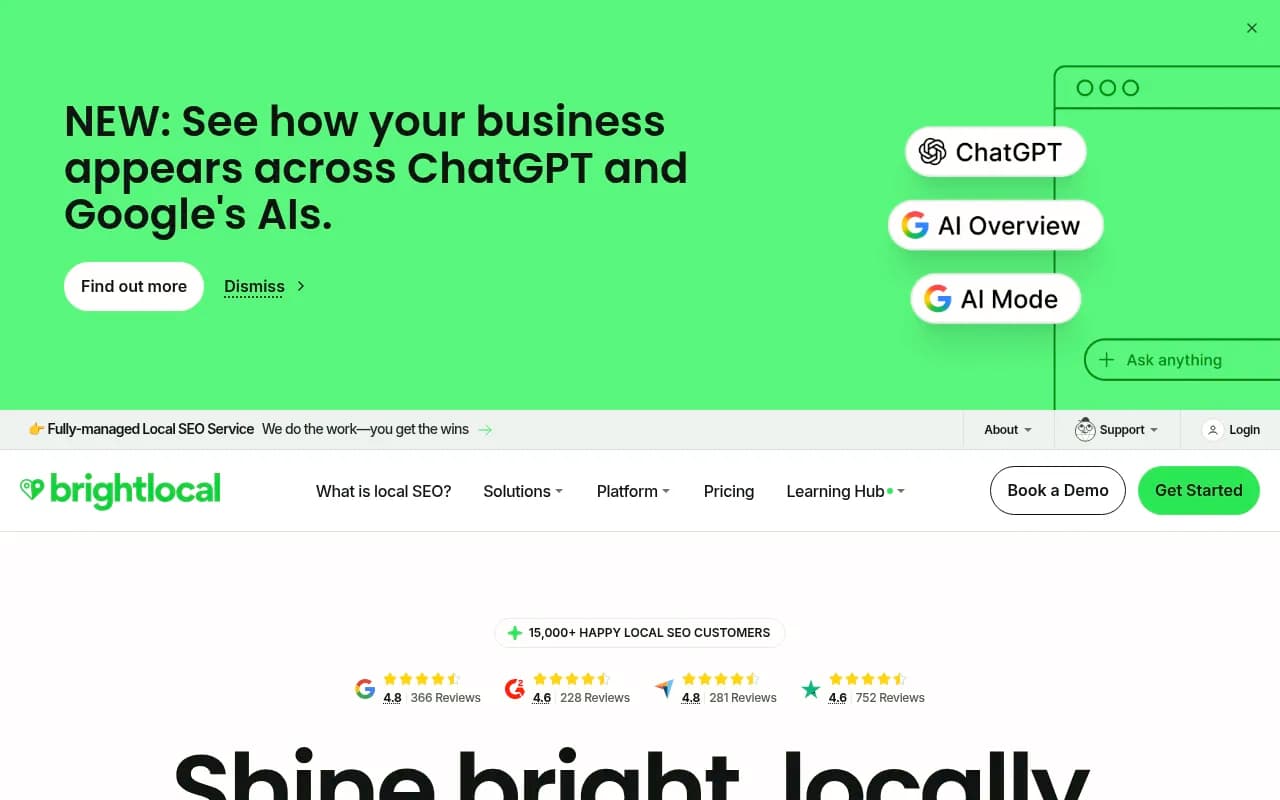
To browse more options, the GEO software directory at bestgeosoftware.com lists them by category.
| Need | Sensible starting point |
|---|---|
| Track mentions and citations across assistants, then act on gaps | Promptwatch |
| Cheap, simple monitoring | Otterly.AI or Peec AI |
| Enterprise reporting | Profound |
| Local, multi-location | Birdeye Search AI, BrightLocal |
| Click and traffic attribution from AI | LLMclicks.ai |
What to do once you know
The results will usually look lopsided. You'll show up in one assistant and be absent in another. Here's how to respond.
If buyers use Google-adjacent assistants
Google's surfaces cite more sources per answer and lean on social platforms far more. Per Promptwatch's October 2026 data, invest in YouTube first, then keep public Facebook and Instagram profiles complete and active. Strong traditional SEO also helps here, because Google AI features draw on the same index.
If buyers use ChatGPT
Don't count on Reddit seeding. Focus on product pages, landing pages, comparison content, and the third-party sites ChatGPT already cites in your category (review sites, marketplaces, docs). Since landing pages and docs stay cited longest, per Promptwatch's content half-life data, while news loses half its pages within 36 days, evergreen pages are the safer investment than news-style posts.
If buyers meet Meta AI
Keep your Meta business profiles accurate, make sure your site is crawlable, and test regularly. With so little public data, the cheapest hedge is solid fundamentals: clean pages, consistent facts about your brand, and presence on the platforms Meta owns.
Whichever assistant it is
- Keep the basic facts about your business (name, address, pricing, product specs) consistent everywhere. When assistants disagree with each other, inconsistent source data is a frequent culprit.
- Publish pages that directly answer the question a buyer asks, in plain language.
- Check weekly or monthly, not once. Citation behavior changed sharply in 2026, with ChatGPT's Reddit collapse in August and the site: operator shift on August 8, per Promptwatch's report. A strategy built on last quarter's behavior ages quickly.
If you'd rather hand this off
Measuring across several assistants, fixing content gaps, and re-checking is a lot of recurring work. Agencies that specialize in generative engine optimization handle it end to end. 1001 SEO Media, which publishes this site, offers AI search and GEO services alongside technical SEO and content work, and it uses Promptwatch for AI visibility measurement. It's one option among several; ask any agency how they measure results across assistants, not just ChatGPT.
The short answer
Your customers don't ask one assistant. They ask whichever is nearest: ChatGPT in a browser tab, Gemini on an Android phone or inside Google, Meta AI inside a chat app. The anecdotal evidence says people split tasks across tools, and the citation data says each engine leans on different sources. Run a prompt set in all three this week, note where you're missing, and fix the biggest gap first. For Meta AI specifically, the honest status is that nobody has published solid sourcing data yet, so measure it yourself.