Key takeaways
- Agencies need different things from GEO software than in-house teams: many client workspaces, branded reports, predictable per-client cost, and a way to turn data into billable work.
- Most tools in this category are monitors. They answer "was the client mentioned?" A smaller group also helps you fix the gap and verify the fix.
- White-label claims vary a lot. Some tools brand the PDF only, others give you a custom domain, branded login and sender address. Test the output before you sign.
- Report each AI engine separately. Citation counts differ by engine, and a single prompt tells you very little.
- Run one real client through every shortlisted tool for a month before committing to an annual plan.
What agencies actually need from a GEO platform
An in-house team tracks one brand. An agency tracks twenty or fifty, each with its own competitors, its own reporting cadence and a client who wants to see their agency's logo, not a vendor's. Most early AI visibility tools were built for a single brand and added a "team seat" as an afterthought. That model breaks the moment you try to run a client portfolio out of it.
When I evaluate tools for agency use, I score them on six things:
- Multi-client workspaces: one project per client, switchable without logging in and out.
- White-label reporting: your logo, colors, sender address and ideally domain on PDFs, dashboards and emails.
- Pricing per client: flat and predictable, or does every new brand trigger an upsell?
- Client access: branded portals or share links, so you aren't stuck emailing PDFs.
- Pitch features: can you pull a visibility baseline on a prospect before the sales call?
- Execution: does the tool give you something to do next, or just a chart?
That last point matters more than it first appears. A retainer client doesn't pay for charts. They pay for movement. The platform question is really: which tool helps you find where each client is missing, fix it, and prove the lift?
Why the data model matters before the branding does
Before comparing logos on PDFs, get clear on what you're measuring. Promptwatch's data on average sources per response shows that ChatGPT cites about 5 sources per web-search answer, Google AI Overviews about 10, and Perplexity almost exactly 10 every day. Microsoft Copilot's average swung from under 2 to nearly 17 within a few weeks before settling low. The practical upshot for reporting: never blend engines into one number. Perplexity is the cleanest signal for client-level change, and Copilot is the noisiest, so judge it on monthly trends.
Citation crowding is the second thing to build into reports. In Promptwatch's unique domains per ChatGPT response data (Sep 28 to Oct 4, 2026), 47.6% of responses cited 10 or more domains and 66.1% cited at least 8. For organic prompts with no brand named, 52.5% cited 10 or more. So your client almost always shares the answer with many other domains. A report that only says "cited / not cited" hides the real story. Better to show position, sentiment, which competitors appear in the same responses, and which third-party review and listicle domains show up.
There is also a content question. Muck Rack's May 2026 analysis of 25M+ links found that 84% of AI citations come from earned media, and Ahrefs has argued that branded mentions correlate with AI Overview visibility far more strongly than backlinks do. Treat those as vendor-adjacent third-party studies, but the direction is consistent: your agency needs tools that show where a client is being talked about off-site, not just on-site.
The shortlist at a glance
| Tool | Type | Agency strengths | Watch out for |
|---|---|---|---|
| Promptwatch | Monitoring plus execution | Agency plans with unlimited projects, white-label reports and client portal, crawler logs, Content Agent | More depth than a simple reseller dashboard needs |
| ReachLLM | Monitoring plus managed execution | White-label dashboards, client share links, managed fulfillment option | Higher entry price ($999/mo Scale per vendor) |
| Rank Prompt | Monitoring plus portal | Low per-brand cost, client portal, prospecting | Vendor-published pricing, verify on trial |
| Peec AI | Monitoring | Clean competitor benchmarking | White-label thinner than dedicated agency platforms |
| Otterly.AI | Monitoring | Lightweight and affordable | Basic; less execution support |
| Profound | Enterprise monitoring | Deep reporting for large accounts | Price point and agency fit |
| Scrunch AI | Monitoring | Strong for brand teams | Evaluate multi-brand pricing carefully |
| Trakkr | Monitoring | Custom domain and branded login via add-on | Per-client add-on cost |
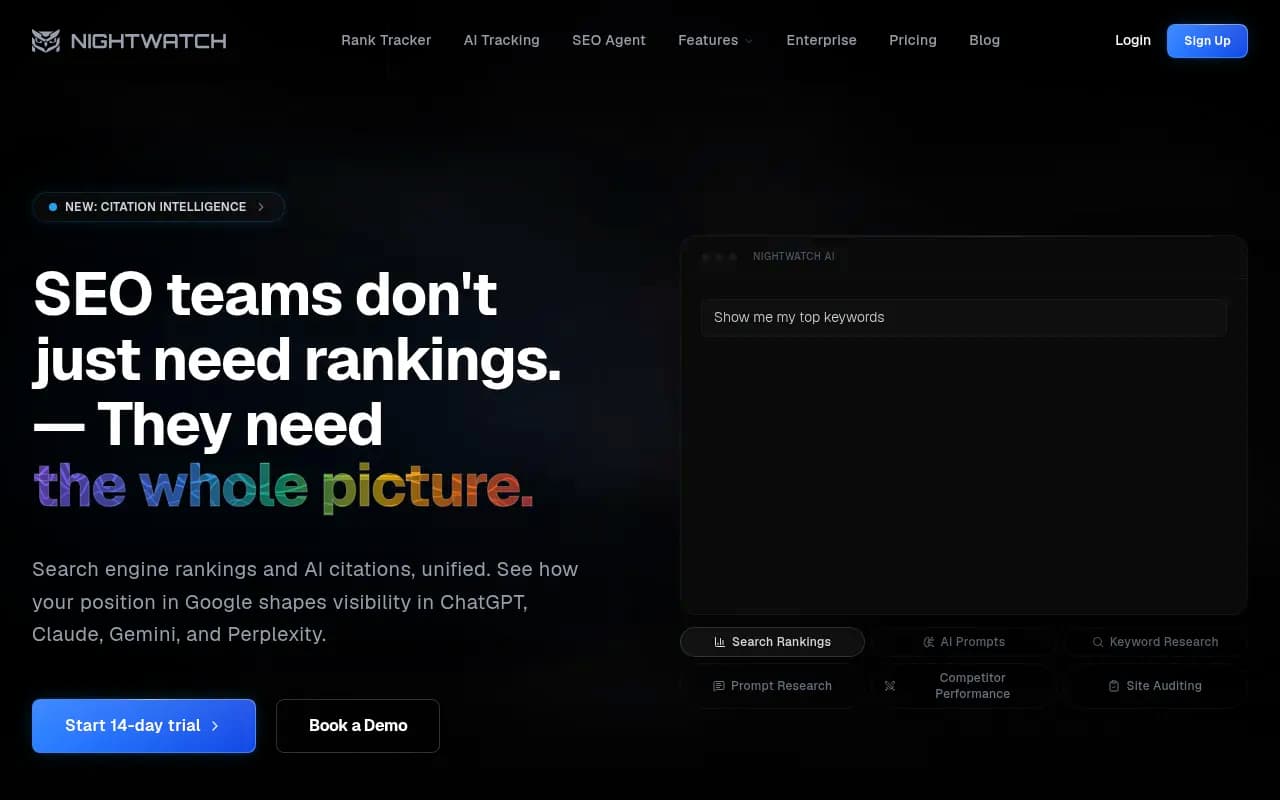
| Rankscale / Nightwatch | Rank tracking extended to AI | White-labeled dashboards, Looker Studio | Tracking-focused |
| Semrush AI toolkit / SE Ranking | SEO suites with AI add-ons | Familiar white-label templates | Shallower AI-specific data |
Pricing and white-label details in this table mix vendor pages and vendor-published comparisons. Several of the source articles were written by competitors selling their own product, so confirm every claim on the vendor's own pricing page.
Platforms built around monitoring and execution
Promptwatch
Promptwatch is the one I'd look at first if your clients expect you to improve their AI visibility, not just report it. The agency plans (Kick-off at $199/mo, Growth at $399/mo, Scale at $799/mo) include unlimited projects, pitch projects and prompts, 10 seats, all models and a white-label workspace with client portal and scheduled white-label PDF reports. Check promptwatch.com/pricing for current numbers.

What separates it from pure monitors is the loop after the dashboard. IP-verified AI crawler logs show whether GPTBot, ClaudeBot or PerplexityBot are even reaching a client's pages. Content gap analysis shows which prompts competitors win. The Content Agent writes and publishes to WordPress, Webflow or Framer, and the Action Board turns findings into a prioritized to-do list you can hand to a delivery team. Published pages are then tracked for crawls, citations and AI traffic, so you can prove the lift in the next client report.
It tracks the real interfaces of ChatGPT, Google AI Overviews, AI Mode, Gemini, Perplexity and Copilot, which matters because user-facing answers can differ from API outputs. For the agency P&L, the useful part is cost per response: the Scale plan covers 65,000 responses across unlimited projects.
ReachLLM
ReachLLM is the publisher of one of the comparison pieces in this space, so read its self-ranking with that in mind. Still, its structure is agency-shaped. Per its own pricing, Scale is $999/month for up to 10 projects and 500 pooled prompts, and Enterprise Agencies is $1,599 for unlimited projects. Both include white-label reports, client share links and unlimited team members. It can also act as a managed GEO fulfillment partner, which suits agencies that want to sell GEO without building delivery capacity.

Rank Prompt
Rank Prompt positions itself on agency economics: a white-label Agency plan at $149/mo (500 brands per its pricing page) and a higher tier with client logins and prospecting. That is a very different cost curve from most competitors. The trade-off is that depth of analysis and execution tooling is lighter, so check it against what your clients will actually ask.
Rank Prompt
Monitoring-first tools worth knowing
Peec AI and Otterly.AI
Peec AI is good at competitor benchmarking, but its white-label and client portal features are thinner than a dedicated agency platform, which means more manual branding and distribution. Otterly.AI is a lightweight, affordable monitor. Both are reasonable if you resell a simple dashboard and don't need crawler logs or content generation.


Profound and Scrunch AI
Profound has strong enterprise reporting and suits agencies serving large brands with large budgets. Scrunch AI is oriented more toward a brand's own team than an agency running dozens of accounts, so test the multi-brand pricing during a trial.


Trakkr, Rankscale and Nightwatch
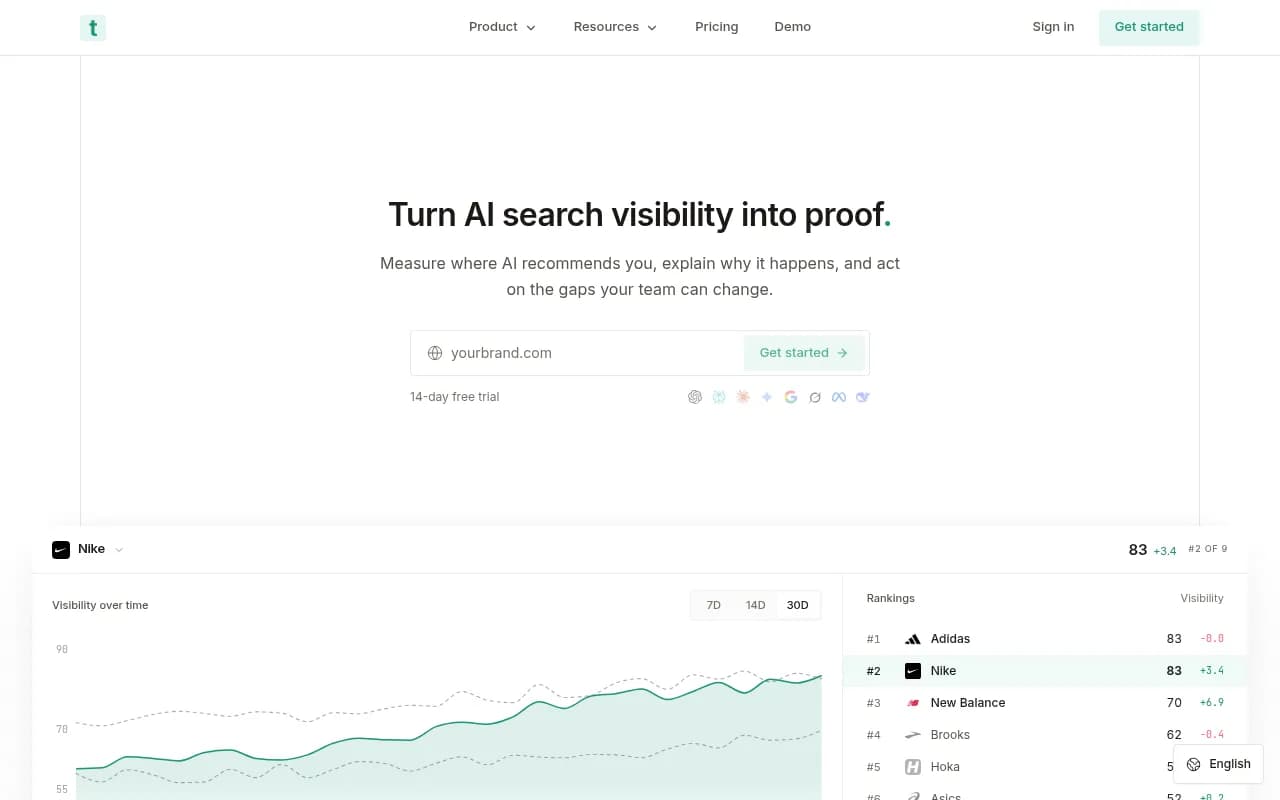
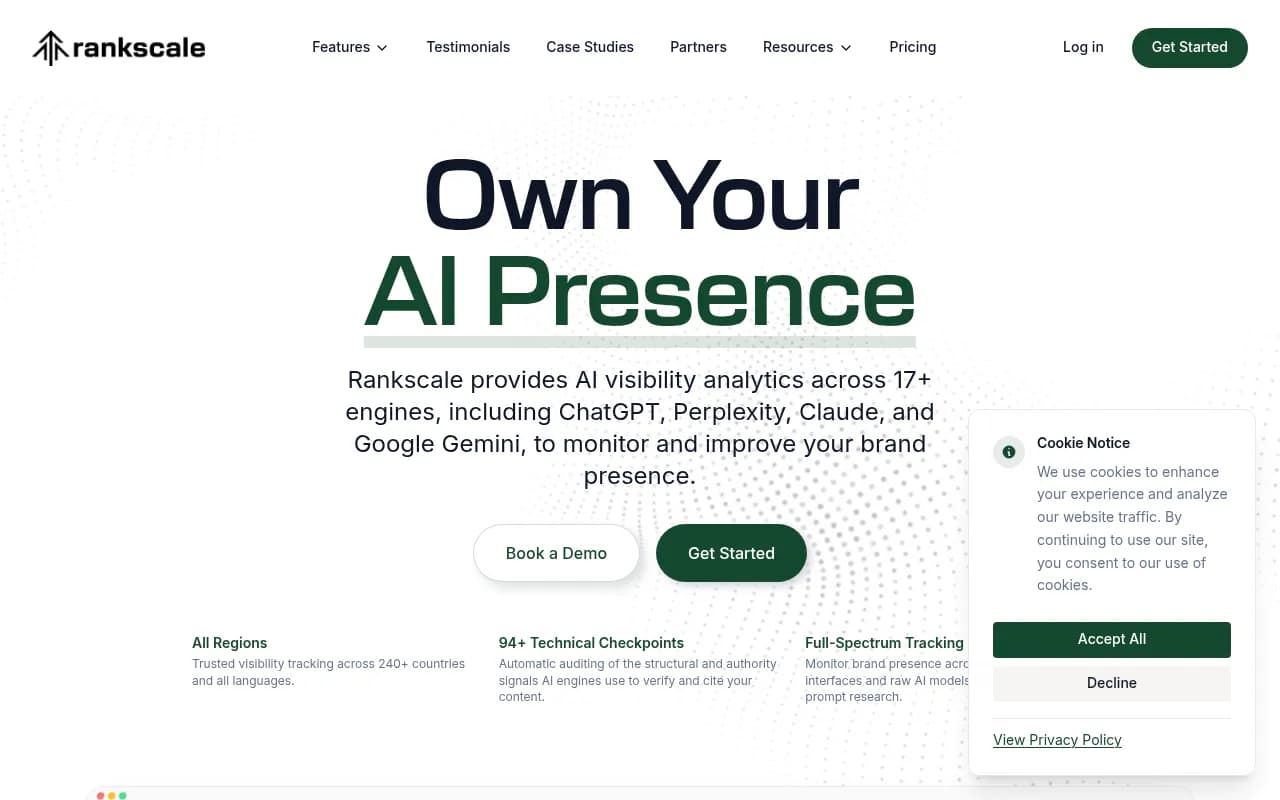
Trakkr offers custom-domain and branded-login capabilities with a per-client white-label add-on. Rankscale and Nightwatch provide white-labeled dashboards and Looker Studio integration. These are good fits when your agency already lives in rank-tracking workflows and wants AI added next to them.
Search Party
Search Party is listed in our catalog as agency-focused. Worth a look if you want a platform designed around the agency workflow from the start.
SEO suites with AI add-ons
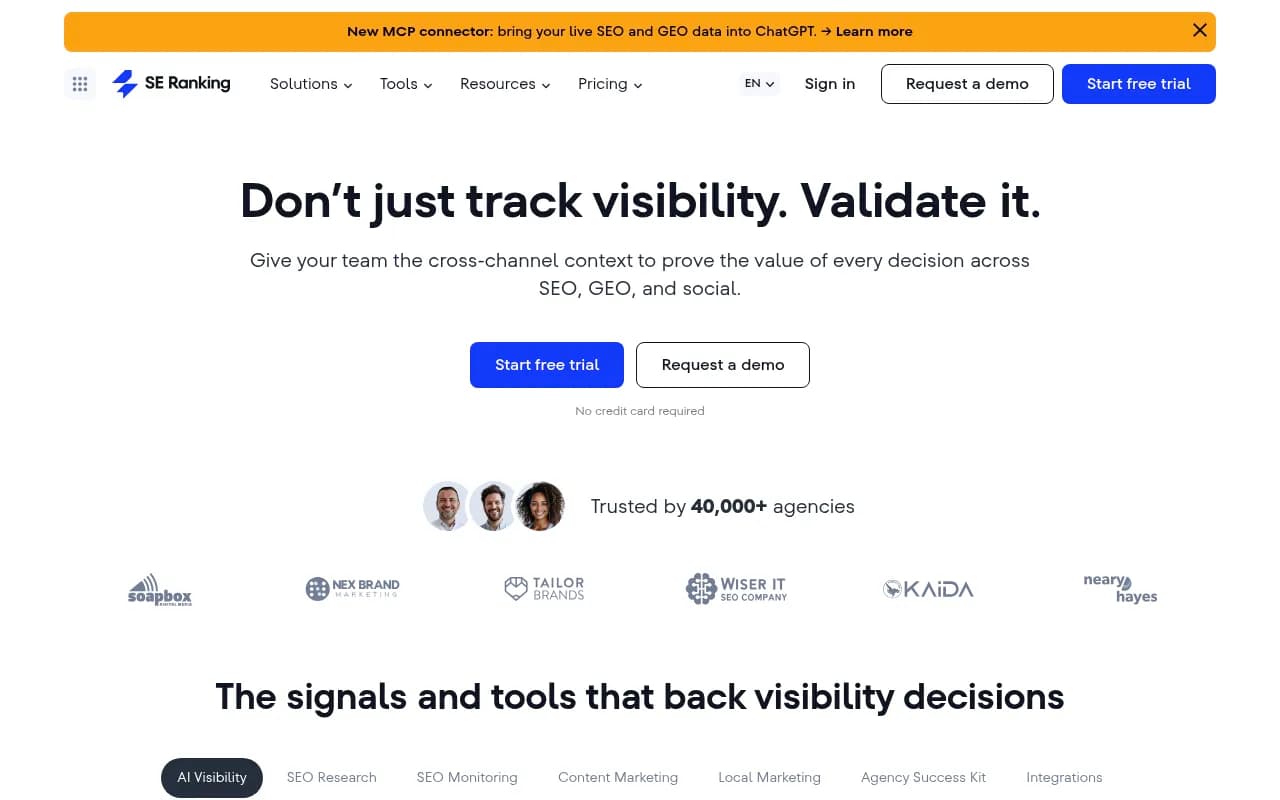
If your agency already pays for Semrush or SE Ranking, the AI add-ons are the lowest-friction way to start. You get familiar white-label templates and reporting infrastructure. SE Ranking is also the cheaper option, with white-label reporting listed at all tiers by one comparison source.
The catch is depth. These suites typically use fixed prompt sets and offer shallow AI-specific data, with no crawler logs and no AI traffic attribution. They're fine for a first service line, but you may outgrow them within a year.
Real white-label vs branded PDF
This is where agencies get burned. Vendors use "white-label" to mean very different things:
- Logo and colors on a PDF export.
- A branded client portal under the vendor's domain.
- A custom domain, branded login and your own sender address on emails.
- Agency-branded dashboards only after a minimum client count (ReachLLM, for example, requires three onboarded clients).
- White-label gated to higher tiers (Writesonic lists it on Enterprise; one GEO reporting tool starts white labeling at $499/month on its Growth plan).
The fix is simple: before buying, run a real client's month through each shortlisted tool and inspect the output. Look at the vendor's name in the footer, the domain in the share link, and the address the email comes from. If your client can find the tool's name, it isn't white-label for your purposes.
How to run a trial
- Pick one client with a few clear competitors and at least 30 prompts worth tracking.
- Load the same prompt set into each tool. Include organic, branded and competitor comparison prompts, since citation behavior differs across them.
- Generate the client report in each tool and send it to yourself as the client would receive it.
- Check what the tool tells you to do next. Count how many of its suggestions you could actually bill for.
- Look at cost per client at your real client count, 10 and 25, not the headline price.
A pitch baseline is useful too. Several tools offer a free scan you can run on a prospect before a sales call. Promptwatch has a free AI Visibility Report, and ReachLLM has its own free report.
Pricing per client: a rough way to compare
| Scenario | What to calculate |
|---|---|
| 10 clients | Total monthly cost divided by 10, including any per-client white-label add-on |
| 25 clients | Same, plus whether response or prompt limits force a plan upgrade |
| Growth | What happens to price when you add the 11th or 26th client |
Flat agency plans with unlimited projects (Promptwatch's agency tiers, Rank Prompt) behave very differently from per-project pricing like ReachLLM's Scale tier, where a vendor quotes $99.90 per client at 10 clients. Neither is better in the abstract. It depends on your client count and whether you want fulfillment help bundled in.
What to put in your client reports
Whatever tool you pick, build reports around these:
- Visibility and share of voice per engine, not blended.
- Position in the answer and sentiment, since being cited alongside 9 other domains is the norm.
- Competitors that appear in the same responses.
- Third-party pages AI cites about the client (reviews, listicles, Reddit, YouTube). Note that social citation habits differ sharply by model: Promptwatch's social media citations by AI model report found ChatGPT got 0.46% of citations from social platforms while Google AI Overviews got 12.2% (Sep 28 to Oct 4, 2026).
- Actions taken this month and their effect.
- AI-referred traffic and conversions where available.
The last two are what separate a retainer from a commodity dashboard.
Which one should you choose?
- You sell GEO as a results service and need execution tools plus reporting: Promptwatch.
- You want fulfillment outsourced under your brand: ReachLLM.
- You need the cheapest possible client dashboard: Rank Prompt or Otterly.AI.
- You already live in an SEO suite: the Semrush or SE Ranking add-on to start, then reassess.
- You serve a few enterprise accounts: Profound.
For wider browsing, the GEO software directory at bestgeosoftware.com lists many more options. If you'd rather hire a team than buy software, agencies such as 1001 SEO Media run GEO programs as a service. That is the same team that publishes this site.
Final thought
The tools above overlap on tracking. They differ on whether they give you something to bill for next month. Pick two finalists, run one real client through both, and let the report that makes you look most like an agency win.