AI Monitor Review 2026
Open-source tool that tracks brand mentions in AI answers and compares performance against competitors across ChatGPT and Perplexity.
Key takeaways
- GetCito (formerly AI Monitor) is a hybrid: a free, MIT-licensed open-source AI visibility tracker plus a managed GEO agency, with paid plans at $599/mo (Growth) and $999/mo (Scale) that bundle human strategists, writers, and outreach hours
- The open-source repo is genuinely active (432 GitHub stars, v9.1.0 shipped August 2026), which is rare in a space full of closed SaaS black boxes
- Monitoring-only gaps: no AI crawler logs, no AI traffic attribution, no automated content generation or CMS publishing, no Reddit/YouTube citation tracking, and no ChatGPT Shopping insights, all of which Promptwatch includes
- Pricing is confusing right now. The main pricing page shows $599/$999, while GetCito's own comparison pages and third-party listings still reference $19/$99 tiers, so verify before committing
- Best suited for brands that want an agency to do the work, or developers who want to self-host a basic tracker. Not ideal for teams that need to know which AI-driven visits actually convert
What GetCito actually is
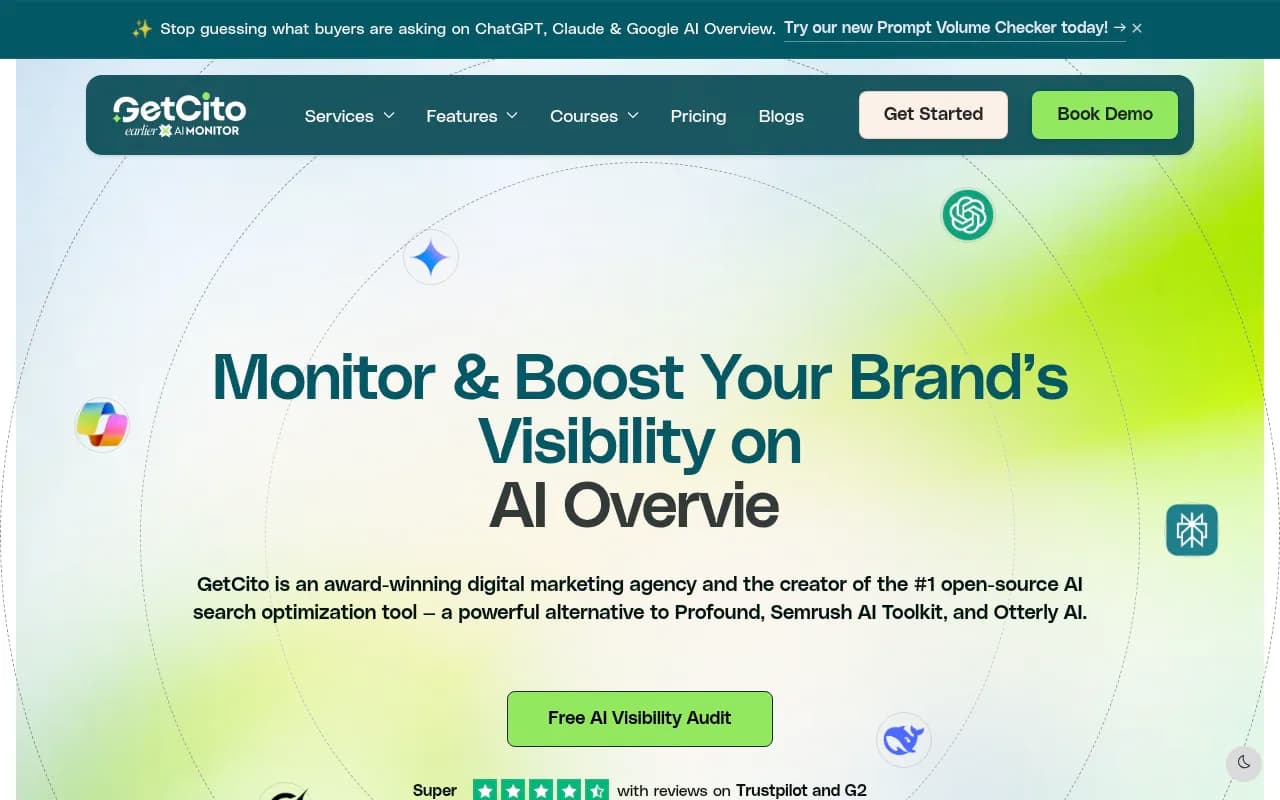
The first thing you need to know: AI Monitor rebranded to GetCito, and getaimonitor.com now serves the GetCito site. If you came here looking for "AI Monitor," this is the same product.
The second thing: it's two businesses in one. There's an open-source tracking tool you can self-host for free (you bring your own API keys for the LLM providers, so you pay OpenAI, Google, and Anthropic directly for usage), and there's a full-service GEO agency where a human team monitors prompts, writes content, builds schema markup, and runs brand mention campaigns on your behalf. The paid plans are really agency retainers with the tool attached, not software subscriptions in the usual sense.
That framing matters when you evaluate the pricing. More on that below.
What the tool does well
The open-source angle is real, not marketing fluff
Plenty of vendors claim transparency. GetCito actually ships code. The GitHub repo (ai-search-guru/getcito-worlds-first-open-source-aio-aeo-or-geo-tool) has 432 stars and 93 forks, runs on a proper monorepo structure with Docker support and e2e tests, and the latest release, v9.1.0, went out in late August 2026 with merged PRs days before this review. For a developer who wants to audit exactly how prompts are sent and how mentions are classified, that's a legitimate differentiator. Most competitors in this category, from Otterly to Profound, give you nothing to inspect.
The self-host plan gets you a full monitoring dashboard, weekly data updates, and basic single-domain analytics. If you're technical and budget-constrained, it's a reasonable way to get started with AI visibility monitoring without a subscription.
Solid monitoring fundamentals
The tracker covers the platforms that matter most: ChatGPT, Perplexity, Gemini, and Google AI Overviews on the Growth and Scale plans, with Claude, Microsoft Copilot, DeepSeek, Meta AI, and Google AI Mode added at Enterprise. You get sentiment analysis (positive vs. negative brand mentions in AI answers), competitor benchmarking, share-of-voice reporting, and a new Prompt Volume Checker that estimates how often buyers ask specific questions on ChatGPT and Claude. Prompt volume data is still scarce across the industry, so having any version of it is useful for prioritizing which prompts to fight over.
Reviews back this up. GetCito holds 4.3/5 on G2 from 17 reviews, and the tone is consistent: the reports are useful, the pricing felt fair, and the team is responsive. One reviewer's comment stuck with me: a competitor had quoted them $35,000 per year for similar functionality. That's the market GetCito is playing in.
The agency side has teeth
The Growth plan ($599/mo) isn't just software. You get a GEO strategist, a content writer, a frontend developer, five human-written content pieces per month, schema markup implementation on 10-15 pages, 10 hours of brand mention acquisition, and 4 hours of Reddit/Quora/forum management. If your alternative is hiring a GEO consultant at $150+/hour, the math can work. The Loop Earplugs case study (a 421% visibility lift) and the Relific case study (33% MoM growth in qualified leads) suggest the team knows what it's doing, though case studies on a vendor's own site always deserve some skepticism.
Where it falls short
It's a tracker, not an optimization platform
This is the core limitation, and it's the same one that affects most of the GEO category. GetCito tells you where you're mentioned and how sentiment trends, but the tool itself doesn't close the loop. Compare that to Promptwatch, which layers AI crawler logs (so you can see when ChatGPTBot or ClaudeBot actually visits your pages and what errors they hit), visitor analytics that attribute real traffic and conversions to AI platforms, content gap analysis with automated briefs, and Content Agents that write and publish GEO-optimized content straight to WordPress, Webflow, or Framer. GetCito's answer to execution is humans on a retainer, which works if you can afford the retainer, but there's no self-serve middle ground where the tool helps you fix what it finds.
Specific gaps worth knowing about:
- No AI crawler logs. You can't see whether AI crawlers are even reaching your pages, which is often the reason visibility scores are low
- No AI traffic attribution. Mentions are tracked, but you can't connect an AI mention to an actual visit or conversion on your site
- No Reddit or YouTube citation tracking as a product feature (Reddit management is sold as a manual agency service instead), despite Reddit and YouTube being heavily cited sources in AI answers
- No ChatGPT Shopping or ads tracking
- No query fan-out data showing how AI expands a prompt into sub-queries
- No page-level citation tracking or automated content generation in the self-hosted tool
For context on why crawler visibility and citation sources matter so much: Promptwatch's data on top ChatGPT citation sources shows a small set of domains capturing the majority of citations, and the mix shifts month to month. A tracker without crawler and citation-source analytics leaves you guessing at the "why" behind your scores.
Pricing is a mess right now
I'll be blunt: GetCito's pricing pages contradict each other. The main pricing page lists Growth at $599/mo and Scale at $999/mo. But GetCito's own comparison page against Geneo AI still advertises a $19 Starter and $99 Growth tier, and Capterra, ColdIQ, and Software Advice all list the old $19-$99 structure. Either the company recently repriced dramatically (from $99 to $599 for the Growth tier is a 6x jump) or it hasn't updated its marketing pages. Either way, confirm current pricing directly with sales before you budget around third-party listings.
Real-world friction from reviewers
G2 reviewers flag a few things that match my expectations from the product's stage. There's no mobile app, which matters if you want to check dashboards on the go. One reviewer called the initial setup "very awful," which tracks with a self-hosted product that requires you to configure third-party API keys. Another complained that notifications are too frequent and not smartly grouped. And one put the value equation plainly: "I like their pricing but let's be honest you get what you pay for." These are the kinds of rough edges you accept in exchange for the price, but you should go in with eyes open.
Coverage limits on lower tiers
Claude, Copilot, DeepSeek, and Meta AI are Enterprise-only. If your buyers live in Claude or Copilot (common in B2B SaaS), the Growth and Scale plans won't show you those surfaces at all, and you're pushed toward a custom-priced conversation.
Who it's for
- Developers and technical founders who want a free, auditable, self-hosted tracker and don't mind wiring up their own API keys. The open-source repo is the strongest offering here.
- Early-stage brands that want done-for-you GEO and would rather pay $599/mo for a small team than hire in-house. The agency bundle is the real product at this tier.
- PR professionals who need sentiment tracking across AI answers for reputation management.
Who should look elsewhere: in-house SEO teams that want a self-serve platform with traffic attribution, crawler diagnostics, and automated content workflows; agencies managing many client sites that need unlimited projects and white-label reporting at a software price point; and anyone who needs to prove AI-driven revenue, not just mentions.
Bottom line
GetCito occupies an unusual and honestly interesting position: it's the only genuinely open-source option in AI visibility tracking, and its agency model makes sense for brands that want humans doing the optimization work. The self-hosted tool is a credible free starting point, and the team behind it is clearly shipping.
But as a platform, it stops where the hard problems start. It shows you mention counts and sentiment, then hands you off to a retainer. If you want a tool that explains why you're invisible (crawler logs), measures whether AI traffic actually converts (visitor analytics), and then fixes the gaps itself (content gap analysis, automated generation, CMS publishing), Promptwatch covers that full stack from $95/mo, with Reddit and YouTube citation tracking, ChatGPT Shopping insights, and prompt volume and difficulty data included. For teams evaluating the broader category, the GEO software directory at bestgeosoftware.com and the AI rank tracking tools directory at ai-rank-tools.com are worth a browse to see how the options stack up.
My verdict: self-host the free tracker if you're technical and curious, or hire the agency if you want done-for-you GEO. But if your goal is a software platform that takes you from insight to executed fix without a human retainer in the loop, GetCito isn't there yet.

Tags:
Frequently asked questions
Is AI Monitor the same as GetCito?
How much does GetCito cost?
Which AI platforms does GetCito track?
Is GetCito really open source?
Who should use GetCito?
Similar and alternative tools to AI Monitor