Key takeaways
- Profound queries the real front-end interfaces of ChatGPT, Perplexity, Claude, Gemini, Copilot, Grok, and DeepSeek, not the raw APIs, so the data reflects what actual users see.
- It tracks four core metrics: Visibility Score (mention rate), Share of Voice, Average Position, and Citation Share, then layers on features like FactCheck and Watched Pages.
- Profound's own research found that running prompts once a day gets you within about 2 percentage points of running them 10 times a day, so obsessing over query frequency matters less than picking the right prompts.
- Pricing has shifted from published self-serve tiers (previously around $99-$399/month) toward a free trial plus custom Enterprise pricing, so you'll need a sales conversation to get a real number in 2026.
- If you want a platform that also acts on the data, not just reports it, tools like Promptwatch add crawler logs, content generation, and CMS publishing on top of the same kind of citation tracking.
What Profound actually does
Profound is one of the better-funded players in the AI visibility space. It raised a $180M Series D on September 15, 2026, co-led by Sequoia Capital and Kleiner Perkins, at a $1.8B valuation, just seven months after a Series C that valued it at $1B. That's a fast climb, and it tells you something about how much money is chasing the question every marketing team is now asking: does my brand actually show up when someone asks ChatGPT or Gemini about my category?
The company says it's used by Ramp, DocuSign, Figma, and Statsig, among others, and claims usage across roughly 10% of the Fortune 500. On G2 it holds a 4.5/5 rating from 1,129 reviews. None of that tells you how the tool works day to day, though, which is the more useful question if you're trying to decide whether to use it.
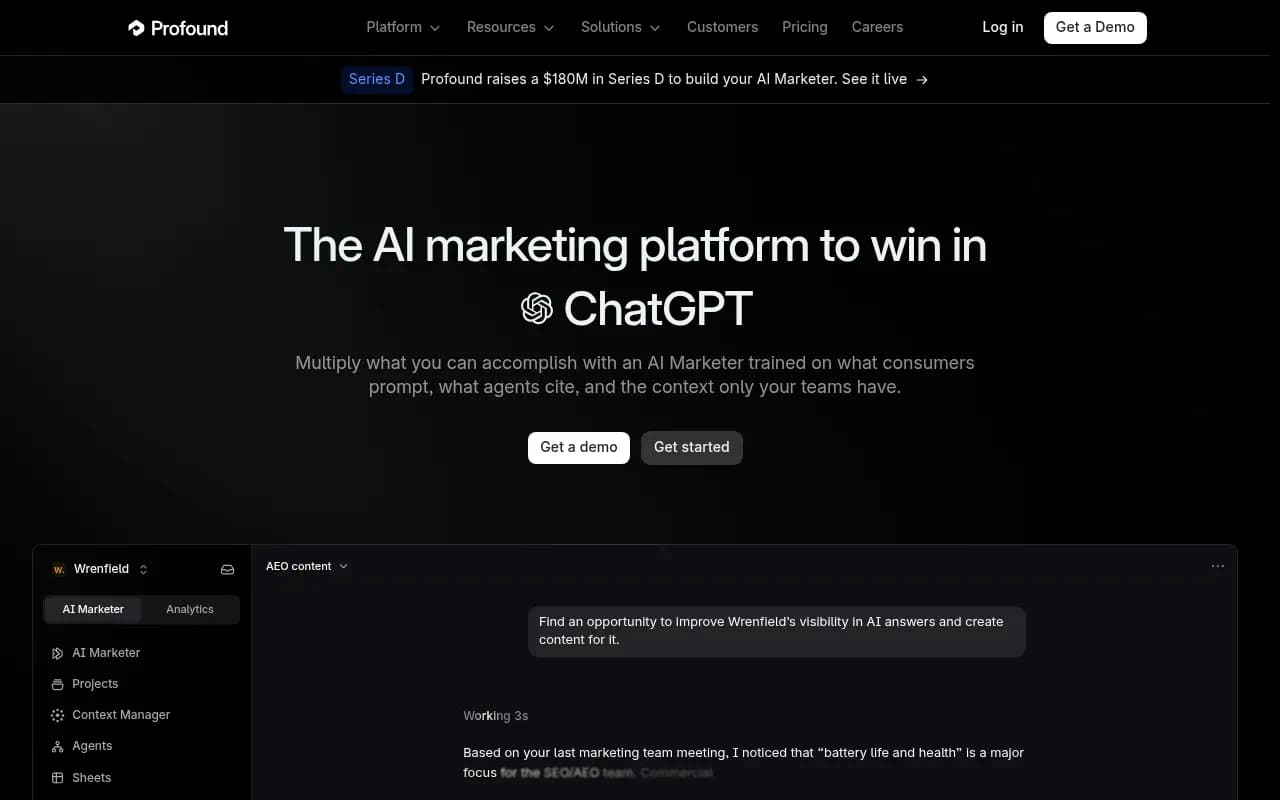
The monitoring method: real UI, not API calls
Here's the detail that matters most and that most competitors don't advertise clearly. Profound queries the actual consumer-facing interfaces of ChatGPT, Perplexity, Claude, Microsoft Copilot, Google AI Overviews, Google AI Mode, Gemini, Grok, and DeepSeek, rather than pulling answers from the underlying API. The company's own line on this is that what you see in Profound is what your customers see when they query AI.
This distinction is not cosmetic. API responses and UI responses from the same model can differ, sometimes a lot, because the consumer product layers on retrieval, ranking, and safety filters that the raw API skips. If a tool only checks the API, it can tell you the model "knows" your brand while completely missing what a real customer would actually be shown. Promptwatch takes the same approach, which is worth knowing if you're comparing the two: it also monitors live UI output across ChatGPT, Gemini, AI Overviews, AI Mode, Perplexity, and Claude rather than relying purely on API sampling.
Promptwatch is built around this same real-UI premise, plus a wider stack of crawler logs, content generation, and CMS publishing layered on top.

How prompts get built and run
Profound gives you three ways to build a tracked prompt set: auto-generate prompts from your brand and topic configuration, upload your own list manually, or pull from Prompt Volumes, which is Profound's own dataset of real queries people actually submit to AI platforms.
Profound's guidance on writing good prompts is fairly practical. Start from your existing SEO keyword clusters and rewrite them as questions a person would actually type, so "best short-form video editing tool" becomes "what's the best short-form video editing tool for creators?" Then mine sales calls, support tickets, and "how did you hear about us" fields for the actual phrasing customers use, because that phrasing is often nothing like your keyword list. Finally, cover the whole buying journey: awareness questions, comparison questions, pricing questions, and post-purchase how-to questions, since AI tools get asked all four kinds and your visibility can vary wildly between them.
One detail worth flagging: a chunk of the responses Profound analyzes for ChatGPT, Perplexity, Copilot, and AI Overviews come specifically from RAG-based, web-search-triggered answers. It's tracking citation-enabled search responses, not the model just reciting whatever it memorized during training. That's the right scope for brand visibility work, since it's the citation-driven answers that actually reflect what's on the live web about you right now.
Does query frequency matter?
Profound ran an internal experiment worth knowing about if you're deciding how obsessive to get with tracking cadence. Over two weeks, they tested 753 prompts across 7 platforms (ChatGPT, Gemini, Perplexity, Copilot, DeepSeek, AI Mode, AI Overviews), comparing running each prompt once a day versus 10 times a day, a total of roughly 129,000 runs versus 860,000 runs.
The result: visibility scores differed by about 2 percentage points (78.7% vs 80.4%) and citation share differed by about 0.3 points (10.24% vs 9.99%) between the two cadences. Their conclusion is that once-daily tracking is close to the practical ceiling of precision you can get, because the thing moving the numbers is platform drift, model updates, retrieval changes, the live web shifting underneath you, not sampling noise you can average away by asking more often. In plain terms: which prompts you track matters a lot more than how often you run them.
The core metrics, explained plainly
Profound organizes its reporting around a handful of metrics that show up across most AI visibility tools, though the naming varies.
Visibility Score is the simplest one: the percentage of tracked prompt responses that mention your brand at all. Mentioned in 40 of 100 tracked responses gets you a 40% visibility score.
Share of Voice compares your mention volume against named competitors across the same set of tracked responses, with a rank showing where you land relative to them. Profound notes that among the top 10 competing brands in a category, share of voice often varies by only a couple of percentage points, which tells you how tight this competition actually is once you're past the obvious market leader.
Average Position measures where your brand lands within an answer relative to other brands mentioned in the same response, expressed as a number like 5.1.
Citation Share tracks how often your own domain gets cited as a source behind an answer, versus competitor domains and third-party sites. Profound auto-tags every cited source into categories: owned, competitor, earned media, PR wire, social, or institution, so you can see whether your visibility is coming from your own content or from third parties talking about you.
On top of these, Profound has a FactCheck feature that flags inaccurate claims AI models make about your brand, traces the claim back to whichever publisher or source is repeating it, and helps you track corrections. There's also Watched Pages, for monitoring citation performance of specific URLs right after you publish or update them, and Opportunities, which ranks content gaps by effort versus impact, essentially surfacing the prompts where competitors get cited and you don't.
Why citation tracking has to be continuous
It's tempting to treat this as a one-time audit, run a batch of prompts, get a snapshot, move on. The data argues against that. Promptwatch's analysis of ChatGPT citation share shows Reddit's share of citations fell from roughly 6.11% in May 2026 to 3.71% in June 2026, a nearly 40% drop in a single month, and a separate Promptwatch report on Reddit citations dropping in ChatGPT shows reddit.com's citation share collapsing from about 4% to 0.5% on a single day, August 14, 2026.
That kind of swing happens because of model updates and retrieval changes on OpenAI's end, not anything the sites involved did differently. If you only check your visibility quarterly, you can completely miss a month where your citation mix reshuffled. Promptwatch's average sources per response data adds another wrinkle: ChatGPT typically cites around 5 sources per web-search response while Google AI Overviews cites close to double that, meaning a single lost citation slot hurts far more on ChatGPT than on AI Overviews, where there's more room. Perplexity is the most stable of the bunch, consistently citing close to 10 sources per answer.
Profound's own research backs the same conclusion from a different angle: even the top competing brands in a category see only a couple of points of separation in share of voice, so small shifts matter and they happen fast.
Engine coverage: what Profound actually tracks
There's some inconsistency across Profound's own marketing pages worth knowing about before you buy. The homepage banner lists ChatGPT, Perplexity, Claude, Gemini, Grok, Microsoft Copilot, DeepSeek, and Google AI Overviews. The pricing page's feature comparison table lists a slightly different set under its top Enterprise tier: ChatGPT, Perplexity, Google AI Mode, Gemini, Microsoft Copilot, DeepSeek, Claude, Google AI Overviews, and Exa Search, which drops Grok from that specific list. Not a dealbreaker, but confirm exact engine coverage for your tier before signing anything.
| AI engine | Tracked by Profound | Notes |
|---|---|---|
| ChatGPT | Yes, all plans | Base coverage on every tier |
| Perplexity | Yes | Higher tiers |
| Google AI Overviews | Yes | Higher tiers |
| Google AI Mode | Yes | Listed on pricing page |
| Gemini | Yes | Enterprise |
| Claude | Yes | Enterprise |
| Microsoft Copilot | Yes | Enterprise |
| DeepSeek | Yes | Enterprise |
| Grok | Homepage yes, pricing table no | Confirm with sales |
Pricing: it's changed, and it's murkier now
This is worth flagging directly because it's easy to get outdated information. Profound's pricing page, as of this writing, no longer publicly lists numbered self-serve tiers. It shows a free Trial (10 prompts, run once, ChatGPT only, no history or exports) and a custom-priced Enterprise tier with up to 9 answer engines, daily tracking, unlimited domains for its Agent Analytics crawler-monitoring feature, CSV/JSON export, API access, and SSO/SOC 2 compliance.
Older third-party write-ups still float specific numbers, a Starter tier around $99/month tracking ChatGPT only with 50 prompts, and a Growth tier around $332-$399/month covering three engines. Those figures may be stale or may reflect grandfathered accounts; either way, don't take them as current without confirming directly. One G2 reviewer, described as a senior content marketing manager, is quoted saying Profound's cost per prompt runs higher than average, which lines up with the shift toward a custom-quote model aimed at enterprise budgets rather than smaller teams testing the waters.
How Profound compares to other options
| Tool | LLM coverage | Starting price (per public/third-party info) | Best for |
|---|---|---|---|
| Profound | ChatGPT, Perplexity, AI Mode, Gemini, Copilot, DeepSeek, Claude, AI Overviews | Free trial, Enterprise custom | Large orgs wanting deep reporting and content optimization |
| Promptwatch | ChatGPT, Gemini, Claude, Perplexity, Grok, DeepSeek, Copilot, Mistral, Meta Llama, AI Overviews, AI Mode | $95/mo Essential | Teams wanting monitoring plus automated content fixes |
| Peec AI | ChatGPT, Perplexity, AI Overviews (others at extra cost) | From about €89/mo | Small teams wanting a basic starting point |
| Otterly.AI | Multiple LLMs, prompt tracking | Budget-tier | Basic brand mention checks without deep analytics |
| Scrunch AI | ChatGPT, Gemini, AI Overviews, AI Mode, Perplexity, Copilot, Claude | From about $100/mo | Smaller sites needing technical AI-readiness fixes |
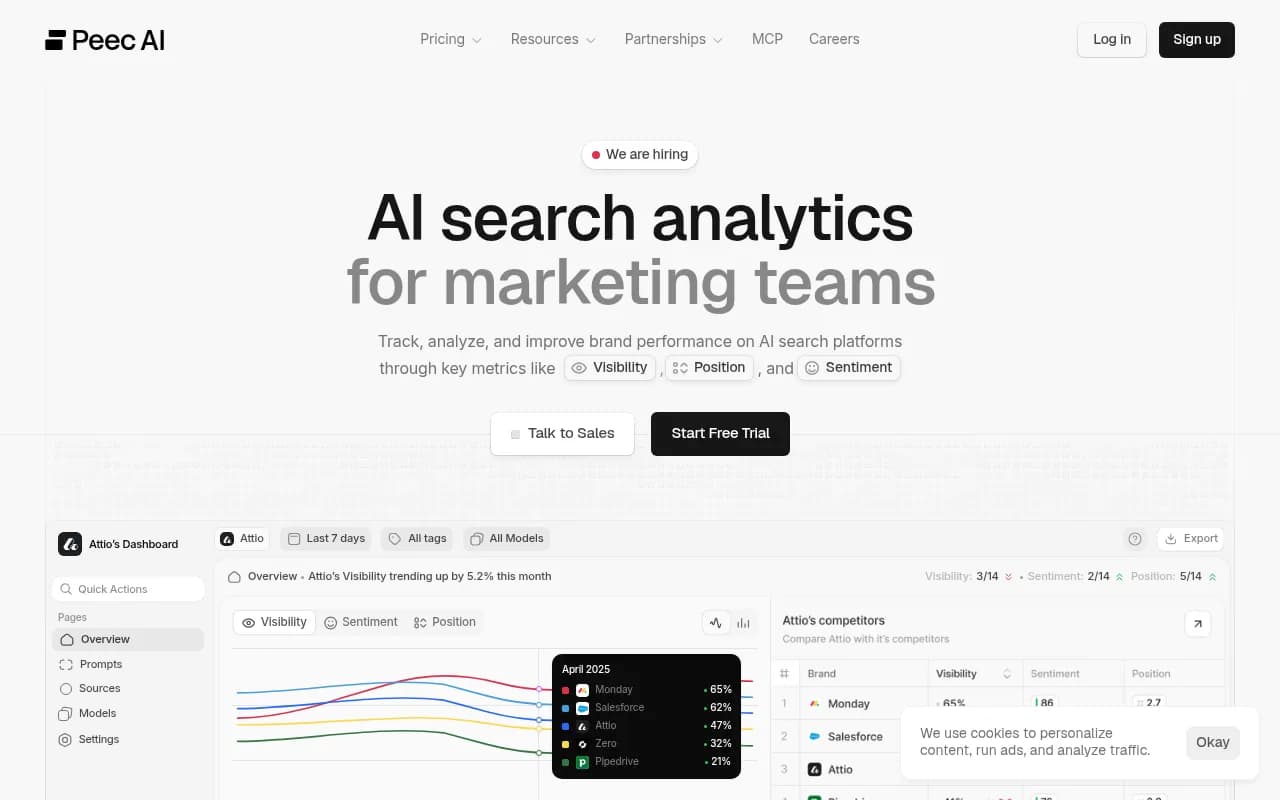
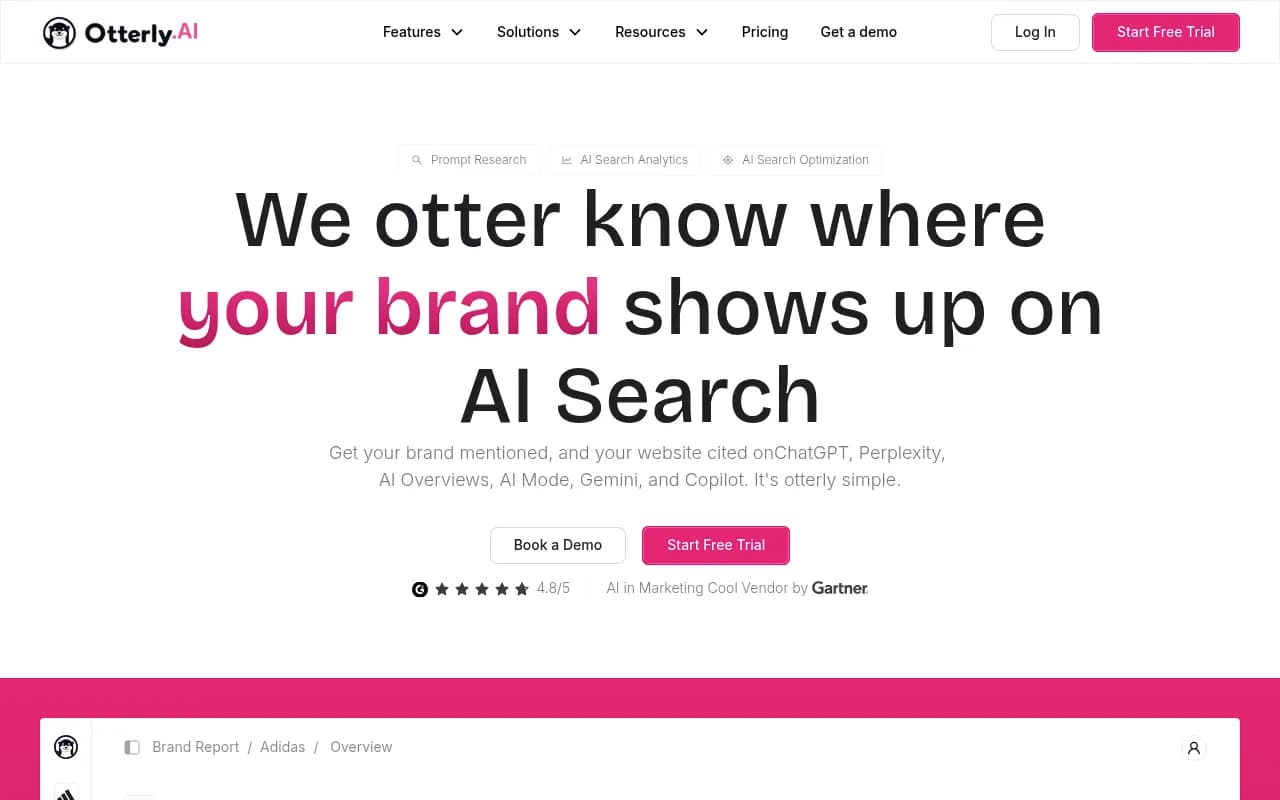
Where Profound genuinely earns its enterprise reputation is depth of reporting and FactCheck, the feature that traces false claims about your brand back to their source. That's a real gap in a lot of cheaper tools. Where it's worth pausing is cost and the fact that pricing transparency has gotten worse, not better, over the past year.
If what you actually need is a platform that goes beyond telling you where you're invisible and starts fixing it, tools built around agentic execution matter more than raw monitoring depth. Promptwatch, for instance, pairs the same kind of citation and mention tracking with AI crawler logs (showing exactly when ChatGPTBot, ClaudeBot, or PerplexityBot hit your pages and whether they errored out), content gap analysis, and Content Agents that draft and publish AEO articles straight to Webflow, Framer, or WordPress on a schedule. That's a meaningfully different job than a dashboard that just reports a visibility score each week. It's used by 1,840+ brands and agencies including Duolingo, Yelp, and Typeform, and it's rated 4.7/5 on G2 based on more than 4.5 billion analyzed citations.
The manual, no-tool version
If you're not ready to pay for any tool yet, there's a manual method that gets you most of the way there for a month, described well in a Quora thread on tracking AI visibility. Pick 8 to 15 real buyer questions, phrased conversationally rather than as keywords ("is [your brand] worth it?" rather than "[brand] review"). Freeze that list, don't change it monthly, or you're not measuring visibility, you're just running random tests. Run the same prompts on a fixed schedule through ChatGPT, Perplexity, Gemini, and AI Overviews, and log three things for each answer: whether you were mentioned, how (recommended versus a passing mention), and which sources got cited. That last column, the citations, is consistently described as the most useful data point, because it tells you exactly which third-party pages are shaping what AI says about you.
A spreadsheet and an hour a month gets you most of the signal a paid tool would give you. What it won't give you is scale, historical trending across dozens of prompts and engines simultaneously, or the automated content production that closes the loop between finding a gap and fixing it. That's the trade-off: manual tracking teaches you the mechanics, tools like Profound or Promptwatch handle the scale once you know what you're looking for. For a broader look at the category, the GEO software directory at bestgeosoftware.com is a reasonable place to compare more options side by side.