Key takeaways
- A brand does not have one AI ranking. It has one per type of buyer, because AI engines infer who is asking and adjust the shortlist.
- Run the same prompt set once per persona and compare visibility, share of voice, position and citations between the runs. Do not average them into one score.
- Write personas around role, situation, constraints and priorities. Names and stock photos change nothing.
- Category leaders hold up across personas. Mid-market brands are the ones that get swapped out, so they have the most to learn from this.
- Personas simulate context. They do not replicate a real user's months of chat memory, so keep a no-persona baseline.
Why one blended score misleads you
Most AI visibility tracking runs prompts as an anonymous user. You get one number per prompt, averaged across models and runs. That answers "how visible are we in general?" Your sales team asks something narrower: visible to whom?
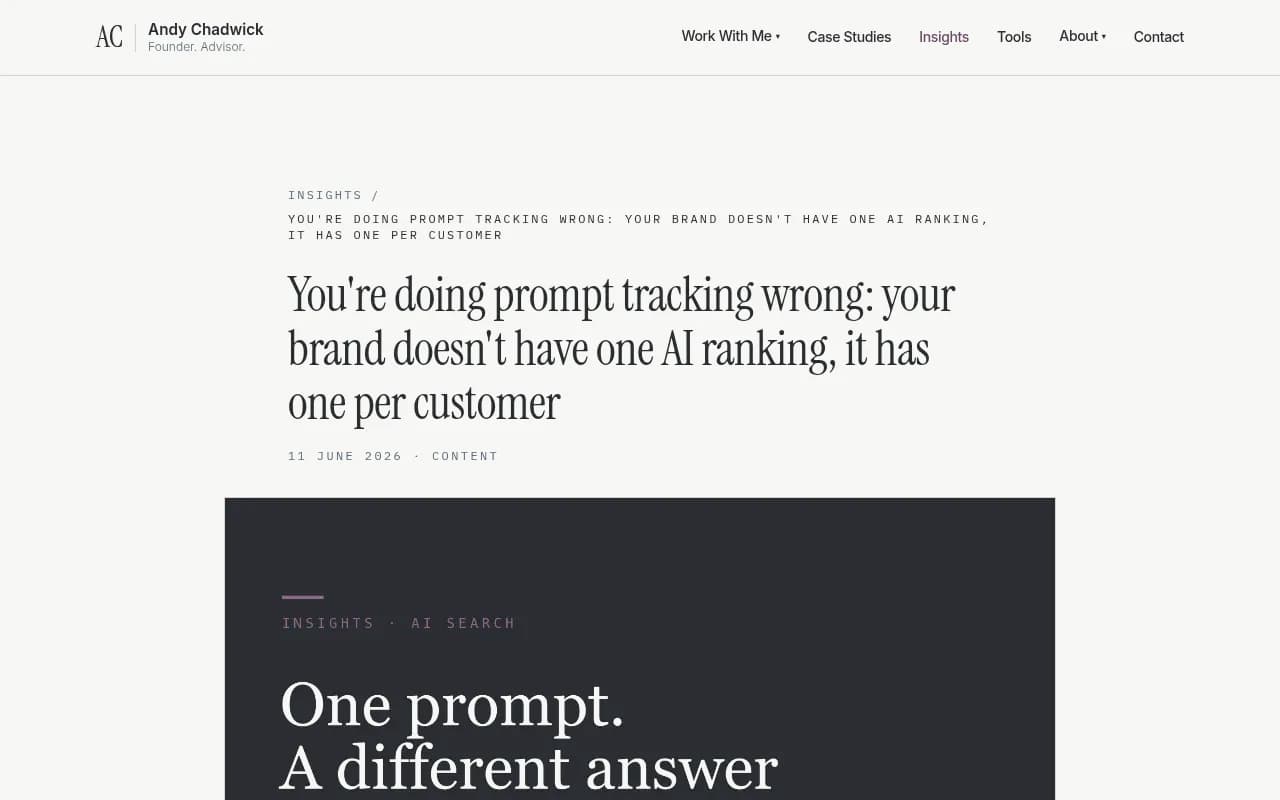
Andy Chadwick ran a small experiment in June 2026 that makes the point better than any chart. He asked ChatGPT for a running shoe recommendation twice, same model, same day. The only change was one sentence. As a CrossFitter training for a marathon, he got the Adidas Adizero Evo SL. As a rock climber training for the London Marathon, he got the ASICS Novablast 5. Both lists included a Brooks Ghost, but one had the Ghost 18 and the other the Ghost 17. When he asked the model to explain itself, the reasoning was revealing: it assumed the climber had tight calves and a loaded Achilles, and picked something cushioned and forgiving. The model built a picture of the buyer first, then shopped for them.
The same thing happens in B2B, with higher stakes. An engineer checks API limits and SOC 2. A department head checks seat pricing and time-to-value. An economic buyer checks vendor stability and total cost of ownership. Ask "what's the best tool for X" as each of them and the engine weighs different criteria, runs different searches and can name different brands. If you lead with technical evaluators and trail with budget owners, a blended average can look healthy while the person who signs the contract never sees you.
What the research says (and what it does not)
A preprint called Persona Conditioning of Brand Recommendations, submitted May 28, 2026, tested this properly. The authors are from Unusual.ai, a vendor in this space, and it is not peer-reviewed, so treat it as strong evidence rather than settled fact. The method is published in full though.
- 10 personas built from industry, company size, job role and location
- 8 buying prompts across B2B software and consumer categories
- 3 model configurations, 10 repetitions each, roughly 2,000 runs
Adding a persona prefix lowered the overlap (Jaccard similarity) of recommendation sets by 0.12 to 0.20 compared with a same-persona baseline, and the confidence intervals excluded zero in all three cells. The more useful finding is about prominence. Category leaders were persona-resistant, with about 80% same-brand consistency across personas. Mid-market brands swapped up to 75% of their recommendation set as the persona changed.
Two caveats from the paper itself. The Anthropic model showed a larger effect than the OpenAI configurations, but the intervals overlap for the closer contrast and one cell had only 4 prompts. And the personas were short prefixes, not rich profiles. Your results with detailed personas may differ in size, though probably not in direction.
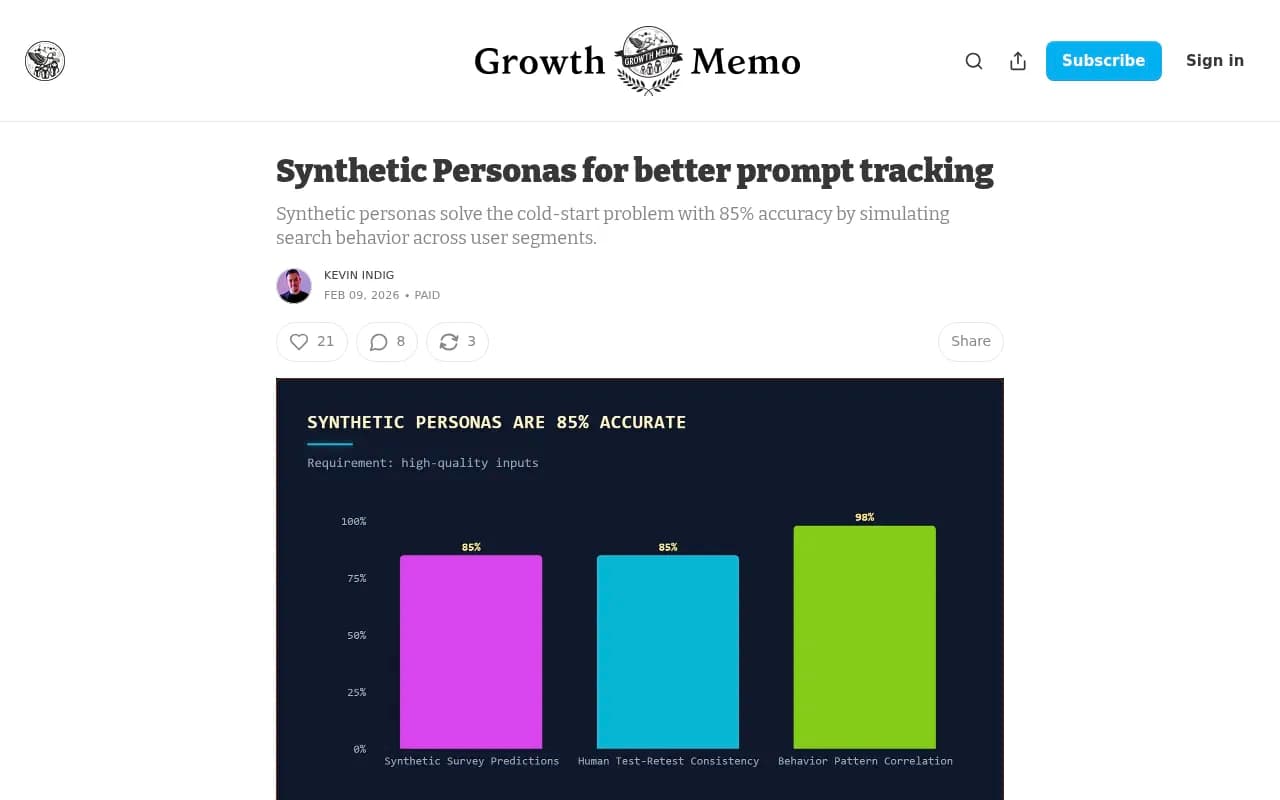
Kevin Indig has also written about using synthetic personas to solve the cold-start problem in prompt tracking, claiming around 85% accuracy at simulating search behavior across segments. That post is paywalled, so I can only point at the headline claim, not verify the method.
One prompt tells you very little
Before personas, a sanity check on sample size. Promptwatch Data found that 47.6% of ChatGPT responses with citations cited 10 or more unique domains (Sep 28 to Oct 4, 2026). For organic prompts with no brand named, that rose to 52.5%. With that many sources per answer, a single prompt run is noisy. Multiply by five personas and you need enough prompts per persona that the differences are not just sampling luck.
There is a second reason the persona matters: query fan-outs. ChatGPT turns your prompt into its own web searches, and Promptwatch's fan-out data shows averages of roughly 1 to 2 searches per response between December 2025 and April 2026, with shorter queries over time. Persona context can change those sub-queries. Your content has to match the fan-out query, not the words the user typed. If the CFO persona triggers searches about "total cost" and "contract terms" and you only have a feature page, you lose that buyer before the answer is written.
Step 1: Pick five personas that actually differ
The goal is five buyers who would ask the same question but care about different things. A useful persona has four parts: role, situation, constraints and priorities. The paper used industry, company size, job role and location, which is a decent starting skeleton.
Here is a B2B software example, for a hypothetical project management tool:
| Persona | Situation | What they weigh |
|---|---|---|
| Technical evaluator | Engineering lead at a 200-person SaaS company | API limits, integrations, SOC 2, uptime |
| Department head | Marketing director with a team of 12 | Seat pricing, onboarding time, reporting |
| Economic buyer | CFO at a mid-market company | Total cost, vendor stability, contract terms |
| Small team founder | Founder, 8 people, no ops hire | Free tier, setup in a day, no training |
| Enterprise procurement | VP at a US enterprise with 5,000 staff | Compliance, SSO, vendor risk, support SLAs |
For consumer categories, swap in life situations like the CrossFitter and the climber. Pull the real wording and concerns from sales calls, support tickets and review sites, not from imagination. Aleyda Solis makes a related point: a non-representative prompt library is one of the biggest mistakes in AI search tracking, and personas will not fix a bad library.
Writing the persona text
Keep it to a short paragraph in first person. Say who they are and how they decide. Compare:
- Weak: "I am a CFO."
- Better: "I'm the CFO of a 400-person company. I approve software spend over $20k a year, I care about total cost over three years and whether the vendor will still exist, and I get nervous about annual lock-in."
Then test it. Run the buying question as that persona and ask the model to explain its picks, exactly like Chadwick did. The explanation shows which buyer profile the model inferred. If it ignores your constraints, the persona is too vague.
Step 2: Fix the prompt set first
Personas multiply everything. Get the base prompts right before you stack anything on top.
- Use 20 to 50 buying prompts that are organic (no brand named), plus a few competitor comparison prompts.
- Keep the prompt text identical across personas. Only the "who is asking" context changes.
- Do not write persona text into each prompt by hand. A 50-prompt set becomes 200 prompts for four personas, the copies drift apart as people edit one and forget the others, and you lose the ability to switch the persona off for a baseline.
- Keep one monitor per country and language. Mixing markets muddies the comparison.
If you do it manually, a spreadsheet works for a first test: one column for the prompt, one for the persona, one for brands mentioned in order, one for cited domains. Scrunch's help center suggests a persona column in a CSV for the same reason. It gets painful past a few dozen prompts.
Step 3: Run the same prompts as each buyer
The mechanics are simple. For each persona, wrap every prompt in the persona text and run it across the models you care about. Repeat several times, since single runs are noisy. Always include a no-persona baseline run so you can see how much each persona moves things.
Do it by hand for a pilot
Open ChatGPT, Gemini or Perplexity in a logged-out session. Do not search for your company name. Ask five questions a real prospect might ask, once per persona. Note which brands appear, in what order, and which sources get cited. Randall Kanna suggests the same exercise for client pitches, and it is genuinely eye-opening in about 20 minutes.
Use a tool once you need scale
A few platforms support personas natively. Which one fits depends on how much of the loop you want in one place.
| Tool | Persona approach | Good fit |
|---|---|---|
| Promptwatch | Persona stacking: one persona per monitor, same prompts, each response tagged with a persona card | Teams that want tracking plus content and crawler data |
| Scrunch | Persona injection, with a persona column in CSV imports | Teams testing audience-specific responses |
| Semrush Enterprise | Persona-based prompt generation | Existing Semrush enterprise users |
| Gumshoe AI | Persona-based visibility tracking | Teams who want personas as the core feature |
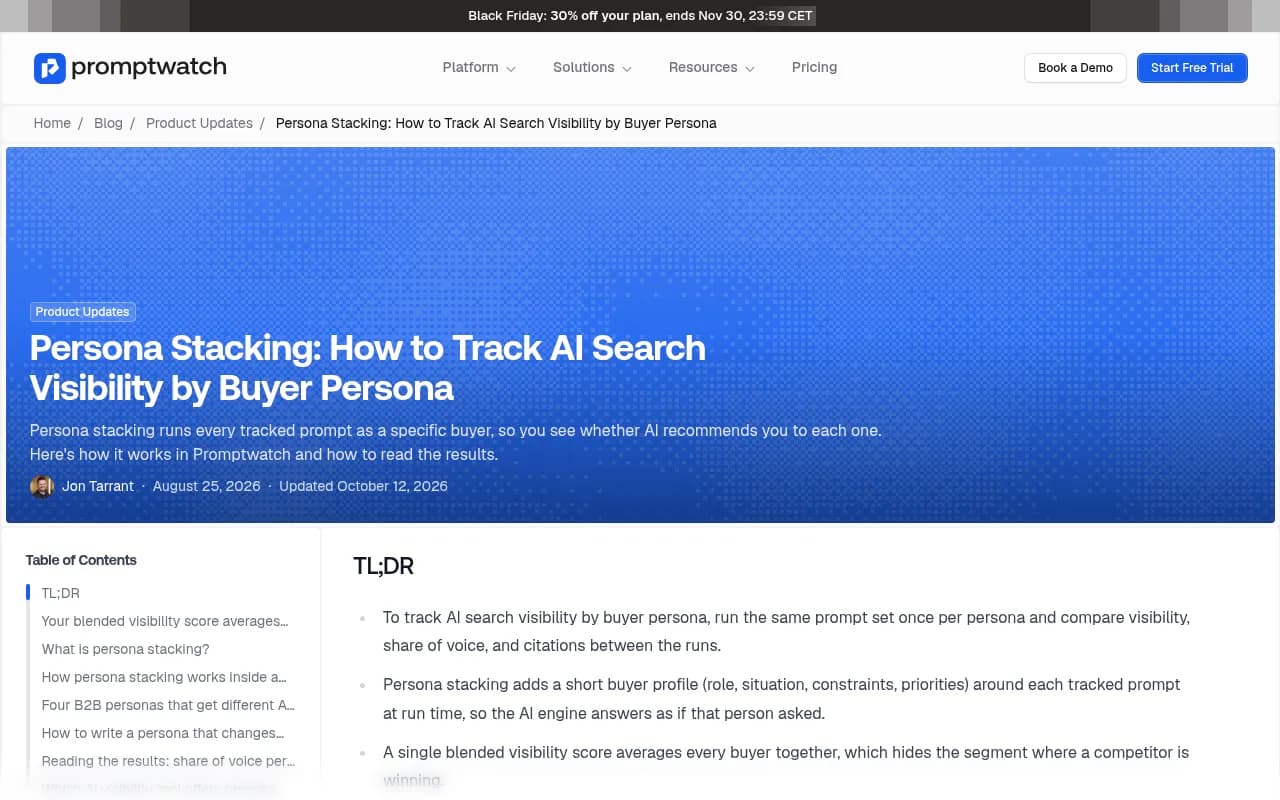
Promptwatch handles this as a monitor setting. Personas live in the project's Brand Book (name, short description, optional age range and education level, and a persona prompt describing who the person is and how they decide), and you reuse them across monitors. The rule is one persona per monitor, so to compare five audiences you run five monitors with the same prompts, and each response carries a persona card. A score change then traces back to a specific buyer.

Other tools in the catalog that touch this space:


If you are shopping around, the GEO software directory at bestgeosoftware.com lists more options. Whichever you choose, check three things: can it run the same prompts under different personas, does it tag every response with the persona, and does it collect from the real interfaces rather than only APIs.
Step 4: Read the results
Do not look at one number. Compare the persona runs on a few metrics together. Each points at a different kind of problem.
| What you see | Likely problem | What to do |
|---|---|---|
| Low share of voice for one persona only | Coverage gap for that buyer | Publish content answering that buyer's questions |
| You appear, but late in the answer | Prominence problem | Strengthen comparison and proof content |
| Mentioned but never cited | Content or crawlability problem | Check AI crawler access and page structure |
| Mentioned with weak sentiment | Reputation problem | Look at what third-party sources say |
| Competitor wins one persona across all models | Segment is lost | Study the pages AI cites for that persona |
The prominence finding from the paper gives you a quick triage. If you are a category leader, expect stable results across personas and treat big swings as a red flag. If you are mid-market, expect swings and treat them as the map of where you are chosen and where you are not.
Read the reasons, not only the ranks
Ask the model to explain the picks for each persona, then compare the criteria. You will often find the persona that never sees you is judging on something you do not publish at all. The CFO persona wants pricing and contract terms. The engineer wants docs and security pages. If your site hides pricing behind a form, one persona is missing from your story.
Check the citations by persona
Look at which domains get cited under each persona. The technical evaluator may pull from docs, GitHub and G2, while the economic buyer pulls from analyst pieces and review sites. Promptwatch's software citation data (Sep 28 to Oct 4, 2026) shows GitHub, Microsoft's docs and G2 leading ChatGPT citations for software prompts, with documentation and help centers earning the largest share. That is the aggregate. Your persona runs show you the version that applies to your category.
Step 5: Turn the gaps into work
Each lost persona maps to a content or reputation job.
- Pick the persona with the biggest gap to the best-performing one.
- List the criteria the model used for that persona.
- Check which of those criteria your site answers on a crawlable page.
- Write or refresh pages for the missing ones, and match the likely fan-out queries, not only the headline prompt.
- Re-run the same monitor a few weeks later and compare against the baseline.
Content type matters here. Promptwatch Data found product pages were the most cited content type in ChatGPT at 22.4% (Sep 28 to Oct 4, 2026), followed by landing pages and listicles. And per the content half-life report, landing pages and docs stay cited longest, while news lost half its pages within 36 days. So for a persona gap, a durable landing page or docs page for that buyer usually beats a one-off news-style post.
AI crawler access is the other thing to rule out. If a persona's answers keep citing competitors, check that the relevant pages are actually being read by AI bots. Promptwatch's crawler logs show whether bots hit a page and where they fail, which separates an access problem from a content problem.
Limits you should know about
Personas are a simulation, and it is worth being honest about that.
- Real users carry memory and history. In November 2025, Lily Ray reported that ChatGPT rewrote her prompts using what it knew about her, including her New York location, and her results rarely matched what tracking tools showed. A persona prefix simulates one slice of context, not months of it.
- Models differ. The preprint found the Anthropic model moved more with personas than the OpenAI setups, and produced 43 to 52% of recommendations without observed retrieval evidence, against 8 to 29% for OpenAI. Training-data answers and live-search answers behave differently, so track both.
- Your personas are hypotheses. If your persona text is invented rather than drawn from customers, you are measuring your assumptions.
- Results move. Models update, so rerun on a schedule instead of treating one test as truth.
A sound way to handle this: track from clean, logged-out, location-matched sessions, keep a baseline with no persona, and treat the persona runs as relative comparisons between buyers, not as a forecast of any individual's answer.
A simple test to see if you need this
Split one topic's prompts randomly into two halves and compare the results. If the halves disagree a lot, your sample is too small or too uneven, and adding personas will make noise worse. Fix the library first. If the halves agree but personas disagree, you have found a real segment effect, and that is the point of the exercise.
Where to start this week
Take your ten most important buying prompts. Write five persona paragraphs from real customer language. Run each combination by hand in a logged-out session, plus one baseline, and record brand order and cited domains. You will probably find one persona where a competitor owns the answer. That is your first content brief. Once the manual version proves its worth, move it into a tool so it runs daily and tags every response. If you want a quick baseline of how AI currently describes your brand before building personas, the free AI visibility report takes no login. For other trackers worth comparing, the directory at ai-rank-tools.com is a good next stop.