Key takeaways
- Compliance claims differ a lot in how verifiable they are. Profound publishes SOC 2 Type II and HIPAA, BrightEdge lists ISO 27001:2022 and ISO/IEC 42001, and Promptwatch is ISO/IEC 27001 certified and GDPR compliant. None of the three publicly covers every certificate the others hold.
- Data quality comes down to method: where prompts come from, whether answers are captured from real AI interfaces or APIs, and whether crawler logs are IP-verified.
- Profound leans on a 2B+ real-conversation prompt panel. BrightEdge leans on decades of SEO data and Google integration. Promptwatch leans on real-UI capture, IP-verified crawler logs and an execution loop.
- Most of what is written about these tools is vendor-authored, including parts of this research. Treat every certificate as something to request, not something to assume.
- Gating differs: Profound keeps API, MCP and Prompt Volumes on Enterprise, BrightEdge prices at enterprise level with no public AI Catalyst figure, and Promptwatch starts at $95 a month with all engines, API and MCP included.
Why compliance and data quality come first in enterprise GEO
When a bank, insurer or health company evaluates an AI visibility platform, the demo usually comes second. Security questionnaires, data processing agreements and a hard look at where the numbers come from come first. A tool can have the best dashboard on the market and still die in procurement.
There is a second problem that gets less attention. AI visibility data is noisy by nature. Answers vary run to run, engines drift, and citation counts differ per engine. Promptwatch Data showed ChatGPT citing about 5 sources per web-search answer, Google AI Overviews about 10, Perplexity almost exactly 10 every day, and Copilot swinging from under 2 to nearly 17 within a few weeks. That page is dated September 2025, so check it is still current. The point stands though: a platform that blends engines into one number hides drift you need to see.
So this guide compares three platforms on two axes only: what they can prove for security review, and how trustworthy their data collection is. For a wider feature view, the GEO software directory at bestgeosoftware.com covers more options.
The three platforms in brief
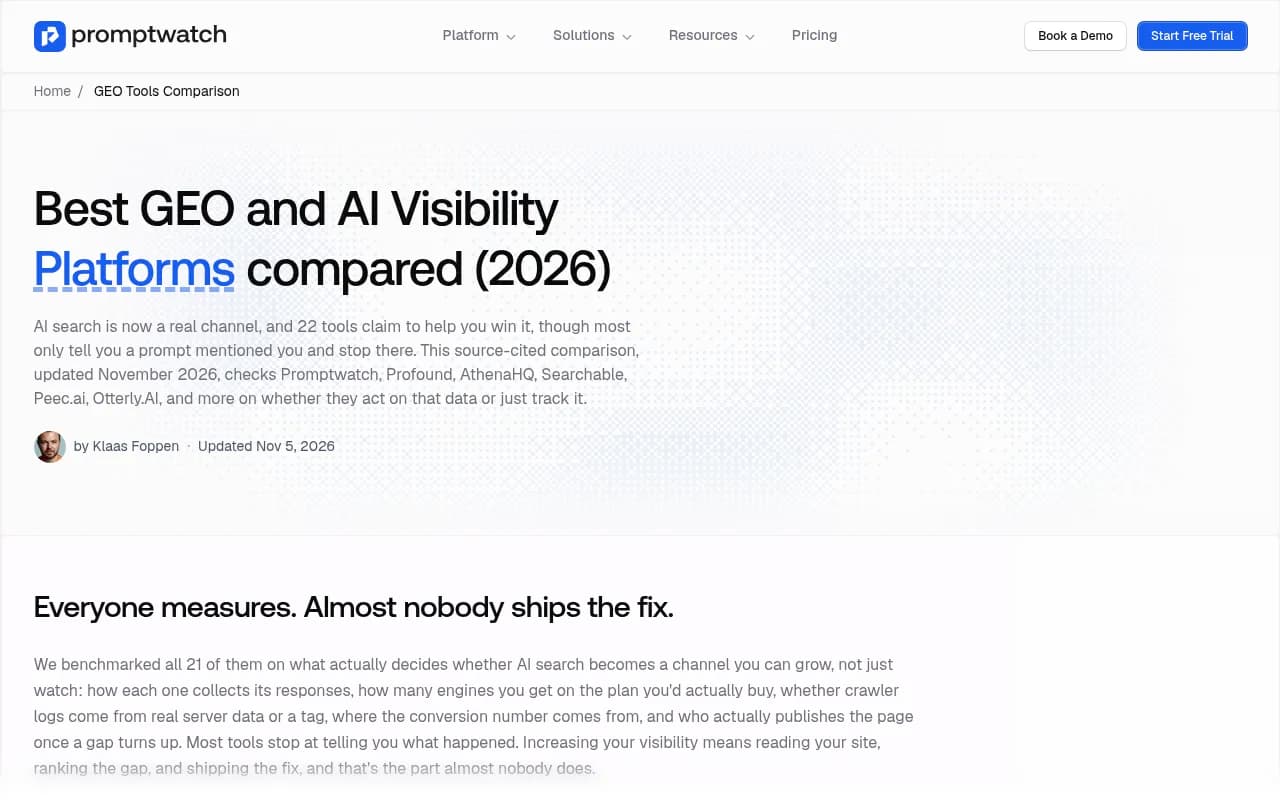
Promptwatch is an end-to-end AI visibility and GEO platform. It tracks brand mentions and citations across ChatGPT, Gemini, Claude, Perplexity, Google AI Overviews, Google AI Mode, Copilot and others, then goes on to content gap analysis, a Content Agent that publishes to WordPress, Webflow or Framer, IP-verified crawler logs and visitor analytics.

Profound is an enterprise AI visibility platform built for the AI era. It markets itself as agentic, with a large real-conversation prompt panel, FactCheck, a visual Agent builder and a wide CMS catalog.

BrightEdge is the established enterprise SEO platform that added AI visibility through its AI Catalyst and AI Hyper Cube modules, sitting on top of its DataMind analytics engine.
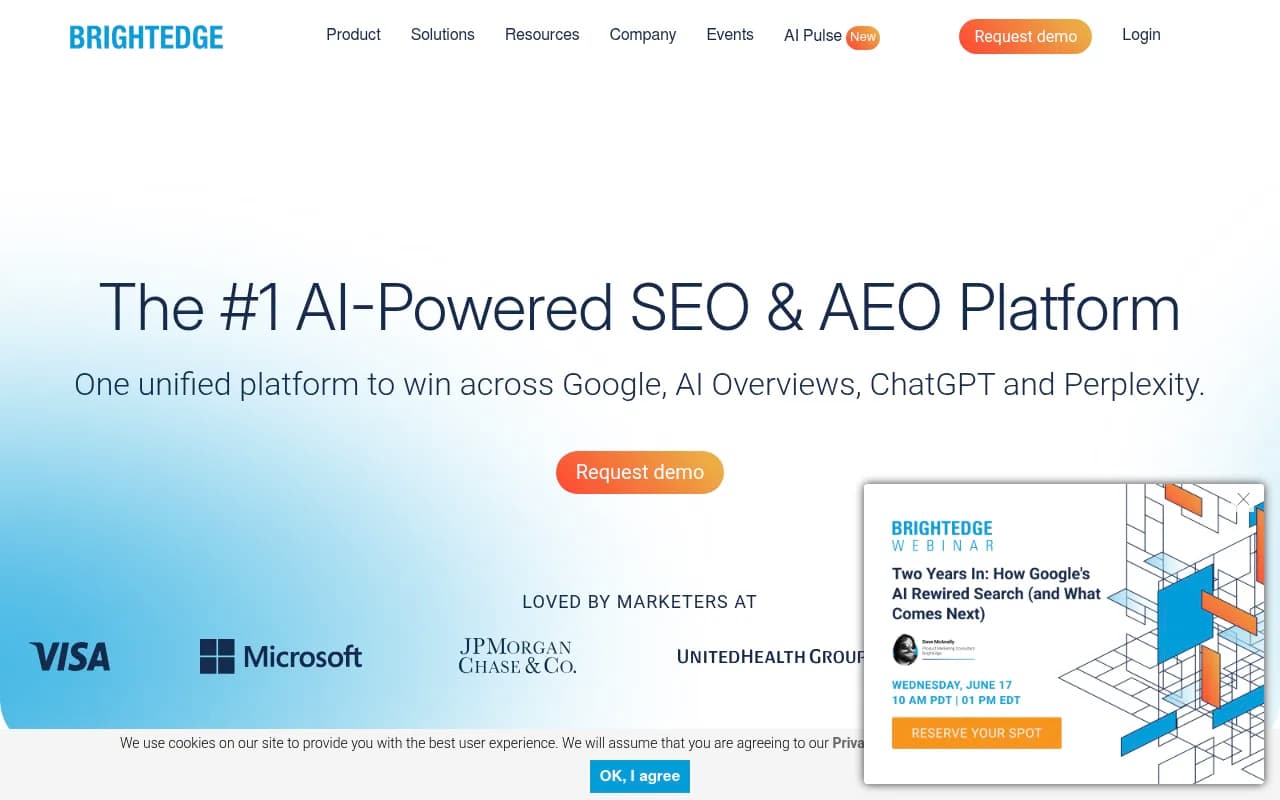
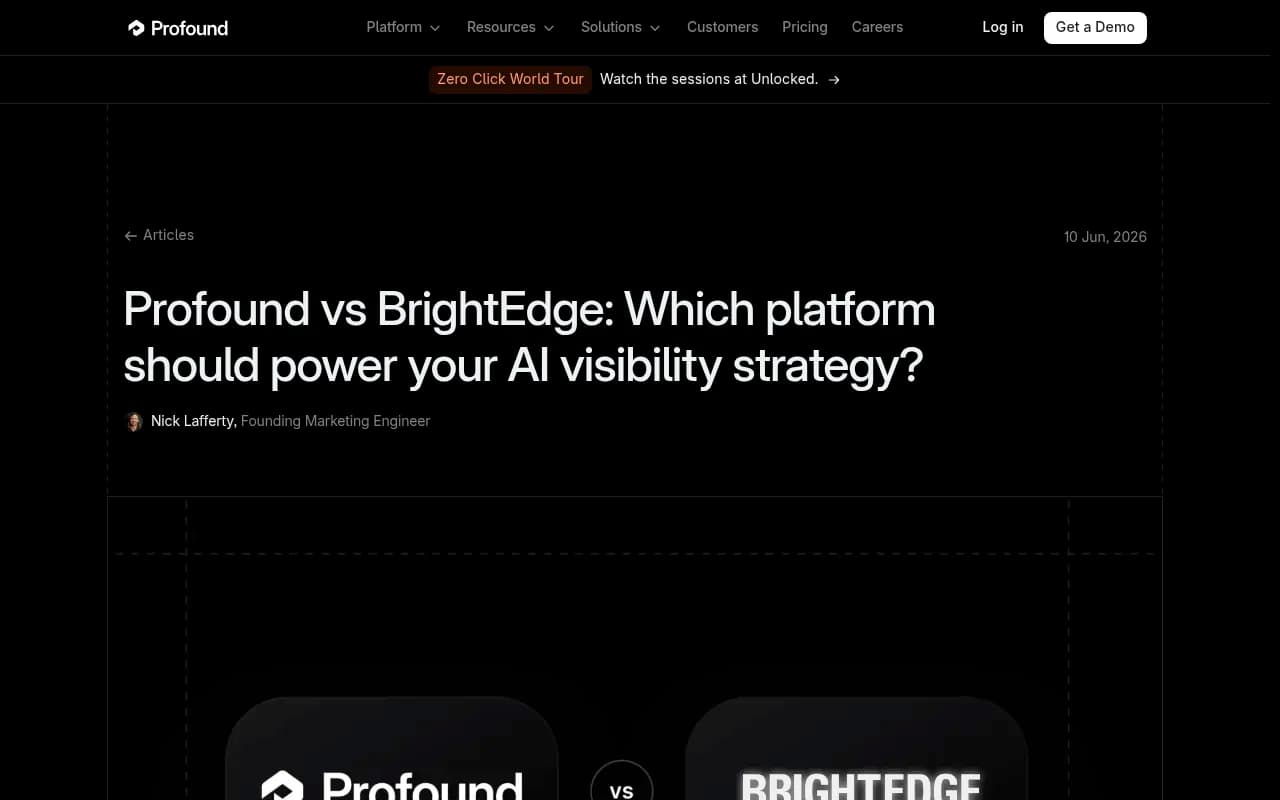
A caveat on sourcing. Profound's article above is written by Profound, and the Promptwatch comparison pages are written by Promptwatch. I have tried to flag which claims come from where.
Compliance compared
Here is what each vendor publicly claims, and how solid the claim looks.
| Area | Promptwatch | Profound | BrightEdge |
|---|---|---|---|
| Security certification | ISO/IEC 27001 certified | SOC 2 Type II (per Profound) | ISO 27001:2022 (per BrightEdge trust page snippet) |
| AI governance | Not listed | Not listed | ISO/IEC 42001 (per trust page snippet) |
| Privacy | GDPR compliant, EU-based company | Prompt Volumes anonymized and scrubbed of PII | Data Privacy Framework, audited annually |
| Healthcare | Not claimed | HIPAA, assessed by Sensiba LLP (per Profound) | Not claimed |
| SOC 2 | Not listed | Type II claimed | Mentioned by third parties, report type unclear |
| SSO | Enterprise plan | SAML and OIDC | Not confirmed in sources |
| Access control | Owner, editor, viewer roles with project-level access | Role-based access control | Not confirmed in sources |
| Audit log | Business, Agency Scale, Enterprise | Not confirmed in sources | Not confirmed in sources |
Profound: the broadest published stack for regulated buyers
Profound's own article lists SOC 2 Type II, HIPAA compliance independently assessed by Sensiba LLP, SSO via SAML and OIDC, role-based access control and automated daily backups. For healthcare, insurance and financial services, that is the most complete set of the three, and the HIPAA claim is the thing neither competitor matches.
Two cautions. First, this comes from Profound itself. Second, a MarGen comparison lists Profound's compliance as "SOC 2, SSO, role-based access, data residency" with no HIPAA mention and no SOC 2 type. The two sources are inconsistent. That does not mean either is wrong, but it means you should ask for the actual report and the assessor's letter, not a logo on a web page.
BrightEdge: ISO coverage and Fortune 500 familiarity
BrightEdge's trust page, as surfaced in search snippets, lists ISO 27001:2022, ISO/IEC 42001 (AI management systems) and Data Privacy Framework compliance with annual audits. Third-party listings add ISO/IEC 27701 and SOC 2. I did not scrape the trust page itself, so treat these as snippet-level facts.
The ISO/IEC 42001 line is interesting. It is a newer standard aimed at AI management, and it is rare in this category. But seoClarity points out that BrightEdge's trust page describes a SOC 2 examination without stating the report type. If your procurement team requires Type II, ask directly.
BrightEdge also benefits from familiarity. MarGen describes it as trusted by more than half the Fortune 500, which means many security teams have already reviewed it once.
Promptwatch: ISO 27001, GDPR and controls built into every plan
Promptwatch is ISO/IEC 27001 certified and GDPR compliant, and data is handled by an EU-based company (Promptwatch B.V., Amsterdam). For European enterprises that is often the cleaner story than US-centric attestations. Operationally, it offers owner, editor and viewer roles with project-level access, scoped project, organization and read-only API keys, SSO on Enterprise, and an organization audit log on Business, Agency Scale and Enterprise that records whether a change came from the dashboard, the API, an MCP client or Agent Chat.
The gap is plain: Promptwatch does not list SOC 2 or HIPAA in the sources I used. If your policy hard-requires SOC 2 Type II or a HIPAA attestation, Promptwatch will not tick that box on paper today, and you should say so in your vendor comparison instead of discovering it late.
A short procurement checklist
- Ask each vendor for the current certificate or report, not the badge. Check scope, dates and assessor.
- For SOC 2, confirm Type I or Type II and the audit period.
- If you handle PHI, get the HIPAA assessment letter and a BAA.
- Ask where data is stored and processed, and whether EU or regional residency is available.
- Ask what is logged for audit: who changed a monitor, who exported data, which API key did what.
- Confirm SSO is in the plan you are actually buying.
Data quality compared
Compliance tells you the vendor handles data safely. It does not tell you the data is right. This is the harder comparison.
Where the prompts come from
Profound's headline asset is a panel of 2B+ real user prompts from real AI conversations, broken down by intent, age, income, country and platform. That is a genuine differentiator for demand modeling: you see what people actually ask, not what you guessed. It is gated to Enterprise, and the free trial covers 50 prompts on three engines for seven days.
BrightEdge, by contrast, draws Copilot prompt suggestions from site content, historical search queries and what it calls emerging AI conversational patterns. It publishes no AI conversation volume, so you cannot audit how the suggestions relate to real usage.
Promptwatch builds prompt intelligence from monthly prompt volumes, difficulty scores, query fan-outs and suggestions from Search Console, People Also Ask and your own pages. Its volumes are modeled and combined with your own first-party data. Profound's panel is the larger real-conversation source, and that is worth saying plainly.
How answers are captured
The key question is whether answers are collected from the consumer interface or from model APIs. User-facing answers, citations and shopping results can differ from API output.
Promptwatch collects from the real interfaces of ChatGPT, Google AI Overviews, Google AI Mode, Copilot, Gemini, Perplexity, Alexa and Meta AI, per country and language, and tracks API models such as Claude, DeepSeek, Mistral and Grok alongside to show training-data beliefs. Per Promptwatch's own comparison, Profound also collects from consumer-facing interfaces, so on method these two are closer than most vendor pages suggest.
BrightEdge's AI Catalyst tracks ChatGPT, Google AI Overviews, AI Mode, Gemini and Perplexity, per Profound's comparison. MarGen's article lists a somewhat different set (including Bing Chat and Claude). The sources disagree, so ask BrightEdge for the current engine list and how each is collected.
Engine coverage and plan gating
| Area | Promptwatch | Profound | BrightEdge |
|---|---|---|---|
| Engines | All supported engines on every paid plan | Starter: ChatGPT. Growth: ChatGPT, Perplexity, AI Overviews. Enterprise: up to nine engines | ChatGPT, AI Overviews, AI Mode, Gemini, Perplexity per Profound's article; sources vary |
| Regions | Any country and language; state and city on Business and up | 150+ regions, 30+ languages; city-level via custom setup | Not confirmed in sources |
| API and MCP | Every paid plan | Enterprise only | Not confirmed in sources |
| Entry price | From $95 a month | Starter from $99 a month billed annually, Growth $399 (per Straight North) | Enterprise pricing, no public figure found |
| Traditional SEO data | Search Console and Bing data alongside AI data | Not included | Full suite: keywords, backlinks, technical SEO |
Pricing changes often. Confirm Promptwatch at promptwatch.com/pricing and ask the others for a written quote.
Crawler data and attribution
This is where data quality quietly breaks. A tag-based tracker can be fooled by spoofed user agents. IP-verified logs from your CDN or server cannot.
Promptwatch's AI crawler logs only count requests whose source IP matches the operator's published ranges. Its AI crawler traffic report (June 8 to September 6, 2026) used that method and found OpenAI made up 79.8% of verified AI crawler requests in the week of August 31 to September 6, down from 94.8% in the week of June 8 to 14. It covers OpenAI, Anthropic, Google, Perplexity and Mistral. The practical advice from the report is good: compare your own logs against that mix, and if a provider is large in the report but near zero in your logs, you are probably blocked by robots.txt, a CDN or a WAF rule.
Profound offers CDN-level integrations including Akamai, AWS, Cloudflare, Fastly, GCP, Netlify, Vercel and WordPress, tracks which content earns citations by which LLMs, and connects to GA4 for downstream human traffic. BrightEdge's AI Agent Insights tracks ChatGPT, Claude, Perplexity and Gemini crawlers, with deep Google integration.
All three therefore do something here. The question for your team is verification: how does each vendor confirm a bot is real, and can you export the raw rows?
Accuracy of what AI says about you
Compliance teams in regulated industries care about wrong claims, not only missing mentions. Profound has FactCheck, and Promptwatch has Brand Narrative and Fact Check (the latter on Business, Agency Scale and Enterprise). Promptwatch's version pulls individual claims from tracked answers, lets you mark them accurate or inaccurate, and points to pages on your site that state the claim or its opposite. BrightEdge offers sentiment and attribute analysis showing which claims and proof points appear in AI mentions. These are not the same capability, so test each on a real false claim about your brand.
Different philosophies, different fits
BrightEdge extends an established SEO platform. Its edge is decades of SEO data, a market research division that publishes benchmark data, and Google integration. Its weakness, as with most suite vendors, is that AI visibility is a module on top of a different core product, and the AI-specific methodology is less documented.
Profound is AI-native with a heavy enterprise emphasis. Athena's comparison suggests it suits organizations with dedicated analyst capacity to interpret prompt-volume data and coordinate execution elsewhere. That fits: the depth is real, but so is the staffing it assumes.
Promptwatch is built around a closed loop: monitor, trace, act, measure. Content Agents write and publish fixes, then crawler logs, citation tracking and visitor analytics check whether the page was read, cited and clicked. If your goal is to produce AI-driven revenue and not just report on visibility, that loop matters. If your goal is passing a SOC 2 Type II plus HIPAA review next month, it is not the deciding factor.
| If you need | Lean toward |
|---|---|
| HIPAA and SOC 2 Type II on paper | Profound |
| Demographic demand data from real conversations | Profound |
| One vendor for traditional SEO and AI visibility | BrightEdge |
| ISO/IEC 42001 AI governance evidence | BrightEdge |
| ISO 27001 plus GDPR with EU data handling | Promptwatch |
| All engines, API and MCP on standard plans | Promptwatch |
| Content creation and CMS publishing in the same tool | Promptwatch |
| IP-verified crawler logs with citation path per page | Promptwatch |
For head-to-head detail, see Promptwatch vs Profound and the wider 2026 platform comparison.
Other enterprise options worth a look
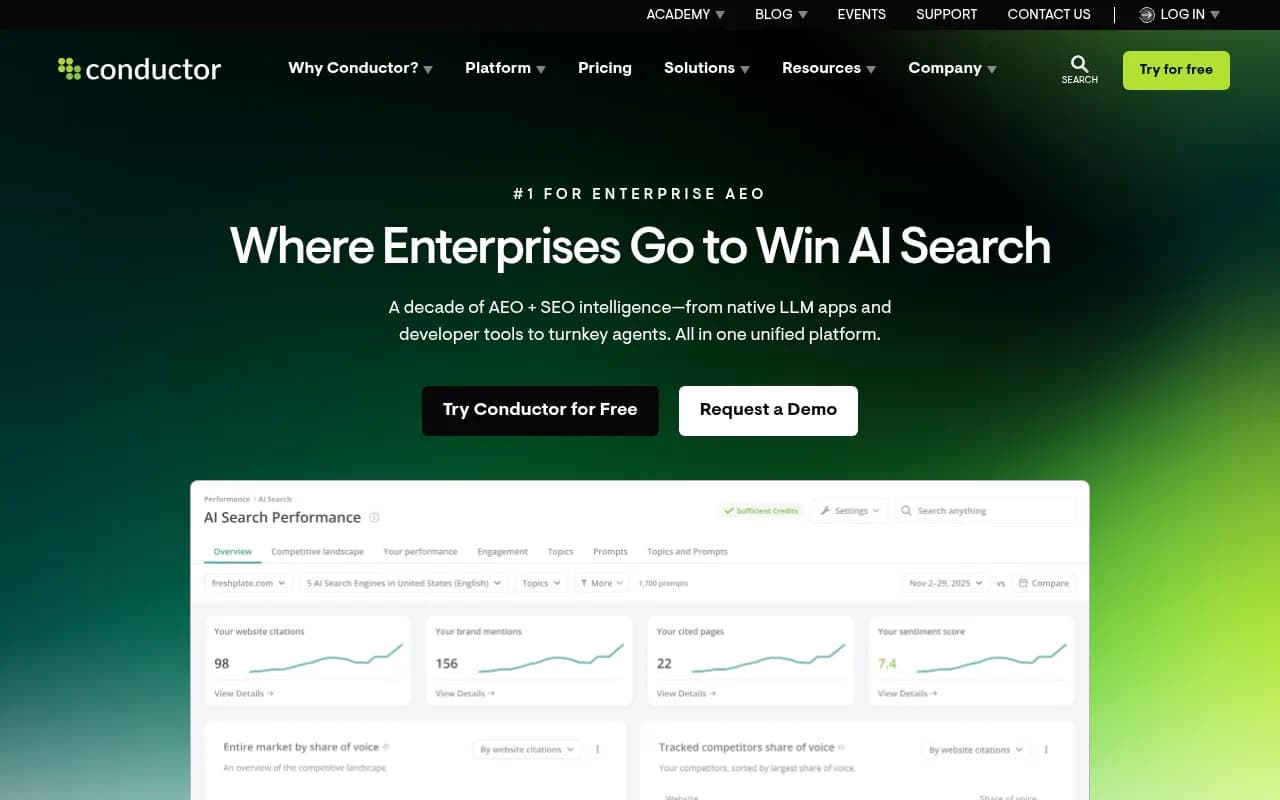
If none of these three fits your compliance profile, the field is wide. Enterprise-leaning alternatives in our catalog include Conductor, Botify, seoClarity and Adobe LLM Optimizer.
For more, the AI rank tracking directory at ai-rank-tools.com lists dozens of trackers across price tiers.
How to run the evaluation
A structured trial beats a feature checklist. Here is a process that works in about two weeks.
- Send the same security questionnaire to all three and compare answers, not logos. Request SOC 2 report type, ISO certificates, DPA and subprocessor lists.
- Pick 30 to 50 prompts you already know the answers to, including a few where AI says something wrong about you.
- Run them in each tool and compare the captured answers against what you see in the live interfaces yourself. Mismatch is your data-quality signal.
- Check crawler data against your own server logs for one week. Do the counts roughly agree?
- Check whether you can export raw responses and citations, and whether the API is in your plan.
- Ask what happens after a gap is found. Who writes and publishes the fix, and how do you measure that it worked?
The free AI visibility report and the 7-day trial on Promptwatch's monthly plans make step 2 cheap to try on one platform. Profound's trial covers 50 prompts on three engines for seven days. BrightEdge will likely require a sales conversation.
Bottom line
There is no single winner, and anyone telling you otherwise is selling something. Profound has the strongest published compliance stack for regulated industries and the biggest real-conversation prompt data. BrightEdge makes sense if you already live in its SEO suite and want ISO-heavy assurances. Promptwatch is the one to pick when you want every engine, the API and MCP without an enterprise contract, IP-verified crawler evidence, and agents that publish the fix. Check its ISO 27001 and GDPR position against your policy first, because SOC 2 and HIPAA are not on its published list.
Whatever you choose, get the reports in writing. Compliance claims on a web page are a starting point for the conversation, not the end of it.
If you also need hands-on help choosing or running a program, 1001 SEO Media works with Promptwatch for GEO and AI visibility work.