Key takeaways
- Coding agent visibility is how often Claude Code, Codex or Cursor recommends, installs or builds on your product. It is part of GEO, but it is measured differently from ChatGPT or Perplexity visibility.
- Hire an agency if your buyers are developers, you lack in-house SEO and docs capacity, and the agency can show actual selections and installs, not just mentions.
- Skip the agency, or start small, if you only need measurement. A platform plus one technical writer often covers it.
- The best vetting question: do you track Claude Code, Codex and Cursor separately, and do you measure build-versus-buy rates?
- Be skeptical of vendor-written agency rankings. Several of the top results for this topic are written by the companies they rank.
Why this question exists now
A developer opens a terminal and types "add payments to this app." The agent picks a library, writes the install command, and moves on. No search results page. No comparison tab. Your product was either in that plan or it wasn't.
That is the new buyer journey for developer tools, and it explains why agencies have started selling coding agent visibility as a service. Whether you need one is a fair question, because the field is young, the measurement is messy, and a lot of the marketing around it is written by people selling something.
This guide is for founders, marketing leads and developer relations teams at API, SDK, infrastructure and SaaS companies. If you sell to developers, read on. If your buyers never touch a coding agent, you can mostly skip it.
What coding agent visibility actually is
Coding agent visibility is how often an AI coding agent such as Claude Code or Codex recommends, installs, or builds on your product when a user asks it to plan or build software. Promptwatch's coding agent visibility guide frames it around four questions: is your product in the plan, is it the default, does the agent build instead of buy, and how does the agent describe you.
It is a subset of GEO, not a separate discipline. The same fundamentals apply: be easy to find, easy to read and easy to cite. What changes is the stakes. When an agent writes npm install your-package, your product becomes a dependency. Swapping it out later costs the developer time, and the tutorials, repos and forum threads that result feed the next generation of agents.
What the research says so far
Two third-party studies are worth knowing before you talk to any agency. Both are small and recent, so treat the numbers as directional.
- Amplifying's February 2026 study, "What Claude Code Actually Chooses," ran 2,430 open-ended prompts across 20 tool categories without naming any tool. In 12 of the 20 categories, the most common pick was a custom-built solution, not a third-party product. Defaults were close to monopolies in some places: GitHub Actions took 93.8% of CI/CD, Stripe 91.4% of payments, Vercel 100% of JavaScript deployment.
- Armature's September 2026 report compared Claude Code, Codex and Cursor. Claude Code built in-house in 19% of sessions, versus 10% for Codex and Cursor. The three agents chose the same tool only 42% of the time. Mentions and selections also diverged sharply: PayPal was mentioned 139 times and never selected, and LangChain was mentioned 194 times and chosen 4 times.
The same Armature report found Codex used web search in 94% of sessions, while Claude Code searched in roughly 30% overall. The implication is that Codex picks track the live web more closely, while Claude Code leans on model knowledge and moves more slowly.
A separate BotRank post argues Claude and Claude Code should be treated as separate visibility surfaces, citing only about 20% overlap in brand mentions for the same prompts. That post is vendor content and says itself that it does not establish causality. Useful signal, not gospel.
On the ChatGPT side, Promptwatch Data on the site: operator shows ChatGPT Search jumping from about 0.4% to about 17% of fanout queries on August 8, 2026. That is a different product from Codex, but it points the same direction: agents that search are increasingly searching specific sites, which makes your docs and canonical pages matter more.
What a GEO agency would actually do for this
Strip away the pitch decks and the work falls into four buckets.
- Measurement. Build a prompt set that reflects how developers ask agents for help, run it across Claude Code, Codex and Cursor, and report on mentions, selections and descriptions.
- Diagnosis. Figure out why you lose. Is the agent building custom code? Picking a competitor? Describing you with outdated facts? Can its crawlers even read your docs?
- Content and docs work. Fix the pages where evaluation happens: quickstarts, API references, comparison pages, pricing, changelogs.
- Off-site work. Get accurate mentions on the third-party pages agents retrieve from, such as GitHub, community threads, tutorials and review sites.
Notice that two of those four, diagnosis and docs work, need people who understand your product at a technical level. That is where agencies tend to struggle. A generalist GEO shop that is excellent at listicle placement may not know why your SDK quickstart fails to mention an install command.
When hiring an agency makes sense
I would lean toward hiring in these situations:
- Developers are your main buyers and you are already losing deals or signups to competitors that agents recommend by default.
- You have no in-house SEO or content team, and your docs are owned by engineers who have other priorities.
- You need coordinated work across docs, content, community and PR, and nobody owns it.
- You want an outside benchmark. Agencies that run this for several developer-tool clients see patterns you will not see from inside one company.
- You are in a category with a dominant default and need a deliberate plan to become the named alternative for specific use cases.
That last point matters. If Stripe owns 90% of payment picks, a realistic goal is not to unseat it. It is to be the agent's choice when the prompt mentions, say, marketplaces, usage-based billing or a particular region. An agency that promises category-wide dominance in a locked category is selling you something.
When you should not hire one
- You only need to know where you stand. Measurement is a software problem, not a services problem.
- Your coding agent exposure is small. If Claude Code and Codex are not part of how your customers evaluate tools, watch it and do not overinvest.
- Your docs are broken. No agency will fix a missing quickstart faster than your own engineers will.
- You are being sold a guarantee. Nobody controls what Claude Code picks. The BotRank report itself notes that rewriting pages is not proven to raise mentions.
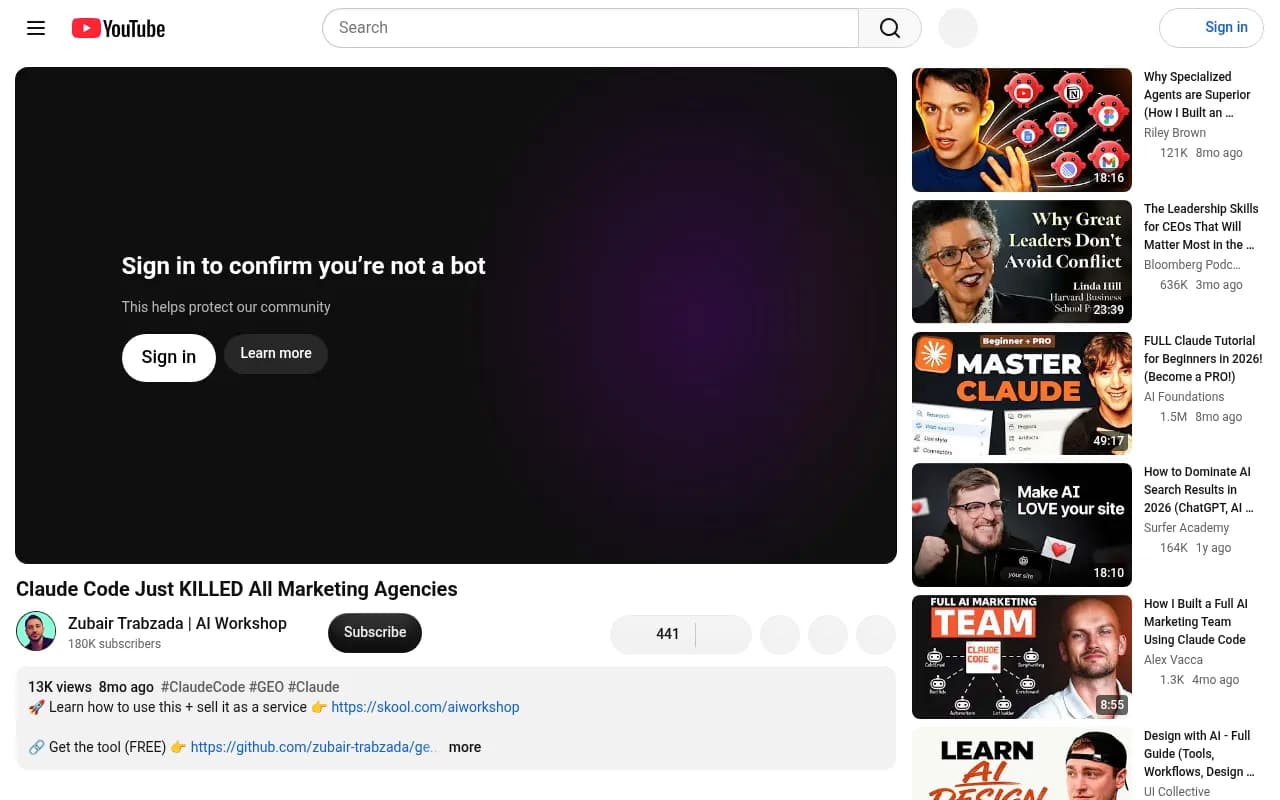
- The "agency" is mostly a Claude Code script. A YouTube walkthrough from February 2026 shows a free GitHub tool that runs a GEO audit in about 60 seconds and claims agencies charge $2K to $12K a month. Treat both the tool and the pricing claim with caution, but notice the signal: a generic audit is now nearly free. What you pay an agency for should be judgment and execution, not a checklist.
Be careful with agency rankings
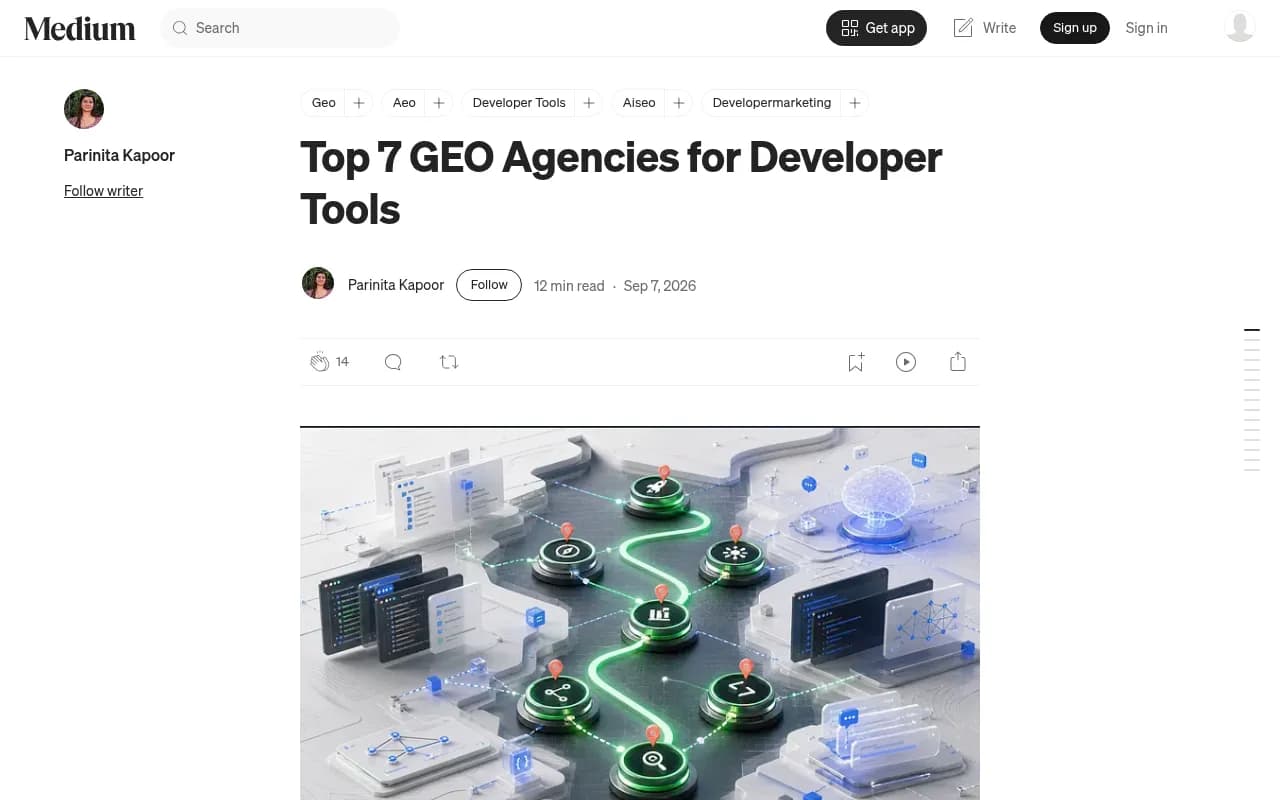
When you search for agencies, you will hit lists like "Top 7 GEO Agencies for Developer Tools" on Medium. That one puts Literally.dev first and praises it for measuring coding agents as part of its framework. It may well be a good agency. But it is a single-author list on a publishing platform, and it reads like a positioning piece: the "which should you choose" section is essentially a pitch for the number one pick.
A Reddit thread on the same question had the more useful advice: the agencies worth hiring can show actual work, meaning structured data audits, entity and citation building, and before-and-after coverage across a few assistants. Another roundup, "Best GEO Agencies (2026): 9 Ranked on Proof," makes a similar point that you tell good from bad by looking at the evidence.
So do your own diligence. Ask for work samples, talk to a developer-tool client, and verify the claims.
Questions to ask any agency
| Question | Good answer | Red flag |
|---|---|---|
| Do you track Claude Code, Codex and Cursor separately? | Yes, with separate reporting, since agents agree only about 42% of the time | "We track Claude" as one surface |
| Do you measure mentions or selections? | Both, plus install behavior where observable | Mentions only |
| Do you measure build-versus-buy? | Yes, custom-built solutions are a named competitor | Never heard of it |
| How do you handle category defaults? | Target specific use cases where you can be the alternative | Promise to displace the default |
| Can you show before/after work? | Named examples with prompts and dates | Screenshots of a dashboard score |
| Who writes the docs changes? | A technical writer or engineer on their side, or a clear handoff to yours | "We will rewrite your homepage" |
| What do you do about Claude Code's slower knowledge updates? | Distinguish training-data effects from live retrieval | One strategy for every agent |
| What does the contract look like? | Monthly, with clear deliverables | Long lock-in with vague scope |
The in-house alternative: software plus a small team
For many developer-tool companies, the right answer is measurement software and one or two people who own docs and content. The software handles the tracking. The people handle the judgment.
Promptwatch is one option that tracks Claude Code and Codex, along with ChatGPT, Gemini and Perplexity, using the same visibility, sentiment and competitor metrics across them. It also has IP-verified AI crawler logs, which help you tell an access problem from a content problem, and a coding agent visibility guide that walks through the four questions above.

If you want to compare alternatives before committing, the GEO software directory at bestgeosoftware.com lists dozens of tools. Be aware that most monitoring tools focus on chat assistants, so check explicitly whether a given tool covers coding agents before you buy.
| Option | What you get | Best for | Watch out for |
|---|---|---|---|
| Specialist GEO agency | Measurement, diagnosis, content and off-site work | Teams with no SEO or content capacity | Vendor-written rankings, vague guarantees |
| Generalist SEO or GEO agency | Broad AI search programs | Companies where coding agents are a small slice | Weak technical and docs depth |
| Software plus in-house owner | Ongoing tracking, you control execution | Teams with a technical writer or DevRel | You need someone with the time |
| DIY scripts and free audits | A one-time snapshot | Early-stage curiosity | No tracking over time, no coding agent data |
A practical way to decide
Here is the process I would follow.
- Spend a week measuring yourself. Pick 30 to 50 prompts developers would plausibly give an agent, run them through Claude Code and Codex, and note whether you appear, get installed, or get replaced by custom code. A tool will do this at scale, but even a manual pass is informative.
- Classify your losses. Is it custom-built solutions? A specific competitor? Wrong facts about you? Unreadable docs?
- Check crawler access. If AI bots are being blocked or erroring on your docs, fix that first. It costs nothing and no agency should charge for it.
- Decide what you cannot do alone. If the gap is docs and content you can staff internally, do it. If it is cross-channel work you cannot cover, shop for help.
- Run a short pilot. Three months, monthly contract, clear metrics: selection rate on a fixed prompt set, accuracy of how agents describe you, and AI-referred signups.
If you do end up hiring for the broader AI search side, an agency like 1001 SEO Media covers technical SEO, content and generative engine optimization with no long-term contracts. Whoever you pick, apply the same questions from the table above.
What good results look like
Calibrate expectations. In categories with a locked default, good looks like appearing as the named alternative for specific use cases. In newer categories, good looks like being in the plan by default. Across the board, good looks like agents describing your product accurately, including current pricing, install steps and capabilities.
Also watch the long game. Because install decisions leave artifacts, such as repos, tutorials and forum answers, early wins compound. That argues for starting measurement now even if you hold off on a retainer.
The bottom line
Hire a GEO agency for coding agent visibility only if it can prove it measures what matters: selections over mentions, each agent separately, build-versus-buy, and accuracy of description. If you mainly need visibility into where you stand, buy software and give one technical person ownership. The evidence base is thin, the studies are a few months old, and no one can guarantee what Claude Code will pick. Start with a measured baseline, fix your docs and crawler access, and pay for outside help only for the gaps you cannot close yourself.