Key takeaways
- Approval bottlenecks rarely come from the content itself. They come from undefined ownership, scattered feedback across Slack/email/texts, and missing deadlines.
- A 2025 West Monroe survey of 214 C-suite executives found 73% of leaders believe their company loses up to 5% of annual revenue to slow decision-making, what the study calls the "Slowness Tax."
- The fix isn't fewer reviews, it's matching review depth to actual risk: routine posts need one quick check, promotional or regulated content needs more eyes, but almost nothing needs five.
- Version-specific approval (locking content after sign-off) and a named backup approver eliminate the two most common causes of stalled posts.
- Dedicated approval features inside tools like Planable, HeyOrca, and Sprout Social close gaps that generic scheduling tools leave open, but the workflow design matters more than the software you pick.
Why social media approval breaks down in the first place
Most teams don't struggle with ideas or talent. I've watched well-staffed content teams with strong writers and sharp designers still miss their publishing windows, and it's almost never because the creative work was bad. It's because the post sat in limbo after it was finished.
Someone approved it in a Slack thread. Somebody else left a comment on a Google Doc version that was already outdated. A third person texted "looks good, just fix the typo" without saying which typo. Nobody actually knows if the post is ready to go live, so it just... doesn't.
That in-between stage, where content gets reviewed, questioned, revised, and eventually signed off, is where most organizations lose control of their publishing calendar. It rarely looks broken from the outside. Reviews are happening. People are responding. But the responses don't converge into a decision, they just pile up.
Social media makes this worse than most content types because the clock is louder. A blog post that slips a week is annoying. A social post tied to a product launch, a trending topic, or a time-sensitive offer that slips a week is often just dead. You can't publish "breaking news" three days late and call it a win.
The real cost of a slow approval loop
This isn't just a workflow annoyance, it shows up on the balance sheet. West Monroe's "Speed Wins" study, fielded in November 2025 across 214 C-suite executives and 1,000 managers at companies with $250M+ in annual revenue, found that nearly three in four leaders estimate their organization loses up to 5% of annual revenue to slow decision-making and delayed execution. About half of respondents put the figure at 4% or more. Social content approval is a small slice of that, but it's the same pattern playing out at a smaller scale: decisions sitting in queues because nobody owns the "go/no-go" call.
For a community manager, the cost shows up differently. When posting goes quiet or becomes erratic because approvals stalled, your audience notices, even if they can't articulate why. Consistency is what tells people a brand's social presence is actually active. A broken approval process doesn't just slow your team down, it makes the account look abandoned at random intervals.
The four types of approval workflows (and matching one to your team)
Not every team needs the same level of process. Posteverywhere's 2026 breakdown of approval tooling groups workflows into four tiers, and picking the wrong one for your size is a common mistake:
- Self-review — a solo creator or two-person team checking their own work before posting. No dedicated software needed, just a checklist.
- Single approver — one editor or content lead signs off before anything goes live. This covers most small-to-midsize teams fine.
- Multi-step approval chain — draft, then content lead, then brand or legal, then publish. Common in regulated industries (finance, healthcare) or large consumer brands where a single mistake is expensive.
- External client approval — agencies need a way for a client to review visual mockups and approve content without needing a login to the internal scheduling tool.
The mistake most teams make is applying tier 3 rigor to every post, including the routine ones. If your weekly "happy Friday" meme goes through the same four-person sign-off as your CEO's crisis statement, you've built a system that guarantees delay.
A workflow model you can copy
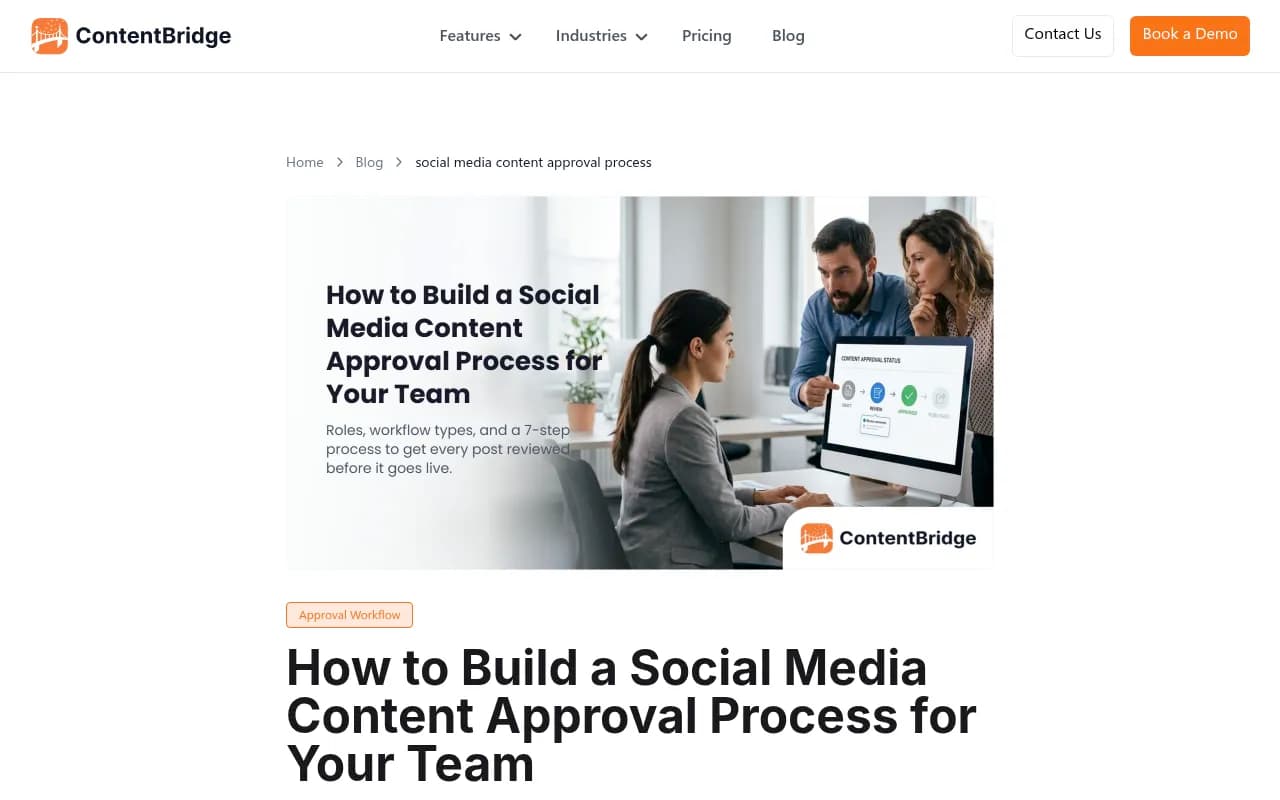
A useful, more granular model breaks the pipeline into eight named statuses, each with a specific owner and a clear "exit condition" before the post can move forward:
| Status | Owner | Exit condition |
|---|---|---|
| Brief approved | Content lead | Brief includes CTA, link, publish date, and source material |
| Draft | Creator | First version written to brief |
| Internal review | Editor | Copy, brand voice, and visuals checked |
| Required review | Subject-matter or compliance reviewer (if applicable) | Facts, claims, and regulatory language confirmed |
| Changes requested | Reviewer | Feedback consolidated into one note, not scattered comments |
| Approved | Named final approver | Sign-off recorded against this specific version |
| Scheduled | Publisher | Post locked, no further edits allowed |
| Published | Publisher | Live on the platform |
The detail that makes this work isn't the number of stages, it's that each stage has exactly one owner and a defined condition for moving forward. When status changes depend on "whoever gets to it," the queue grows invisibly until a post is too late to run. One workflow guide puts it bluntly: "A publishing date without a review deadline is not an approval workflow. It is a future emergency."
Matching review depth to risk, not habit
The single biggest lever for speed is tiering review by risk level instead of treating every post the same:
- Routine content (evergreen tips, recurring templates): creator self-check plus one delegated reviewer. No committee.
- Promotional content (offers, discounts, launches): brand reviewer checks tone, and the offer owner verifies the price, link, and expiration date specifically.
- Technical or expert content: a subject-matter reviewer checks accuracy, then one final approver signs off.
- Sensitive or regulated content: specialist plus executive review, and sometimes the honest answer is that it shouldn't publish at all.
- Partner or client content: internal review happens first, then it goes to a named external approver with an explicit deadline, never "the client team" as a vague group.
Sprout Social's own guidance on this echoes the point: approvals should protect the brand, not bottleneck it. Tie your required review layers to a prioritized risk list so a low-stakes post doesn't get stuck behind the same gate as a legal disclosure.
Five practices that actually remove the bottleneck
Centralize feedback on the post itself
The number one reason approval breaks is feedback living in five different places at once. Comments in Slack, a reply-all email thread, a text message, a note scrawled in a shared doc. Nobody can tell which version is actually final. Keep every comment, revision, and sign-off attached directly to the post. If your current tool treats approval as an afterthought bolted onto scheduling, that's usually the root problem, not your team's discipline.
Lock content after approval
Once a post gets final sign-off, nobody should be able to edit the copy, swap the image, or change the link without triggering a new review. If someone tweaks the caption after approval, the version going live isn't the version anyone actually reviewed. That's not just sloppy, in regulated industries it's a compliance gap. Approval should be version-specific: a changed CTA, a new claim, or an edited link invalidates the prior sign-off and requires a fresh look.
Name a backup approver
If your only approver is out sick or on a plane, content shouldn't sit for four days. Every approval stage needs a named primary and a named backup, with clear rules for when the backup takes over.
Set a response window, not an open-ended request
"Let me know when you get a chance" is how approvals die. Replace it with a specific window: feedback due within 24 or 48 hours, escalation triggers automatically if nothing comes back. For agencies managing client sign-off, batching posts into a weekly or biweekly review round works better than sending individual requests as content gets finished, since it gives the client one focused block of time instead of constant interruptions.
Send a complete decision package
Reviewers who get a caption with no link, no publish date, and no context will ask questions that create another round-trip. Every review request should include the full post as it will appear, the destination link, the scheduled date, and any source material the claim is based on. Incomplete packages are one of the most avoidable causes of extra revision cycles.
Where dedicated approval tools help (and where they don't)
A generic scheduling tool with a "leave a comment" feature isn't the same as a tool built around approvals. Here's roughly how the major social media management platforms handle it, based on current vendor pricing and third-party comparisons:
| Tool | Approval depth | External client access | Entry price for approval features |
|---|---|---|---|
| Planable | Deep multi-step chains, lock-after-approval, 2-3+ approval types by tier | Yes, no login required for reviewers | Free for 50 posts; Basic from $33/workspace/mo |
| HeyOrca | Custom approval workflow, visible status at a glance | Yes, link-based review | Basic $59/calendar/mo (unlimited users on every paid tier) |
| Sprout Social | Multi-step approval across all paid tiers | Up to 3 external approvers free on Advanced plan | Essentials $79/user/mo |
| Hootsuite | Multi-step, role-based, legal/compliance routing | Yes | Approval depth gated to Enterprise (custom pricing) |
| SocialPilot | Approval workflows plus white-label client reports | Limited | Premium tier $100/mo flat |
| Sendible | Client approvals, white-label portal | Yes | Plus plan from $84/mo annual |
A few things worth noting before picking one. HeyOrca's unlimited-user pricing is a real differentiator if your reviewers aren't full-time seats, since competitors often charge per user. Sprout Social's free external-approver slots on its Advanced plan matter if you regularly need client or legal sign-off without buying them a license. Hootsuite's approval tooling is genuinely strong, but it's locked behind Enterprise pricing, so budget for that before assuming it fits a small team. Vendor pricing pages are also inconsistent across sources (several third-party comparisons cite different numbers for the same Hootsuite and Agorapulse tiers), so verify current pricing directly with the vendor before committing.
For teams that want approvals built into a broader content operation, including drafting and distribution rather than just scheduling, a platform like [tool:storychief] folds AI-assisted drafting and multi-channel publishing into the same workflow, which can cut down on the handoffs between your writing tool and your approval tool.
What this looks like once it's actually fixed
Teams that get this right don't describe it as "fewer approvals," they describe it as approvals that stop feeling like a separate task. The post, the feedback, the approval status, and the publish schedule live in one place instead of four. Reviewers know exactly what's waiting on them and by when. Creators aren't guessing whether a thumbs-up emoji in Slack counts as final sign-off.
The goal was never zero review. It's matching the weight of the review to the actual risk of the post, giving every stage a single owner, and making sure a decision that's already been made can't quietly unravel because someone edited a caption after the fact. Get those three things right and the rest of the bottleneck tends to disappear on its own.