Key takeaways
- Real estate GEO has two different buyers: a brokerage or individual agent who needs to be named in local answers, and a portal or marketplace that needs listing and market pages cited at scale. Tools fit one or the other better.
- Tracking alone does not move anything. Pick a platform that shows which pages get crawled and cited, and helps you fix gaps.
- In Promptwatch's data (Sep 28 to Oct 4, 2026), product pages and landing pages earn about 39% of ChatGPT citations. For real estate, think listing, neighborhood and service pages.
- Do not build a strategy on Reddit for ChatGPT. Its share fell from about 4% to about 0.5% in August 2026.
- Agencies are an option, but many agency lists are written by agencies ranking themselves. Check the methodology.
Why real estate needs its own GEO approach
People ask ChatGPT, Gemini and Perplexity things like "best neighborhoods for young families in Austin" or "who is the best listing agent near me" and get two or three names back. First Page Sage cites a realtor.com survey claiming 82% of Americans use AI for housing market information and property shopping. I would treat that number as directional, but the behavior is clearly real.
Real estate is odd for GEO in three ways.
First, the category is dominated by portals. Onely notes that the top searches in the category are dominated by Zillow, Redfin and similar giants. If you are an individual brokerage, you are competing with them for citations, so you need to win the questions they handle badly: hyperlocal, opinionated, current.
Second, the data is local. Business name, address and phone consistency, Google Business Profile and reviews matter more here than in most industries. One agency's own marketing claims that mismatched NAP data excludes a large share of businesses from AI answers. That figure comes from a vendor page, so take it as a reason to audit your data, not as a proven statistic.
Third, the buyer differs. Onely's research found that when you ask AI engines for the best real estate SEO agency, the answers are written for an individual agent, and 7 of the 17 providers surfaced sell a website or CRM. Brokerage networks, portals, developers and proptech brands barely appear. If that is you, advice built for agents will mislead you.
What a real estate GEO tool needs to do
Before comparing products, decide what job you are hiring the tool for. I would score every candidate on these:
- Real AI interface tracking, not just API calls. Answers shown to users can differ from API output.
- Location tracking. A prompt like "best realtor in Tampa" gives different answers depending on city, so country-only tracking is thin for local agencies.
- Competitor and portal tracking, so you can see when Zillow, Redfin or a local rival takes the slot.
- Citation source data: which of your pages are cited, and which third-party pages (reviews, local news, directories) are cited instead.
- Crawler visibility. If AI bots hit errors on your listing pages, nothing else matters.
- A path from insight to action, whether that is content briefs, a to-do list or publishing.
What AI actually cites: the content types
Promptwatch Data's analysis of ChatGPT citation share by content type (Sep 28 to Oct 4, 2026) is the most useful frame I found for real estate teams, even though it is cross-industry.
| Content type | Share of ChatGPT citations |
|---|---|
| Product pages | 22.4% |
| Landing pages | 16.8% |
| Listicles | 13.6% |
| How-tos | 8.7% |
| Documentation | 7.5% |
| General articles | 6.1% |
| Comparisons | 5.9% |
| News | 5.7% |
| FAQ pages | 3.3% |
| Reviews | 1.7% |
The mapping to real estate is my inference, not a finding from the report. Listing pages and service pages are your product and landing pages. Neighborhood guides and market reports are your listicles and how-tos. Commercial prompts, where people compare options, lean even harder on product pages (26.0%), landing pages (20.6%), listicles (15.0%) and comparisons (7.9%).
Two more data points matter for planning. Promptwatch's content half-life report found that news pages lose half their citations within about 36 days, while landing pages and docs last longer. So a monthly market-update post is a short-lived asset, while a well-built neighborhood or service page keeps earning. And the travel citation report shows booking and search sites taking more than half of ChatGPT's travel citations, a decent analog for how portals dominate property prompts.
The best GEO tools for real estate in 2026
Promptwatch
Promptwatch is the one I would put first for brokerages with multiple offices and for portals, mainly because it goes past monitoring. It tracks real interfaces (ChatGPT, Google AI Overviews, AI Mode, Gemini, Perplexity, Copilot and more), with state and city tracking on the Business plan, which matters when your prompts are "agent in [city]".

The parts that matter for property businesses:
- IP-verified AI crawler logs show whether bots can actually read your listing and neighborhood pages, and where they hit errors. Portals with heavy JavaScript or aggressive bot blocking often have this problem without knowing.
- Citation and page-level data shows which pages get cited, so you can see whether it is your market guide or someone else's.
- Content gap analysis and the Content Agent can plan and publish GEO-focused pages to WordPress, Webflow or Framer, then track whether they get crawled and cited. Many real estate sites run on WordPress, so that fits.
- Prompt volumes, difficulty scores and query fan-outs help you choose which local questions are worth chasing.
Plans run from a free Explore tier to Essential at $95/month, Business at $579/month, and agency plans from $199/month. Confirm current numbers at promptwatch.com/pricing.
Birdeye Search AI
Birdeye is built around local visibility with location-level tracking, which suits a multi-office brokerage that cares about reviews and per-location presence. If your biggest gap is reviews and local profiles rather than content, start here.
Profound
Profound is an enterprise AI visibility and analytics platform. It is a reasonable pick for a large portal with a budget and an analyst team, though it costs more and is monitoring-led.

Peec AI
Peec AI is a cleaner, cheaper tracker. Good for an individual agent or small team that wants to see mentions and competitors without an enterprise contract. Expect less on crawlers, traffic attribution and content production.

Otterly.AI
Otterly.AI is affordable monitoring. It answers "are we mentioned?" fine. It will not tell you why not.

Semrush and Ahrefs Brand Radar
If your team already lives in Semrush or Ahrefs, their AI modules are convenient for a first look. They are add-ons to SEO suites, so prompt sets and AI-specific depth are shallower than purpose-built platforms.

Botify
For large portals with millions of listing URLs, technical crawl management comes first. Botify is an enterprise technical SEO platform with AI search optimization, useful when your problem is crawl budget and rendering rather than content.
WordLift and InLinks
Schema and entity work matters for listings, agents and neighborhoods. WordLift and InLinks automate structured data and entity-based internal linking. I have not verified real-estate-specific schema support in either, so test on a small set of pages first.

Comparison table
| Tool | Best for | Crawler visibility | Local/city tracking | Content action |
|---|---|---|---|---|
| Promptwatch | Brokerages, portals, agencies | Yes (IP-verified logs) | City/state on Business | Content Agent, Action Board |
| Birdeye Search AI | Multi-location local brands | Limited | Location-level | Reviews and profiles |
| Profound | Large enterprise portals | Check with vendor | Check with vendor | Mostly monitoring |
| Peec AI | Individual agents, small teams | No | Check with vendor | Suggestions |
| Otterly.AI | Budget monitoring | No | Basic | None |
| Semrush / Ahrefs | Teams already in these suites | No | Limited | Via the SEO suite |
| Botify | Huge listing inventories | Technical crawl focus | n/a | Technical fixes |
I left cells as "check with vendor" where I could not confirm details. Verify before you buy.
Which tool for which team
Individual agent or small team
You probably do not need an enterprise platform. Start with a free scan, then a low-cost tracker such as Peec AI or Promptwatch's Essential plan. Spend more of your effort on your Google Business Profile, consistent business data, recent reviews and pages that state plainly who you are, where you work and what you have sold. That is what local answers quote back.
Multi-office brokerage
You need per-market views. A single national visibility score hides the fact that you may be strong in Dallas and absent in Phoenix. Pick a tool with city-level tracking and put reviews tooling alongside it.
Property portal or marketplace
Your risks are different: bots blocked or erroring on listing pages, thin duplicated neighborhood content, and competitors with stronger brand. Crawler logs, page-level citation data and technical crawling matter more than prompt counts. Think of how Skyscanner and Tripadvisor win travel citations: they are the answer to the booking intent. Your pages need to be that for housing intent.
Agency managing several clients
Look for white-label reporting and unlimited projects. Promptwatch's agency plans and Search Party are aimed at that. Browse the wider field at the GEO software directory.
A word on real estate GEO agencies
Several published lists rank agencies for real estate. First Page Sage ranks itself first of 47 agencies it reviewed, with Siana Marketing, Genevate, Luxury Presence, Real Estate Webmasters, Agent Image, Dakno Marketing and Union Street Media following. Bulletproof's list ranks Bulletproof first. Onely's research page ranks no one, and says plainly that it is biased and best for international portals and brokerage networks, not single agents.
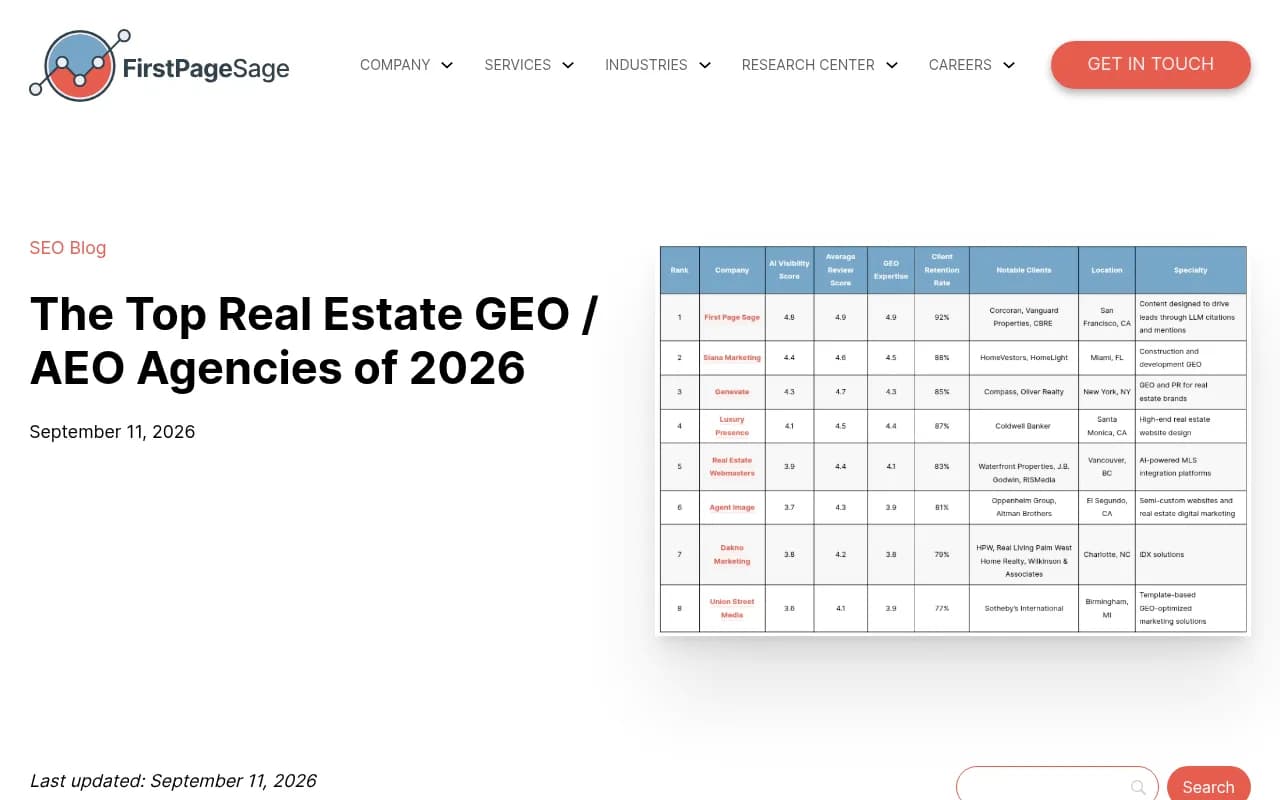
The pattern is obvious: nearly every list is published by a vendor in it. I did not verify any of their claims. Onely's five checks are the best part of that material:
- Is the agency built for a real estate company or for an agent?
- Does it work on the questions buyers ask before they ask who to hire?
- Can it show proof from a company like yours, with a result and not a logo?
- How does it measure each market on its own?
- What does its price depend on?
If you want an agency partner with AI search focus, 1001 SEO Media covers technical SEO, content, digital PR and GEO, and uses Promptwatch for AI visibility measurement. Whoever you hire, ask to see the tracking data, not a slide.
A practical 30-day plan
- Week 1: write 30 to 50 prompts that real buyers, sellers and renters would ask, split by city and by intent ("best agent", "is X neighborhood safe", "compare Y and Z"). Run them in a tracker and record who gets named.
- Week 2: check crawler access. Make sure AI bots are not blocked by robots.txt or your CDN, and that listing and neighborhood pages render without scripts.
- Week 3: fix the foundation. Align name, address and phone everywhere, tidy the Google Business Profile, and request fresh reviews.
- Week 4: publish or refresh the pages that match what gets cited: neighborhood landing pages, service pages, FAQs, and honest comparison pages. Add structured data.
- Then repeat monthly and check whether the new pages were crawled, cited, and drove visits.
What not to do
Do not lean on Reddit for ChatGPT visibility. Promptwatch's Reddit data showed reddit.com holding about 3.83% of ChatGPT citations until early August 2026, then falling to about 0.52% after August 14. Promptwatch calls the size of the drop provisional, but the direction is clear. Google's surfaces declined more gradually. Social platforms overall are a minor source for ChatGPT, per the October 2026 social citation report, where ChatGPT drew 0.46% of citations from social and AI Overviews drew 12.2%. If you invest in social for AI visibility, the payoff is more likely in Google's surfaces.
Also avoid stuffing every neighborhood page with templated text. Thin, duplicated pages are the easy way for a portal to lose citations to a small local site with real opinions.
Bottom line
If you are a single agent, a cheap tracker plus disciplined local basics will get you most of the way. If you run a brokerage network or a portal, pick a platform that shows crawler behavior and page-level citations and helps you act on them. Promptwatch is the one I would shortlist first for that, with Birdeye alongside it for review-heavy local work. For more options, see the directory of AI rank tracking tools.