Key takeaways
- A clinic needs a GEO tool that tracks local, treatment-specific prompts ("emergency dentist near me", "same-day crowns") and shows which pages and third-party sources AI actually cites.
- Healthcare citations are spread thin. In Promptwatch Data's report for Sep 9 to Oct 8, 2026, the top 20 domains earned only 15.54% of ChatGPT healthcare citations, so the long tail is where small practices compete.
- Tracking-only tools are cheap and fine for a single-location practice. Multi-location groups should look at local-first or enterprise platforms, and anyone without in-house marketing staff should weigh an agency.
- Treatment pages, FAQ pages, complete profiles and evidence-backed medical claims matter more than any tool feature.
- Verify every price on the vendor's own site. Third-party roundups of GEO pricing go stale quickly.
Why clinics need GEO in the first place
A patient breaks a molar at 9 PM. They are less likely to scroll through ten blue links than to ask ChatGPT or Gemini who to call. The answer is often a short list of two or three practices. If yours isn't on it, you never knew the patient existed.
Dental and medical searches are specific and local. "Does this dentist take my insurance?" "What does a sedation appointment involve?" "Which clinic nearby does Invisalign?" Each question pulls from different sources, and a clinic that ranks well in Google can still be invisible in AI answers.
GEO (generative engine optimization, sometimes called AEO) is the work of making your practice readable, trustworthy and citable for those AI systems. Software helps you measure it, and some of it helps you act on it. None of it replaces having good pages.
What AI actually cites for healthcare prompts
Before picking a tool, it helps to know what you are optimizing for. Promptwatch Data's healthcare citation report covers organic healthcare prompts in ChatGPT (treatments, medications, insurance, finding care) from Sep 9 to Oct 8, 2026.
- NIH is the top source at 5.46% of citations, spread across six nih.gov subdomains. PubMed Central (2.38%) and PubMed (2.33%) follow.
- The FDA is second at 1.76%, and the NHS is third at 1.1%.
- Government and public health sites earn 7.06% overall. Hospitals and clinics earn 0.89%. Reviews and directories earn 0.46%.
- The top non-government site is the American Society of Plastic Surgeons at 0.64%, then the American Academy of Dermatology at 0.54%. Those two associations together earn more than Mayo Clinic and Cleveland Clinic combined.
- The top 20 includes no dentist-specific domains, such as the ADA.
Two things stand out to me. First, health is a trust-heavy category, so AI leans on institutions. Second, the top 20 is only 15.54% of the total, which means the remaining 84% is a long tail where individual practices, local directories and specialty bodies can show up. That is your opening.
Note the data is a US and UK mix (nhs.uk, cqc.org.uk and boots.com appear), so non-US clinics should treat it as a pattern, not a local benchmark.
Which of your pages get cited
In Promptwatch's ChatGPT content type data for Sep 28 to Oct 4, 2026, product pages earned 22.4% of citations, landing pages 16.8%, listicles 13.6%, how-tos 8.7% and FAQ pages 3.3%. For a clinic, treatment and service pages are your product and landing pages. For branded prompts like "is [clinic] good", reviews rise to 5.6% and FAQ pages to 4.8%.
Page lifespan matters too. Promptwatch's content half-life data shows news pages lose half their citations in about five weeks, while landing pages and docs stay cited for months. Evergreen treatment pages beat occasional news-style blog posts.
Social profiles depend on the engine
According to Promptwatch's social citation data (Sep 28 to Oct 4, 2026), social platforms make up just 0.46% of ChatGPT citations but 12.2% of Google AI Overviews citations. In AI Overviews, YouTube is 4.28% and Facebook 2.38%, with Instagram at 1.61%. If your patients use Google, a YouTube video explaining a procedure and active Facebook and Instagram profiles are worth the effort.
What to look for in a GEO tool for a clinic
Most GEO software was built for SaaS and ecommerce. A few things matter more for clinics than the feature lists suggest.
- Location-level tracking. "Best dentist" means nothing without a city. You want prompts tested from your service area, not just nationally.
- Treatment-level prompts. Track implants, orthodontics, emergency care, specific procedures, plus insurance and cost questions.
- Citation sources. You need to see which directories, review sites and association pages AI pulls from, so you know where to get listed.
- Competitor visibility. Patients get two or three names. Knowing who gets them in your area is the whole game.
- Action, not just reporting. A dashboard of mention counts does nothing for a practice manager with no spare hours.
- Honest data. Real AI interface tracking tends to differ from API outputs, and patients use the interfaces.
Best GEO tools for dental and medical clinics
I did not test every product below hands-on. Capabilities come from vendor positioning, and pricing changes often, so confirm plans on each vendor's site.
Promptwatch for clinics that want to act on the data
Promptwatch tracks the real interfaces of ChatGPT, Google AI Overviews, Google AI Mode, Gemini, Perplexity and Copilot, by country (and by state or city from the Business plan). For a clinic, the useful parts are the Answer Gap style content analysis, the Action Board with prioritized to-dos, and the citation reports showing which directories and third-party pages AI uses. The Content Agent can draft and publish treatment and FAQ pages to WordPress, Webflow or Framer, with a review inbox so a clinician can approve everything before it goes live.

Plans start with a free Explore tier (10 prompts, ChatGPT only) and paid Essential at $95/month for 50 prompts and all models. Agencies serving several practices can look at the Kick-off, Growth and Scale plans. Confirm current pricing at promptwatch.com/pricing. Medical content still needs clinical review, no matter who or what drafts it.
Birdeye Search AI for local and multi-location practices
Birdeye comes from the reviews and reputation world, which suits healthcare, and its Search AI product focuses on location-level visibility. If you run several clinics and already manage reviews there, it is a logical place to start.
Semrush AI Visibility Toolkit for teams already in Semrush
If your marketing person or agency already lives in Semrush, adding the AI toolkit avoids a new login and a new invoice. The tradeoff is that traditional SEO suites tend to have fixed prompt sets and shallower AI-specific data.
Profound for large health systems
Profound is built for enterprise brands. That fits hospital networks and large groups with a dedicated team. It is more than a single-dentist practice needs. A third-party roundup listed starter pricing from $99 and a Growth tier at $399, but I could not verify that, so check the vendor page.

Otterly.AI and Peec AI for budget monitoring
Both are straightforward prompt trackers. If you only want to know whether your practice is mentioned and how competitors compare, they are cheap ways to start. Neither will tell you why you are missing or fix it.


Ahrefs Brand Radar for SEO-savvy teams
Good if you already use Ahrefs for backlinks and keywords and want AI mentions in the same place.

Other options worth a look
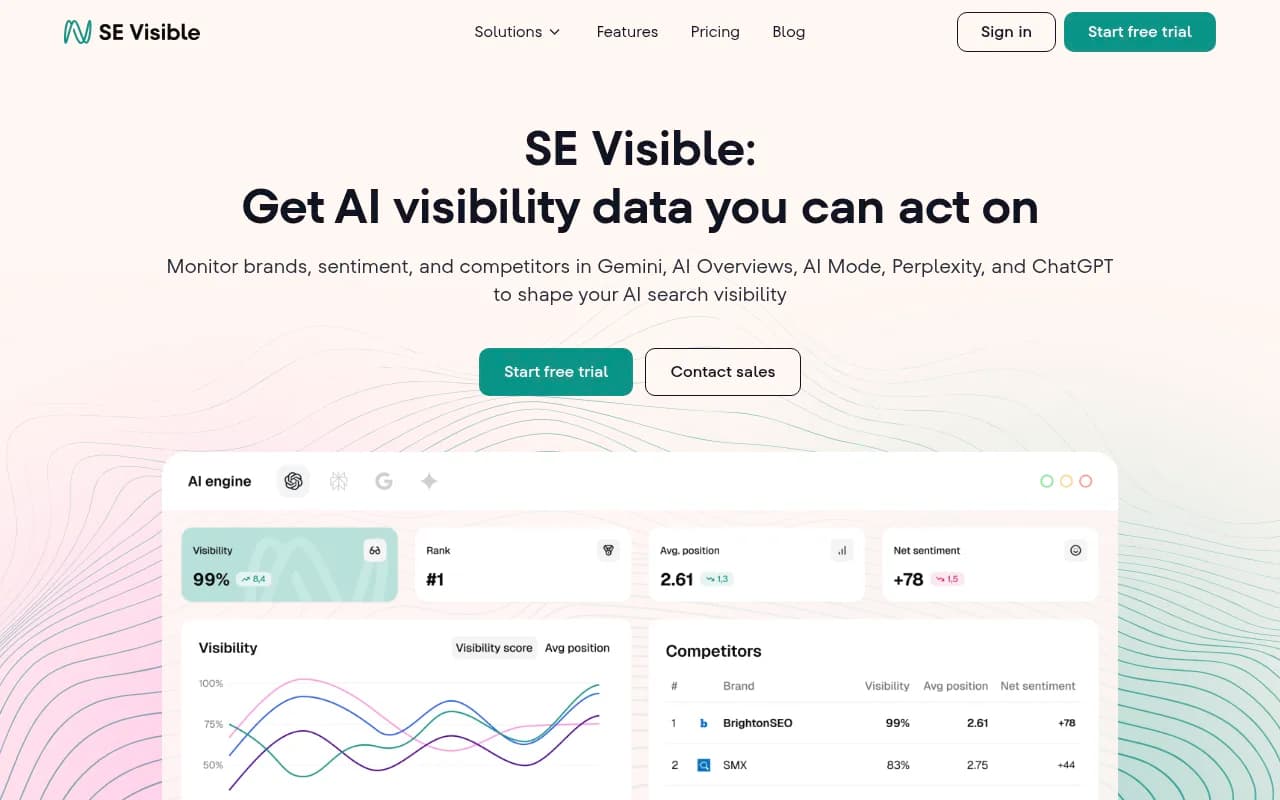
AthenaHQ and Scrunch AI are monitoring-focused platforms with agency-friendly setups. SE Ranking Visible suits small teams that want a lighter product.


For more options, the GEO software directory at bestgeosoftware.com lists many more platforms, including some I haven't covered here.
Comparison table
| Tool | Best for | Local or location tracking | Helps create content | Typical fit |
|---|---|---|---|---|
| Promptwatch | Single practices to groups that want to fix gaps | Country on all paid plans, state/city from Business | Yes, with CMS publishing | Small to mid-size practices, agencies |
| Birdeye Search AI | Multi-location, review-led groups | Location-level | Limited | Multi-clinic groups |
| Semrush AI toolkit | Teams already using Semrush | Varies by plan | Via the wider suite | SEO-led teams |
| Profound | Enterprise health systems | Tier-dependent | No | Hospital networks |
| Otterly.AI / Peec AI | Basic monitoring on a budget | Limited | No | Solo practices |
| Ahrefs Brand Radar | Teams with an Ahrefs workflow | Limited | No | SEO-led teams |
What to do with the data: a clinic checklist
Tools only measure. The work happens on your site and across the web.
- Build one strong page per treatment. Cover what it is, who it is for, cost ranges, recovery, insurance and who performs it, since service pages map to the most-cited content types.
- Add an FAQ page covering common questions about your practice, including insurance and booking.
- Back medical claims with peer-reviewed studies, linked on PubMed or PubMed Central, and keep pages consistent with FDA, CDC, NHS or NICE guidance as relevant. This follows Promptwatch's own recommendations from the healthcare data.
- Work with your specialty's medical association. Those bodies out-earn big hospitals in the citation data.
- Keep Doctify and WebMD doctor profiles complete. They are the only review and directory sites in the healthcare top 20, at 0.23% each.
- Collect reviews on the platforms patients trust, and keep Google Business Profile and directory details identical everywhere.
- Check that AI crawlers can actually read your site. A tool with crawler logs, or a simple robots.txt review, catches accidental blocks.
- Publish a short video for each major procedure if Google-driven patients are a priority.
Compliance and YMYL cautions
Health is a YMYL (your money or your life) category, so be careful. I did not research HIPAA specifics for individual tools, so ask each vendor directly before connecting anything that touches patient data. In practice, GEO tools monitor public AI answers and your public pages. They should not need patient records, and you should not paste any into them.
If AI-generated drafts go on your site, have a licensed clinician review them. A confidently wrong claim about a medication or procedure hurts patients and your reputation.
When an agency makes more sense
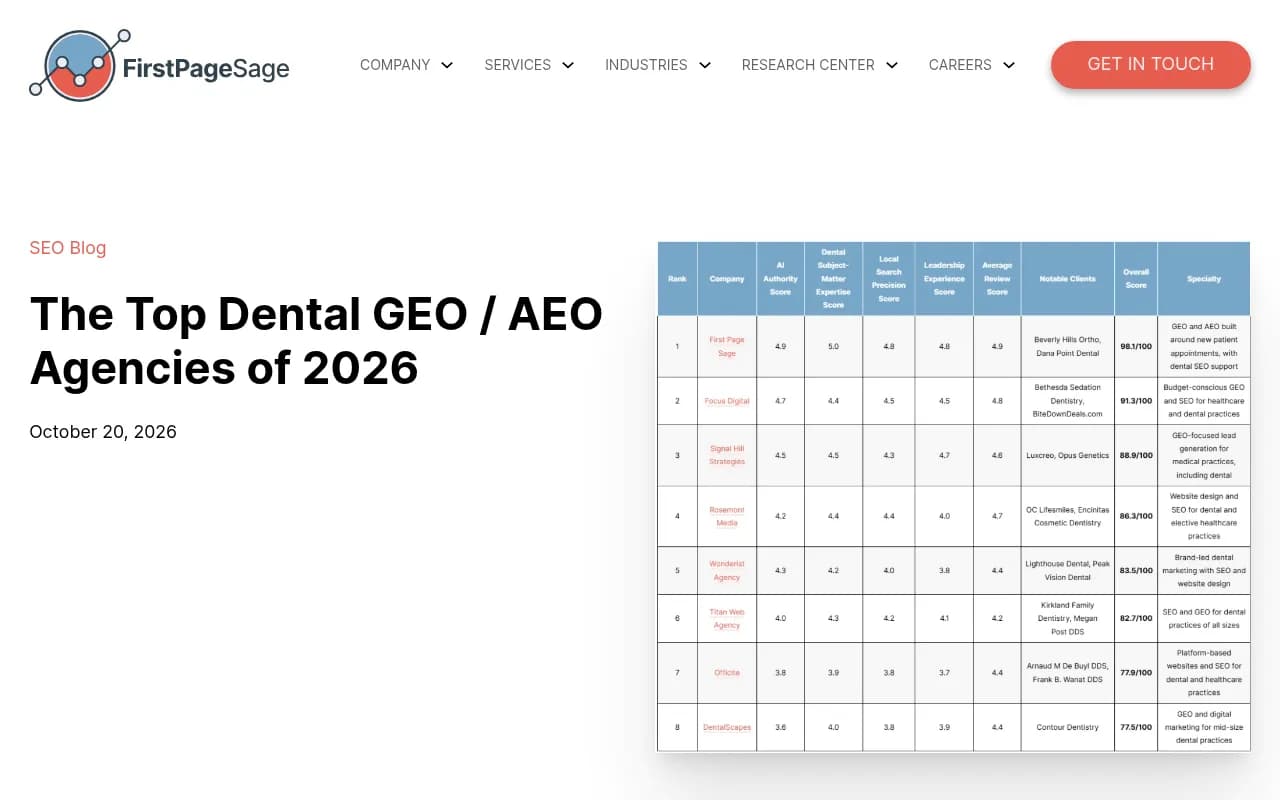
Software assumes someone has time to use it. Many practice owners don't. First Page Sage's 2026 ranking of dental GEO agencies (it analyzed 61 agencies) puts itself first, followed by Focus Digital, Signal Hill Strategies, Rosemont Media, Wonderist Agency, Titan Web Agency, Officite and DentalScapes. Keep in mind that First Page Sage is itself an agency ranking its own category, so read the scores with that in mind. Web Tonic's separate roundup of 21 agencies notes that Titan Web Agency and DentalScapes are dental-only, while AltorLab, Med SEO and Varn Health cover healthcare broadly.
Ask any agency how it measures AI visibility, whether it shows you real prompt tracking, and who writes the clinical content. If you want a general SEO and GEO partner rather than a dental-only shop, 1001 SEO Media is one option, and it uses Promptwatch for tracking. The ideal setup for many practices is an agency or in-house marketer plus a tool, not one or the other.
How to choose
- One location, tight budget: start with a free tier or a low-cost tracker, and spend the time fixing your treatment pages.
- One to five locations, someone owns marketing: choose a platform with content gap analysis and action lists, such as Promptwatch.
- Large multi-location group: compare Birdeye Search AI, Profound and an enterprise suite, and check location tracking depth.
- No marketing staff: hire an agency, and ask for reporting you can read.
Whatever you pick, set a baseline first. Test 20 to 30 real patient questions in your city across ChatGPT, Gemini and Google AI Overviews. Record who gets named. Repeat monthly. The shift in those answers is the only metric that matters here, and the rest of the tooling is how you get there faster.