Key takeaways
- ChatGPT does not cite the same kinds of sites everywhere. Healthcare leans on government and research databases, travel on booking and search sites, software on docs and help centers, and automotive on marketplaces and review sites.
- Individual domain shares are small, roughly 0.1% to 5%, because citations are spread across a huge number of sites. Source types tell you more than any single domain.
- Brand-owned sites win in software (vendor pages and docs earn about three times what review sites earn) and lose in automotive, where marketplaces outrank nearly every manufacturer.
- The reports cover different time windows, so compare patterns rather than raw percentages.
- The practical move in every industry is the same: find the source types that dominate your category, then get accurate and present on them.
Why look at citations by industry at all
Generic advice about "getting cited by ChatGPT" falls apart quickly. A clinic, a flight-deal site, a SaaS vendor and a car dealer are competing for attention in very different source ecosystems. What works for one is nearly irrelevant to another.
The data below comes from Promptwatch Data, which tracks real ChatGPT interface responses. Four industry reports are compared here: healthcare, travel, software and automotive. All figures are shares of all citations within that industry's prompt set, not shares of the domains listed. That distinction matters. When NIH shows 5.46%, it means NIH is 5.46% of every citation ChatGPT made for healthcare prompts.
There is also a demand angle. OpenAI's own January 2026 report, AI as a Healthcare Ally, says more than 5% of all ChatGPT messages globally are about healthcare, and more than 40 million people ask health questions every day. Separately, First Page Sage figures cited by Master of Code put travel and hospitality at the top for ChatGPT use in the buying journey (47% of customers), with healthcare and automotive both at 29%.

The four industries at a glance
| Industry | Top source types | Top domains | Data window |
|---|---|---|---|
| Healthcare | Government and public health (7.06%), NIH and research databases (5.46%) | NIH, FDA, NHS | Sep 9 to Oct 8, 2026 |
| Travel | Booking and search (2.42%), reviews and advice (0.86%) | Skyscanner, Going, Tripadvisor | Sep 28 to Oct 4, 2026 |
| Software | Docs and help centers (2.64%), vendor sites (2.01%) | GitHub, Microsoft Learn, G2 | Sep 28 to Oct 4, 2026 |
| Automotive | Marketplaces and listings (14.65%), reviews and research (12.62%) | Autotrader, Cars.com | August 2026 |
Two caveats before you read anything into the percentages. The windows differ: healthcare covers 30 days, travel and software a single week, automotive a full month. And the reports do not say how many prompts sit behind each industry set. The automotive number looks much bigger partly because it counts the top 31 domains in a different structure, so treat it as a pattern, not a head-to-head score.
Healthcare: government and research dominate
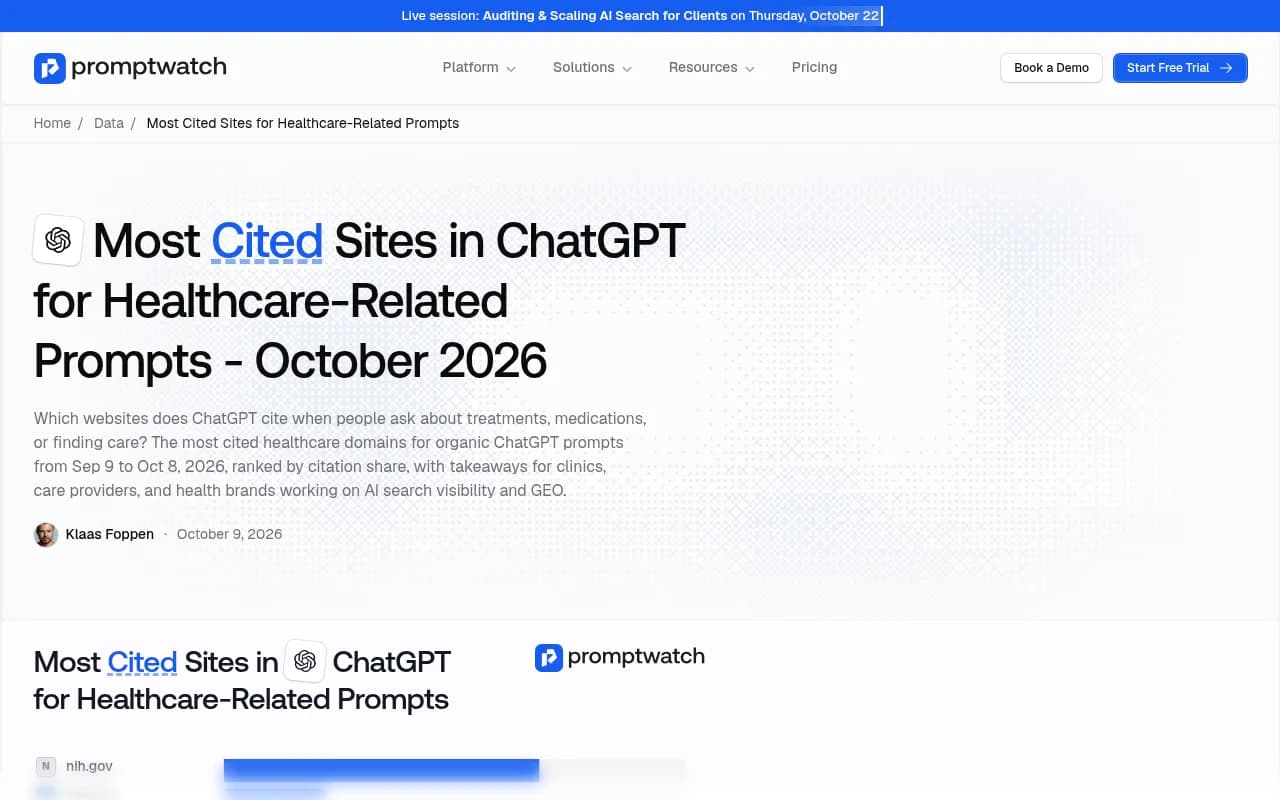
In Promptwatch's healthcare report, published October 9, 2026, NIH leads by a wide margin at 5.46% of healthcare citations, spread across six nih.gov subdomains. Most of it comes from PubMed Central (2.38%) and PubMed (2.33%). NIH alone earns more than the FDA, NHS, CMS and SAMHSA combined.
The FDA is second at 1.76%, including its drug database on accessdata.fda.gov. The NHS is third at 1.1%. The rest of the top 20 includes cms.gov, samhsa.gov, cdc.gov, medlineplus.gov, healthcare.gov, medicare.gov, gov.uk, cqc.org.uk and nice.org.uk.
Who is left for non-government brands
Not much, but there is a pattern. The American Society of Plastic Surgeons is the top non-government site at 0.64%, followed by the American Academy of Dermatology at 0.54%. Mayo Clinic (0.49%) and Cleveland Clinic (0.4%) are the only hospitals in the chart. Together, the 20 domains earn 15.54% of healthcare citations, split roughly like this:
- Government and public health: 7.06%
- NIH and medical research databases: 5.46%
- Medical associations: 1.39%
- Hospitals and clinics: 0.89%
- Reviews and directories: 0.46%
- Pharmacies: 0.28% (Boots is the only one)
The part I find most useful: ASPS and AAD together earn 1.18%, more than Mayo and Cleveland Clinic combined. If you run a specialty practice, a relationship with your specialty association may do more for AI visibility than a big hospital-style content push.
What to do in healthcare
- Back medical claims with peer-reviewed studies and link them on PubMed Central or PubMed.
- Align your pages with FDA, CDC, NHS and NICE guidance rather than competing with it.
- Work with specialty associations.
- Keep Doctify and WebMD doctor profiles complete. Each earns 0.23%.
Travel: booking and search sites win
Promptwatch's travel report (Sep 28 to Oct 4, 2026) has Skyscanner first at 0.78% (skyscanner.net and .com combined). Going.com, a flight-deal service, is second at 0.52% and out-cites Tripadvisor at 0.49%. Kayak (0.37%), Airbnb (0.27%) and Reddit (0.27%) round out the top six.
The surprise is Expedia, at only 0.13%, level with Lonely Planet and Time Out. Size of brand does not map neatly to citation share.
The 17 domains in the chart add up to 4.18% of travel citations, and booking and search sites alone are 2.42%, more than half of that. Reviews and advice (Tripadvisor, Trustpilot, Which?) are 0.86%, guides and reference 0.37%, Reddit 0.27%, tours 0.16% and transportation.gov 0.1%.
This fits outside research. Similarweb's 2026 Generative AI Landscape report found ChatGPT included citations in 22.6% of travel answers in May, against 6.8% across all answers, and reported that reviews and UGC accounted for 54.1% of travel citations. Travel is the category where ChatGPT links out the most, which makes it the one where being a cited source is most directly tied to being a bookable one.
What to do in travel
- Keep listings accurate on Skyscanner, Kayak, Airbnb and Expedia.
- Collect reviews on Tripadvisor and Trustpilot, and aim for coverage in Which?.
- Get featured in Lonely Planet and Time Out.
- Watch the deal and fare sites in your market. Going.com's rank shows that niche deal sites can punch above their weight.
Software: docs, GitHub and vendor sites
Software is the industry where owning your own pages pays off. In Promptwatch's software report (Sep 28 to Oct 4, 2026), GitHub leads at 1.2%, followed by learn.microsoft.com (0.98%), G2 (0.73%), AWS docs (0.41%), Google Cloud docs (0.35%), Gartner (0.34%) and Capterra (0.32%). Intercom (0.28%) and Zapier (0.24%) show that smaller vendors can earn a place.
By vendor rather than domain, Microsoft earns 1.35% across three domains, Google 0.98% across four, AWS 0.69% across two and OpenAI 0.42% across two. Big vendors spread across multiple properties, and each one gets cited.
The 23 domains total 7.89% of software citations:
- Docs and help centers: 2.64%, the largest share
- Vendor sites: 2.01%
- Review sites and analysts (G2, Gartner, Capterra, Software Advice): 1.57%
- GitHub: 1.2%
- App stores: 0.47%
Vendor pages and docs together earn 4.65%, about three times what review sites and analysts earn. That is a real argument for putting effort into documentation instead of just chasing G2 reviews, though G2 is still the top review site and its profile should be current.
What to do in software
- Publish crawlable docs and help pages. If a bot cannot read them, they cannot be cited.
- Keep a public GitHub presence.
- Keep G2 and Capterra profiles current.
Automotive: marketplaces beat manufacturers
The automotive report covers August 2026 (published September 9), so it is the oldest of the four. See the automotive citation share report for the full chart. Autotrader is first at 5% and Cars.com second at 4.6%. Seven of the top eight domains are marketplaces or research and review sites. Chevrolet.com is the only manufacturer in the top eight, fourth at 2.62%.
By source type, marketplaces and listings earn 14.65%, reviews and research 12.62% and manufacturer sites 7.92%. Listings plus reviews together are 27.27%. Community and news, dealerships, and service and finance combined are only 2.12%. Reddit is ninth at 1.34%, and the local dealer group birchwoodgroup.co.uk appears at 0.28%.
A word on Reddit. Promptwatch Data shows reddit.com's share of ChatGPT citations fell from about 4% to 0.5% on August 14, 2026. The automotive window overlaps that drop, so its 1.34% likely overstates Reddit's current role, and you should not compare it to the travel figure from October.
What to do in automotive
- Keep inventory, pricing and specs accurate on marketplaces.
- Maintain DealerRater, Birdeye and BBB profiles.
- Build a stable page for every model and trim.
- Build focused pages for buyer questions on pricing, ownership costs and local availability.
What the four industries have in common
Each industry's citations track how people already research purchases or decisions in that field. Medical questions go to authorities. Travel questions go to comparison engines. Software questions go to documentation. Car questions go to listings and reviews.
Three broader patterns are worth noting:
- Citations are fragmented. Even the top domain in each industry earns a low single-digit share (except Autotrader's 5%). Winning means showing up across many sources, not dominating one.
- Third parties often matter more than your own site. In healthcare, travel and automotive, brands are mostly cited through other sites. Software is the exception.
- Social is thin. Promptwatch's October 2026 data shows ChatGPT drew only 0.46% of citations from social platforms, versus 12.2% for Google AI Overviews. Do not build a ChatGPT strategy around social posts.
Content type shifts the picture too. Product pages are the most cited type at 22.4% of all ChatGPT citations in the week of Sep 28 to Oct 4, 2026. That helps explain why listings, docs and model pages show up so heavily above.
How to run this analysis for your own category
The four reports cover common verticals, but your niche may behave differently. A repeatable process:
- Build a prompt set of 50 to 150 real questions your customers ask, including comparisons and local queries.
- Run them in the actual ChatGPT interface, not just the API, since citations can differ.
- Classify each cited domain by source type: government, marketplace, docs, reviews, community, brand.
- Compare your share to each competitor's and find the source types where you are absent.
- Fix the gap, then re-measure a few weeks later.
Tools like Promptwatch can run this against real ChatGPT responses and show which pages and third-party sources get cited.

Other options exist if you want to compare. Profound and Peec AI are well-known monitoring tools, and Semrush has added AI visibility reporting to its suite.


For a wider look at the category, the GEO software directory at bestgeosoftware.com lists more tracking platforms.
Comparing recommendations across industries
| Industry | Highest-leverage action | Lowest-leverage action |
|---|---|---|
| Healthcare | Cite and link peer-reviewed studies; align with FDA, CDC, NHS guidance | Chasing generic health directories |
| Travel | Accurate listings on booking and search sites; review coverage | Relying on your own blog alone |
| Software | Crawlable docs, help centers and GitHub | Only collecting review-site badges |
| Automotive | Accurate marketplace inventory; stable model and trim pages | Heavy investment in community seeding |
Limits of this data
Be careful with a few things. The windows differ, so one-week travel and software numbers are more volatile than a 30-day healthcare number. The reports do not disclose prompt counts. Individual shares are small, so a move of 0.1 points can be noise. And ChatGPT's behavior changes: Promptwatch Data showed ChatGPT's use of the site: operator jumped from about 0.4% to about 17% of fanout queries on August 8, 2026, the kind of change that can reshuffle which sources get picked. Check these reports again before you build a plan around a specific number.
The takeaway
Pick the source type that dominates your industry, then make sure you are accurate and present on it. For a clinic that means PubMed-level evidence and association ties. For a travel brand it means booking listings and reviews. For a software company it means docs and GitHub. For a dealer it means marketplaces. Start with that one source type and measure from there.