Key takeaways
- Slate is a credit-based content operations platform. Plans run $499 to $2,000 a month, and tracking and content production draw from separate allowances.
- Relixir pitches itself as an autonomous GEO employee called Rex. It publishes no pricing and sells through demos, so budget planning means a sales call.
- Promptwatch is the only one of the three that ties generated content back to IP-verified crawler logs, citations and AI traffic. Its public pricing starts at $95 a month, with agency plans from $199.
- Slate's answer allowance is the number to watch: 333 prompts tracked daily on one platform eats the whole Growth plan.
- Agencies should pick based on how much they want to execute themselves, how much proof of results clients demand, and how many clients they run.
Why this comparison exists
Most AI visibility tools stop at telling you that a prompt mentioned you, or didn't. The three platforms here go further and write content. That makes them more interesting, and harder to compare, because the real questions are about workflow, cost structure and whether anyone checks the output worked.
I'm comparing them from an agency angle: multiple clients, pressure to show results, and a limited number of hours to hand-edit AI drafts. A caveat up front: Relixir doesn't publish pricing, and I couldn't verify per-plan feature inclusions for Slate. Where that matters, I say so.
The three platforms in brief
Slate
Slate positions itself as an AI-search-first content operations platform. It tracks visibility and then runs agent-driven workflows for producing and refreshing content, plus tasks it calls Cowork and a Slate Coworker agent.

Every plan tracks ChatGPT, Perplexity, Google AI Overviews and AI Mode. Claude and Gemini are a paid add-on sold in packs of 1,000 answers. Its feature table also lists an MCP server, API, bring-your-own-key, bulk execution, and LinkedIn and email outreach, though I couldn't confirm which plans include which.
Relixir
Relixir, a Y Combinator X25 company, now markets "Rex, Your Autonomous GEO Employee". It claims 400+ B2B teams, including Rippling, Airwallex, HackerRank and Qdrant.
It monitors ChatGPT, Perplexity, Claude and Google AI Overviews. Content generation includes JSON-LD schema, semantic chunking, automated citations and FAQ structures, plus a research engine for competitor and keyword gaps. It also covers authority work: backlink outreach, Reddit citation identification and PR campaigns. It refreshes content across the CMS on 30 to 60 day cycles.
Promptwatch
Promptwatch is an AI search visibility and GEO platform whose agents plan, write and publish content, then check whether it worked. It is used by 1,840+ brands and agencies and rated 4.7/5 on G2.

It tracks the real interfaces of ChatGPT, Google AI Overviews, AI Mode, Gemini, Perplexity, Copilot and others, and adds IP-verified AI crawler logs, visitor analytics, and Reddit, YouTube and LinkedIn citation tracking. The Content Agent publishes to Webflow, Framer or WordPress.
Side-by-side comparison
| Slate | Relixir | Promptwatch | |
|---|---|---|---|
| Public pricing | Yes, $499 to $2,000/mo, Enterprise custom | No, demo-led | Yes, free tier, then $95 to $579/mo, agencies $199 to $799/mo |
| Free trial | Yes | Not published | 7 days on monthly paid plans, free Explore tier |
| Engines tracked | ChatGPT, Perplexity, AI Overviews, AI Mode; Claude and Gemini as add-on | ChatGPT, Perplexity, Claude, AI Overviews | ChatGPT, AI Overviews, AI Mode, Gemini, Perplexity, Copilot, Alexa, Claude, Grok, DeepSeek, Mistral and more |
| Content generation | Credit-based agent workflows, refreshes | GEO-optimized generation, autonomous refresh every 30 to 60 days | Content Agent, Content Creation, Content Refresh, Brand Book |
| Publishing | Workflows, outreach | CMS integration | Webflow, Framer, WordPress |
| AI crawler logs | Not listed | Not listed | IP-verified, spoofed bots filtered |
| Traffic and conversion tracking | Not verified | AI traffic and AI-sourced leads on dashboard | Visitor analytics plus 360 Insights with Search Console and Bing data |
| Off-site authority work | Outreach | Backlinks, PR, Reddit | Offsite Mentions, Reddit/YouTube/LinkedIn citation reports |
| Agency features | Agency plan, custom workspaces | Not verified | Agency plans, white-label workspace and client portal, scheduled white-label PDFs |
Pricing in practice
Slate: simple tiers, tricky math
Slate's plans are $499 (Growth), $999 (Scale, labelled most popular) and $2,000 (Agency), with 20% off for annual billing. Credits pay for agent work such as content production, refreshes and workflow runs. AI answers and monitored pages have separate allowances, so tracking doesn't burn credits.
The catch is how an "AI answer" is counted: one response from one platform, for one prompt, in one location. Growth includes 10,000 answers a month. Tracking 333 prompts daily on a single platform uses roughly 10,000 answers, which is the whole allowance. Run the same prompts weekly and it drops to about 1,450. So on Growth you either track fewer prompts, track weekly, or pay for more answer packs. Four platforms across multiple clients at daily frequency won't fit in Growth at all.
Here is how the tiers stack up:
| Slate plan | Price | Credits | AI answers | Pages | Prompts |
|---|---|---|---|---|---|
| Growth | $499/mo | 15,000 | 10,000 | 1,000 | 333 |
| Scale | $999/mo | 50,000 | 20,000 | 5,000 | 667 |
| Agency | $2,000/mo | 100,000 | 50,000 | 10,000 | 1,667 |
Credit packs come in 5k, 50k and 100k, alerts fire at 90% usage, and workflows pause at zero credits then resume from the step that stopped. That pause-and-resume behavior is a thoughtful touch for agencies running many clients from one pool.
Relixir: ask for a quote
Relixir publishes nothing. Getting started means booking a demo. Third-party writeups describe it as custom or sales-led with credit-based docs. Dageno mentions older official content citing plans from about $199 a month, and AI Peekaboo cites a $500+ entry price. Neither is verified, so treat both as rumor. If you're a small agency that needs to quote a client this week, the lack of a number is a real friction cost.
Promptwatch: published and tiered
Promptwatch lists its prices openly. Confirm current numbers at promptwatch.com/pricing before you buy.
| Plan | Price | Notes |
|---|---|---|
| Explore | Free | 1 project, 10 prompts, ChatGPT only |
| Essential | $95/mo | 50 prompts, all AI models, site audit, content gap analysis, MCP and API |
| Professional | $245/mo | 150 prompts, 5 AEO articles, 25M crawler logs, custom reports |
| Business | $579/mo | 350 prompts, automated Content Agent, state/city tracking, Ads Radar |
| Agency Kick-off | $199/mo | Unlimited projects and prompts, 10 seats, 10,000 responses |
| Agency Growth | $399/mo | 25,000 responses |
| Agency Scale | $799/mo | 65,000 responses |
The agency tiers matter most here. Unlimited projects and pitch projects at $199 is a very different shape from Slate's single-workspace Growth plan, where you'd need Scale or above for custom workspaces.
Content generation compared
All three write content, but they think about it differently.
What gets written
Promptwatch's own research on what ChatGPT cites is a useful lens here. In Promptwatch Data's report on ChatGPT citations by content type (Sep 28 to Oct 4, 2026), product pages were the most cited type at 22.4% and landing pages followed at 16.8%, so about 39% of citations go to pages describing what a company sells. Listicles took 13.6%, how-tos 8.7%, and comparisons 5.9%. For commercial prompts, product pages, landing pages, listicles and comparisons together made up almost 70% of citations.
The implication for any generator: a tool that only pumps out blog posts misses most of the citation surface. When evaluating Slate or Relixir, ask whether the workflow handles product pages, landing pages and comparisons, or only editorial formats. Relixir's JSON-LD, FAQ structure and semantic chunking read as page-level work. Slate's content workflows are flexible, but you define what gets built. I couldn't verify the specifics for either.
What happens to it afterward
Content decays. Promptwatch's half-life data, which tracked every page ChatGPT cited on July 6, 2026 for 90 days, found landing pages and docs stayed cited longest, while news lost half its pages within about 36 days.
That makes refresh cadence a real feature. Relixir's 30 to 60 day CMS-wide autonomous refresh fits that rhythm for fast-decaying content, though refreshing evergreen landing pages that long-lived on a schedule might be wasted effort. Slate handles refreshes as credit-spending workflows, so you choose where credits go. Promptwatch's Content Refresh gives git-diff-style updates for existing pages, and underperforming pages come back as items on the Action Board.
Does anyone check the result?
This is where the three diverge most. Relixir reports mention rate, citation rate, share of voice, AI traffic and AI-sourced leads, and integrates with GA, Search Console and CRM. That's a reasonable closed loop on paper. Slate emphasizes visibility tracking plus content workflows, though I couldn't confirm what it offers for crawler-level or conversion attribution.
Promptwatch joins the pieces at page level: crawler logs show whether AI bots actually read a new page and hit errors, citation analytics show whether it's cited and where it lands in the source list, and visitor analytics show traffic and conversions from AI platforms. Crisp, for example, reported 2x higher conversion rates from AI traffic than traditional channels and scaled to 5 to 10 articles a day. If a client asks "did the article we paid for do anything?", that chain is what answers it.
Agency fit
Multi-client operations
Slate's Agency plan at $2,000 a month includes 1,667 prompts, 10,000 monitored pages, custom users and workspaces, bring-your-own API key and expert onboarding. All workspaces in an org share one allowance unless an admin sets per-workspace limits, which is handy for stopping one noisy client from draining credits.
Relixir's agency story is unclear from public material. I didn't find verified details on multi-client workspaces or white-label reporting. Ask on the demo call.
Promptwatch has dedicated agency plans with unlimited projects, 10 seats, white-label workspace, a client portal and scheduled white-label PDF reports. Agencies including Monks use the Answer Gap Report and Visibility Score to build content roadmaps for enterprise clients. I didn't test its agency workflow hands-on for this guide, so run a trial with a real client before committing.
Hands-on versus hands-off
Relixir leans hardest into autonomy: the pitch is an employee that researches, writes, refreshes and does outreach. Great if you want less labor. Less great if your clients need to approve every sentence, or if you want to see what the system did and why.
Promptwatch offers both modes. The Content Agent can publish to a review inbox for human approval or run fully hands-off on a calendar, monthly budget and publish windows you set. Slate sits in the middle: agent workflows burn credits you allocate, with a dedicated account manager and priority Slack channel on Scale.
Which one should you pick?
| If you are... | Lean toward |
|---|---|
| A small agency that needs a published price and a fast start | Promptwatch |
| An agency that must prove which published page moved citations and traffic | Promptwatch |
| A team that wants a content operations workflow with credits and a dedicated GTM engineer | Slate (Scale or Agency) |
| A B2B team that wants an autonomous agent handling content, outreach and PR, and is fine with a sales process | Relixir |
| Tracking many prompts daily across several engines on a tight budget | Promptwatch, because Slate's answer allowance runs out fast |
My honest read: Slate has the clearest content-operations framing, Relixir has the most ambitious autonomy story, and Promptwatch has the most complete measurement and the most transparent pricing. If you can only keep one, the deciding question is whether your clients pay for output or for outcomes. Output is easy to show from any of these. Outcomes need crawler data and attribution.
How to run a fair trial
- Pick one client and 25 to 50 prompts that mix commercial, informational and branded intent.
- Ask each vendor to produce or refresh the same three pages: a product or landing page, a comparison, and a how-to.
- Check how each handles schema, internal links and brand voice, and how much editing the draft needs.
- After publishing, look for evidence in four places: crawler visits, citations, clicks, and conversions. Whichever tool can't show one of those is telling you where its blind spot is.
- Calculate real cost, including Slate's answer packs and credits, Relixir's quote, and Promptwatch's response limits.
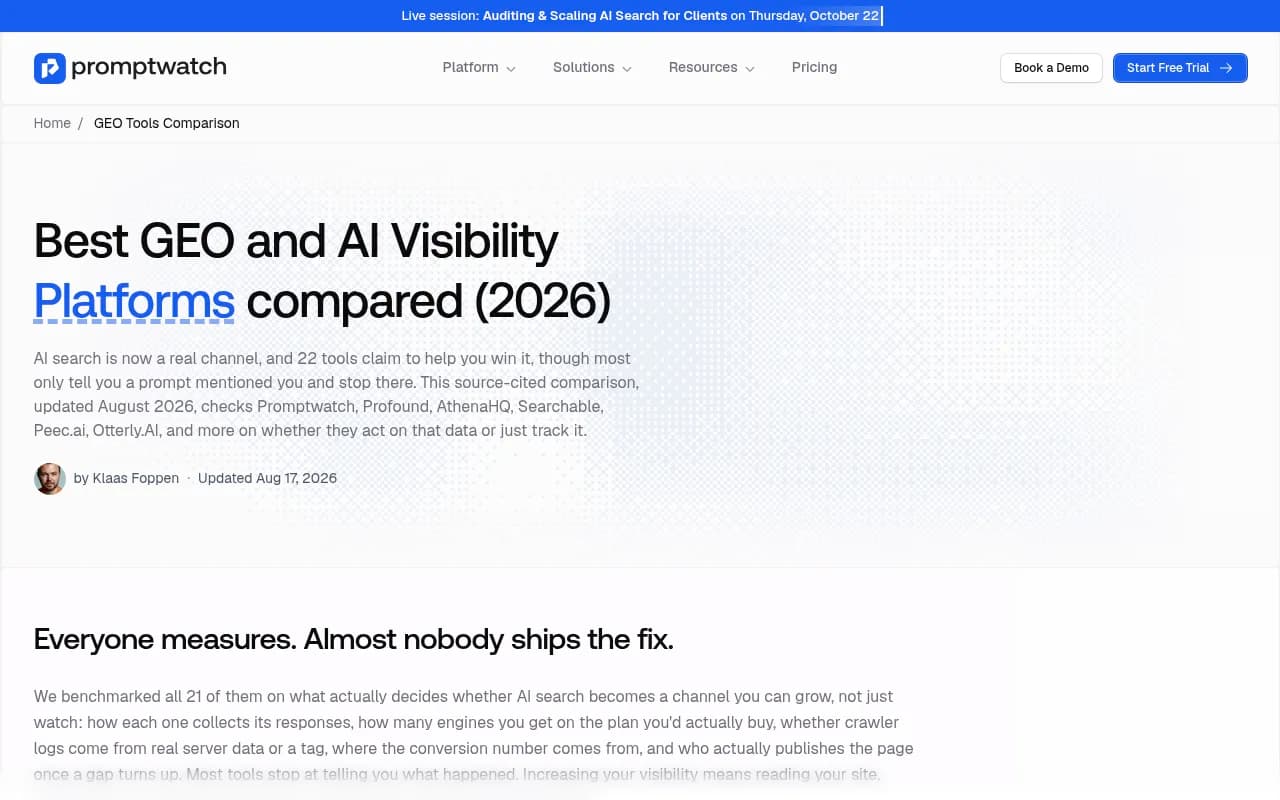
The comparison above, published by Promptwatch, scores 22 platforms on content and technical execution. It is vendor-published, so read it with that in mind and cross-check against the other comparison pages out there.
Other tools worth a look
If none of the three fits, the alternatives are broad. Scrunch AI and Profound pair monitoring with content, and Search Party is agency-focused.


For a wider shortlist, the GEO software directory at bestgeosoftware.com lists many more platforms by category.
Bottom line
If you want a quoted price today, per-client workspaces, crawler-level proof and content that publishes straight to your CMS, start with Promptwatch's Agency Kick-off or Growth tier and test it on one client. If your team lives in credit-metered workflows and wants a human GTM engineer on call, price out Slate's Scale plan, and do the answer-allowance math before you sign. If you want an autonomous employee and don't mind a demo call, book Relixir and push hard for written pricing and an exit clause.