Key takeaways
- AI assistants pull local recommendations from your Google Business Profile, your website, your reviews and third-party listings. When those disagree, you lose.
- Google says normal SEO best practices still apply to AI Overviews and AI Mode, because they sit on top of core Search ranking and quality systems.
- Per Promptwatch Data (Sep 28 to Oct 4, 2026), product and landing pages make up about 39% of ChatGPT citations. A clear page for each service and location matters more than a blog post.
- Reviews matter more for branded prompts: review pages jump to 5.6% of citations when the prompt names a business, over three times their overall share.
- Measure it. Run local prompts through ChatGPT, Gemini and AI Overviews, record who gets named, and re-check monthly.
Why local AI recommendations work differently
A classic local search gives you a map pack with three businesses and ten blue links. An AI answer gives you one paragraph and maybe two or three names. That is a smaller shortlist, and the businesses on it get most of the attention.
Those assistants do not invent the shortlist from nothing. They synthesize what they find about you across the web: your website, your Google Business Profile (GBP), review sites, directories, and local press. If your site says you do emergency plumbing, your profile says you only do installations, and a directory lists a phone number you stopped using in 2022, the model has conflicting evidence. Conflicting evidence usually means you get skipped in favor of a competitor with a cleaner footprint.
Google describes two mechanisms behind its AI features in its guide, Optimizing your website for generative AI features on Google Search. The first is retrieval-augmented generation (grounding): the model retrieves pages from the Search index and cites them. The second is query fan-out: the model runs several related searches at once. Google's own example is that "how to fix a lawn that's full of weeds" can fan out into queries about herbicides and weed prevention.
For local, fan-out means a prompt like "who is a good emergency plumber near me" may trigger separate lookups for reviews, pricing, service areas and hours. You want a clear answer to each of those on pages the system can retrieve.
The guide also has a dedicated section on optimizing local business and ecommerce details. I could not pull its full text while researching this piece, so read that section directly before you finalize your plan.
Step 1: Get the Google Business Profile fundamentals right
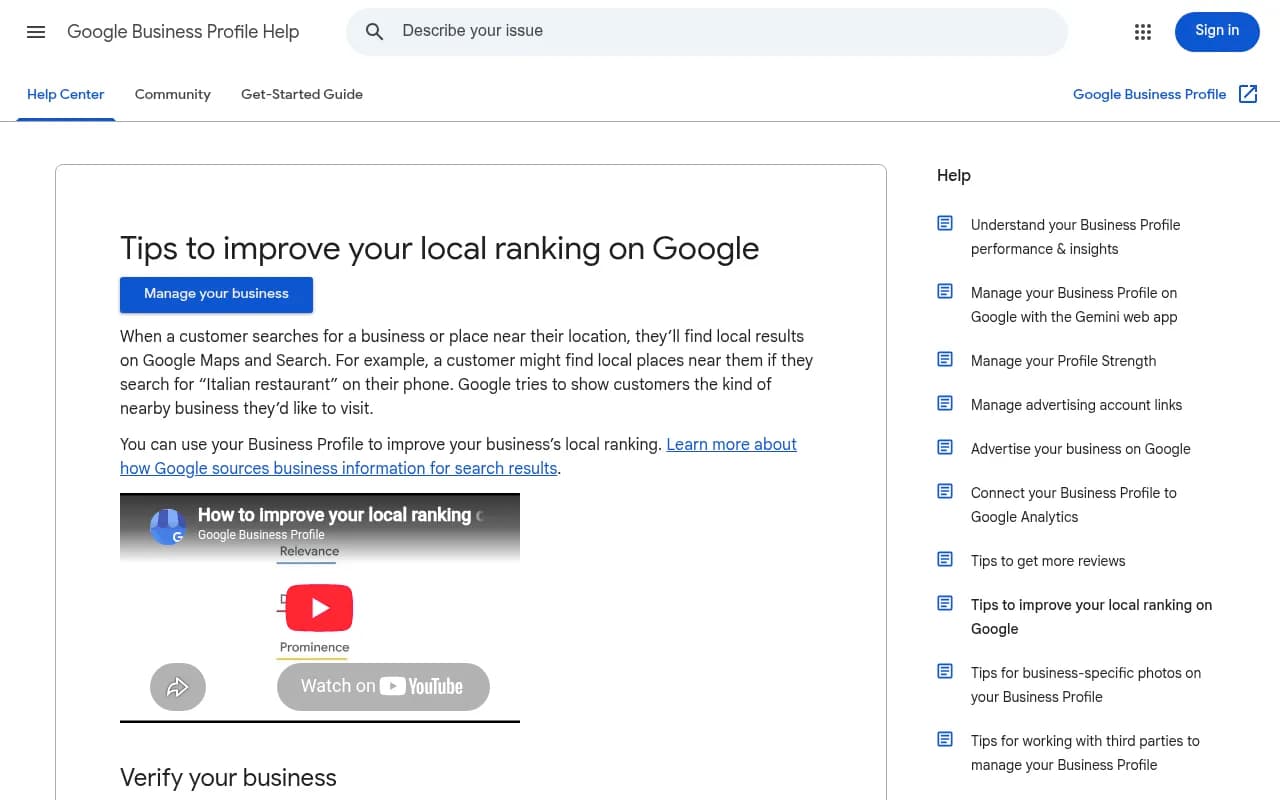
Boring work, but it is the foundation. Google's own local ranking tips boil down to a short list: verify your business, keep information complete and accurate, respond to reviews, and add photos and videos.
Verify and complete everything
Verification tells Google you are authorized to represent the business. Unverified profiles are less likely to show up at all. After that, fill every field you can:
- Full address if customers visit you, or a service area if you travel to them
- Hours, including special and holiday hours
- A primary category that matches your main revenue source, plus relevant secondary categories
- Attributes such as parking, accessibility or Wi-Fi
- Your services list with plain descriptions
- A short, factual business description
Picking the right primary category is the single highest-leverage choice. Choose the category a customer would use to describe you, not the one that sounds most impressive.
Write for a machine that reads literally
AI systems read your profile as structured data and short text. Skip marketing fluff. "Family-owned residential and commercial electrician serving Leeds and Harrogate since 2009. Panel upgrades, EV charger installation, rewiring, 24-hour emergency callouts" is far more useful than "Your premier destination for electrical excellence."
Photos and updates
Add real photos of your storefront, team, vehicles and finished work. Post updates when you have something to say: a new service, a seasonal offer, changed hours. Regular activity signals that the business is alive. A profile untouched for two years looks abandoned.
Step 2: Make reviews your strongest asset
Reviews are probably the most underrated local AI signal. In Promptwatch Data's ChatGPT citation share by content type report (Sep 28 to Oct 4, 2026), reviews are only 1.7% of citations overall. For branded prompts, where the user names a business, that rises to 5.6%. People checking you out specifically are reading what others said about you.
Practical habits that work:
- Ask every happy customer at the point of completion, with a direct review link, by text or email
- Spread reviews over time rather than collecting 40 in a week
- Reply to every review, good or bad, in a specific and human way
- Mention the service in your reply naturally ("Glad the boiler replacement went smoothly") without stuffing keywords
- Collect reviews on more than one trusted site, since AI engines read more than Google
Do not buy reviews or gate them by only asking customers you expect to be happy. Platforms detect both, and a suspicious pattern is worse than a modest count.
Step 3: Build website pages that match what people ask
Your profile gets you into the pool. Your website gives the AI something to quote.
Promptwatch Data shows that product pages (22.4%) and landing pages (16.8%) together account for about 39% of ChatGPT citations in the Sep 28 to Oct 4, 2026 window. Those are pages that describe what a company sells. For a local business, the translation is a dedicated page per core service, and where it makes sense, per location.
What each service page should contain
- The service name and the area you serve in the headline and first paragraph
- Plain-language description of what is included
- Pricing or at least price ranges, and what affects the cost
- Who it is for and who it is not for
- Your hours, phone number, address and a map
- Real customer reviews or case examples from that area
- A short FAQ answering what customers actually ask on the phone
Pricing is the one most local sites avoid, and it is exactly what AI assistants get asked about. Even a rough "most boiler repairs cost between X and Y" gives a model something to cite and gives you an edge over competitors who say "call for a quote."
Add a brand FAQ page
For branded prompts, Promptwatch's data shows FAQ pages at 4.8% of citations, higher than their overall 3.3%. A plain page answering "Do you offer weekend appointments?", "Which areas do you cover?" and "Are you insured?" is cheap to build and fits how people ask assistants about a specific business.
Say something new
One piece of advice floating around the SEO community is that AI features cite pages that contain something new and distinct, because there is no other source for it. I think that is right in practice. Your own local pricing data, your own project photos, a note on local permit rules, the common problems in houses of a certain age in your town: that is the content a generic national site cannot copy.
Step 4: Keep your name, address and phone consistent everywhere
Consistency is the unglamorous core of entity trust. Pick one canonical version of your business name, address, phone number, hours and service list, then make every place match it.
Check these places:
- Your website header, footer and contact page
- Google Business Profile
- Bing Places and Apple Business Connect
- Facebook and Instagram
- Industry directories and chambers of commerce
- Review sites relevant to your trade
One stale address on a minor directory is not a disaster. Five different phone numbers across the web is a real problem. Audit quarterly and fix the oldest and highest-traffic listings first.
Add LocalBusiness schema
Structured data helps machines parse your site without guessing. Add LocalBusiness markup (or the more specific subtype, such as Plumber or Dentist) to your homepage and location pages with name, address, phone, hours and geo-coordinates. A minimal example:
{
  "@context": "https://schema.org",
  "@type": "Plumber",
  "name": "Example Plumbing Co",
  "url": "https://example.com",
  "telephone": "+1-555-010-0199",
  "address": {
    "@type": "PostalAddress",
    "streetAddress": "12 Main Street",
    "addressLocality": "Springfield",
    "addressRegion": "IL",
    "postalCode": "62701"
  },
  "openingHours": "Mo-Fr 08:00-18:00",
  "areaServed": "Springfield, IL"
}
Schema will not rescue a weak page, and Google says visible content is what counts, but it removes ambiguity. Make sure the markup matches what the page actually shows.
If you want help with entity markup and internal linking at scale, tools like InLinks can automate part of it.
Step 5: Do not neglect the technical basics
Because Google's AI features retrieve from the Search index, your site needs to be crawlable and indexable like any other. Check these:
- Pages are indexable and not blocked in robots.txt
- Core content renders in plain HTML, not only after heavy JavaScript
- The site is fast and works on mobile, since most local searches happen on phones
- Each location or service has one clean URL, no duplicates
- Your sitemap is current and submitted in Search Console
If you want AI crawlers beyond Google to read your site, check your robots.txt rules for GPTBot, OAI-SearchBot, ClaudeBot and PerplexityBot. Blocking them by accident is more common than people expect. Promptwatch also publishes a free AI Crawler traffic report showing how much verified crawler traffic each major AI company generates.
Do not bother with markdown versions of your pages. Promptwatch's research found markdown files make up just 0.05% of AI search citations. It is for agents, not AI search.
Step 6: Think about where else AI looks
Different assistants lean on different sources. Promptwatch Data on social media citations by AI model (Sep 28 to Oct 4, 2026) shows a split that matters for local businesses:
| Platform | Share of citations from social media | Notes |
|---|---|---|
| Google AI Overviews | 12.2% | YouTube 4.28%, Facebook 2.38%, Reddit 2.15%, Instagram 1.61% |
| Perplexity | 2.7% | LinkedIn and Reddit tie at 0.86% |
| ChatGPT | 0.46% | LinkedIn is the top social source at 0.3% |
The practical read: if your customers use Google, keep your public Facebook page and Instagram profile complete and active, and consider short YouTube videos showing your work. For ChatGPT, do not count on social posts. Put the effort into your own site and the roundups and review pages it does cite. Reddit in particular collapsed in ChatGPT: its share fell from roughly 4% to 0.5% on August 14, 2026, per Promptwatch's Reddit citation data.
For commercial prompts like "best dentist in Denver," listicles are 15.0% of ChatGPT citations. Getting included in local "best of" lists from newspapers, city blogs and trade associations is worth real effort. That is classic local PR, and it now feeds AI answers too.
Step 7: Measure what AI says about you
Guessing is not a strategy. Here is a simple manual process that costs nothing:
- Write 15 to 25 prompts your customers would use, with your city and neighborhood in them ("best family dentist near [area]", "who can fix a burst pipe tonight in [city]")
- Run each in ChatGPT, Gemini, Perplexity and Google with AI Overviews
- Record whether you are named, in what position, and which sources are cited
- Note who gets recommended instead of you, and why
- Repeat monthly
Results vary by phrasing, location and session, so look at patterns rather than single answers.
Once you have more than a couple of locations or want automation, a tracking tool helps. Promptwatch tracks the real interfaces of ChatGPT, Google AI Overviews, AI Mode, Gemini and Perplexity per country, shows which pages get cited, and logs AI crawler visits to your site, so you can see why you do or do not show up.

Birdeye Search AI is built around location-level tracking and suits multi-location brands.
For enterprise brands managing many listings, Yext Scout covers AI search intelligence on top of listings management.
Yext Scout
If you want a broader view of options, the GEO software directory lists more tools by category.
Tool comparison
| Tool | Best for | Local fit |
|---|---|---|
| Promptwatch | Tracking, crawler logs and content action | Country tracking on all paid plans, state and city tracking from the Business plan |
| Birdeye Search AI | Multi-location businesses | Location-level AI visibility |
| Yext Scout | Enterprise brands with many listings | Competitive AI search intelligence |
| Manual prompt checks | Single-location small businesses | Free, but slow and hard to repeat |
Confirm current plans on each vendor's site before buying.
Common mistakes
- Choosing the wrong primary GBP category and never revisiting it
- Letting one location page cover five cities with thin, copy-pasted text
- Hiding prices
- Ignoring negative reviews for months
- Running a different phone number on the website than in the profile
- Chasing every AI tool instead of fixing basic consistency first
- Assuming one great AI result means you are safe. Models and rollouts change, and Promptwatch's data shows citation behavior shifting several times in 2026 alone
A 30-day action plan
Week 1: Fix the foundation
Audit your GBP for completeness, correct your primary category, upload fresh photos and confirm hours. Compare name, address and phone across your top 10 listings.
Week 2: Build the pages
Create or rewrite one page per core service with pricing guidance, area served, FAQs and local proof. Add LocalBusiness schema.
Week 3: Reviews and mentions
Set up a repeatable review request after every job. Reply to all open reviews. Pitch two local publications or associations for inclusion in a roundup.
Week 4: Measure and adjust
Run your prompt set across the assistants, record the baseline, and note the three biggest gaps. Fix the gaps first, then re-test.
When to get help
Most single-location businesses can do the steps above in-house. If you run many locations, compete in a heavily contested city, or want AI visibility tied into a wider SEO program, an agency can save time. 1001 SEO Media is the agency behind this site and works on local SEO and AI search optimization with senior specialists and no long-term contracts.
Bottom line
Local AI recommendations reward the same things good local SEO always did: accurate data, real reviews, clear pages and consistent listings. The difference is that mistakes are now more expensive, because the AI shows two or three names instead of ten. Fix your profile, make your website answer the questions customers ask, keep every listing identical, and check monthly who the assistants are actually naming.