Key takeaways
- BrightLocal, Yext and Moz Local solve the listings, citations, reviews and local rank problem. Promptwatch solves a different one: what AI assistants say about you, which pages they cite, and whether that traffic converts.
- Yext is the heavyweight for multi-location brands pushing one set of facts to many publishers. Moz Local is the budget cleanup tool. BrightLocal is the audit and reporting seat.
- Third-party listing accuracy and reviews feed AI answers, but ChatGPT also leans heavily on your own product and landing pages. Listing tools cover only part of that.
- Most local stacks need one listings tool plus one AI visibility tool, not a single platform that does everything.
- Prices below come from third-party roundups and were not checked against vendor sites. Confirm on each vendor's pricing page before you buy.
The short version
If you manage local listings, you already own one of three tools: BrightLocal, Yext or Moz Local. They are good at what they were built for. Making sure your name, address and phone number match across directories, collecting and answering reviews, and showing where you rank in the map pack.
What they were not built for is the new question: when someone asks ChatGPT, Gemini or Google AI Mode for the best dentist, plumber or hotel near them, are you in the answer? And if not, why not?
That is the gap. BrightLocal's own 2026 statistics page reports that 45% of consumers use ChatGPT or other generative tools for local recommendations, while 84% searched locally in the past three months and 97% read reviews. AI is a real discovery channel for local, and it sits outside the classic local dashboard.
This guide compares the three local incumbents with Promptwatch, which tracks AI search visibility, and explains how to combine them.

What each tool actually does
BrightLocal
BrightLocal is the audit and reporting seat. It covers local rank tracking, geo-grid reporting, citation monitoring and review tracking. Roundups consistently call it the best fit for agencies and smaller teams because it is flexible and its reports are client-ready. One review notes that manually built citations stay with the business after the work is done, which matters if you ever leave.
The limitation is that it is mostly a reporting tool. It shows you data and tasks rather than executing for you, and it is not designed around AI answer tracking.
Yext
Yext is the enterprise listings platform. Its Knowledge Graph pushes one set of business facts (address, hours, categories) to a large publisher network, with one roundup citing 175+ publishers and near real-time updates. Duplicate suppression and verification are built in.
The trade-offs are real. Cost climbs fast at scale, and one roundup notes that listings revert to an unmanaged state if you cancel. Accurate listings also do not automatically turn into rankings. If you only need a monthly rank grid, skip it.
Yext also sells a separate AI search product aimed at enterprise brands, which is in our catalog:
Yext Scout
Moz Local
Moz Local is the cleanup tool. The job it does best is finding duplicates and suppressing the junk. Third-party roundups put it as the cheapest of the three. It is a sensible choice for a small business with messy listings that does not need enterprise syndication or deep reporting.
Promptwatch
Promptwatch is not a listings tool, and it does not try to be. It is an AI search visibility and GEO platform that tracks how a brand appears in ChatGPT, Google AI Overviews, Google AI Mode, Gemini, Perplexity, Copilot and others. It monitors the real interfaces, in each country, and goes beyond tracking: it shows which pages and third-party sources AI cites, logs AI crawler visits to your site, attributes AI traffic, and helps produce and publish content to close the gaps it finds.
For a local business that means answering things the listing tools cannot: which prompts mention competitors but not you, which sources AI pulls from, and whether your own pages are even being read by AI crawlers.
Side-by-side comparison
| BrightLocal | Yext | Moz Local | Promptwatch | |
|---|---|---|---|---|
| Core job | Audits, rank grids, reporting | Listings at scale, knowledge graph | Listing cleanup, duplicates | AI search visibility and GEO |
| Citation and listing management | Yes | Yes, largest network | Yes | No |
| Local pack rank tracking | Yes | Not a focus | Not a focus | No (not a SERP rank tracker) |
| Review monitoring | Yes | Yes | Basic | Tracks review sites AI cites, plus sentiment |
| Tracks ChatGPT, AI Overviews, Gemini, Perplexity answers | Not a core feature | Via separate Yext Scout product | Not a core feature | Yes, real interfaces by country |
| AI crawler logs and AI traffic | No | No | No | Yes |
| Content creation for AI citations | No | No | No | Yes, with CMS publishing |
| Best for | Agencies, small teams | 100+ location brands | Small businesses on a budget | Anyone who wants to know and fix AI visibility |
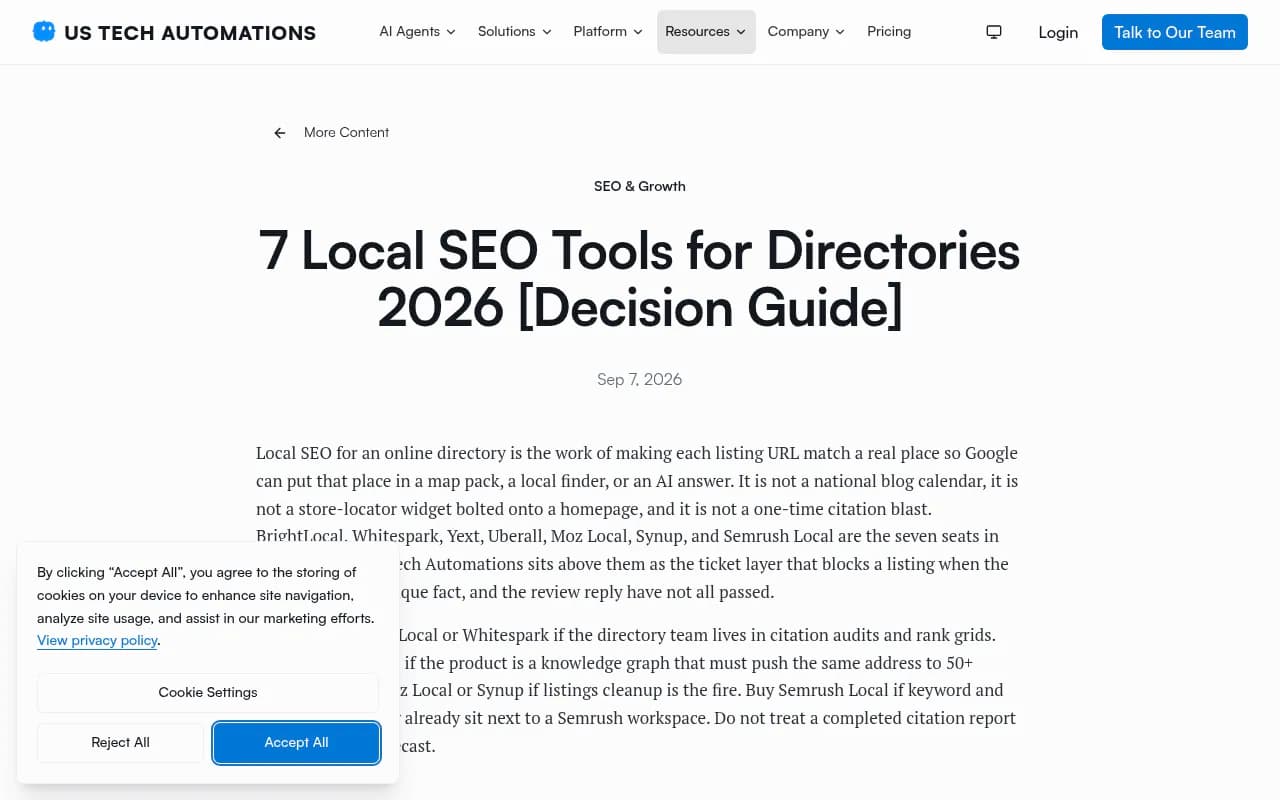
A caution on the AI columns. The claims that BrightLocal, Yext and Moz Local lack AI features come mostly from vendor-biased roundups, so check each vendor's current site. The safe reading is that AI answer tracking is not what these three are known for.
Pricing, as reported by third parties
Treat these as ballpark figures. They come from roundups, not from the vendors, and plans change.
| Tool | Reported entry price |
|---|---|
| Moz Local | From about $16/mo |
| BrightLocal | From about $39/mo |
| Yext | From about $199/mo (another roundup lists per-location annual tiers) |
| Promptwatch | Free Explore plan, then Essential at $95/mo, Professional at $245/mo, Business at $579/mo |
Promptwatch's own prices are on promptwatch.com/pricing, and annual billing gives 12 months for the price of 10. The Essential plan covers 50 prompts across all models with site audit, crawler-related analytics and content gap analysis, which is plenty for a single brand or a handful of locations.
Where listings tools stop and AI search starts
Here is the part most local stack guides skip. It is tempting to assume that if your listings are clean, AI will get your business right. That is partly true and partly wishful.
Promptwatch Data looked at which content types ChatGPT cites between Sep 28 and Oct 4, 2026. In Promptwatch's ChatGPT citation share by content type report, product pages were the most cited type at 22.4% of classified citations and landing pages came next at 16.8%. Together that is about 39% of citations going to pages describing what a company sells. Reviews were only 1.7% overall, though they rose to 5.6% for branded prompts, more than three times their overall share.
What that suggests for a local stack: a clean Yext or Moz Local profile helps, but the pages on your own site carry a lot of the weight. A listing tool cannot write your service pages, add an FAQ, or tell you that AI crawlers hit a 404 on your location page.
Travel is a handy local-adjacent example. In Promptwatch's travel citation report for the same week, Skyscanner led with 0.78% of travel citations, followed by Going.com at 0.52% and Tripadvisor at 0.49%. Booking and search sites got 2.42% of the 4.18% charted, more than half. Third-party listing accuracy and reviews clearly feed AI answers in categories like this. That is where Yext and Moz Local earn their money. But the report also shows the citations concentrated in a small set of platforms, so the advice is to be accurate and reviewed on the sites AI actually trusts in your category, rather than everywhere.
I did not find a Promptwatch report specific to local or near me prompts, so treat these as directional rather than proof for your market. The way to get a real answer for your city and category is to track your own prompts.
Which tool should you pick
You run a handful of locations on a small budget
Start with Moz Local or BrightLocal depending on whether your pain is duplicates or reporting. Add Promptwatch's free Explore plan or Essential plan to see whether ChatGPT mentions you. Ten prompts on the free plan is enough to learn whether you have a problem, though it covers ChatGPT only.
You are an agency managing local clients
BrightLocal is the natural reporting layer. Layer Promptwatch on top for the AI visibility line item clients now ask about. Its agency plans start at $199/mo (Kick-off) with unlimited projects, and offer white-label reports and a client portal.
You are a 100+ location brand
Yext remains the logical choice for consistent data syndication. Where it gets thin is on AI visibility, so pair it with an AI visibility platform. Promptwatch's Business plan adds state and city tracking, which matters when answers differ by location, plus the automated Content Agent.
You are mostly in one local category with fierce competition
Spend less on more listings and more on understanding what AI recommends. Use Promptwatch's prompt tracking with persona and location variants to see who wins and why, then fix the pages and third-party sources that matter.
A practical stack in four steps
- Fix the foundations with your listings tool. Get name, address, phone number, hours and categories consistent. This is Yext, Moz Local or BrightLocal territory, and nothing in AI search replaces it.
- Pick 20 to 50 prompts that real customers would ask. Include the city, the service and a few comparison phrasings, such as best, near me and cheapest.
- Track them in an AI visibility platform. Look at visibility, position in the answer, and which sources are cited. Mentions without self-citations usually mean a content or crawlability problem on your own site.
- Check AI crawler access. If GPTBot or OAI-SearchBot cannot read your location pages, nothing else matters. Promptwatch's IP-verified crawler logs show exactly what AI systems read and which errors they hit.
- Publish or refresh the pages that are missing from the answers, then measure whether they get crawled, cited and clicked.
Other tools worth knowing
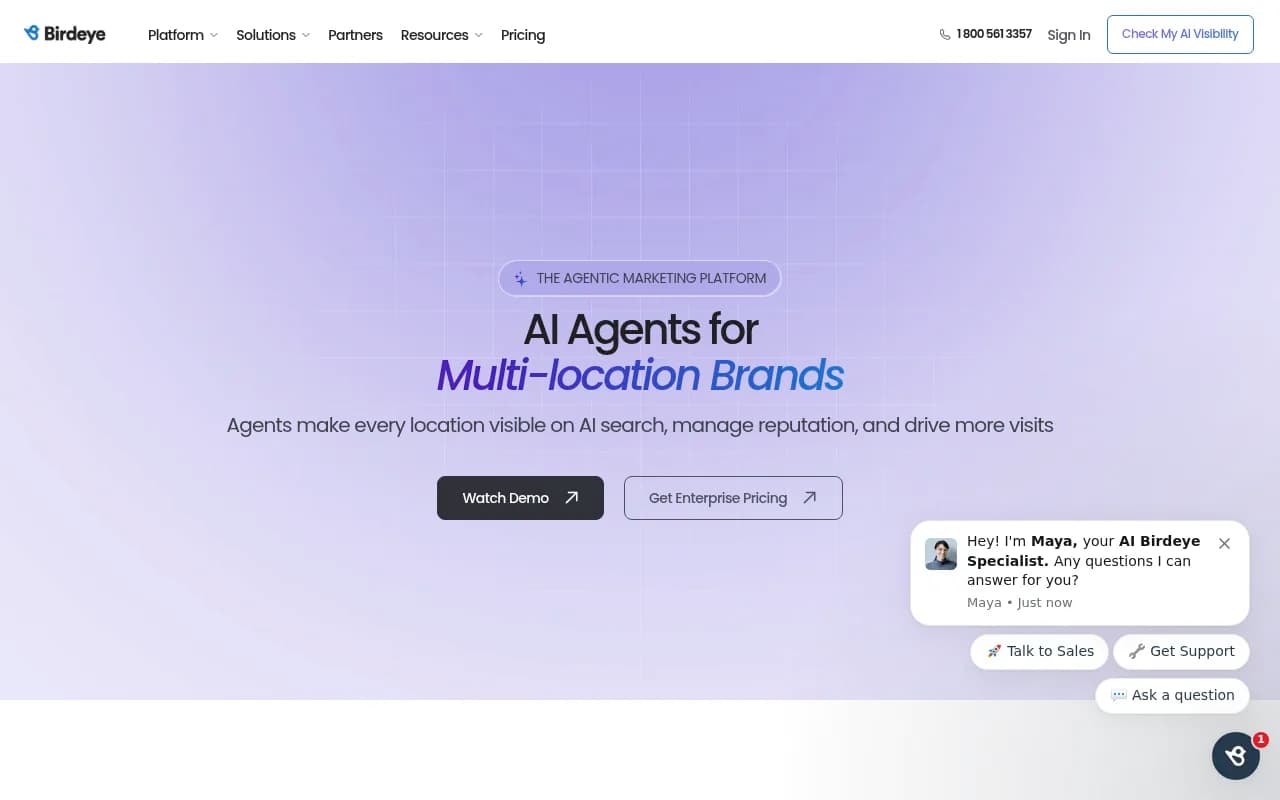
If you want options beyond this four-way comparison, a few others in the catalog are relevant to local and multi-location teams. Birdeye Search AI focuses on location-level AI visibility:
Semrush's AI visibility toolkit suits teams that already live in Semrush:
For a broader view of the category, the GEO software directory at bestgeosoftware.com lists many more AI visibility platforms.
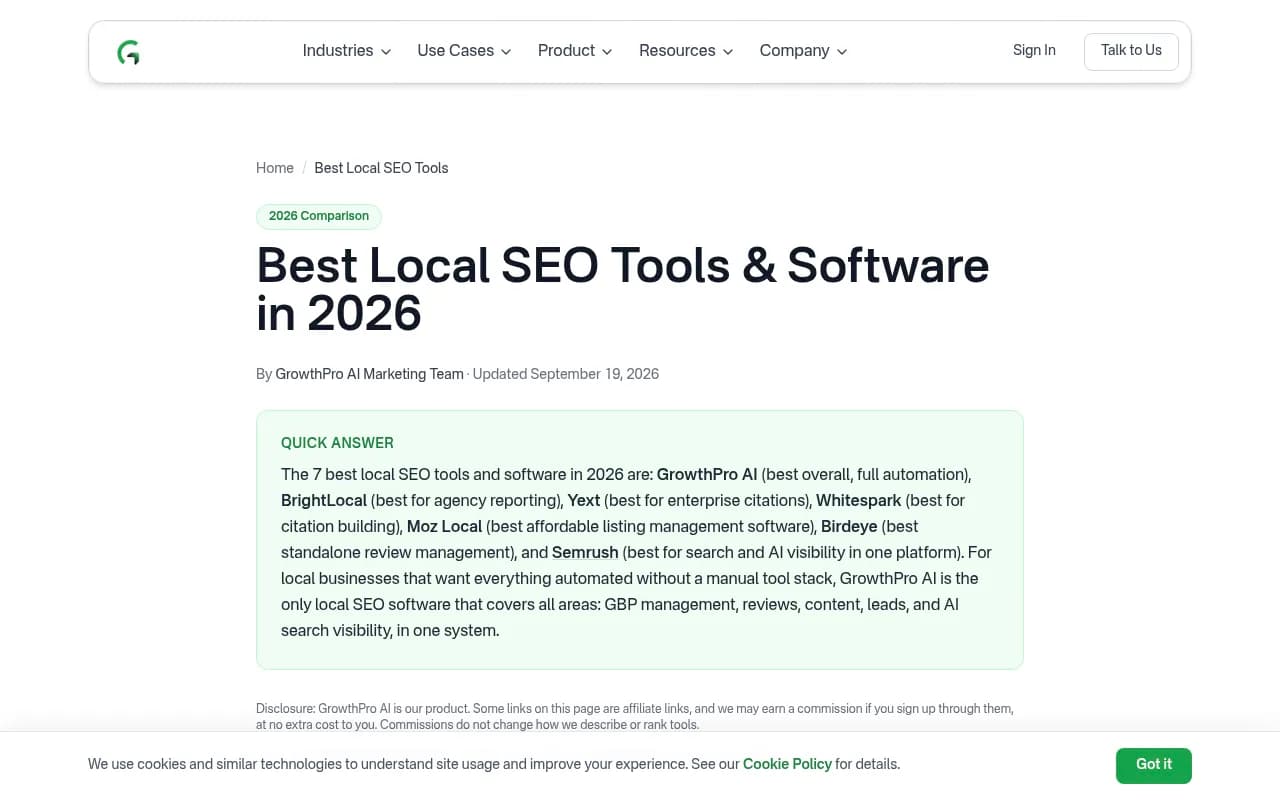
One warning about roundups. Some of the comparison pages ranking for this topic are published by vendors selling their own product. For example, a GrowthPro AI roundup that rates itself the top pick while marking competitors as lacking AI search. That does not make the points wrong, but it is why I flagged the feature claims above as unverified.
What I would do
Keep the listings tool you already have unless it is actively failing you. Switching Yext for Moz Local will not change your AI visibility. Add one AI visibility platform, run it for a month, and let the data show you whether your problem is listings, reviews, or your own pages.
If I had to pick one pairing for most small and mid-sized local teams: BrightLocal for audits and rank grids, Promptwatch for AI answers. For enterprises with hundreds of locations: Yext plus Promptwatch's Business or Enterprise plan. For tiny budgets: Moz Local plus the free Promptwatch plan.
FAQ
Do BrightLocal, Yext or Moz Local track ChatGPT answers?
Not as their core product, as far as the research I reviewed shows, though Yext sells a separate AI search tool and vendors keep adding features. Confirm on each vendor's current site.
Can Promptwatch replace my listings tool?
No. It does not manage citations or push NAP data to directories. It tells you what AI says and cites, and helps you fix the gaps.
Does fixing listings improve AI visibility?
Sometimes, especially in categories where booking, review and directory sites dominate citations, as in travel. But your own landing and product pages account for a large share of ChatGPT citations too, so listings alone are rarely enough.
How much should I budget?
Listings tools start around $16 to $199 a month by third-party reports. Promptwatch is free to try, with paid plans from $95 a month. Check promptwatch.com/pricing and each vendor's page for current numbers.
Where can I see more of Promptwatch's AI search research?
The Promptwatch Data hub publishes free reports on citations, crawlers and AI answer behaviour.