Key takeaways
- Checking your brand name alone catches almost nothing. Adobe's own research on tracking mentions shows visibility is defined by inclusion in generated answers, not by rank, and inclusion happens across dozens of query phrasings your brand name will never trigger.
- Google AI Overviews now cite product pages more than listicles as of late July 2026, according to Promptwatch's citation-type data, which changes what kind of page you need live for each query type.
- Category, comparison, and problem-first queries carry more competitive risk than branded queries because you have no guaranteed presence there and everyone else is fighting for the same slots.
- 40-60% of cited domains change monthly for identical queries, per Profound's volatility research, so a one-time audit tells you almost nothing. You need a recurring query set run on a schedule.
- The 9 query types below cover branded, discovery, competitive, and transactional intent, the combination that actually mirrors how real buyers use AI Overviews.
Why brand-name searches aren't enough
Here's the mistake I see constantly: a marketing team types their own company name into Google, sees an AI Overview mention, and calls it a day. That tells you almost nothing.
AI Overviews trigger on informational, commercial, transactional, and navigational queries at wildly different rates depending on your industry. In education, trigger rates jumped from 18% to 83% between February 2025 and February 2026. In e-commerce, they stayed under 14% the whole time, because Google is protecting ad revenue on transactional queries. If you only test your brand name, you're testing a navigational query type that behaves nothing like the category queries where your actual customers are researching.
And the content that gets cited is shifting too. Promptwatch's July 2026 data on AI Overviews citation types found that from July 28 onward, product pages overtook listicles as the single most-cited format for the first time, at roughly 18% vs 16%. Video citations also climbed to 6.3% of AI Overview citations by late July, up from 2.7% in January, which means most brands still have zero video competing for those slots. If you're monitoring the wrong query types, you won't even notice these shifts happening under you.
The 9 query types, and why each one matters
1. Brand name alone
"What is [Brand]?" or just "[Brand]". This is your baseline. It tells you whether Google's AI Overview even understands who you are and describes you accurately. It's the lowest-value query type competitively, since nobody else can win it for you, but it's the fastest way to catch factual errors, outdated info, or a negative framing before it spreads.
2. Brand + category
"[Brand] project management software" or "[Brand] CRM pricing". This checks whether Google connects your brand to the category it actually operates in. Miss this and you risk being described vaguely or, worse, associated with the wrong category entirely if your company name overlaps with something else.
3. Category queries without a brand name
"Best [category] for [use case]" or "top [category] tools for small teams". This is where the real competitive fight happens. Nobody typing this knows your name yet. CitedSpy's research on brand monitoring frames this correctly: branded queries are lower priority than category-level queries, because on category queries "you have no guaranteed presence and competition is highest." These are discovery queries, and they're the ones worth tracking weekly, not monthly.
4. Problem-first queries
"How do I [solve the problem your product addresses]?" People don't always know a category name exists for their problem. "How do I track what ChatGPT says about my company" is a real query that has nothing to do with brand or category vocabulary, but it's exactly the moment your product should surface. These queries also trigger AI Overviews at unusually high rates when phrased as questions, since roughly 58% of AIO-triggering queries are phrased as questions.
5. Comparison queries ("X vs Y")
"[Your brand] vs [Competitor]" and the reverse. These are high-intent, bottom-of-funnel moments, and AI Overviews increasingly pull from comparison-formatted content to answer them. If a competitor has a dedicated "X vs Y" page and you don't, you're handing them the framing of the entire comparison.
6. Alternative queries
"[Competitor] alternatives" or "alternative to [Competitor]". Someone already committed to a competitor's category but is shopping around. This query type rewards brands with strong third-party presence, review sites, comparison roundups, Reddit threads, because AI Overviews lean on external validation here more than on-site marketing copy.
7. Validation queries
"Is [Brand] worth it?", "Is [Brand] legit?", "[Brand] reviews". Frase's monitoring framework separates these from discovery queries because they signal someone already knows you and is doing due diligence. This is where sentiment matters more than mention frequency. A neutral or slightly negative summary here can kill a deal that was otherwise close.
8. Local or geographic queries
"[Category] near me" or "[category] in [city]". Relevant if you have any local, regional, or service-area component. AI Overviews weight local pack data and location-specific pages differently than pure informational queries, so this needs its own tracking lane if it applies to your business.
9. Long-tail, multi-word informational queries
Questions phrased in full sentences, 8+ words, rather than short keyword fragments. These trigger AI Overviews at notably higher rates, up to 7x more likely to surface an AIO than short queries according to WordStream's analysis. Your traditional keyword tool probably isn't even tracking these phrasings, since they look nothing like the 2-3 word keywords SEO teams are used to targeting.
How these map to what AI Overviews actually cite
| Query type | Intent stage | What Google AI Overviews tends to cite |
|---|---|---|
| Brand name alone | Navigational | Your own site, Wikipedia, about pages |
| Brand + category | Navigational/commercial | Your site, review aggregators |
| Category (no brand) | Discovery | Listicles, product pages (near-tied as of July 2026) |
| Problem-first | Discovery/informational | How-to content, news articles |
| Comparison (X vs Y) | Consideration | Comparison pages, forum threads |
| Alternatives | Consideration | Review sites, Reddit, third-party roundups |
| Validation | Decision | Reviews, forums, social posts |
| Local | Decision | Local landing pages, directories |
| Long-tail informational | Informational | How-tos, listicles, news |
This table is a starting point, not a fixed rulebook. Otterly.ai's own research found that 59.8% of AI Overview citations point to brand websites, notably higher than ChatGPT or Perplexity, which lean harder on Wikipedia and Reddit. That's actually good news: if you're monitoring category and problem-first queries and finding you're not cited, the fix is often as straightforward as building the page that directly answers the query, rather than chasing third-party PR.
Building your actual query list
Don't overthink the first pass. Pull 20-30 queries covering all nine types above, weighted toward your business. A B2B SaaS company might lean hard into categories 2, 3, 5, and 6. A local service business needs category 8 covered thoroughly and can probably de-prioritize 9.
A few practical rules that come up across most monitoring frameworks:
- Test multiple phrasings of your highest-value queries. Wording changes which sources get cited, sometimes significantly.
- Run each query more than once. These systems are non-deterministic; a single check on a single day tells you the rate at which you appear, not a yes/no fact.
- Test logged out or in a fresh session. An account with months of history discussing your company gives the model context a first-time user won't have, and you'll overestimate your real visibility.
- Don't stop at Google. Content overlap between what ChatGPT, Perplexity, and Google AI Overviews cite for the same query is only 10-15%, according to ZipTie's analysis of the space. Tracking one platform and assuming it represents the others is a mistake.
Cadence: how often to actually check
Monthly is the bare minimum, and honestly it's not enough for anything competitive. Citation source mixes can flip overnight. Promptwatch's data on Reddit citations dropping in ChatGPT shows Reddit's share of ChatGPT Search citations collapsing from around 4% to 0.5% in a single week in August 2026, coinciding with a broader change in how ChatGPT runs background searches. A brand relying on a monthly spreadsheet check would have missed that entirely and drawn the wrong conclusions about why their citations moved.
Realistically:
- Validation and brand queries (types 1, 2, 7): weekly. These affect reputation and deal outcomes directly.
- Category, problem-first, comparison, alternatives (types 3, 4, 5, 6): weekly if you're in a competitive category, biweekly otherwise.
- Local and long-tail (types 8, 9): monthly is usually fine unless local is core to your business.
Manual tracking vs a dedicated platform
A spreadsheet works fine to learn the basics. Pick your 20-30 queries, run them on a schedule, log whether you appeared, how you were described, and which competitors showed up instead. It's genuinely useful for the first month or two because it forces you to understand what you're measuring instead of trusting a dashboard blindly.
Where manual tracking falls apart is scale and consistency. Running 30 queries across four platforms every week, logged out, multiple runs per query, with screenshots for a paper trail, becomes a part-time job fast. That's the gap dedicated AI visibility platforms are built to close.
Promptwatch is built specifically around this problem, monitoring the real user-facing interfaces of ChatGPT, Gemini, Claude, Perplexity, Google AI Overviews, AI Mode, Grok, and others, not just their APIs, which matters because what a user actually sees can differ from raw API output. It tracks prompt-level citation rates, query fan-outs (how a single query expands into sub-searches), and gives you a Content Gap Analysis that maps your existing pages against what AI is actually answering, then generates briefs to close the gaps. It also tracks Reddit and YouTube citations specifically, two channels most competitors in this space ignore entirely.
Other tools worth knowing about depending on your needs: Otterly.AI is a low-cost entry point focused specifically on AI Overview and Perplexity monitoring at scale.
Profound leans enterprise, with strong prompt-fanout analysis for large brands.
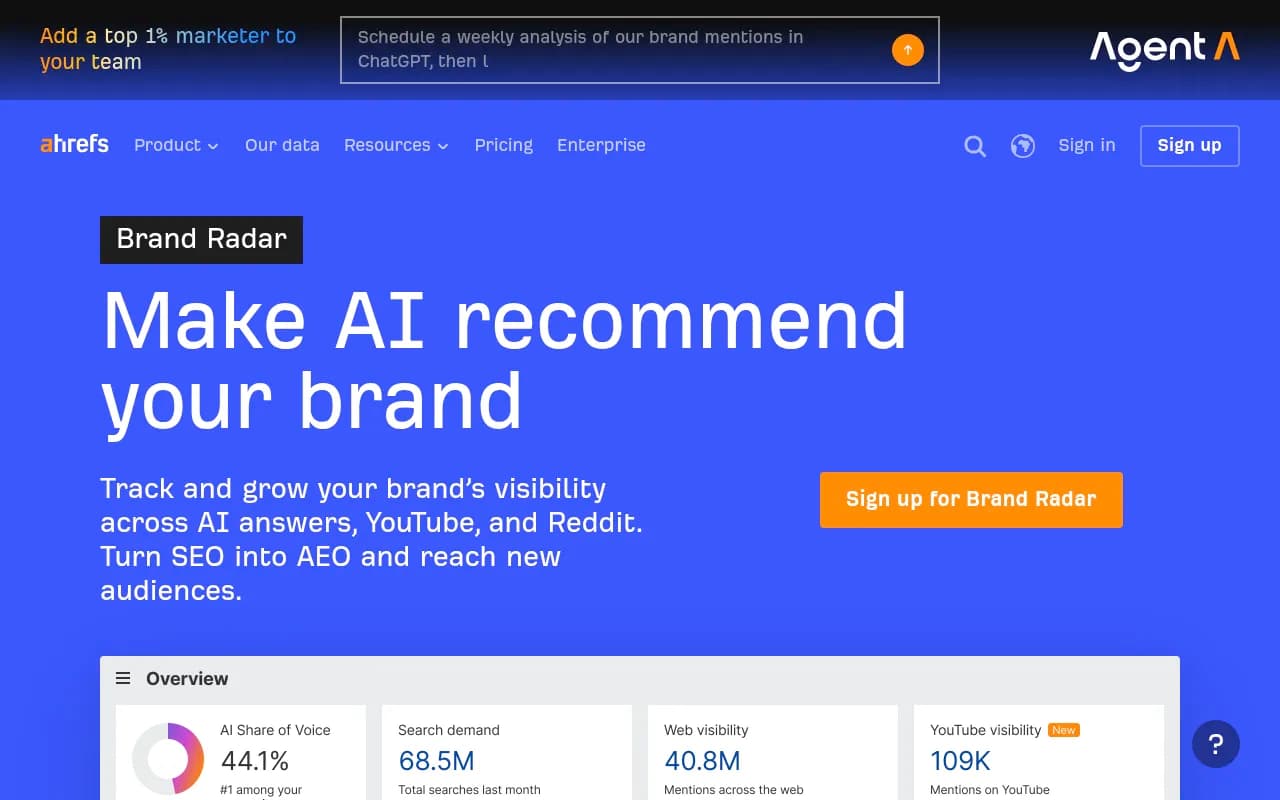
Ahrefs Brand Radar folds AI tracking into an existing SEO subscription if you're already paying for Ahrefs.
| Tool | Entry price | Platforms tracked | Best for |
|---|---|---|---|
| Promptwatch | $95/mo | ChatGPT, Gemini, Claude, Perplexity, AI Overviews, AI Mode, Grok, Copilot, more | End-to-end monitoring plus content fixes |
| Otterly.AI | $29/mo | ChatGPT, AIO, Perplexity, Copilot | Budget-conscious teams, basic tracking |
| Profound | $99/mo | ChatGPT (base tier); adds Perplexity, AIO on higher tiers | Enterprise prompt-fanout analysis |
| Ahrefs Brand Radar | Add-on to Ahrefs plan ($129+/mo) | Multiple, tied to Ahrefs' index | Teams already on Ahrefs |
If you want a broader view of the category before picking one, the GEO software directory at bestgeosoftware.com lists a wider set of options side by side.
What to do with the data once you have it
A citation count without context is close to useless. You need a competitor benchmark, so you know if you're at 20% mention rate because your content is weak or because that's just what this query type does industry-wide. You need historical trending, because a single snapshot can't tell you if you're improving or declining. And you need to weight mentions by quality, not just count: a linked citation ranked first in the answer is worth far more than an unlinked mention buried at the bottom.
Also, don't panic and blame your content team every time a number drops. When ChatGPT's average citations per response fell about 27% after the GPT-5.3 rollout in March 2026, per Promptwatch's citation-drop data, it happened across every model simultaneously, a platform-wide behavior change, not something any individual brand did wrong. If your citation rate drops right after a known model update across the board, check whether competitors dropped too before rewriting your content strategy.
Run the nine query types above on a real schedule, across more than one platform, and you'll catch nearly every meaningful AI Overview mention of your brand instead of just the handful your brand name happens to trigger.