Key takeaways
- AI crawlers like GPTBot, PerplexityBot, and ClaudeBot leave traces in your server logs every time they visit your site -- long before any user clicks through from an AI answer.
- Log analysis is currently the most reliable way to see which pages AI engines are reading, how often they return, and which ones they're ignoring entirely.
- Pages that rank well in Google may be invisible to AI engines, and vice versa. Logs expose that gap.
- Different AI crawlers behave very differently -- crawl frequency, depth, and user-agent patterns vary significantly between OpenAI, Perplexity, and Anthropic.
- Platforms like Promptwatch turn raw crawler log data into actionable dashboards, connecting crawl activity to actual citations and traffic.
The problem with AI search: it's a black box
Traditional SEO has always had a feedback loop. Google Search Console tells you which queries you rank for, which pages get impressions, and roughly how much traffic you're getting. It's imperfect, but it's something.
AI search has no equivalent. When ChatGPT recommends your competitor's product instead of yours, you don't get a notification. When Perplexity cites an article from your site in a response about your industry, you might see a trickle of referral traffic -- or nothing at all, because the user got their answer without clicking.
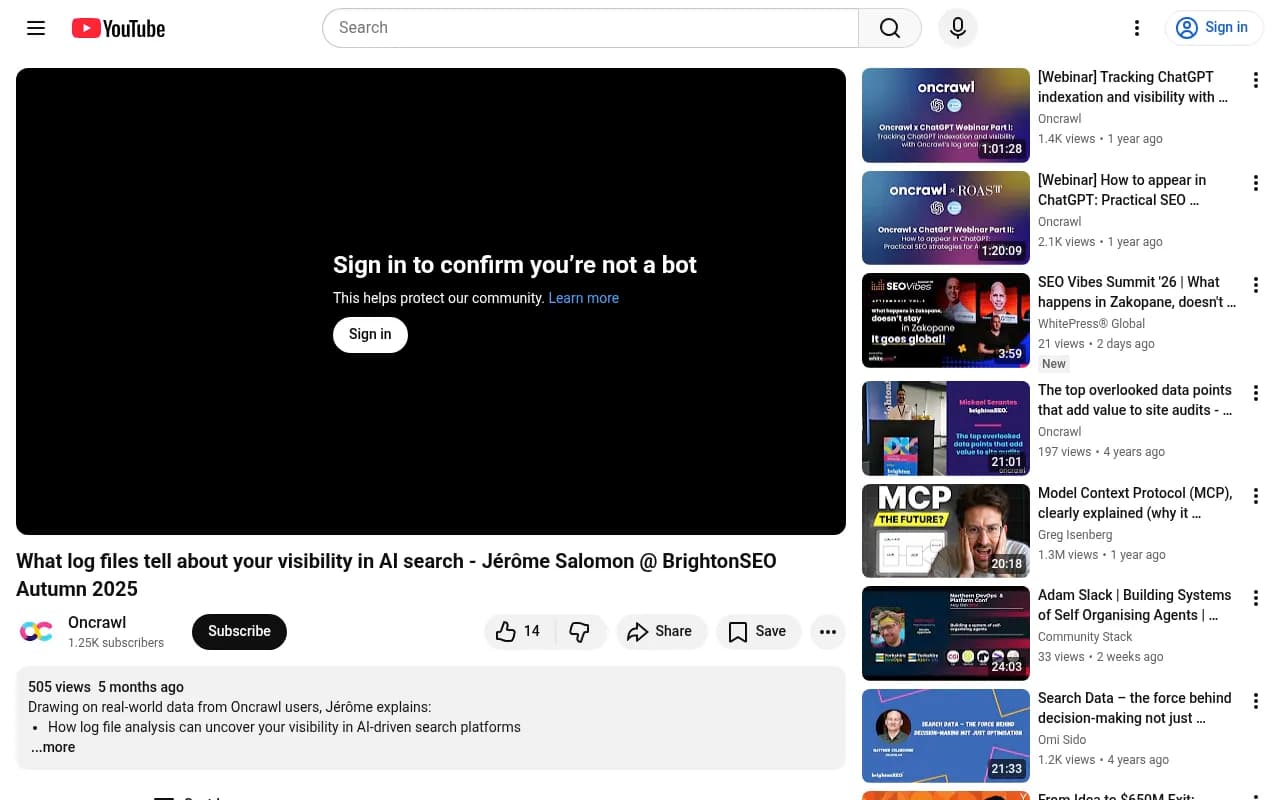
This is what Jérôme Salomon described at BrightonSEO Autumn 2025: "AI search is a black box. We don't get to see the court. We don't get to watch the game." His talk, based on real data from Oncrawl users, made a compelling case that log files are currently the closest thing SEOs have to an AI search console.
The insight is simple: even when AI engines don't send clicks, they do send crawlers. And those crawlers leave footprints.
What AI crawler logs actually are
Every time a bot visits your website, your server records a log entry. A typical line looks something like this:
66.249.64.20 - - [13/Jun/2026:09:14:22 +0000] "GET /blog/seo-guide HTTP/1.1" 200 4521 "-" "GPTBot/1.0"
That single line tells you:
- The IP address of the crawler
- The exact timestamp of the visit
- Which URL was requested
- The HTTP status code returned (200 = success, 404 = not found, etc.)
- The user-agent string identifying the bot
For years, SEOs have used these logs to track Googlebot behavior -- monitoring crawl budget, spotting 404 errors, identifying pages that get crawled but never indexed. The same method applies to AI crawlers. Same files, same analysis approach. The difference is what the data reveals.
AI crawlers tell a different story than Googlebot. They're not building a ranked index. They're fetching content for retrieval, training, or real-time answer generation. Understanding that distinction changes how you interpret the data.
Which AI crawlers are visiting your site?
The first thing most SEOs discover when they look at their logs is that there are more AI bots than they expected. Here's a quick reference for the major ones:
| Crawler | User-agent string | Associated product |
|---|---|---|
| GPTBot | GPTBot/1.0 | ChatGPT / OpenAI |
| ChatGPT-User | ChatGPT-User | ChatGPT real-time browsing |
| PerplexityBot | PerplexityBot/1.0 | Perplexity AI |
| ClaudeBot | ClaudeBot/0.5 | Anthropic / Claude |
| Claude-User | Claude-User | Claude real-time retrieval |
| CCBot | CCBot/2.0 | Common Crawl (used by many LLMs) |
| Applebot-Extended | Applebot-Extended/0.3 | Apple Intelligence |
| Meta-ExternalAgent | Meta-ExternalAgent/1.1 | Meta AI |
| Bytespider | Bytespider | ByteDance / TikTok AI |
The distinction between GPTBot and ChatGPT-User is worth understanding. GPTBot is OpenAI's training crawler -- it's building the model's knowledge base. ChatGPT-User is the real-time browsing agent that fetches live content when a user asks ChatGPT a question with web search enabled. Seeing ChatGPT-User in your logs means your content is being actively retrieved during real user conversations. That's a much stronger signal.
What logs reveal that other tools can't
A Reddit thread from a technical SEO who analyzed 11 million log events over three months put it well: "Each AI crawls website completely differently." The crawl patterns, frequencies, and page preferences vary enormously between OpenAI, Perplexity, and Anthropic bots. You can't infer one from the other.
Here's what log analysis specifically tells you that you can't get from rank trackers or citation monitoring tools alone:
Which pages AI engines are actually reading
You might assume AI engines crawl your most popular pages. Often they don't. They follow links, sitemaps, and their own internal prioritization logic. Logs show you the actual list of URLs being fetched -- which can be surprisingly different from your top-traffic pages.
Crawl frequency and recency
How often is PerplexityBot coming back to your site? Is it revisiting your blog posts weekly or has it not returned in two months? Frequency matters because AI engines that retrieve live content need fresh crawls to surface updated information. If a bot visited once and never returned, your updated content isn't being seen.
HTTP errors AI crawlers are hitting
This is underused. If GPTBot is hitting a 404 on a page that used to exist, or getting a 403 because your server is blocking it, that's a direct crawlability problem. Your content can't appear in AI answers if the crawler can't read it. Logs surface these errors immediately.
The gap between crawled and cited pages
Not every page that gets crawled ends up cited in AI answers. But pages that never get crawled definitely don't. Logs give you the crawl side of the equation. Pair that with citation tracking and you can start to understand which crawled pages are converting into actual AI visibility.
How AI crawlers differ from Googlebot
This is where it gets interesting. Googlebot's job is to index pages for a ranked list. AI crawlers have different objectives, and that changes their behavior in a few important ways.
Googlebot respects crawl budget constraints and tends to prioritize high-authority, frequently updated pages. AI crawlers -- especially training crawlers like GPTBot and CCBot -- often go deeper into a site's archive, fetching older content that Googlebot might deprioritize.
AI retrieval agents (the real-time ones like ChatGPT-User and Claude-User) behave more like a user following a specific research path. They may fetch a handful of pages in quick succession, following internal links, then stop. This is very different from Googlebot's broad, systematic crawl.
One practical implication: a page that Google has effectively stopped crawling because it's old and low-authority might still be actively fetched by AI engines if it answers a specific question well. Your logs might reveal that an article from 2022 is getting regular visits from PerplexityBot even though Google hasn't touched it in months.
Why this matters for your SEO strategy
The core argument for paying attention to AI crawler logs is that they give you visibility into a part of the search ecosystem that has no other data source.
If you're only looking at Google Search Console, you're missing the picture. AI search is already a meaningful traffic channel for many sites, and for informational queries, it's growing fast. More importantly, AI answers influence decisions even when they don't generate clicks -- a user who gets a product recommendation from ChatGPT may go directly to that brand's website without ever clicking a search result.
Understanding which of your pages AI engines are reading (and which they're ignoring) lets you:
- Fix crawlability issues that are blocking AI visibility
- Identify content gaps where AI engines are visiting but not finding what they need
- Prioritize content updates on pages that are actively being fetched
- Understand which topics and formats AI engines prefer on your specific site
The Search Engine Land analysis of log file data for AI crawlers makes the point directly: tracking how AI crawlers access your site and identifying crawl gaps is foundational work, not advanced optimization. It's the equivalent of making sure Googlebot can find your pages -- except now you need to think about eight or ten different crawlers, not one.
How to start analyzing your AI crawler logs
Step 1: Access your raw logs
Where your logs live depends on your hosting setup. Common options:
- Apache/Nginx servers: usually in
/var/log/apache2/access.logor/var/log/nginx/access.log - Cloudflare: enable Logpush to export logs to a storage bucket
- CDN providers (Fastly, Vercel, AWS CloudFront): each has its own log export mechanism
- Managed hosting: check your control panel or ask your host
If you're on a shared host with no log access, this is a real limitation. It's worth advocating internally for log access if you're serious about technical SEO.
Step 2: Filter for AI bot user-agents
Once you have raw logs, you need to filter for the AI crawler user-agents listed above. A basic grep command works for a quick check:
grep -i "GPTBot\|PerplexityBot\|ClaudeBot\|ChatGPT-User\|CCBot" access.log
For ongoing analysis, you'll want something more structured -- either a log analysis tool or a platform that ingests logs automatically.
Step 3: Look for patterns
Raw log lines are hard to interpret at scale. What you're looking for:
- Which URLs are being crawled most frequently by each bot?
- Are there 4xx or 5xx errors in AI bot requests?
- How does crawl frequency compare across different AI crawlers?
- Are there sections of your site that no AI crawler has visited?
Step 4: Connect crawl data to citation data
This is where the real insight comes from. Knowing that PerplexityBot crawled a page is useful. Knowing that it crawled the page and then Perplexity started citing it in answers is much more useful. That connection -- from crawl to citation -- is what lets you build a feedback loop.
Promptwatch does this automatically. Its AI Crawler Logs feature ingests your server logs (via Cloudflare, Fastly, Vercel, server log uploads, or a tracking snippet) and shows you which pages AI engines are reading, what errors they're hitting, and how crawl activity correlates with actual citations across ChatGPT, Perplexity, Claude, and other models. The timeline from crawl to citation is visible in one place.
Tools for AI crawler log analysis
You don't have to do this manually. Several tools now support AI crawler log analysis, either as a dedicated feature or as part of a broader SEO platform.
| Tool | AI crawler log support | Citation tracking | Content optimization |
|---|---|---|---|
| Promptwatch | Yes (native, multi-model) | Yes | Yes (content agents) |
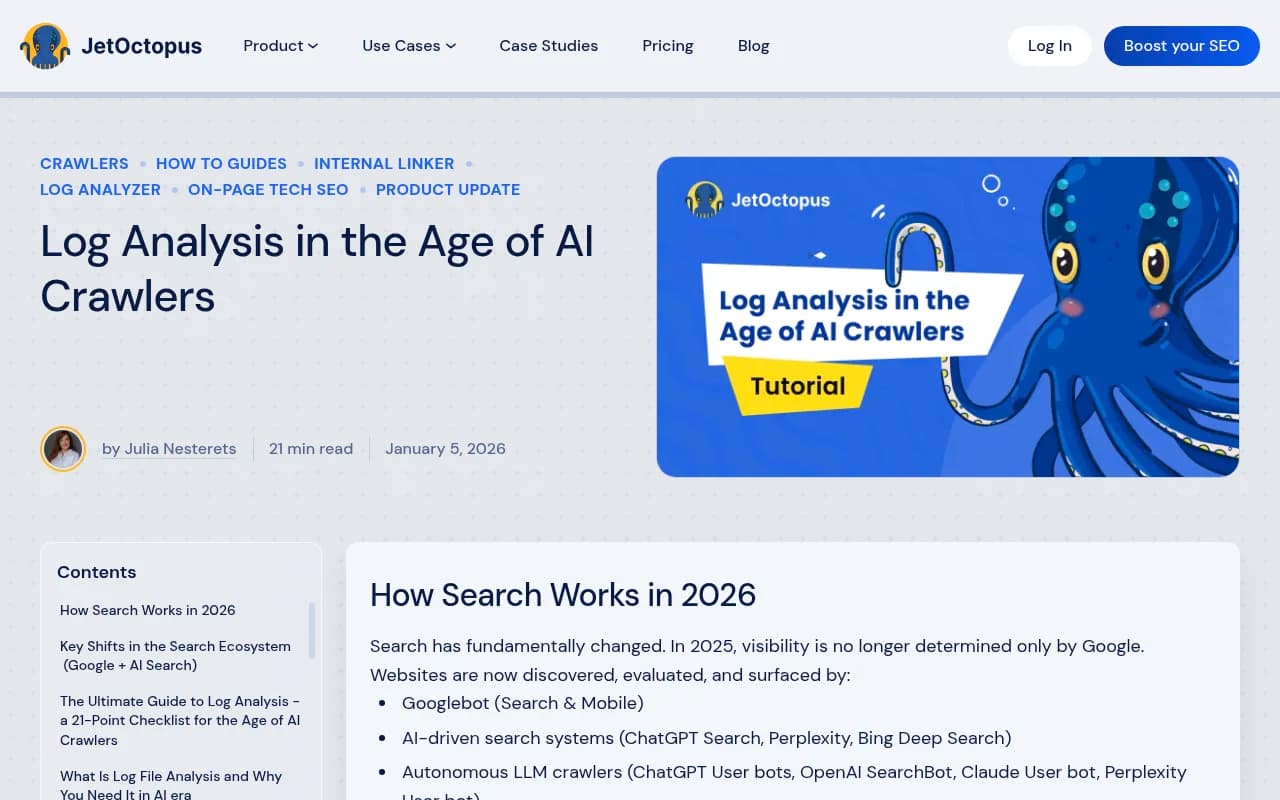
| JetOctopus | Yes (log analyzer) | Limited | No |
| Oncrawl | Yes (log analysis) | No | No |
| Semrush | Partial (site audit) | Limited | Yes |
| Ahrefs | No dedicated log feature | Brand Radar only | No |
| Screaming Frog | Manual log import | No | No |
For pure log analysis, JetOctopus and Oncrawl are solid technical tools. They're built for SEOs who want to dig into raw crawl data at scale.
Where Promptwatch differs is in connecting log data to the full picture: which prompts users are asking, which AI engines are citing your competitors but not you, and what content you need to create to close those gaps. Log analysis is one input into a larger optimization workflow.
Common mistakes SEOs make with AI crawler logs
A few things worth avoiding once you start looking at this data:
Treating all AI crawlers the same. GPTBot (training) and ChatGPT-User (real-time retrieval) have very different implications. A page getting crawled by GPTBot might influence future model training. A page getting fetched by ChatGPT-User is being read right now, during an active user conversation.
Assuming robots.txt blocks are working as intended. AI crawlers vary in how strictly they follow robots.txt directives. Your logs will tell you what's actually happening, which sometimes differs from what you've configured. A Medium analysis of server log data found that AI retrieval systems expose only fragments of the pipeline -- what you see in logs is real, but it's not the complete picture.
Ignoring 403 errors. If your server is returning 403 Forbidden to AI crawlers, that's a deliberate or accidental block. Some sites do this intentionally. Many don't realize it's happening. Check your logs for 403s from AI user-agents and decide whether that's the outcome you want.
Focusing only on crawl volume. A page that gets crawled 50 times by PerplexityBot but never cited is less valuable than a page crawled 5 times that shows up in answers regularly. Volume is a starting point, not the goal.
The bigger picture
Log file analysis isn't new. SEOs have been doing it for Googlebot for over a decade. What's changed is that there are now ten or more AI crawlers that matter, each with different behavior, different objectives, and different implications for your visibility.
The good news is that the skill set transfers. If you've ever analyzed Googlebot crawl patterns to optimize crawl budget, you already understand the fundamentals. You're just applying them to a more complex environment.
The harder part is connecting crawl data to AI citations and then to actual business outcomes. That's where most manual log analysis falls short -- it tells you what's being crawled but not whether it's working. Platforms that close that loop, from crawler activity through to citation tracking and traffic attribution, are where the real value is in 2026.
For SEOs who want to stay ahead of how AI search actually works, not just how it's supposed to work, crawler logs are the most honest data source available right now.