Key takeaways
- No one source dominates software prompts. In Promptwatch Data for Sep 28 to Oct 4, 2026, the top domain (github.com) earned just 1.2% of software citations in ChatGPT.
- Docs, help centers and vendor sites together earn about 3 times the share of review sites and analysts, but G2, Capterra, Gartner and Software Advice combined (1.57%) still beat any single vendor.
- Product and landing pages make up 39% of ChatGPT citations overall, and nearly half for commercial prompts like "best CRM for small businesses".
- Models disagree. One 13,184-citation study across 4 LLMs found they almost never cite the same sources, so you need a per-model plan.
- Promptwatch has no marketing-software-only report. Everything below about marketing tools is an inference from the broader software data.
The short answer
When someone asks ChatGPT which email platform, CRM or analytics tool to buy, the answer is stitched together from a long tail of pages. Documentation, vendor product pages, GitHub repos, review sites and a few blogs all get a slice. None gets a big one.
That matters if you sell marketing software. The playbook is not "win one channel." It is "be present in four or five kinds of places, and make each one crawlable and current."
A caveat up front. The best first-party data I can point to is Promptwatch Data's report on software prompts, covering Sep 28 to Oct 4, 2026. It is about software in general, not marketing software specifically. HubSpot's blog shows up in the chart, and so do Intercom, Zapier, Zendesk and Salesforce's help center, which hints at how the category behaves. But treat the conclusions as informed inference, not proof.
What the software citation data shows
Shares are a percentage of all software citations, so every single domain looks small. That is the first finding.
| Domain | Share of software citations |
|---|---|
| github.com | 1.2% |
| learn.microsoft.com | 0.98% |
| g2.com | 0.73% |
| docs.aws.amazon.com | 0.41% |
| docs.cloud.google.com | 0.35% |
| gartner.com | 0.34% |
| capterra.com | 0.32% |
| intercom.com | 0.28% |
| zapier.com | 0.24% |
The chart also lists blog.hubspot.com, help.salesforce.com, zendesk.com, softwareadvice.com, adobe.com and a few app stores, without figures in the page text. The 23 charted domains together earn 7.89% of all software citations. The rest is long tail.
Source types, not just domains
Grouped by type, the picture is clearer:
| Source type | Share |
|---|---|
| Docs and help centers | 2.64% |
| Vendor sites | 2.01% |
| Review sites and analysts (G2, Gartner, Capterra, Software Advice) | 1.57% |
| GitHub | 1.2% |
| App stores | 0.47% |
Vendor sites and docs together earn 4.65%, about three times the review-site share. Still, the review sites combined out-earn any single vendor, Microsoft included. So if you only invest in your own site, you are leaving the second biggest bucket to your competitors' G2 profiles.
Big vendors are split across domains
Microsoft earns 1.35% across 3 domains. Google gets 0.98% across 4. AWS gets 0.69% across 2, and OpenAI 0.42% across 2. Docs subdomains, support sites and marketing sites all get cited separately. For a marketing software company, that is a reminder that your help center and your developer docs are citation surfaces in their own right, not afterthoughts.
What types of pages get cited
Source type is one lens. Page type is another. Promptwatch's content type report for the same week shows how ChatGPT's citations break down.
| Content type | Share of ChatGPT citations |
|---|---|
| Product pages | 22.4% |
| Landing pages | 16.8% |
| Listicles | 13.6% |
| How-tos | 8.7% |
| Documentation | 7.5% |
| Articles | 6.1% |
| Comparisons | 5.9% |
| News | 5.7% |
| FAQ | 3.3% |
| Reviews | 1.7% |
Product and landing pages add up to 39%. For commercial prompts, the kind a buyer types when shopping, the weight tilts even more: product pages 26.0%, landing pages 20.6%, listicles 15.0% and comparisons 7.9%. Those four types make up almost 70% of commercial citations.
I find this the most useful number in the whole dataset, because it contradicts the instinct many content teams have. Years of SEO taught us that blog posts win. For buying prompts, your product page is often the cited asset, not your blog.
Branded prompts behave differently
When someone asks something like "is HubSpot good for startups," reviews jump to 5.6% of citations, more than three times their overall share. FAQ pages hit 4.8%, social posts 3.0% and press releases 2.1%. Product pages (23.3%) and landing pages (22.8%) still lead.
That suggests a practical split:
- Category prompts ("best email marketing software") are won by product pages, landing pages and listicles.
- Brand prompts ("is X worth it") lean on reviews, FAQs and your own pages answering objections.
- Informational prompts ("how do I set up lead scoring") lean on how-tos (10.7%) and documentation (8.5%).
The models do not agree with each other
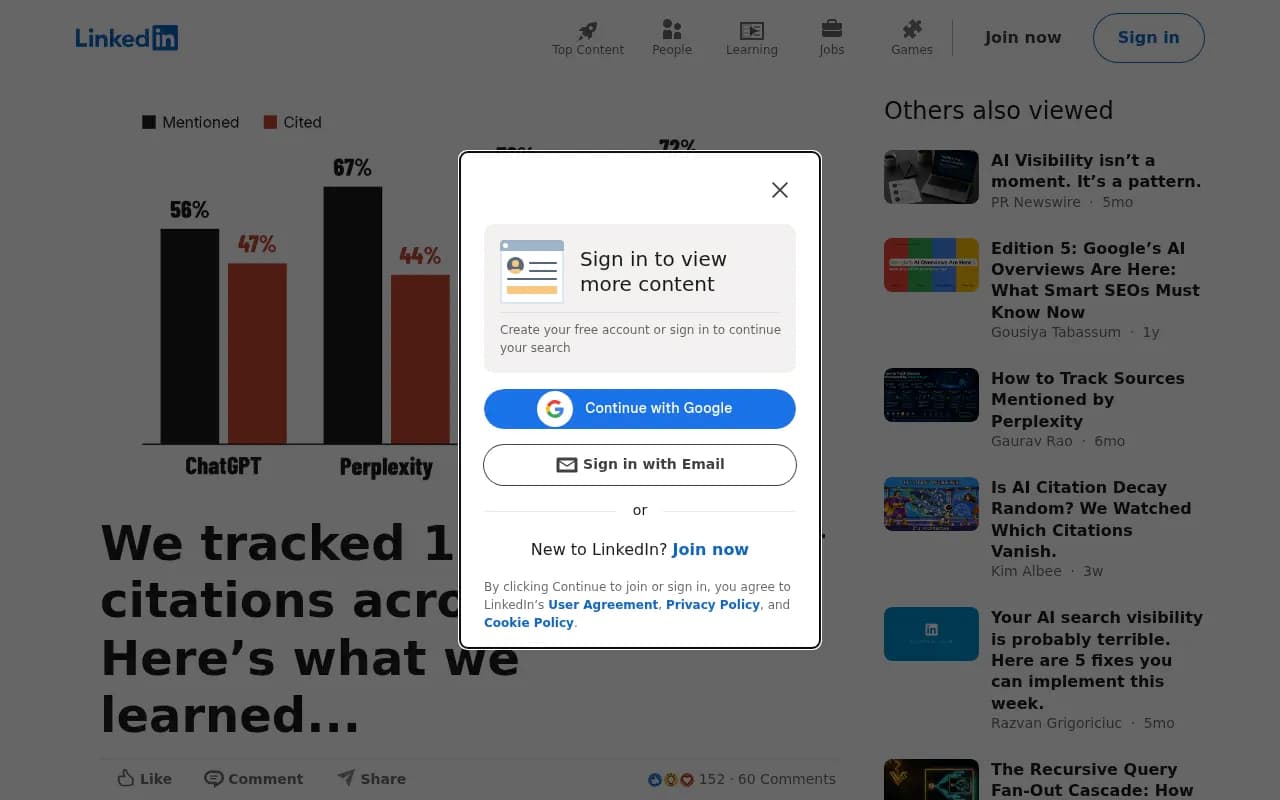
Another data point worth keeping in mind: a study by Andy Crestodina tracked 13,184 AI citations across 4 LLMs and found the models almost never cite the same sources. Across 1,792 query-and-domain combinations, all four agreed on the same domain only a handful of times.
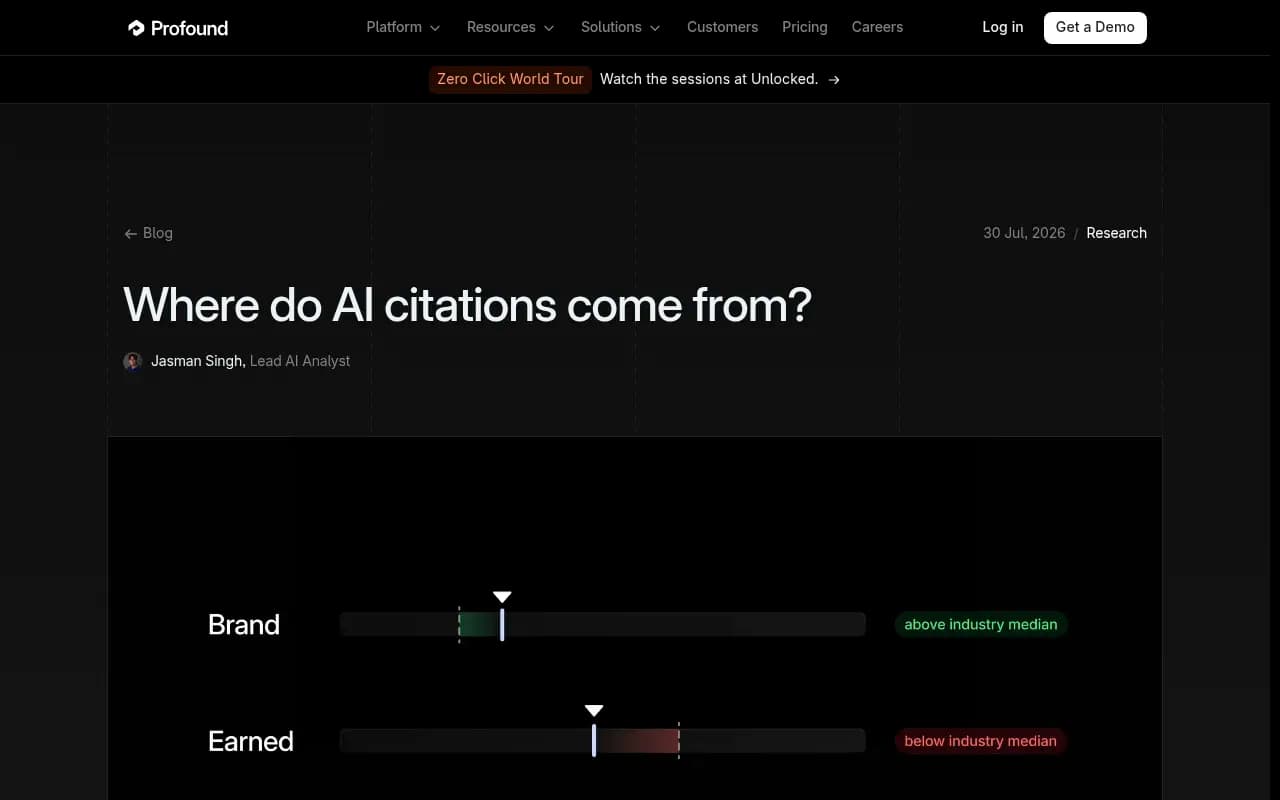
Profound makes a similar point in its research on where AI citations come from: the source mix depends on which model answers, and ChatGPT's data licensing deals mean it can see data other models cannot. Profound's analysis of 11.8 billion citations across 29 industries and 8 models found that about 57% of citations globally come from brand sites, and that marketing is far more reliant on brand media (72% of citations) than pharma (33%). That is a useful hint for marketing software vendors: your competitors' own sites are a big part of the citation pool.
Social platforms by model
The social picture is especially model-specific. From Promptwatch's social media citation data (Sep 28 to Oct 4, 2026):
| Model | Social share of citations | Notable detail |
|---|---|---|
| ChatGPT | 0.46% | Reddit fell from 5.19% to 0.09%; LinkedIn is now top social at 0.3% |
| Perplexity | 2.7% | LinkedIn and Reddit 0.86% each; YouTube 0.79% |
| Google AI Overviews | 12.2% | YouTube 4.28%, Facebook 2.38%, Reddit 2.15% |
AI Overviews gets about 26 times ChatGPT's social share. The ChatGPT Reddit collapse is covered in Promptwatch's report on Reddit citations dropping: reddit.com's share fell from roughly 4% to 0.5% on August 14, 2026. If your strategy for ChatGPT visibility was seeding Reddit threads, that advice is stale. For Google surfaces, YouTube is the platform to take seriously.
What marketing software vendors should do
Here is how I would translate the data into a to-do list. These are inferences, not guarantees.
1. Treat docs and help pages as marketing assets
Docs and help centers are the largest source-type bucket in the software data. Vendors like Intercom, Zendesk and Salesforce appear because their help content answers specific how-to questions. Make sure your docs are public, crawlable without a login and written around the questions buyers actually ask. Put the answer in the first sentence under each heading. Evertune's guidance on citation factors says the same thing: if your header reads "Benefits of project management software," state the primary benefit immediately instead of building up to it.
2. Sharpen product and landing pages
These are the most cited page types for commercial prompts. Include concrete details a model can quote: who the product is for, pricing structure, integrations, limits and a plain-language feature list. Vague positioning copy gives a model nothing to extract.
3. Keep G2, Capterra and Gartner listings current
Review sites and analysts combined beat any single vendor. Complete the profile, collect recent reviews and fix outdated category tags. This is boring work with a measurable payoff.
4. Publish comparison and listicle content, honestly
Listicles are 13.6% of ChatGPT citations and comparisons 5.9%. Models pick up pages that compare options in a scannable way. Write your own "X vs Y" and "best tools for Z" pages, but be fair. Obviously rigged comparisons are weak, and models also pull from independent listicles you do not control, which is where digital PR comes in.
5. Plan for content decay
According to Promptwatch's content half-life report, landing pages and docs stay cited longest, while news lost half its pages within 36 days. Time-sensitive launch posts will fade. Evergreen product and docs pages keep working, so refresh them rather than constantly publishing new announcements.
6. Pick social channels by model
YouTube for Google audiences. LinkedIn and Reddit for Perplexity. Do not count on Reddit for ChatGPT. Skip X, which peaks around 0.1% anywhere in this dataset.
7. Expect a crowded source list
Per Promptwatch's unique domains report, almost half of ChatGPT responses cite 10 or more unique domains (Sep 28 to Oct 4, 2026). Wide citation lists mean a lot of room for mid-sized brands, but also that you share each answer with many competitors.
How to measure this for your own category
Aggregate data is a starting point. Your category may look different. Marketing software prompts ("best marketing automation for B2B," "HubSpot alternatives") will surface different domains than generic software prompts, and the only way to know is to track your own prompts.
A workable process:
- Build a list of 30 to 100 prompts: category, comparison, brand and how-to questions.
- Run them daily across ChatGPT, AI Overviews, Perplexity and Gemini.
- Group cited domains by type: your site, competitors, review sites, docs, social, publishers.
- Find the prompts where competitors are cited and you are not.
- Fix the page, listing or content gap, then check again.
Promptwatch does this end to end, from tracking real AI interface responses to showing which pages get cited and which AI crawlers read your site, then helping draft content for the gaps.

Other tools worth a look for citation tracking include Profound for enterprise monitoring, Peec AI and Otterly.AI for lighter prompt tracking, and Evertune for analyzing AI responses at scale.




If you want more options, the GEO software directory at bestgeosoftware.com lists many of them side by side.
Comparing tool approaches
| Tool | Strength | Typical use |
|---|---|---|
| Promptwatch | Citation tracking plus crawler logs, traffic attribution and content creation | Teams that want to fix gaps, not just see them |
| Profound | Enterprise monitoring and large-scale research | Large brands needing analyst-style data |
| Peec AI | Straightforward visibility tracking | Smaller teams starting out |
| Otterly.AI | Affordable monitoring | Budget-conscious tracking |
| Evertune | Analysis of AI responses at scale | Brand perception research |
What the data cannot tell you
A few honest limits. The software report covers one week. Citation share moves fast: ChatGPT's Reddit share went from about 4% to 0.5% in a day. The shares are percentages of all software citations, so a 0.3% domain may still be significant in your niche. And no single report distinguishes marketing software from the rest of the category, so use it to shape hypotheses, then test them on your own prompts.
If you need help turning citation data into a plan, an agency like 1001 SEO Media works on technical SEO, content and AI search visibility together. For most teams, though, start with the audit: which of your pages are cited, which are not, and which review profiles are out of date.
Bottom line
For software prompts, ChatGPT cites a wide spread of docs, vendor pages, GitHub and review sites, and no source cracks 1.2%. Your job is to be in several of those buckets at once, with pages specific enough to quote. Check your own prompts weekly, because the mix keeps shifting.