Key takeaways
- AI engines build a picture of your brand from several sources at once: your site, Wikipedia, Crunchbase, review sites like G2, and more. When they disagree, the answer gets blurry or wrong.
- Stale funding rounds, old CEOs, wrong categories and outdated pricing are the usual errors, and they mostly originate in third-party profiles you haven't touched in a year.
- In Promptwatch's October 2026 software data, G2, Gartner, Capterra and Software Advice together earned 1.57% of ChatGPT software citations, more than any single vendor.
- Fix order matters: correct your own site first, then Crunchbase and G2 (which you can edit), then Wikipedia (which you mostly can't edit directly).
- Monitor what AI actually says, because you can't fix claims you haven't seen.
Why these three sources cause so much damage
Most brand errors in AI answers are not hallucinations in the dramatic sense. They are accurate copies of old facts.
The Growth Rocket team put it well in their brand fact sheet guide: AI engines aggregate from whatever public sources are most consistent, most structured and most frequently repeated. If your site has three versions of the About page, a Wikipedia entry nobody has touched since 2019 and a Crunchbase profile with the wrong Series A, the model blends all of it into something that looks like you but isn't.
Wikipedia, G2 and Crunchbase each play a different role in that blend:
- Wikipedia is treated as a neutral reference. Models lean on it for definitions, history and category.
- Crunchbase is the structured source for funding, headcount, founders and industry tags.
- G2 is the opinion and comparison layer: features, pricing, alternatives, and what buyers say.
A commentary piece from Wenstein describes the pattern bluntly: when prospects ask AI about your company, it cites a Wikipedia entry with outdated positioning and Crunchbase categories that are wrong, so a competitor ends up owning your category. That is anecdotal, but it matches what many teams find when they first look.
How much do these sources actually get cited?
Before you spend a week on a Wikipedia edit war, it helps to know how large these sources really are. The numbers are small in absolute terms, but they punch above their weight.
From Promptwatch Data's software citation report (organic ChatGPT prompts, Sep 28 to Oct 4, 2026):
- G2 is the third most cited software domain at 0.73%, behind GitHub (1.2%) and learn.microsoft.com (0.98%).
- G2 is the most cited review site. Gartner sits at 0.34% and Capterra at 0.32%.
- G2, Gartner, Capterra and Software Advice combined earn 1.57%, which is more than any single vendor, Microsoft included.
- Docs and help centers earn 2.64% and vendor sites 2.01%, so vendor pages and docs together (4.65%) are still about three times the share of review sites and analysts.
That last point is the useful one. Your own site is the biggest lever, but the review layer is not trivial, and it is the layer you probably neglect.
Wikipedia is murkier. Promptwatch's top ChatGPT sources report is internally inconsistent: its chart blurb says 3 to 5%, its text says 0.4 to 1% daily, and the snapshot shows en.wikipedia.org at 0.7%. I'd treat Wikipedia as a sub-1% direct citation source in that dataset, with a larger indirect effect, because models absorbed it during training and other pages copy it. In the same report, G2 and Trustpilot are the review sites that get cited at roughly 0.1 to 0.3% of all citations. Crunchbase doesn't show up in the data I could verify, so I won't pretend to quote a share for it. Its influence is more likely through training data and through integrations such as its 2025 partnership that put Crunchbase firmographic and funding data inside Perplexity Enterprise Pro.
The broader lesson from that same report: Reddit's share fell by about 90% in a few weeks in September 2025. Third-party sources can vanish from AI answers overnight, so don't build your brand accuracy on one of them. Promptwatch also tracks the later Reddit drop in ChatGPT, when reddit.com fell from about 4% to 0.5% of citations on August 14, 2026.
Source by source: where the errors come from
Wikipedia
Wikipedia errors are usually old rather than invented. A founding year, a former CEO, a product line you discontinued, a description of your market from five years ago.
The constraint is policy. Wikipedia's core barrier is notability: a brand needs coverage from multiple independent, reliable third-party sources. And if you are connected to the company, you have a conflict of interest, so you shouldn't rewrite your own page.
A real example of how thin the sourcing can be: the English Wikipedia article for Crunchbase itself currently carries a maintenance banner saying it relies excessively on primary sources and needs secondary or tertiary ones (flagged January 2026). If a company that sits in the middle of this ecosystem has that problem, yours probably does too.
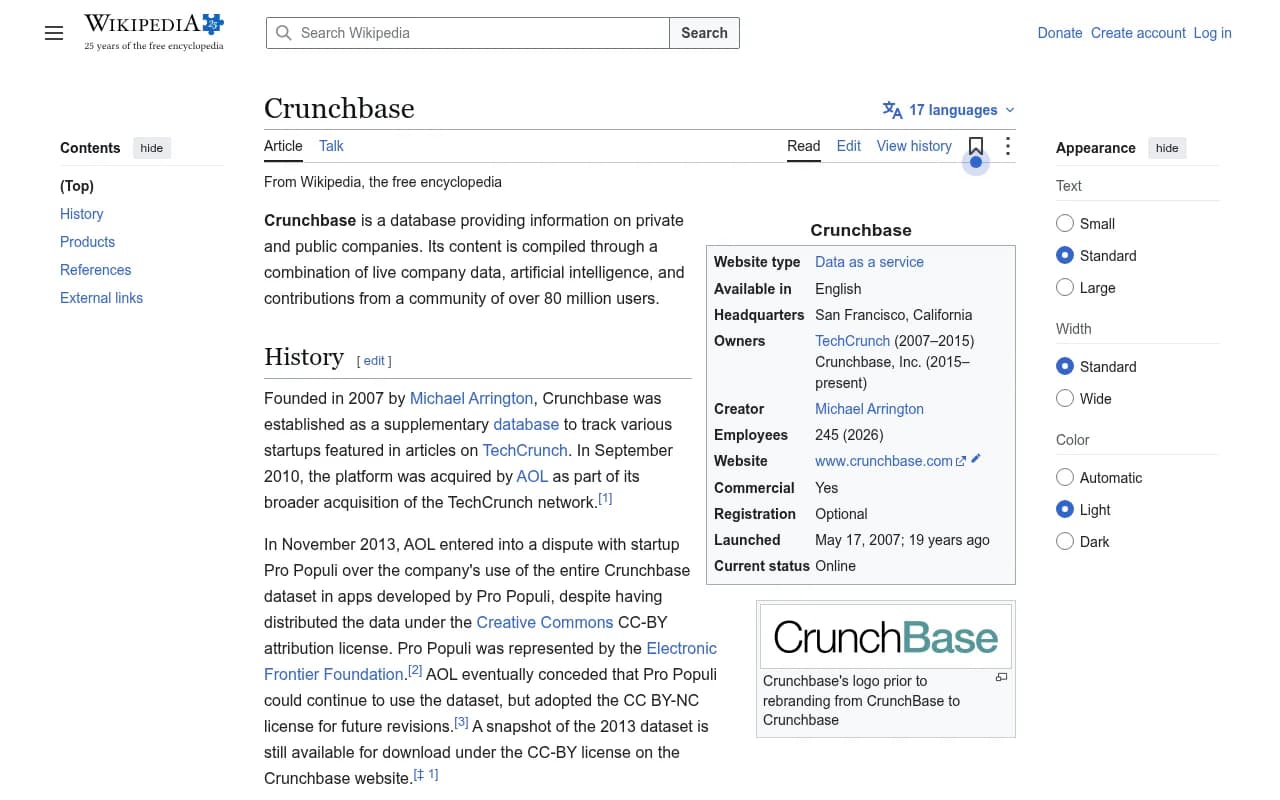
The same article also shows how fast facts age. It lists 245 employees for 2026 and mentions the 2025 Perplexity partnership, details that are fine today and wrong the moment they change.
Practical Wikipedia steps:
- Read the article and list every factual claim that is wrong, with a reliable source for the correct version.
- Post corrections on the article's Talk page, and disclose your affiliation openly.
- Request edits through the edit-request process rather than editing directly.
- Fix the underlying sources. Wikipedia cites press, so an outdated TechCrunch article can keep an old fact alive. A fresh, independent piece gives editors something to cite.
- Check Wikidata, which feeds knowledge panels and entity data, and which has its own rules for properties like website, founders and inception date.
Crunchbase
Crunchbase is where funding history, categories, location and headcount live. Its own pitch is 39B live private market signals and 30M+ verified updates a year, and its page on Wikipedia says content comes from live company data, AI and a community of over 80 million users. That mix is why errors sneak in: some of it is community-contributed, some of it machine-inferred.
What goes wrong:
- Wrong or missing funding rounds and investors
- Industry tags that put you in the wrong category
- Old founders or executives still listed
- Stale employee ranges and descriptions
You can claim and edit your profile, and you should. I haven't verified Crunchbase's current edit workflow or pricing for this guide, so check their help documentation for how claims and change requests work today. The important habit is to treat the profile as a spreadsheet you reconcile against your own fact sheet every quarter.
G2
G2 is different because the content is partly yours (the vendor profile) and partly users' (reviews). G2 says it tries to identify fraudulent reviews, including employees reviewing their own products or their competitors', so don't try to game it.
What goes wrong on G2:
- Feature lists and category placement that no longer match the product
- Pricing information that is outdated or missing
- Competitor comparisons and alternatives pages that frame you poorly
- Review themes from two product versions ago still dominating the sentiment
Promptwatch's advice in the software report is to keep G2 and Capterra profiles complete and current while treating your own site as the primary citation source. I agree with both halves. A complete G2 profile is cheap; building your whole strategy around it is not smart.
Why conflicting facts hurt more than missing ones
Maria Dykstra's entity resolution guide describes the mechanism: AI merges your site, Wikipedia, Crunchbase and reviews into one model of your brand, and when the signals conflict, you become hard to map to a single entity. That matches what you see in practice. Two descriptions, two founding years, two categories, and the model hedges, picks one at random, or gives a competitor the cleaner answer.
Here is how the conflict usually shows up:
| Fact | Where it goes stale | What AI does with it |
|---|---|---|
| Founding year and founders | Wikipedia, Crunchbase, old press | States the wrong date or person with confidence |
| Funding and investors | Crunchbase, news archives | Quotes an old round as the latest |
| Category and positioning | Wikipedia lead, Crunchbase tags, G2 category | Lumps you in with the wrong competitors |
| Pricing | G2 pricing tab, old reviews | Quotes retired plans or invents a range |
| Features | G2 features list, comparison pages | Says you lack features you shipped |
| Leadership and headcount | Crunchbase, LinkedIn, Wikipedia | Names departed executives |
A practical audit: find the wrong facts first
Don't start by editing. Start by finding out what AI says.
Step 1: Write your canonical facts
Build one source of truth: legal and brand name, founding date, founders and current leadership, HQ, funding, category, one-sentence description, pricing structure, flagship products. Publish it on your site as a dedicated page with Organization schema and consistent wording. The Growth Rocket guide covers the tactical levers well: schema markup, FAQ pages and a dedicated About architecture.
Step 2: Run the prompts buyers actually use
Ask ChatGPT, Gemini, Perplexity, Claude and Google AI Overviews things like "what is [brand]", "who founded [brand]", "how much does [brand] cost", "[brand] vs [competitor]" and "best tools for [category]". Log every wrong claim and, crucially, the source it cites or seems to echo.
Doing this by hand across models and countries gets old fast. Tools like Promptwatch can track the claims AI makes about you (its Brand Narrative feature groups them by theme such as pricing or features) and show which pages get cited, so you can trace a wrong claim back to a Wikipedia, G2 or Crunchbase page.

Its Fact Check feature (Business plans and above) lets you mark a claim as inaccurate and then finds the pages on your own site that state it or its opposite. That is the part most people skip: sometimes the wrong fact is on your site.
Step 3: Trace each error to a source
For every wrong claim, record where it lives. Typical outcomes:
- It's on your own site (old blog post, outdated pricing page). Fix first.
- It's on Crunchbase or G2. You can edit it.
- It's on Wikipedia. Needs Talk page and sourcing work.
- It's in third-party articles. Needs outreach or fresh coverage.
- It's nowhere you can find. Probably model memory; the only cure is more consistent, fresher sources over time.
Fixing it, in the right order
1. Your own site
This is the most-cited source category in the software data (vendor sites and docs together earn about three times the share of review sites and analysts). Consolidate duplicate About content, date-stamp key facts, and make sure AI crawlers can actually read the pages. Check robots.txt and crawler access; the free Agentic Readiness Check is a quick way to see which AI crawlers can reach your site.
2. Crunchbase
Claim the profile, correct funding, leadership, headcount, location and categories, and rewrite the description to match your canonical one-liner word for word. Then calendar a quarterly review.
3. G2 (and Capterra, Gartner Digital Markets, Software Advice)
Complete every field: description, categories, features, pricing, screenshots, integrations. Respond to reviews that carry outdated claims ("no API" when you have one). Ask recent customers for reviews so current-version feedback outweighs old.
4. Wikipedia and Wikidata
Only pursue this if you meet notability. Use the Talk page, disclose your relationship, cite independent sources, and be patient. If you don't meet notability, put your effort elsewhere; a failed article creation does more harm than none.
5. The press that Wikipedia cites
If the wrong fact originates in a 2017 article, no edit will stay fixed for long. Pitch updated coverage, and publish original data or announcements others can cite. This is where digital PR earns its keep, and it is the part that usually needs outside help. If you want specialists on that, an agency such as 1001 SEO Media handles digital PR and AI search work together.
Tools for monitoring what AI says about you
You need two things: a way to see AI answers across models, and a way to see which sources they draw on. The category is crowded, so here is a short, opinionated comparison for this specific job (catching wrong facts and tracing them to sources).
| Tool | Strength for this task | Watch out for |
|---|---|---|
| Promptwatch | Tracks real AI interfaces, claim-level Brand Narrative, citation tracing, Fact Check, then content fixes and crawler logs | Fact Check and Content Agent need Business plan or above |
| Profound | Enterprise monitoring and analytics | Higher price point, monitoring-focused |
| Peec AI | Simple prompt tracking and suggestions | Lighter on source tracing and execution |
| Otterly.AI | Affordable brand monitoring | Basic tracking, no content workflow |
| Waikay | Focused on AI brand perception | Narrower scope |
| Yext | Verified brand data pushed to listings and AI channels | Better for location and listings data than for narrative claims |




For more options, the GEO software directory lists dozens of tools by capability.
A monitoring dashboard only tells you something is wrong. The more useful loop is trace, fix, and verify: Promptwatch's page tracker and citation data show whether a corrected page starts getting cited, and its action board turns gaps into a to-do list. Plans start at $95 a month for Essential, and you can confirm current pricing at promptwatch.com/pricing. There is also a free AI visibility report if you just want a first look at how ChatGPT, Gemini and Perplexity describe you.
Keeping facts clean after the fix
One cleanup isn't enough. Facts decay, and every funding round, rebrand or pricing change reopens the problem.
- Keep a change log. Every time a core fact changes, update the canonical page first, then Crunchbase, G2 and the rest within the same week.
- Review quarterly. Re-run your buyer prompts and compare against the last run.
- Watch for source shifts. Reddit's collapse in ChatGPT citations shows how quickly the source mix moves, so recheck citation share data rather than assuming last quarter's pattern still holds.
- Use consistent wording. Same company name, same one-line description, same category label everywhere. Boring, and it works.
What I'd do this week
Pick your ten most important facts. Check them in ChatGPT and Perplexity today. Find the first wrong one, trace it to a source, and fix that source. Then do the next. It is dull work, but it is the cheapest accuracy gain available, because the models are mostly repeating what the internet already says about you.