Yext Review 2026
Yext is an enterprise agentic marketing platform built on a Knowledge Graph of verified brand data. It distributes listings, pages, reviews and content across search and AI for multi-location brands, franchises and regulated industries, and offers MCP and API access.
Key takeaways
- Yext is strongest for large multi-location brands that need one verified source of truth pushed out to maps, directories, search engines and AI. Its customer pitch is built around 9M+ locations under management.
- Pricing is not public. The /pricing page returns a 404, and third-party estimates suggest per-location annual costs from the high hundreds to several thousand dollars, plus onboarding fees. Expect a sales process.
- Yext's AI visibility product (Scout) leans toward competitive insight and distribution. Compared with Promptwatch, it lacks IP-verified AI crawler logs, AI traffic attribution, prompt volume and difficulty scoring, Reddit, YouTube and LinkedIn citation reports, AI Shopping and Ads Radar, and a content-gap-driven Content Agent that publishes to Webflow, Framer or WordPress.
- Review sentiment is mixed. There is a large G2 base (about 1,124 reviews), but Software Advice, Trustpilot and Reddit carry complaints about contract renewals, pricing consistency and what happens to listings after cancellation.
- Best fit: enterprise brands with hundreds or thousands of locations. Poor fit: small businesses, single-location shops, and teams that mainly want to track and improve AI search visibility.
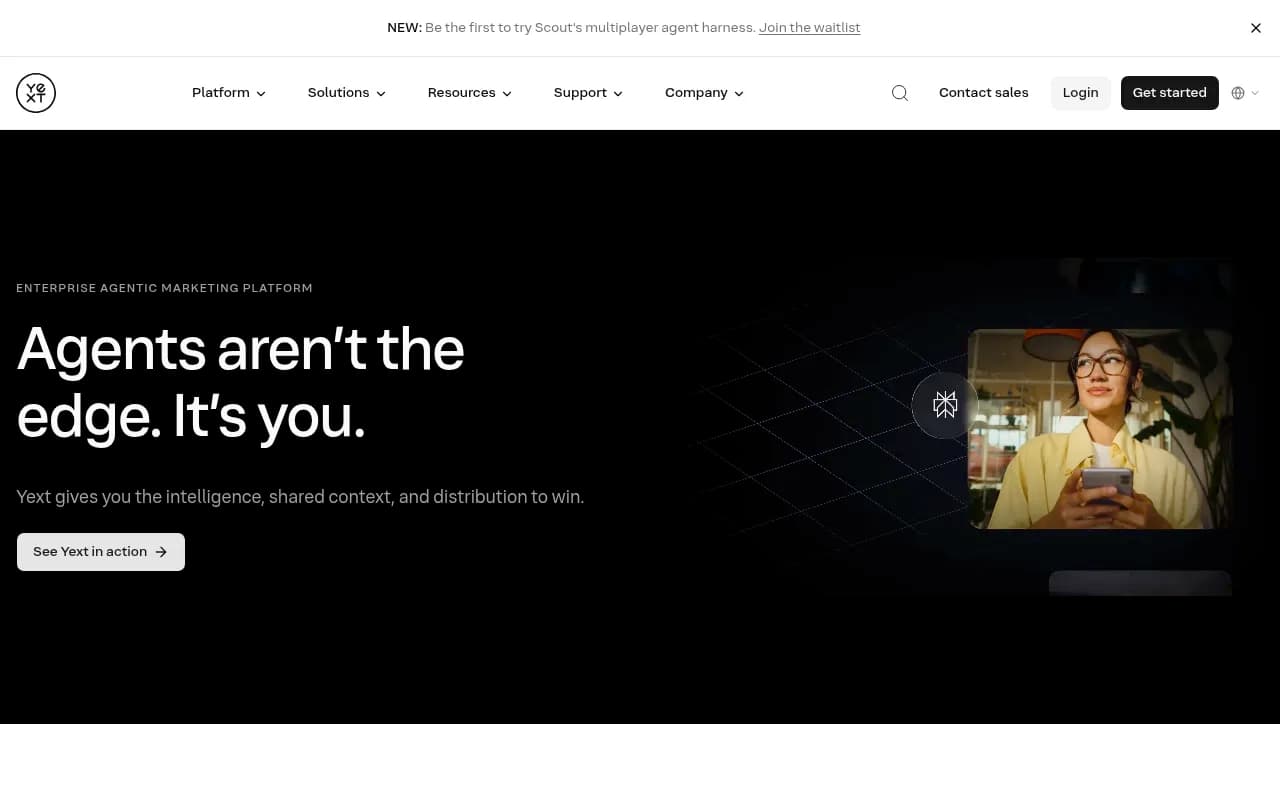
Yext is a New York-based software company that spent most of its life as the listings management vendor. You gave it your business name, address, hours and phone number, and it pushed that data to Google, Apple Maps, Bing, Yelp, Facebook and a long list of other publishers. Over the years it added Pages, Reviews, Search and a Knowledge Graph underneath. Now it describes itself as an enterprise agentic marketing platform, with the pitch that agents are not the edge, you are. That line is more marketing than product, but the product direction is clear.
The core idea is shared context. Yext wants your marketers, local teams, agencies and AI agents to work from the same verified brand data, history, rules and decisions. From that base it offers insight into where you win and lose visibility, tools to create and distribute content, and developer access so you can plug your own agents in.
The audience is enterprise. Think hospital systems, retail chains, franchisors, banks and consumer goods companies, with customer stories on the site from OhioHealth, Campbell's, Sorbet and the Great Clips franchise world. If you manage one location, this is not built for you.
Key features
Knowledge Graph. This is the heart of Yext. It is a structured database of your brand facts: locations, services, people, products, FAQs, hours, menus, and anything else you want treated as authoritative. Everything else in the platform reads from it. The practical value is that when a phone number changes, you change it once and it propagates. The OhioHealth quote on the site frames it as the thing that fuels smart search, SEO and AI search visibility. Competitors like Birdeye and Reputation.com handle listings and reviews, but few put a structured, queryable data model at the center the way Yext does.
Listings and the publisher network. Yext's long-standing product syncs your data to a large network of maps, directories, apps and search engines. For brands with thousands of locations this is where most of the ROI story sits: consistent NAP data, correct hours, and fast updates during holidays or closures. It also now includes distribution aimed at AI answer engines, since those systems pull heavily from structured, consistent third-party data.
Scout and competitive insight. Scout is the visibility layer. Yext says it shows where your brand wins and loses visibility, from market-wide trends down to individual locations, where competitors outrank you, and what to do next. The location-level view is the differentiator. A national tracker tells you your brand shows up in 30% of AI answers. Scout is designed to tell you that the Dallas stores are invisible while Phoenix is fine. There is also a waitlist for a multiplayer agent harness for Scout, which tells you this area is still moving.
Yext AI and shared workspace. Marketers, local teams, agencies, Yext experts and agents are meant to share one workspace, connected to your Knowledge Graph, past decisions and rules. In practice that is a governance pitch. Enterprises worry less about whether an agent can write a page and more about whether it will invent a store hours or a medical claim. Grounding agents in verified data is a sensible answer to that.
Content creation and distribution. Yext agents create on-brand pages, social content, review responses and email campaigns, then distribute them across channels. Yext Pages (the site builder, with a developer-focused flavor documented in Yext's help center) lets brands publish location pages that draw straight from the Knowledge Graph. The review response tooling is useful for franchise systems where hundreds of owners need consistent tone.
Reviews and reputation. Review monitoring and response sit alongside Listings. Steve Hockett's quote from the Great Clips side describes Yext as the layer between franchisee, franchisor and customer, managing listings, reputation and the brand-to-customer interface. That is accurate to how large franchise systems use it.
Search. Yext also sells on-site search (search.yext.com), a product from the company's earlier years that uses the same Knowledge Graph for answers on a brand's own website. It is a separate buying decision from the marketing visibility stack.
MCP, API and developer platform. You can connect your own AI agents to the Knowledge Graph and the publisher network via MCP and API, and build custom workflows with the developer platform. Yext has a public GitHub organization (github.com/yext) with SDKs and site tooling. This is a real advantage for enterprises with in-house engineering teams.
Research. Yext publishes its own studies, including a citation behavior analysis covering 17.2 million citations that concludes every AI model cites differently, plus a Google ranking study and a retail citation study. For context, Promptwatch's own data on ChatGPT citation share by content type points the same way: what gets cited varies a lot by model, content type and industry.
Who is it for
The sweet spot is a multi-location enterprise with a central marketing team and many local operators. A regional hospital network keeping physician and facility data accurate. A retailer with 800 stores that needs holiday hours updated everywhere in a day. A franchisor like the Sorbet and Great Clips examples, where local owners need discoverability but the brand needs control. Healthcare, retail, financial services, restaurants and automotive are the natural verticals, because location accuracy and compliance matter there.
Agencies serving those enterprises also use Yext, though one Software Advice reviewer complained that pricing quoted to an agency differed from pricing quoted to a business. Worth confirming up front if you go that route.
Who should skip it? Small businesses and single-location companies. The cost structure, onboarding fees and sales-led process are built for scale. Also skip it if your actual need is to understand and improve how ChatGPT, Perplexity, Gemini and Google AI Overviews mention and cite your brand. Yext touches that problem, but it is a data distribution platform first. A dedicated GEO tool will go deeper. The GEO software directory at bestgeosoftware.com is a decent place to compare those.
Integrations and ecosystem
Yext's ecosystem is mostly its publisher network: the maps, directories, social platforms and search engines it pushes data to. On the technical side you get a REST API, an MCP connection to the Knowledge Graph, the developer platform for custom agents and workflows, and Pages for Developers for teams that want to build sites in code. The research I found did not confirm specifics on named integrations like Salesforce, Slack or Zapier, so ask during a demo rather than assuming. Likewise I could not confirm a mobile app or browser extension.
Pricing and value
There is no public pricing. The official pricing URL is a 404. Third-party sources describe a move to solution pricing, where Yext bundles features around an outcome rather than pricing each product line separately. Treat these numbers as estimates, not quotes:
- Vendr-style estimates put Listings for buyers with 10 to 50 locations at roughly $600 to $1,500 per location per year.
- Multi-product bundles (Listings, Pages, Reviews) are described as reaching $5,000 to $6,000 per location annually at the top end, with mid-market list pricing of $600 to $2,500 per location.
- Onboarding fees of $2,000 to $20,000 or more, and premium publisher or usage charges that can add 10 to 30%.
- Multi-year terms reportedly reduce cost by 10 to 25%.
- One estimate for 50 locations on Listings plus Reviews is $40,000 to $80,000 a year, versus $25,000 to $60,000 for Birdeye in the same comparison.
An aggregator also lists plans starting at $25.50 a month, but I would not trust that for the current enterprise product. There is no confirmed free plan or trial. For a large brand with real location sprawl, the value case can hold. For anyone else it will feel expensive.
Strengths and limitations
What it does well
- A genuine structured-data foundation. The Knowledge Graph is the most mature version of the single-source-of-truth idea in this category.
- Location-level visibility, which most AI visibility trackers do not offer at this depth.
- Distribution reach: one change goes to a wide network of publishers.
- Developer openness via API, MCP and an active GitHub presence.
- Enterprise credibility. Yext was named a G2 Enterprise Leader in SEO Tools for Spring 2026 (its own announcement), and G2 shows about 1,124 reviews.
Where it falls short
- Opaque pricing and a reputation for contract friction. Trustpilot complaints include listings staying incorrect indefinitely after payment stops, little support or accountability, and a medical practice whose doctors' Google Business Profiles were flagged after signing up. A Reddit r/SEO thread alleges ghosting around renewals. That is anecdotal, and Trustpilot skews toward unhappy customers, but the pattern is worth asking about in reference calls. Software Advice rates Yext 4.2 from 114 reviews.
- Compared with Promptwatch, the AI visibility side is thinner. I could not find evidence of these features in Yext's materials: IP-verified AI crawler logs and crawl-to-citation tracking, AI traffic and conversion attribution, prompt volumes and difficulty scores, query fan-outs, Reddit, YouTube and LinkedIn citation reports, ChatGPT and Alexa shopping tracking, Ads Radar, Google Search Console and Bing data joined to AI data, page-level tracking with offsite mentions, an Action Board, or a Content Agent that publishes straight to Webflow, Framer or WordPress and then tracks whether each page gets crawled, cited and clicked. Promptwatch also tracks real UIs across 15+ AI engines, including coding agents like Codex and Claude Code.
- Complexity. A broad platform with many modules means long onboarding and heavy internal change management.

Bottom line
Yext makes sense if you run hundreds or thousands of locations and your pain is data accuracy, listings consistency, reputation and local discoverability at scale. The Knowledge Graph and publisher network are real assets, and the agent story is credible because it is grounded in verified data. Go in with eyes open on pricing, contract terms and cancellation behavior, and get references from a company your size.
If your goal is to find out why AI engines cite or ignore you, and then fix it with content, crawler access and traffic measurement, Promptwatch is the stronger pick. It is built for optimization, not just distribution and monitoring. Best use case for Yext in one sentence: keeping a large multi-location brand's facts correct and visible across search, maps and AI.
Tags:
Frequently asked questions
What is Yext?
How much does Yext cost?
Does Yext have a free plan?
Who is Yext best for?
How does Yext compare to Promptwatch?
Does Yext offer an API?
Similar and alternative tools to Yext