Key takeaways
- Promptwatch is a dedicated AI search visibility platform. Lebesgue is an eCommerce marketing analytics tool with AI features bolted on. These are fundamentally different products that happen to overlap in one area.
- If your goal is to rank in ChatGPT, Perplexity, or Gemini, Promptwatch is purpose-built for that. Lebesgue's AI visibility features are secondary to its core ad analytics and eCommerce intelligence offering.
- Lebesgue wins for eCommerce operators who need ad performance tracking, competitor ad monitoring, budget allocation, and inventory management all in one place. It's an AI CMO for online stores, not a GEO platform.
- Promptwatch covers 10+ AI models with crawler logs, content gap analysis, prompt volume scoring, and AI content generation. Lebesgue has no equivalent depth in any of those areas.
- Pricing is close at entry level ($79/mo Lebesgue vs $99/mo Promptwatch), but the value proposition is entirely different depending on what you're trying to solve.
- These tools are more complementary than competitive. A serious eCommerce brand could reasonably use both.
Overview
Promptwatch
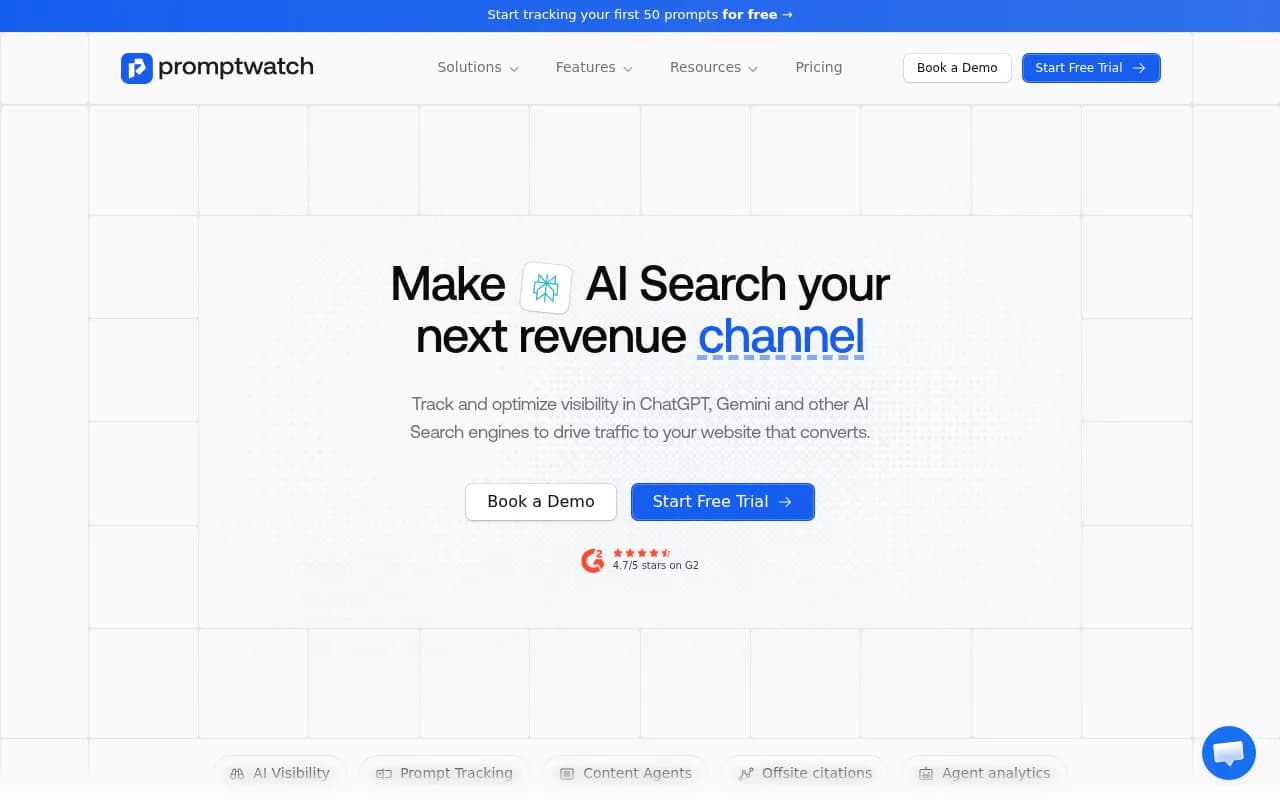
Promptwatch is an end-to-end GEO (Generative Engine Optimization) platform built around one question: how does your brand appear when people ask AI engines about your category? It tracks citations, monitors brand mentions, analyzes content gaps, and generates content designed to rank in AI search results. The platform covers ChatGPT, Perplexity, Gemini, Claude, Google AI Overviews, DeepSeek, Grok, Mistral, Meta AI, and Copilot. Trusted by 1,480+ brands including Booking.com, Duolingo, Typeform, and Yelp, it's rated 4.7/5 on G2.
The core loop is: find where you're invisible in AI results, generate content to fill those gaps, then track whether AI models start citing your new pages. That cycle is what separates it from monitoring-only tools.
Lebesgue
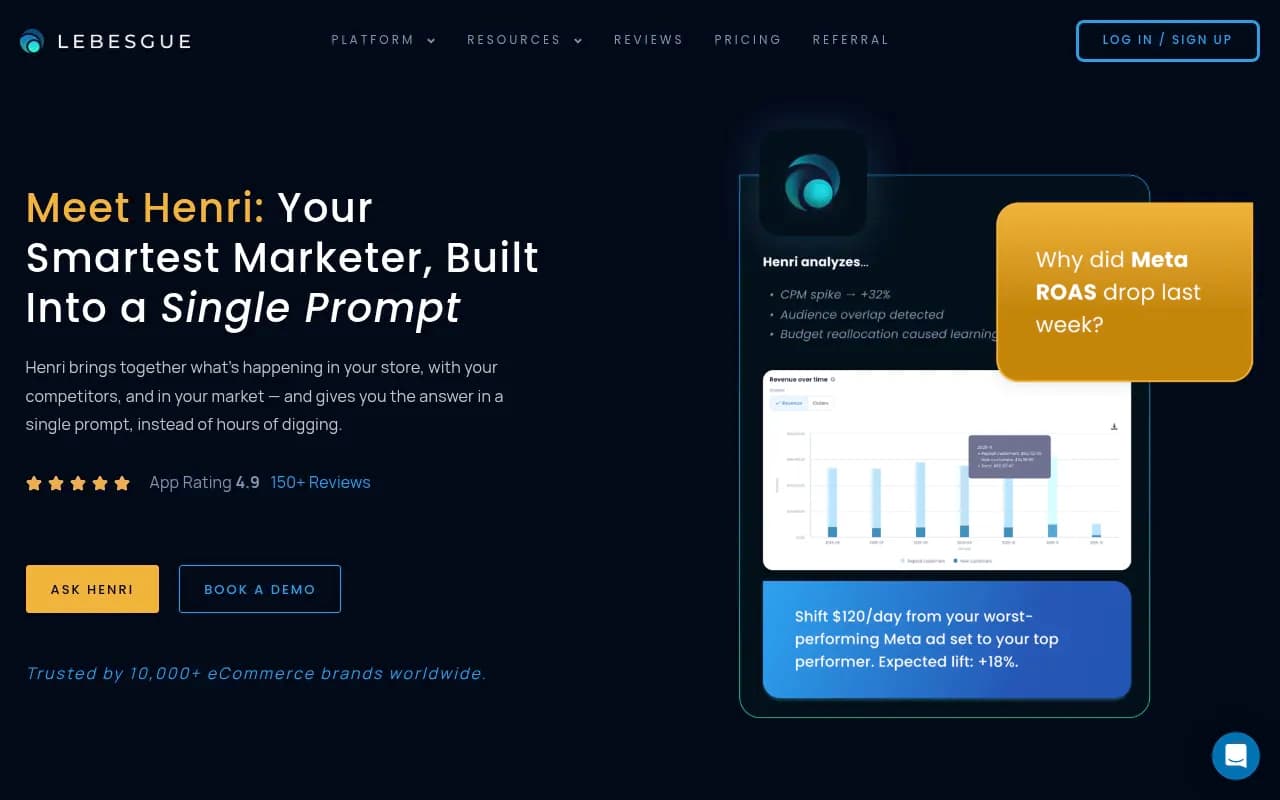
Lebesgue is an AI-powered marketing analytics platform aimed squarely at eCommerce brands. Its flagship feature is Henri, an AI CMO assistant that answers marketing questions by pulling together store data, competitor intelligence, and market trends in a single prompt. The platform covers ad performance analysis, competitor ad monitoring, email strategy decoding, budget allocation, inventory management, creative feedback, and first-party attribution via its Le-Pixel. Trusted by 10,000+ eCommerce brands, it's rated 4.9/5 on Capterra.
Lebesgue includes AI visibility tracking as part of its analytics suite, but it's one module among many rather than the platform's reason for existing.
Side-by-side comparison
| Feature | Promptwatch | Lebesgue |
|---|---|---|
| Primary use case | AI search visibility & GEO | eCommerce marketing analytics |
| AI models monitored | 10+ (ChatGPT, Perplexity, Gemini, Claude, Grok, DeepSeek, Mistral, Copilot, Meta AI, Google AI Overviews) | Limited (not primary focus) |
| Content gap analysis | Yes, detailed prompt-level gaps | No |
| AI content generation | Yes (articles, listicles, comparisons) | No |
| Crawler logs / agent analytics | Yes, real-time AI crawler logs | No |
| Prompt volume & difficulty scoring | Yes | No |
| Competitor visibility heatmaps | Yes | Ad-focused competitor monitoring |
| Ad performance tracking | No | Yes (Facebook, Google, TikTok) |
| Budget allocation AI | No | Yes (Balancer agent) |
| Inventory management | No | Yes (Sentry agent) |
| Email competitor intelligence | No | Yes (Echo agent) |
| First-party attribution pixel | No | Yes (Le-Pixel) |
| Reddit & YouTube insights | Yes | No |
| ChatGPT Shopping tracking | Yes | No |
| Multi-language / multi-region | Yes | Limited |
| Free plan | Free trial (50 prompts) | Free plan available |
| Starting price | $99/mo | $79/mo |
| Target audience | SEO/marketing teams, agencies, brands | eCommerce store owners, DTC brands |
| G2 / Capterra rating | 4.7/5 (G2) | 4.9/5 (Capterra) |
Head-to-head feature deep-dive
AI search visibility
This is where the gap between the two tools is widest.
Promptwatch tracks how your brand appears across 10 AI engines, at the prompt level. You can see exactly which prompts your competitors rank for that you don't, get volume and difficulty estimates for each prompt, and drill into which specific pages AI models are citing. The crawler logs show you when ChatGPT or Perplexity's crawlers visit your site, which pages they read, and when those pages move from "crawled" to "cited." That level of detail doesn't exist anywhere else in the market.
Lebesgue includes AI visibility as part of its broader analytics offering, but it doesn't offer prompt-level tracking, crawler logs, content gap analysis, or any mechanism for improving your AI search rankings. It can tell you something about your AI presence, but it can't help you fix it.
Verdict: Promptwatch by a wide margin for anyone whose goal is AI search visibility.
Content creation and optimization
Promptwatch's Content Agents generate articles, listicles, and comparison pages grounded in real prompt data. The briefs include brand instructions, competitor analysis, search results, screenshots, and uploaded knowledge-base files. The output is designed to answer the specific gaps AI models are exposing, not generic SEO filler.
Lebesgue's Strategist agent gives creative feedback on ad creatives. That's a different thing entirely -- it's about improving paid ad performance, not organic AI search visibility.
Verdict: Promptwatch for AI content optimization. Lebesgue for paid creative feedback.
Competitor intelligence
Both tools offer competitor monitoring, but they're looking at completely different things.
Promptwatch's competitor heatmaps show which brands are winning visibility across AI models for specific prompts. You can see who's being cited more than you, for which queries, and on which platforms. The offsite citation analysis surfaces which Reddit threads, YouTube videos, and third-party pages are driving competitor visibility.
Lebesgue's Sentinel agent monitors competitor ad campaigns in real time. Echo decodes competitor email strategies to surface product launches and discount patterns. These are genuinely useful for eCommerce operators running paid campaigns, but they have nothing to do with AI search.
Verdict: Depends entirely on what you're competing on. Promptwatch for AI search. Lebesgue for paid media.
eCommerce-specific features
Lebesgue has a clear advantage here. Its suite of agents covers the full eCommerce marketing stack:
- Balancer figures out how to split budget across channels
- Guardian detects anomalies in your data before they become problems
- Spotlight identifies high-potential products to push
- Sentry monitors inventory to prevent stockouts
- Prophet uses GAM models for spend predictions
- Le-Pixel provides first-party attribution that doesn't rely on platform-reported data
Promptwatch has ChatGPT Shopping tracking, which is relevant for eCommerce brands that want to appear in AI-generated product recommendations. But it doesn't touch ad performance, inventory, or attribution.
Verdict: Lebesgue for eCommerce operations. Promptwatch for AI search presence.
Ease of use and setup
Promptwatch connects via Cloudflare, Fastly, Vercel, server logs, Google Search Console, or a tracking snippet. Setup is straightforward for technical teams, and the dashboard is organized around the find-gaps-create-content-track-results loop.
Lebesgue integrates with Shopify, Facebook Ads, Google Ads, TikTok Ads, and Klaviyo. For a Shopify store owner, setup is quick. Henri, the AI CMO, is designed to answer plain-language questions, which lowers the barrier for non-technical users.
Verdict: Lebesgue is probably easier for eCommerce operators who just want answers. Promptwatch requires more intentionality but rewards it with deeper data.
Data quality and model coverage
Promptwatch tracks real user-facing AI responses, not just API outputs. This matters because what ChatGPT shows a user in its interface can differ from what the API returns. The platform has processed 4.5 billion citations, clicks, and prompts, and its data has been cited in the Wall Street Journal and Axios.
Lebesgue's data quality story is about first-party attribution. Le-Pixel captures customer journey data that platform-reported ROAS often misses. That's a real problem it solves well, but it's a different domain.
Verdict: Both have strong data quality stories in their respective domains.
Pricing comparison
| Plan | Promptwatch | Lebesgue |
|---|---|---|
| Free | Free trial (50 prompts, 5 articles) | Free plan available |
| Entry | Essential: $99/mo (1 site, 50 prompts, 5 articles) | Ultimate: $79/mo |
| Mid-tier | Professional: $249/mo (2 sites, 150 prompts, 15 articles, crawler logs) | -- |
| Growth | Business: $579/mo (5 sites, 350 prompts, 30 articles) | -- |
| Agency/Enterprise | Custom pricing | Custom pricing |
| Annual discount | Yes | Yes |
Lebesgue's entry price is lower at $79/mo, but the comparison is a bit apples-to-oranges. You're not paying for the same thing. Promptwatch's $99/mo Essential plan gives you 50 prompt slots, 5 AI-generated articles, and citation tracking across 10 AI models. Lebesgue's $79/mo gives you Henri plus the full eCommerce analytics suite.
If you're an eCommerce brand that needs both, budget for both. They don't overlap enough to justify choosing one over the other on price alone.
Pros and cons
Promptwatch
Pros:
- Purpose-built for AI search visibility -- the deepest feature set in the category
- Crawler logs show exactly how AI engines interact with your site
- Content Agents generate content grounded in real prompt data, not guesswork
- Covers 10+ AI models including Google AI Overviews, DeepSeek, and Grok
- Reddit and YouTube insights surface off-site citation opportunities
- ChatGPT Shopping tracking for eCommerce brands
- Strong customer base (Booking.com, Duolingo, Yelp, Typeform)
Cons:
- No eCommerce-specific features (ad performance, inventory, attribution)
- Higher entry price than Lebesgue ($99/mo vs $79/mo)
- Requires some SEO/GEO knowledge to get full value from the data
- Not designed for Shopify store operators who just want quick marketing answers
Lebesgue
Pros:
- Excellent eCommerce marketing suite -- covers ads, email, inventory, attribution, and budget
- Henri AI CMO is genuinely useful for non-technical store owners
- First-party attribution via Le-Pixel solves a real problem with platform-reported data
- Lower entry price at $79/mo
- 4.9/5 rating across Capterra, GetApp, and Software Advice
- Trusted by 10,000+ eCommerce brands
Cons:
- AI visibility tracking is shallow compared to a dedicated GEO platform
- No crawler logs, no content gap analysis, no AI content generation
- Limited prompt-level tracking across AI models
- Not useful for non-eCommerce brands or agencies focused on AI search
- No Reddit or YouTube citation insights
Who should pick which tool
Pick Promptwatch if:
- Your primary goal is to appear in ChatGPT, Perplexity, Gemini, or other AI search results
- You're an SEO or marketing team that wants to understand and improve AI search visibility
- You run a digital agency managing AI visibility for multiple clients
- You want to know exactly which prompts your competitors are winning and you're not
- You need content that's engineered to rank in AI search, not just generic blog posts
- You're tracking a brand in a competitive category where AI-generated answers drive purchase decisions
Pick Lebesgue if:
- You run a Shopify or DTC eCommerce store and need a unified marketing analytics platform
- Ad performance, budget allocation, and ROAS optimization are your daily concerns
- You want an AI assistant that can answer "what should I do with my marketing this week?" in plain language
- Competitor ad monitoring and email intelligence are important to your strategy
- First-party attribution is a problem you're actively trying to solve
- You don't have a dedicated SEO team and need something that works without deep technical knowledge
Consider using both if:
You're a mid-to-large eCommerce brand that runs paid campaigns AND cares about appearing in AI-generated product recommendations. Lebesgue handles the paid side; Promptwatch handles the AI search side. They don't compete for the same budget line.
Final verdict
These two tools are solving different problems. Lebesgue is an AI CMO for eCommerce -- it helps you run better paid campaigns, allocate budget smarter, and understand your store's performance. Promptwatch is an AI search visibility platform -- it helps you show up when people ask AI engines questions about your category.
If someone is choosing between them specifically for AI visibility tracking, Promptwatch wins without much debate. The depth of its prompt tracking, crawler logs, content gap analysis, and content generation has no equivalent in Lebesgue's feature set.
If someone is choosing between them for eCommerce marketing analytics, Lebesgue wins just as clearly. Promptwatch doesn't touch ad performance, inventory, or attribution.
The honest answer: most eCommerce brands asking "which one should I use?" are probably asking the wrong question. They need both, or they need to decide which problem is more urgent right now.