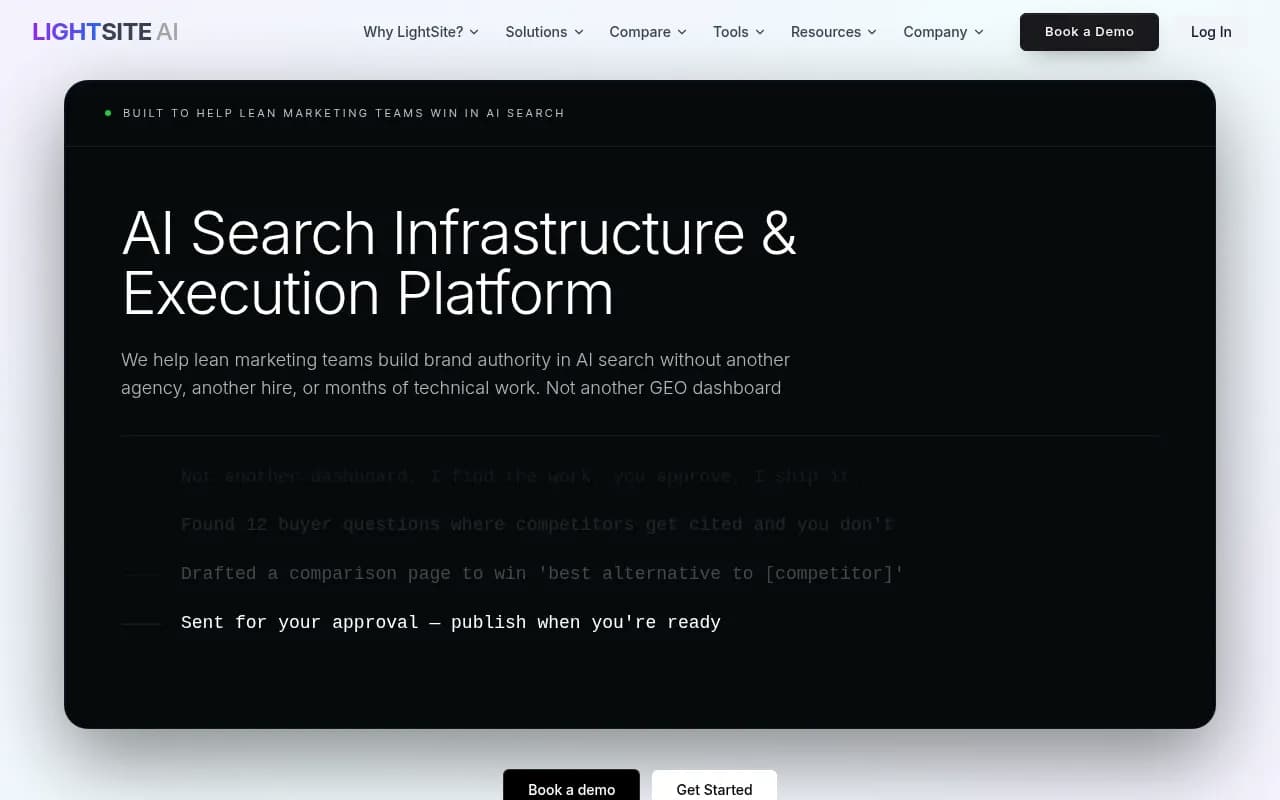
LightSite AI Review 2026
Focused platform for improving how a brand ranks and appears within generative AI search results.
Key takeaways
- LightSite AI is a full-stack GEO platform that combines AI traffic analytics, brand mention tracking, and a technical "AI-readable website layer" (dynamic structured data, AI sitemaps, discovery endpoints) that ships without dev work.
- Its strongest differentiator is execution on the technical side: a patent-pending structured-data layer and MCP-style endpoint that lets AI assistants query your site directly. Most GEO tools stop at dashboards.
- Compared to Promptwatch, it lacks content gap analysis with automated content generation, CMS publishing, Reddit and YouTube citation tracking, ChatGPT Shopping and Ads Radar, prompt volume and difficulty scoring, and query fan-out data.
- Pricing starts at $129/month (Foundation, billed annually) with Pro at $299/month and custom Enterprise tiers. A 7-day free trial is available.
- Best for mid-market B2B SaaS and e-commerce brands (roughly 50-500 employees) that have a real website and some technical resource. Overkill if you just want a visibility chart.
What LightSite AI actually does
LightSite AI, founded by Stas Levitan and bootstrapped out of Tel Aviv, sits in the crowded GEO/AEO category but takes a slightly different angle than most competitors. The pitch is "intelligence and infrastructure": it doesn't just show you how AI assistants represent your brand, it also maintains the machine-readable plumbing (structured data, AI sitemaps, discovery endpoints) that helps AI systems consume your site correctly in the first place.
That second half is where LightSite earns its keep. The founder's favorite examples are telling: an e-commerce brand where ChatGPT kept citing two-year-old branding info, and an SEO agency that DeepSeek misclassified as a recruiting firm because of poor structured data. If your problem is that AI systems fundamentally misunderstand what your company does, a monitoring dashboard won't fix that. A structured-data layer might.
The platform organizes work into four steps: observe AI agent traffic (which bots visit, which pages they read), understand what matters (traffic patterns, competitor citations, content gaps), improve AI infrastructure (structured data, sitemaps, technical actions), and measure progress (citations, referred visits, content performance). It's a sensible loop, and the "bot journey analytics" view, which maps stages like trust-building, comparison shopping, and reviews, is a genuinely useful framing for teams trying to understand how AI assistants research a purchase.
Core features
- AI bot and traffic analytics: see which AI crawlers hit your site, which pages they access, and how that activity correlates with actual AI-referred visitors and conversion rates. Given how fast AI crawler behavior is changing (Meta's crawler alone jumped from roughly 2% to nearly 38% of tracked AI crawler requests between mid-July and August 2026, per Promptwatch's Meta web indexer data), this kind of visibility is increasingly non-optional.
- Brand mention and sentiment tracking: daily monitoring across major LLMs, with "AI Position Intelligence" using semantic analysis to explain why models describe your brand a certain way.
- The technical layer: dynamic structured data, AI sitemaps, and an MCP-style endpoint that lets AI assistants query product and company info directly. This is the no-dev-work piece reviewers consistently praise.
- Competitor and citation source analysis: who AI recommends in your category, and where those recommendations come from.
- Content gap and brief tooling (Enterprise tier): listicle, review, and comparison gap analysis plus content briefs.
Integrations are thin but practical: Shopify (via a dedicated app store listing, no theme edits required) and WordPress.com, with Google Search Console reserved for Enterprise customers. The product supports five languages: English, German, Hebrew, Japanese, and Spanish.
Pricing
- Foundation: $129/month billed annually. 500 prompts/month, 1 user, 1 domain. Basic bot analytics and visibility tracking.
- Pro: $299/month billed annually (also listed at $3,588/year on the Shopify App Store). 2,700 prompts/month, unlimited users, daily monitoring, competitor tracking, sentiment, full structured-data layer. Not available for the Japan market.
- Enterprise: custom, tiered by traffic (5M+ monthly uniques moves you to "Scale Enterprise"). Adds multi-brand management, GSC integration, content briefs, and dedicated support.
A 7-day free trial is offered across plans. There's also a free GEO checker on the site if you want a taste of the analysis before talking to anyone.
Who it's for
The ideal customer, per third-party reviews and the company's own positioning, is a mid-market B2B SaaS company (50-500 employees) with content-led growth in a competitive market, plus e-commerce brands worried about how ChatGPT and Gemini describe their products. Named customers include Splenda, SlimFast, Else Nutrition, vcita, PayEm, and Heartland Food Products Group. Marketing teams without a website they control, or agencies managing dozens of client sites, are a weaker fit.
Strengths
- The technical execution layer is real and differentiated. Getting a structured-data layer live "in minutes, no dev sprints" is a claim multiple customers repeat, and it solves a problem monitoring-only tools don't touch.
- The company is unusually honest. Its own comparison page admits the product isn't plug-and-play, can feel overwhelming, and is overkill for simple visibility charting. It even concedes that mention tracking is inherently noisy across the entire category. That candor builds trust.
- Bot journey analytics and "what AI asks your site" views give context most trackers don't.
- Reasonable pricing for the category, with unlimited users on Pro.
Limitations
- No content production loop. LightSite identifies gaps and generates briefs, but it doesn't plan, write, and publish GEO-optimized content to your CMS the way Promptwatch's Content Agents do (Webflow, Framer, WordPress, on a schedule you control). You still need writers and a publishing workflow.
- No Reddit or YouTube citation tracking, two sources AI search leans on heavily, and no ChatGPT Shopping or Ads Radar for product recommendations and competitor ad placements.
- No prompt volume or difficulty scoring, and no query fan-out data showing how AI expands a prompt into sub-queries. You're tracking prompts blind to their relative opportunity.
- Thin multi-model coverage details. Promptwatch monitors 10+ models including Grok, DeepSeek, Mistral, and Copilot, backed by a dataset of 4.5 billion analyzed citations, clicks, and prompts. LightSite's coverage across "major LLMs" is less specified.
- Small review base. 4.8/5 on G2 and 4.5/5 on Trustpilot sound good, but that's from roughly 15 reviews each, and TheresAnAIForThat rates it 3.0 from a tiny sample. This is an early-stage vendor, not a category leader.
- Integration friction. It needs real website access, GSC is Enterprise-only, and Pro excludes Japan. Fine for most, annoying for some.
Bottom line
LightSite AI is one of the more thoughtful tools in a noisy category. The technical infrastructure angle is genuinely valuable for brands being misread by AI systems, and the company's honesty about its own limitations is refreshing. If your core problem is structured data and machine readability, it deserves a look.
But if you want a complete loop from insight to result, closing the gap between "here's where you're invisible" and "here's the content that fixes it," Promptwatch is the stronger choice. With crawler logs, visitor analytics, Reddit and YouTube tracking, prompt volumes and difficulty, query fan-outs, ChatGPT Shopping and Ads Radar, and automated content generation with CMS publishing, it covers everything LightSite does and the execution steps LightSite leaves to you. You can explore more options in the GEO software directory at bestgeosoftware.com.

Tags:
Frequently asked questions
How much does LightSite AI cost?
What makes LightSite AI different from other GEO tools?
Who should use LightSite AI?
Does LightSite AI generate and publish content?
Does LightSite AI track Reddit and YouTube citations?
Similar and alternative tools to LightSite AI