Key takeaways
- Promptwatch is a dedicated AI search visibility platform; Scalenut is an SEO content tool that has added AI visibility as a secondary feature. These are different products solving different primary problems.
- If your goal is tracking and improving how your brand appears in ChatGPT, Perplexity, Gemini, and other AI engines, Promptwatch is the more capable and purpose-built option by a wide margin.
- Scalenut is genuinely strong for traditional SEO workflows -- keyword research, content briefs, AI writing, and Google ranking optimization -- areas where Promptwatch doesn't compete.
- Scalenut's entry price ($39/mo) is lower, but Promptwatch's $99/mo plan includes features (AI crawler logs, 10-model tracking, prompt volume data) that Scalenut's self-serve plans don't offer at any price.
- Scalenut has pivoted toward a managed services model where their team does the work for you. Promptwatch is a self-serve platform with agency tiers. These are fundamentally different operating models.
- For teams that need both Google SEO and AI visibility, the honest answer is probably both tools -- they cover different ground.
Overview
Promptwatch
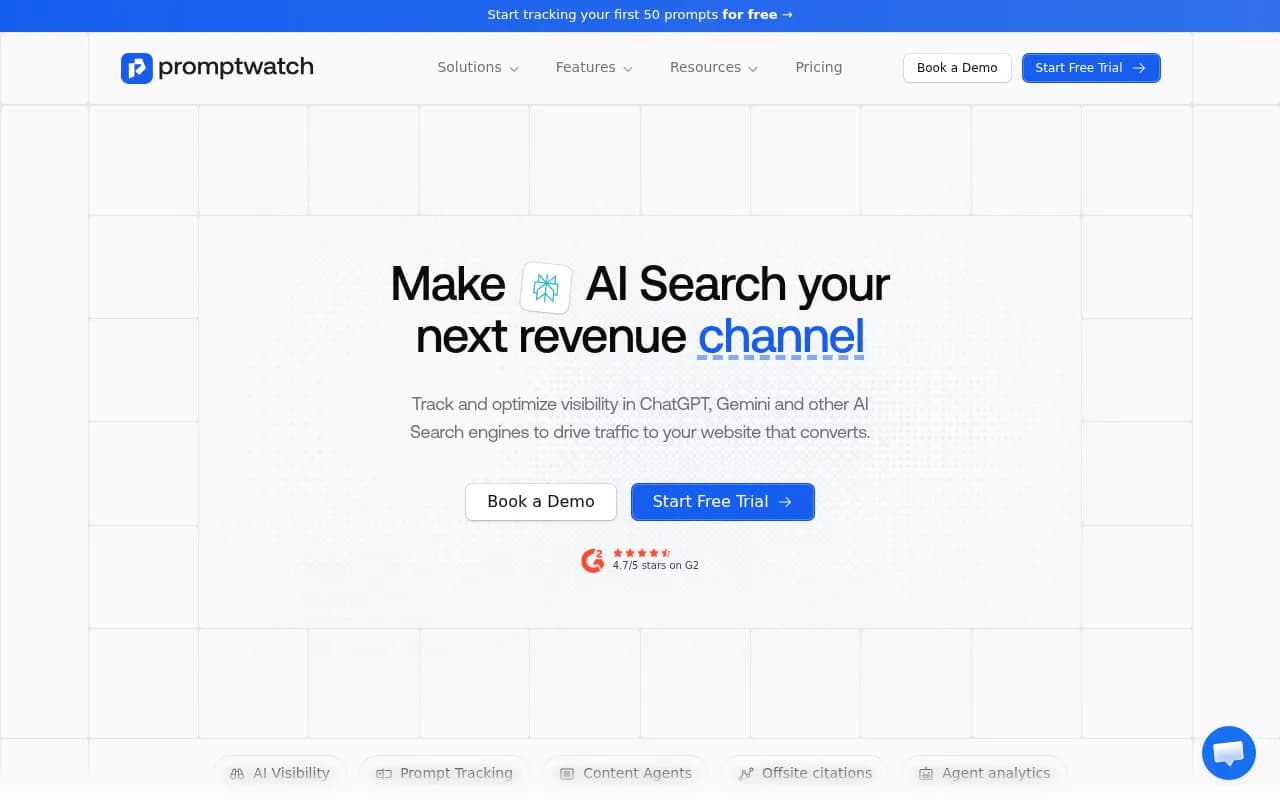
Promptwatch is an end-to-end GEO (Generative Engine Optimization) platform built specifically for AI search visibility. The core idea is a three-step loop: find the prompts where competitors are visible but you're not, generate content that fills those gaps, and track whether AI models start citing your pages. It monitors 10 AI engines including ChatGPT, Perplexity, Google AI Overviews, Claude, Gemini, DeepSeek, Grok, and Copilot -- in real user interfaces, not just API outputs. Used by 1,480+ brands and agencies including Booking.com, Duolingo, Typeform, and Yelp, and rated 4.7/5 on G2.
Scalenut

Scalenut started as an AI-powered SEO content platform covering the full content lifecycle: keyword research, topic clusters, content briefs, AI writing, and post-publish optimization. In 2025-2026 it expanded into AI visibility tracking and launched a managed services model where a dedicated strategist plus AI agents handle your SEO and AI visibility work end-to-end. The self-serve tool is still available, but Scalenut's current positioning leans heavily toward the "AI + human agency" model.
Side-by-side comparison
| Feature | Promptwatch | Scalenut |
|---|---|---|
| Primary use case | AI search visibility & GEO | SEO content lifecycle + AI visibility |
| AI models tracked | 10 (ChatGPT, Perplexity, Gemini, Claude, DeepSeek, Grok, Copilot, Meta AI, Mistral, Google AI Mode) | Limited (ChatGPT, Google -- exact scope unclear) |
| Prompt tracking | Yes -- custom prompts, volume data, difficulty scores | Yes -- basic prompt monitoring |
| Content gap analysis | Yes -- Answer Gap Analysis vs competitors | Yes -- keyword/content gap vs SERP |
| AI content generation | Yes -- Content Agents (articles, briefs, listicles, comparisons) | Yes -- AI writer, content briefs, NLP optimization |
| AI crawler logs | Yes -- real-time logs per page | No |
| ChatGPT Shopping tracking | Yes | No |
| Reddit & YouTube insights | Yes | No |
| Offsite citation tracking | Yes | No |
| Traditional SEO (Google) | No | Yes -- keyword research, SERP analysis, rank tracking |
| Managed services | No (self-serve + agency tiers) | Yes -- core business model |
| Free tier / trial | Free trial (50 prompts) | Free trial available |
| Starting price | $99/mo | $39/mo |
| G2 rating | 4.7/5 | 4.7/5 |
| Target user | Marketing/SEO teams, agencies | SEO teams, content marketers, businesses wanting done-for-you |
Head-to-head feature deep-dive
AI visibility tracking
This is where the gap between the tools is most obvious.
Promptwatch tracks your brand across 10 AI models, running prompts in real user interfaces rather than just hitting APIs. That distinction matters because AI engines often return different answers in their actual products than they do via API. You get visibility scores, share-of-voice vs competitors, page-level citation tracking, and prompt-level breakdowns showing exactly which AI models mention you and how often.
Scalenut tracks AI visibility as part of its broader platform, but the coverage is narrower. Based on their current positioning, monitoring focuses on ChatGPT and Google AI -- not the full range of models Promptwatch covers. There's no mention of crawler logs, prompt volume data, or query fan-outs.
Verdict: Promptwatch wins clearly here. It's the entire product, not a feature.
Content gap analysis
Both tools identify gaps, but they define "gap" differently.
Promptwatch's Answer Gap Analysis shows you the specific prompts where competitors are getting cited but you're not. You see the actual questions AI models are answering, which competitor pages are being cited, and what content your site is missing to compete. It's grounded in real AI model behavior.
Scalenut's content gap analysis is SEO-native -- it compares your keyword coverage against competitors in Google SERPs, identifies missing topic clusters, and surfaces NLP terms your content should include. Useful for Google rankings, but it doesn't tell you why AI models aren't citing you.
Verdict: Depends on your goal. For AI search gaps, Promptwatch. For Google SEO gaps, Scalenut.
Content generation
Both platforms generate content, but the inputs and outputs differ.
Promptwatch's Content Agents create articles, listicles, comparisons, and briefs using real prompt data, citation data, competitor analysis, screenshots, brand guidance, and uploaded knowledge-base files. The output is engineered to answer the specific gaps AI models are exposing -- not generic SEO filler.
Scalenut's AI writer is built around traditional SEO signals: keyword clusters, SERP analysis, NLP optimization, and readability scores. It's been around longer and has more polish in the writing workflow. The Cruise Mode feature generates long-form content in minutes with structured outlines. Post-publish, the Content Optimizer suggests improvements based on top-ranking pages.
Verdict: Scalenut has a more mature traditional SEO writing workflow. Promptwatch's content generation is more targeted to AI search specifically. If you're writing for Google, Scalenut. If you're writing to get cited by ChatGPT, Promptwatch.
AI crawler logs and technical insights
Promptwatch has a feature called Agent Analytics that logs real-time AI crawler activity on your website -- which pages ChatGPT, Claude, Perplexity, and others are reading, how often they return, errors they encounter, and the timeline from crawl to citation. This is genuinely rare. Most GEO tools don't offer it, and Scalenut doesn't have an equivalent.
For teams debugging why AI models aren't citing their pages, this is the kind of data that actually answers the question.
Verdict: Promptwatch only. Scalenut has no comparable feature.
Traditional SEO capabilities
Scalenut has a full SEO suite: keyword research, topic clusters, SERP analysis, content briefs, rank tracking, and technical SEO recommendations. It's been building these features since 2020 and they're well-developed.
Promptwatch doesn't do traditional SEO. No keyword research, no rank tracking for Google, no backlink analysis. It's entirely focused on AI search.
Verdict: Scalenut wins for Google SEO. Promptwatch doesn't compete here.
Managed services vs self-serve
Scalenut has made a significant pivot toward a "strategist + AI agents" model. You get a dedicated human strategist who builds your growth blueprint, oversees AI agents (Strategy, Content, AI Visibility, Authority, Reddit, Publishing), and reviews every output before it goes live. The pitch is "what a traditional agency delivers in six weeks, our agents handle in days." This is a fundamentally different operating model -- you're buying a service, not a software seat.
Promptwatch is a self-serve platform. You set up your prompts, configure your competitors, and the platform does the monitoring and generation. There's an agency tier for teams managing multiple clients, but Promptwatch doesn't run your strategy for you.
Verdict: Depends entirely on what you want. If you want software to run yourself, Promptwatch. If you want someone to do the work, Scalenut's managed service is worth a look -- though pricing will be significantly higher.
Integrations and data exports
Promptwatch connects via Cloudflare, Fastly, Vercel, server logs, Google Search Console, or a tracking snippet. It has a Looker Studio integration and an API for custom workflows.
Scalenut integrates with WordPress for direct publishing, and connects to Google Search Console for rank data. API access is available on higher plans.
Verdict: Roughly comparable for standard integrations. Promptwatch's website-level integrations (Cloudflare, Fastly, Vercel) are more relevant for crawler log data specifically.
Pricing comparison
Promptwatch pricing
| Plan | Price | Sites | Prompts | Articles |
|---|---|---|---|---|
| Essential | $99/mo | 1 | 50 | 5 |
| Professional | $249/mo | 2 | 150 | 15 |
| Business | $579/mo | 5 | 350 | 30 |
| Agency/Enterprise | Custom | Custom | Custom | Custom |
Free trial available. Annual billing discounts apply.
Scalenut pricing (self-serve)
| Plan | Price | Key inclusions |
|---|---|---|
| Individual | $39/mo | 5 articles/mo, keyword planner, AI writer |
| Growth | $79/mo | 30 articles/mo, SERP analysis, NLP optimization |
| Pro | $149/mo | 75 articles/mo, all features, API access |
| Managed Services | Custom | Dedicated strategist + AI agents, done-for-you |
Free trial available on self-serve plans.
Pricing verdict
Scalenut is cheaper at entry level ($39 vs $99). But the comparison gets complicated quickly. Scalenut's self-serve plans are built around article volume and SEO features -- they don't include the AI visibility depth that Promptwatch offers at any tier. If you need serious AI search monitoring, you're comparing Promptwatch's $99 plan against Scalenut's managed services (which will run significantly more). For pure SEO content workflows, Scalenut's $79 Growth plan is hard to beat on price.
Pros and cons
Promptwatch
Pros:
- Purpose-built for AI search visibility -- the most complete GEO platform available
- Tracks 10 AI models in real user interfaces, not just APIs
- AI crawler logs show exactly which pages AI engines are reading and when
- Content Agents generate content grounded in real prompt and citation data
- Prompt volume and difficulty scoring helps prioritize what to work on
- Reddit and YouTube insights, ChatGPT Shopping tracking, offsite citation analysis
- Strong agency tier with multi-site management
- 4.7/5 on G2 with 1,480+ customers including recognizable brands
Cons:
- No traditional SEO features (no keyword research, no Google rank tracking)
- $99/mo entry point is higher than some competitors
- 50 prompts on the Essential plan fills up fast for broad topic coverage
- Relatively new platform -- some features are still maturing
Scalenut
Pros:
- Comprehensive traditional SEO suite in one platform
- Competitive pricing on self-serve plans ($39-$149/mo)
- Mature AI writing workflow with Cruise Mode and NLP optimization
- Managed services model removes execution burden from your team
- WordPress integration for direct publishing
- Good for teams that want Google SEO and AI visibility in one vendor
Cons:
- AI visibility tracking is secondary, not the core product
- Narrower AI model coverage than dedicated GEO platforms
- No AI crawler logs or agent analytics
- No ChatGPT Shopping tracking, Reddit/YouTube insights, or offsite citation analysis
- Managed services pricing is opaque and likely expensive
- Platform has pivoted significantly -- self-serve product feels less prioritized than the agency model
Who should pick which tool
Pick Promptwatch if:
- AI search visibility is your primary concern and you want the most complete picture of how your brand appears across ChatGPT, Perplexity, Gemini, and other AI engines
- You want to understand why AI models aren't citing your pages (crawler logs, citation analysis)
- You're running GEO campaigns and need content generated specifically to rank in AI search
- You're an agency managing AI visibility for multiple clients
- You already have an SEO tool for Google and just need the AI search layer
Pick Scalenut if:
- Your main goal is improving Google rankings through better content
- You want a single platform for keyword research, content briefs, AI writing, and rank tracking
- You're interested in the managed services model and want a team to execute your SEO strategy
- Budget is a constraint and you need a capable SEO content tool under $100/mo
- AI visibility is a nice-to-have rather than a core priority
Consider both if:
- You're running a serious content operation that targets both Google and AI search
- You have the budget to run separate tools for separate jobs (this is actually the cleaner approach)
Final verdict
These tools aren't really competing for the same job. Promptwatch is the right choice if AI search visibility is what you're trying to solve -- it's more thorough, more actionable, and more purpose-built than anything Scalenut offers in that space. Scalenut is the right choice if you need a traditional SEO content platform and want AI visibility as part of the package, especially if the managed services model appeals to you.
The honest answer for most growing brands in 2026: use Scalenut (or a similar SEO tool) for Google, and use Promptwatch for AI search. They cover different ground, and trying to get one tool to do both jobs well usually means compromising on one of them.