Key takeaways
- Promptwatch is purpose-built for AI search visibility -- it tracks 10 AI models with custom prompts, crawler logs, content gap analysis, and AI content generation. Semrush is a broad SEO platform that added AI monitoring as one feature among dozens.
- Semrush's AI Visibility Toolkit uses fixed prompt sets; Promptwatch lets you define your own prompts, which matters a lot when your customers search in specific ways.
- For teams that only need AI visibility work, Promptwatch is cheaper and more capable. For teams that need traditional SEO, PPC, social, and AI monitoring under one roof, Semrush is hard to beat on breadth.
- Promptwatch includes AI crawler logs (showing which pages ChatGPT, Claude, and Perplexity are actually crawling and when) -- Semrush has no equivalent feature.
- Semrush has a much larger user base, more integrations, and a more established ecosystem. Promptwatch is newer but has grown to 1,480+ brands and agencies with a 4.7/5 G2 rating.
- Neither tool replaces the other. Many teams run both: Semrush for traditional SEO research, Promptwatch for the AI search layer.
Overview
Promptwatch
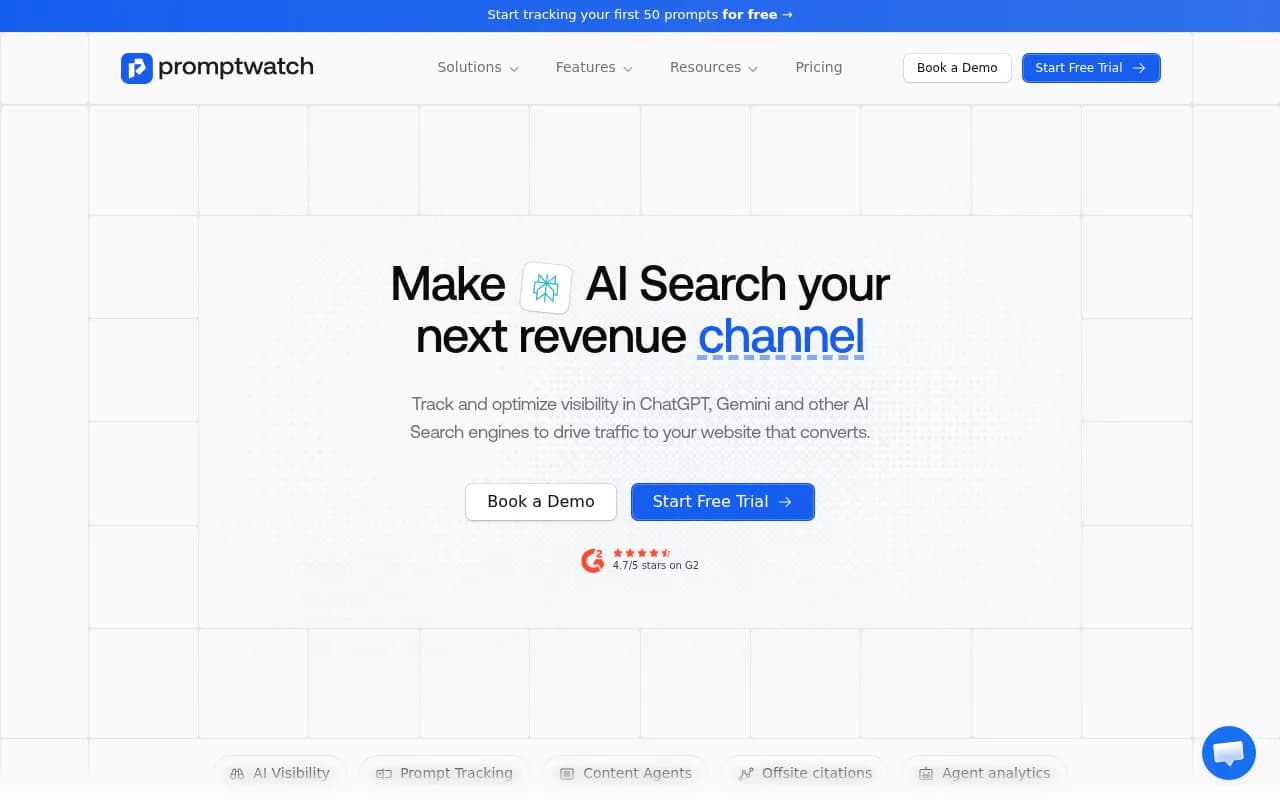
Promptwatch is an end-to-end AI search visibility and GEO (Generative Engine Optimization) platform. It was built from the ground up to answer one question: how does your brand appear when people ask AI engines questions, and what can you do about it? The platform tracks citations across ChatGPT, Perplexity, Claude, Gemini, Grok, DeepSeek, Copilot, Mistral, Meta AI, and Google AI Overviews -- in real user interfaces, not just API outputs. It's used by 1,480+ brands and agencies including Booking.com, Duolingo, Typeform, and Shutterstock.
What separates Promptwatch from most competitors is the action loop: it doesn't just show you where you're invisible, it helps you fix it. Answer Gap Analysis surfaces the exact prompts where competitors appear but you don't. Content Agents then generate articles, comparisons, and briefs grounded in that real prompt data. AI Crawler Logs show which of your pages AI engines are actually reading. The whole system is designed around closing the gap between "we know we're invisible" and "we're now getting cited."
Semrush
Semrush is one of the most widely used digital marketing platforms in the world, with over 10 million users and a toolkit that spans SEO, PPC, content marketing, social media, competitive research, and -- more recently -- AI search visibility. The AI Visibility Toolkit is a relatively new addition to the Semrush suite, added as AI search became impossible to ignore. It tracks brand mentions in AI Overviews and LLM-generated results, and the "Semrush One" positioning now puts AI visibility alongside traditional SEO as a core use case.
For teams already deep in the Semrush ecosystem, the AI Visibility Toolkit is a natural extension. You get AI monitoring without switching tools. The trade-off is that it's one module in a very large platform, and it doesn't go as deep as a dedicated AI visibility tool.
Side-by-side comparison
| Feature | Promptwatch | Semrush |
|---|---|---|
| Primary focus | AI search visibility / GEO | SEO + digital marketing suite |
| AI models tracked | 10 (ChatGPT, Claude, Gemini, Perplexity, Grok, DeepSeek, Copilot, Mistral, Meta AI, Google AI Overviews) | AI Overviews + select LLMs |
| Custom prompts | Yes -- fully custom | No -- fixed prompt sets |
| Prompt volume & difficulty scoring | Yes | No |
| AI crawler logs | Yes (real-time, per-page) | No |
| Content gap analysis | Yes (Answer Gap Analysis) | Limited |
| AI content generation | Yes (Content Agents) | Via separate Content Marketing toolkit |
| Offsite citation tracking | Yes (Reddit, YouTube, third-party pages) | No |
| ChatGPT Shopping tracking | Yes | No |
| Competitor heatmaps | Yes | Basic |
| Traditional SEO (keywords, backlinks) | No | Yes -- industry-leading |
| PPC / advertising tools | No | Yes |
| Social media tools | No | Yes |
| Free tier | Free trial (50 prompts) | Free tier available |
| Starting price | $99/mo | $117.33/mo (billed annually) |
| G2 rating | 4.7/5 | 4.5/5 |
| Multi-language / multi-region | Yes | Yes |
| API access | Yes | Yes |
| Agency plans | Yes (custom) | Yes |
Head-to-head feature deep-dive
AI model coverage
Promptwatch tracks 10 AI models in real user interfaces. That last part matters more than it sounds. API outputs from AI models can differ from what users actually see in ChatGPT, Perplexity, or Gemini -- citations, shopping recommendations, and answer formats can all vary. Promptwatch captures the user-facing experience.
Semrush's AI Visibility Toolkit focuses primarily on Google AI Overviews and a selection of LLMs. The coverage is narrower, and there's no indication it captures real user-interface behavior vs API outputs.
Verdict: Promptwatch covers more models and does it more accurately for real-world visibility.
Custom prompts vs fixed prompts
This is one of the most meaningful differences between the two tools. Promptwatch lets you define exactly which prompts to track -- the specific questions your customers are asking AI engines. You can track "best project management software for remote teams" or "which CRM integrates with HubSpot" -- whatever is relevant to your business.
Semrush uses fixed prompt sets. You're tracking visibility across a predefined list of queries, not the ones that actually matter to your specific audience. For broad benchmarking that's fine. For actionable optimization work, it's a real limitation.
Verdict: Promptwatch wins clearly here. Custom prompts are fundamental to doing GEO properly.
Content gap analysis and content generation
Promptwatch's Answer Gap Analysis shows you the specific prompts where competitors are being cited but you aren't. It then connects that to Content Agents -- an AI content generation system that creates articles, listicles, comparisons, and briefs grounded in real prompt data, citation patterns, and competitor analysis. The output is content engineered to close specific AI visibility gaps, not generic SEO filler.
Semrush has a Content Marketing Toolkit with an AI Writing Assistant, but it's not connected to AI visibility data in the same way. You can create content briefs and use AI to write, but the link between "this prompt is a gap" and "here's the content to fill it" isn't as direct.
Verdict: Promptwatch's action loop -- find gap, generate content, track results -- is more cohesive and purpose-built for AI search.
AI crawler logs
Promptwatch's Agent Analytics feature shows real-time logs of AI crawlers (ChatGPT, Claude, Perplexity, etc.) hitting your website. You can see which pages they read, errors they encounter, how often they return, and the timeline from crawl to citation. This is genuinely useful for diagnosing why certain pages aren't being cited -- maybe the crawler is hitting a 404, or a page isn't being revisited frequently enough.
Semrush has no equivalent feature. It can tell you about traditional search crawler behavior through its site audit tools, but AI crawler activity is a blind spot.
Verdict: Promptwatch only. This feature doesn't exist in Semrush.
Traditional SEO capabilities
Semrush is one of the best SEO platforms available. Keyword Magic Tool, Backlink Analytics, Site Audit, Position Tracking, Competitive Research -- these are mature, well-built tools with enormous databases. If you're doing keyword research, link building, technical SEO audits, or competitive analysis for traditional search, Semrush is hard to beat.
Promptwatch doesn't do any of this. It's not trying to. It's an AI visibility platform, not an SEO suite.
Verdict: Semrush wins by a wide margin for traditional SEO. Promptwatch doesn't compete here.
Offsite citation tracking
Promptwatch tracks which external sources -- Reddit threads, YouTube videos, third-party listicles, news articles -- AI models are citing in their responses. This matters because AI engines often pull from community content and third-party reviews, not just your own website. Knowing that a Reddit thread is driving AI citations for your competitor is actionable intelligence.
Semrush has no offsite AI citation tracking. Its AI Visibility Toolkit is focused on your own brand's appearance in AI results, not the ecosystem of sources that influence those results.
Verdict: Promptwatch only.
Pricing
| Plan | Promptwatch | Semrush |
|---|---|---|
| Free | Free trial (50 prompts, 5 articles) | Free tier (limited features) |
| Entry | $99/mo (Essential: 1 site, 50 prompts, 5 articles) | $117.33/mo (Pro, billed annually) |
| Mid-tier | $249/mo (Professional: 2 sites, 150 prompts, 15 articles, crawler logs) | $208.33/mo (Guru, billed annually) |
| Higher tier | $579/mo (Business: 5 sites, 350 prompts, 30 articles) | $416.66/mo (Business, billed annually) |
| Agency/Enterprise | Custom | Custom |
A few things worth noting on pricing. Semrush's Pro plan at $117.33/mo doesn't include the full AI Visibility Toolkit -- that's more accessible on Guru and above. So if you're specifically buying Semrush for AI monitoring, your effective entry point is closer to $208/mo. Promptwatch's $99/mo Essential plan includes core AI visibility features from day one.
On the other hand, Semrush's higher-tier plans include SEO, PPC, content, and social tools that Promptwatch simply doesn't have. If you need all of that, the value calculation shifts.
Verdict: Promptwatch is cheaper for AI-only visibility work. Semrush offers more total value if you use the broader toolkit.
Ease of use and onboarding
Promptwatch has a focused interface -- you're not navigating 50 different tools. Setup involves adding your domain, defining your prompts, and connecting your site (via Cloudflare, Vercel, server logs, or a tracking snippet). Most users are tracking their first prompts within minutes. Some reviewers have noted the UI is functional rather than flashy, which is fair.
Semrush is a large platform and can feel overwhelming at first. There's a lot of surface area. The AI Visibility Toolkit is one section among many, and finding your way around takes time. That said, Semrush has extensive documentation, an Academy with free courses, and a large community.
Verdict: Promptwatch is simpler to get started with for AI visibility specifically. Semrush has a steeper learning curve but more resources.
Pros and cons
Promptwatch
Pros:
- Purpose-built for AI search visibility -- every feature connects to the same goal
- Custom prompts let you track what actually matters to your business
- AI crawler logs are unique and genuinely useful for diagnosing citation issues
- Answer Gap Analysis + Content Agents create a real optimization workflow, not just a dashboard
- Tracks 10 AI models including ChatGPT Shopping, Grok, DeepSeek, and Meta AI
- Offsite citation tracking (Reddit, YouTube, third-party pages)
- Prompt volume and difficulty scoring helps prioritize where to focus
- 4.7/5 on G2, strong customer roster
Cons:
- No traditional SEO features (keyword research, backlinks, site audit)
- Newer platform -- smaller ecosystem and fewer integrations than Semrush
- UI is functional but not the most polished in the category
- Prompt limits per plan can feel restrictive for large-scale monitoring
Semrush
Pros:
- Industry-leading traditional SEO toolkit (keywords, backlinks, technical audit, competitive research)
- Covers SEO, PPC, social, content, and AI visibility in one platform
- Massive database and long track record
- Extensive learning resources (Academy, Knowledge Base, webinars)
- Strong integrations ecosystem
- Good for teams that want one tool for everything
Cons:
- AI Visibility Toolkit uses fixed prompts -- you can't track custom queries
- No AI crawler logs or agent analytics
- No offsite AI citation tracking
- AI monitoring is one module in a large platform, not a core focus
- AI features are less developed than dedicated GEO tools
- Higher effective cost if you're only buying it for AI visibility
Who should pick which tool
Choose Promptwatch if:
- AI search visibility is your primary or growing concern
- You want to track specific prompts relevant to your business, not a fixed list
- You need to understand why AI engines aren't citing your content (crawler logs)
- You want to generate content specifically designed to close AI visibility gaps
- You're an agency running GEO campaigns for clients
- You need ChatGPT Shopping tracking, Reddit/YouTube citation analysis, or prompt volume data
Choose Semrush if:
- You need a single platform for traditional SEO, PPC, social, and AI monitoring
- You're already a Semrush user and want to add AI visibility without switching tools
- Keyword research, backlink analysis, and site audits are core to your workflow
- You want broad AI visibility benchmarking rather than deep custom prompt tracking
- Your team is primarily SEO-focused and AI search is a secondary concern for now
Use both if:
- You have a mature SEO operation and are now building out an AI search strategy
- Your SEO team uses Semrush for traditional search while a GEO specialist handles AI visibility
- You want Semrush's keyword and backlink data to inform your Promptwatch content strategy
Final verdict
These two tools are solving different problems. Semrush is a comprehensive digital marketing platform that happens to include AI visibility features. Promptwatch is an AI visibility platform, full stop.
If AI search is where you're investing attention in 2026 -- and given how fast ChatGPT, Perplexity, and Google AI Mode are eating into traditional search traffic, it probably should be -- Promptwatch gives you more depth, more actionability, and a clearer path from "we're invisible in AI search" to "we're getting cited." The custom prompts, crawler logs, and content generation pipeline are things Semrush simply doesn't have.
If you need one tool to run your entire digital marketing operation and AI visibility is one piece of that, Semrush is the more practical choice. Just go in knowing that its AI monitoring is a starting point, not a complete solution.
For most teams doing serious GEO work, the answer is probably both -- Semrush for the SEO foundation, Promptwatch for the AI visibility layer.