Key takeaways
- Promptwatch is purpose-built for AI search visibility and GEO -- it tracks 10+ AI models, generates content to close ranking gaps, and logs AI crawler activity on your site. Semrush's AI Visibility Toolkit is an add-on to a traditional SEO platform, not a dedicated GEO tool.
- Semrush uses fixed prompt sets for AI monitoring, which means you can't customize the prompts it tracks. Promptwatch lets you define your own prompts, personas, and regions -- a meaningful difference for any brand with a specific audience.
- For teams already paying for Semrush's SEO suite, the AI Visibility Toolkit adds useful (if basic) AI monitoring without a second subscription. For teams whose primary need is AI search visibility, Promptwatch covers more ground at a lower or comparable price.
- Promptwatch includes AI crawler logs -- real-time data on which AI agents (ChatGPT, Perplexity, Claude) are crawling your pages, how often, and what errors they hit. Semrush has no equivalent feature.
- Semrush wins on breadth: backlinks, PPC, social, local, competitive keyword research. If you need all of that plus light AI monitoring, it's a reasonable all-in-one. If AI visibility is the job, it's the wrong tool for it.
- Promptwatch starts at $99/mo for a focused AI visibility plan. Semrush's entry plan is $117/mo but the AI Visibility Toolkit features are limited at that tier -- meaningful access requires higher plans.
Overview
Promptwatch
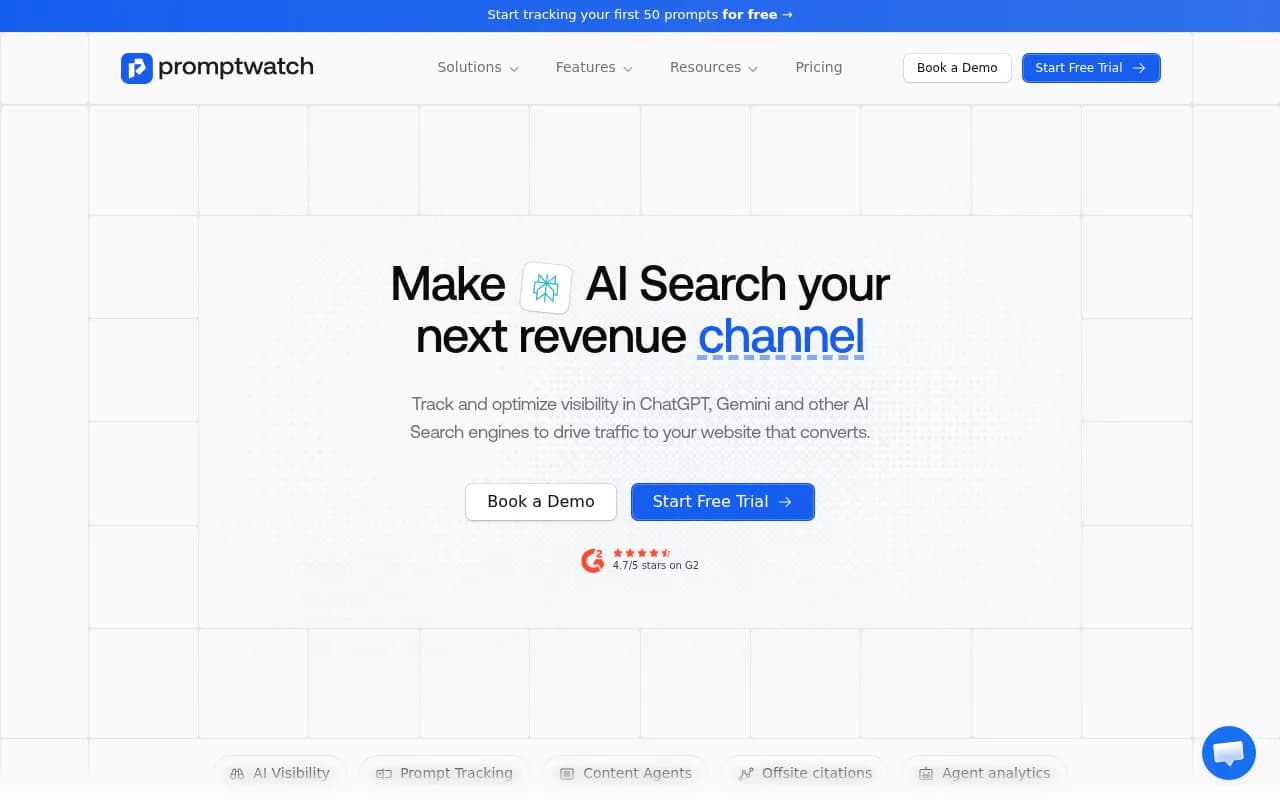
Promptwatch is a dedicated AI search visibility and GEO (Generative Engine Optimization) platform. It tracks how brands appear in AI-generated responses across ChatGPT, Perplexity, Gemini, Claude, Grok, DeepSeek, Copilot, Meta AI, Mistral, and Google AI Overviews. The core idea is an action loop: find the prompts where competitors are visible but you're not, generate content to close those gaps, then track whether that content earns citations. Over 1,480 brands and agencies use it, including Booking.com, Duolingo, Typeform, and Shutterstock.
What separates it from most competitors is that it doesn't stop at monitoring. Answer Gap Analysis, AI Content Agents, and crawler log access turn raw visibility data into something you can actually act on.
Semrush AI Visibility Toolkit
Semrush is one of the most established names in digital marketing software, with tools covering SEO, PPC, content, social, local, and competitive research. Its AI Visibility Toolkit -- part of the "Semrush One" bundle -- adds AI search monitoring on top of that existing stack. It tracks brand mentions in AI-generated results, provides an AI Visibility Score, and includes a free AI Visibility Checker tool anyone can use without signing up.
The toolkit is genuinely useful for teams that already live in Semrush and want a single platform. But it's an extension of an SEO product, not a ground-up AI visibility platform. That distinction matters when you start looking at depth of features.
Side-by-side comparison
| Feature | Promptwatch | Semrush AI Visibility Toolkit |
|---|---|---|
| Primary focus | AI search visibility & GEO | Traditional SEO + AI monitoring add-on |
| AI models tracked | 10 (ChatGPT, Perplexity, Gemini, Claude, Grok, DeepSeek, Copilot, Meta AI, Mistral, Google AI Overviews) | ~5 (ChatGPT, Perplexity, Gemini, Copilot, Google AI Overviews) |
| Custom prompt tracking | Yes -- define your own prompts | No -- fixed prompt sets only |
| AI crawler logs | Yes -- real-time per-page logs | No |
| Content gap analysis | Yes -- Answer Gap Analysis | No |
| AI content generation | Yes -- Content Agents | No (separate SEO writing tools only) |
| ChatGPT Shopping tracking | Yes | No |
| Reddit & YouTube insights | Yes | No |
| Offsite citation tracking | Yes | Limited |
| Persona & region targeting | Yes -- custom personas, multi-language | Limited |
| Traditional SEO tools | No | Yes -- full suite |
| Backlink analysis | No | Yes |
| PPC / advertising tools | No | Yes |
| Free tier | Free trial (50 prompts) | Free AI Visibility Checker |
| Starting price | $99/mo | $117/mo (limited AI features) |
| G2 rating | 4.7/5 | 4.5/5 |
| Agency plans | Yes -- custom | Yes |
| API access | Yes | Yes |
Head-to-head feature deep-dive
AI model coverage and tracking accuracy
Promptwatch tracks 10 AI models and does so by monitoring responses as they appear in actual user-facing interfaces -- not just through API calls. This matters because what ChatGPT shows a real user in its web interface can differ from what the API returns. Citation behavior, shopping recommendations, and source lists can all vary.
Semrush monitors a smaller set of models and relies on API-based queries. Several users in community discussions have noted that Semrush's AI tracking still feels like traditional keyword monitoring applied to AI results -- it doesn't fully account for the conversational, context-dependent nature of AI search.
Verdict: Promptwatch tracks more models and does it more accurately for real-world use cases.
Prompt customization and targeting
This is one of the sharpest differences between the two tools.
Promptwatch lets you define exactly which prompts to track -- your own product questions, competitor comparison queries, category-level questions your customers actually ask. You can set custom personas (e.g., "a 35-year-old CFO in Germany evaluating accounting software") and monitor responses in different languages and regions.
Semrush uses a fixed prompt methodology. You enter your domain, and it evaluates your visibility against a predetermined set of prompts relevant to your industry. You can't add your own. For many brands, the prompts Semrush picks won't match how their actual customers search.
Verdict: Promptwatch wins clearly. Custom prompt tracking is table stakes for serious AI visibility work.
Content optimization and gap analysis
Promptwatch's Answer Gap Analysis shows you the specific prompts where competitors appear in AI results but your brand doesn't. You see the exact content gaps -- topics, angles, question formats -- that AI models are exposing. From there, Content Agents generate articles, listicles, comparison pages, and briefs grounded in that prompt data, citation patterns, and competitor analysis.
Semrush has strong content tools (SEO Writing Assistant, Topic Research, Content Audit), but they're built for traditional search. They don't generate content based on AI citation gaps or prompt data. The AI Visibility Toolkit shows you your score -- it doesn't tell you what to write to improve it.
Verdict: Promptwatch is in a different category here. Semrush shows you the problem; Promptwatch helps you fix it.
AI crawler logs and technical insights
Promptwatch's crawler log feature is one of its most distinctive capabilities. It shows you in real time which AI agents (ChatGPT's crawler, Perplexity's bot, Claude's indexer) are visiting your pages, which pages they're reading, what errors they encounter, how frequently they return, and when a crawled page eventually earns a citation. You can connect via Cloudflare, Fastly, Vercel, server logs, or a tracking snippet.
Semrush has no equivalent. Its AI monitoring is output-focused (what does the AI say?) rather than input-focused (how does the AI discover and process your content?).
Verdict: Promptwatch only. This feature category doesn't exist in Semrush's toolkit.
Traditional SEO and broader marketing tools
This is where Semrush pulls far ahead. Its keyword database covers billions of terms. Backlink analysis, site audits, rank tracking, PPC competitor research, social media scheduling, local SEO, and display advertising intelligence -- Semrush has been building these tools for over 15 years. If you need a single platform for all of digital marketing, Semrush is hard to beat.
Promptwatch doesn't try to compete here. It has no backlink tools, no keyword rank tracking for traditional search, no PPC features. It's entirely focused on AI search visibility.
Verdict: Semrush wins on breadth. If traditional SEO is a core need, this matters a lot.
Reddit, YouTube, and offsite citation tracking
Promptwatch tracks which Reddit threads, YouTube videos, and third-party pages AI models cite when answering prompts. This is genuinely useful -- Reddit in particular has become a major source for AI citations, and knowing which discussions are driving AI recommendations lets you participate in or create that content.
Semrush has Reddit and social listening tools, but they're not connected to AI citation analysis. There's no feature that maps Reddit discussions to AI search outcomes.
Verdict: Promptwatch only for AI-specific offsite citation work.
Pricing comparison
| Plan | Promptwatch | Semrush |
|---|---|---|
| Free | Free trial (50 prompts, 1 site) | Free AI Visibility Checker (limited, no account needed) |
| Entry | $99/mo -- Essential (1 site, 50 prompts, 5 articles/mo) | $117/mo -- Pro (limited AI visibility features) |
| Mid-tier | $249/mo -- Professional (2 sites, 150 prompts, 15 articles, crawler logs) | $187/mo -- Guru (more AI visibility access, content tools) |
| Higher tier | $579/mo -- Business (5 sites, 350 prompts, 30 articles) | $374/mo -- Business (full AI toolkit access) |
| Agency/Enterprise | Custom pricing | Custom pricing |
A few things worth noting on pricing:
Semrush's Pro plan at $117/mo gives you access to the AI Visibility Toolkit, but the feature set at that tier is limited -- you get basic AI monitoring without the deeper analysis available at Guru and Business levels. Promptwatch's $99/mo Essential plan is fully functional for AI visibility tracking from day one.
For teams that need both traditional SEO and AI visibility, Semrush's all-in-one pricing can be cost-effective. For teams whose primary need is AI search visibility, paying $117/mo+ for Semrush to get features that Promptwatch covers more thoroughly at $99/mo is hard to justify.
Pros and cons
Promptwatch
Pros:
- Tracks 10 AI models including DeepSeek, Grok, Mistral, and Meta AI
- Custom prompt tracking -- define exactly what you want to monitor
- Answer Gap Analysis shows which content to create, not just where you're missing
- AI Content Agents generate content grounded in real prompt and citation data
- AI crawler logs show how AI agents discover and index your pages
- ChatGPT Shopping and entity tracking
- Reddit and YouTube citation insights
- Multi-language, multi-region, custom persona support
- Purpose-built for GEO -- every feature connects back to improving AI visibility
Cons:
- No traditional SEO tools -- if you need keyword rank tracking or backlinks, you'll need a separate tool
- Newer platform compared to Semrush -- smaller community and fewer third-party integrations
- The interface is functional but less polished than some competitors
- Smaller prompt volume limits on lower plans (50 prompts on Essential)
Semrush AI Visibility Toolkit
Pros:
- Massive traditional SEO feature set -- backlinks, keywords, site audits, PPC, social, local
- AI visibility monitoring bundled into an existing subscription many teams already pay for
- Free AI Visibility Checker requires no account
- Large user community, extensive documentation, and training resources
- Trusted brand with 15+ years of data
- Broad integrations with Google Analytics, Search Console, and other marketing tools
Cons:
- Fixed prompt sets -- you can't track the specific prompts that matter to your brand
- No AI crawler logs or technical AI indexing insights
- No content generation for AI search gaps
- No ChatGPT Shopping tracking
- No Reddit/YouTube citation mapping
- API-based monitoring may not reflect real user-facing AI responses accurately
- AI visibility features feel bolted on rather than core to the product
Who should pick which tool
Choose Promptwatch if:
- AI search visibility is a primary channel you're actively trying to grow
- You want to track specific prompts your customers actually use, not a generic set
- You need to understand why AI models aren't citing your content (crawler logs, indexing errors)
- You want to generate content specifically engineered to earn AI citations
- You're an agency building GEO services for clients
- You need to track ChatGPT Shopping, Reddit citations, or offsite brand mentions in AI results
- You want to monitor across 10 AI models including newer ones like Grok and DeepSeek
Choose Semrush if:
- You already use Semrush for SEO and want basic AI monitoring without a second subscription
- Traditional SEO (backlinks, keyword rankings, site audits) is still your primary focus
- You need PPC, social, or local marketing tools alongside search visibility
- You're a small team that wants one platform for everything and can accept lighter AI visibility features
- You want access to Semrush's massive keyword and backlink databases
Use both if:
- You're a larger marketing team or agency that needs deep AI visibility work (Promptwatch) alongside traditional SEO and competitive research (Semrush)
- The two tools serve genuinely different purposes and don't overlap much -- Promptwatch for AI search, Semrush for everything else
Final verdict
Semrush is a great SEO platform that added AI visibility features. Promptwatch is an AI visibility platform, full stop. If you're serious about ranking in ChatGPT, Perplexity, and Gemini -- not just monitoring whether you appear, but actually improving it -- Promptwatch is the more capable tool. Semrush's AI Visibility Toolkit is a reasonable starting point for teams already in its ecosystem, but it doesn't go deep enough for brands where AI search is a real growth channel.