Key takeaways
- Scrunch AI was acquired by Sitecore in June 2026, which changes the roadmap, support structure, and long-term product direction even though the founders say it will "continue to operate as a standalone platform."
- Core plan pricing sits at $250/month for 125 prompts and 5,000 responses, which independent trackers put at roughly 192% above the category median, so cost-per-response is a real negotiating point.
- AXP (Agent Experience Platform), Scrunch's flagship differentiator, is Enterprise-only and has reportedly still been on a waitlist for some customers, meaning you may be paying for a feature you can't use yet.
- Recurring G2 complaints (export limits, weekly CSV refresh, no day-over-day comparison) are worth testing yourself before you sign another year.
- If your renewal conversation raises more questions than it answers, that's usually the answer itself, and it's worth trialing at least one alternative before you commit.
Renewing a SaaS subscription is usually a rubber-stamp exercise. Renewing an AI visibility tool in 2026 is not, because the category is changing month to month and the vendor you signed with a year ago might not be the same company anymore. Scrunch AI is a good example of exactly that situation. It got acquired, its pricing has drifted depending on which page you read, and the feature that made it interesting in the first place is still gated behind the most expensive tier.
None of this means you should cancel. It means you should ask better questions before you click renew. Here are the ten I'd actually ask, plus what the typical answer tends to reveal.
1. Who owns Scrunch now, and what does that mean for our contract?
Sitecore acquired Scrunch on June 3, 2026. The official announcement frames it as combining Scrunch's AI-visibility insights with Sitecore's digital experience platform. Scrunch's own founder post the same day says the product "isn't going away" and will "continue to operate as a standalone platform."
That's the reassurance every acquired startup gives customers on day one. What it usually reveals in practice is a roadmap that starts leaning toward whatever Sitecore's enterprise DXP customers need, not what a self-serve brand team needs. G2's listing already shows the seller as "Sitecore" rather than Scrunch AI independently, which tells you the go-to-market motion has already shifted. Ask directly: is there a written commitment to standalone pricing and support for the next 12-24 months, or just a blog post?
2. What does our actual price-per-response look like compared to the market?
Scrunch's Core plan is $250/month for 125 prompts and 5,000 responses across 4 LLMs (ChatGPT, Perplexity, Google AI Overviews, Copilot). Independent pricing trackers put that at roughly 192% above the category median of $85.50/month, ranking Scrunch around #31 of 38 tools by price in this space. There's no free plan.
Compare that with what else is on the market. Peec AI starts around $95-199/month with unlimited countries and languages included. AthenaHQ has a free Essential tier and a $295 Starter with 3,600 credits. Otterly.ai starts at $29/month.
| Tool | Entry price | Prompts / credits | Engines covered | Notable differentiator |
|---|---|---|---|---|
| Scrunch AI Core | $250/mo | 125 prompts, 5,000 responses | 4 (ChatGPT, Perplexity, AIO, Copilot) | AXP shadow site (Enterprise only) |
| Profound Growth | $399/mo | 100 prompts, 9,000 responses | Up to 3 at entry, 10 at Enterprise | Real prompt-volume data, Shopping module |
| AthenaHQ Starter | $295/mo (free tier exists) | 3,600 credits/mo | 9-11 models | Free tier, Shopify revenue attribution |
| Peec AI Pro | ~$95-199/mo | 100-9,000 responses | 4 base + DeepSeek | Unlimited countries/languages |
| Otterly.ai | $29-189/mo | 100 prompts (Standard) | 4 (+add-ons) | Looker Studio integration |
If your renewal price hasn't moved despite this competitive pressure, ask why. "Because we haven't reviewed it" is a common answer, and it means you have leverage.
3. Is AXP actually live for our account, or still on a waitlist?
AXP, the Agent Experience Platform, is Scrunch's headline feature: a parallel version of your site served to AI agents and crawlers without touching the human-facing site. It's the reason a lot of teams picked Scrunch over a plain monitoring tool. It's also Enterprise-only, marked with a dash on the Core pricing page.
At least one published review (Writesonic) noted AXP was "not live yet... on waitlist" for their account at the time of review. If you're paying Enterprise pricing partly for AXP, ask for a screen share showing your actual agent traffic data inside the tool, not a roadmap slide. If the feature you're renewing for is still theoretical for your account, that's a hard number to negotiate down on price or delay the renewal until it ships.
4. How fresh is our citation data, really?
One recurring third-party criticism is that Scrunch's citation mapping has relied on weekly CSV exports rather than a real-time, drillable view, and that charts in the platform aren't clickable. G2's own cons summary lists "Data Limitations" with 8 mentions and no day-over-day or week-over-week comparison view in some walkthroughs.
This matters more in 2026 than it used to, because citation behavior on the AI platforms themselves can flip overnight. ChatGPT's average citations per response dropped roughly 27% around the GPT-5.3 rollout in March 2026, hitting GPT-5.3, GPT-5.4, and GPT-5-Mini simultaneously, and it never recovered a month later, per Promptwatch's data on the ChatGPT citation drop (https://promptwatch.com/data/chatgpt-citation-drop). Reddit's citation share in ChatGPT also collapsed from roughly 4% to 0.5% in a single day on August 14, 2026 (https://promptwatch.com/data/reddit-citations-are-dropping-in-chatgpt). If your monitoring tool only refreshes weekly, you find out about shifts like that two weeks after your competitors do. Ask Scrunch for the actual refresh cadence on your plan, in writing, not the marketing page's language.

5. Can we get a client-ready report out of this without a workaround?
A verified 4.5-star review cited in a competitive teardown states plainly that Scrunch "has no way to generate reports and doesn't have any solutions for less tech-savvy users." G2's cons summary backs this up with "Export Issues" cited in multiple reviews as a problem for professional reporting and client delivery, alongside "Platform Limitations" around tag removal and restricted exports.
If you're an agency or an internal team that needs to hand a PDF or dashboard to a stakeholder every month, test this before renewal, not after. Ask your rep to generate a sample report live, in the format you'd actually send to a client or a CMO, and watch how many manual steps it takes.
6. What happened to Content Gaps, and are we actually using it?
Scrunch shipped a genuinely useful feature in March 2026: Content Gaps, which auto-detects missing content for your tracked prompts, shows which competitors are winning citations instead of you, and generates a content brief with direct hand-off links to ChatGPT or Claude.
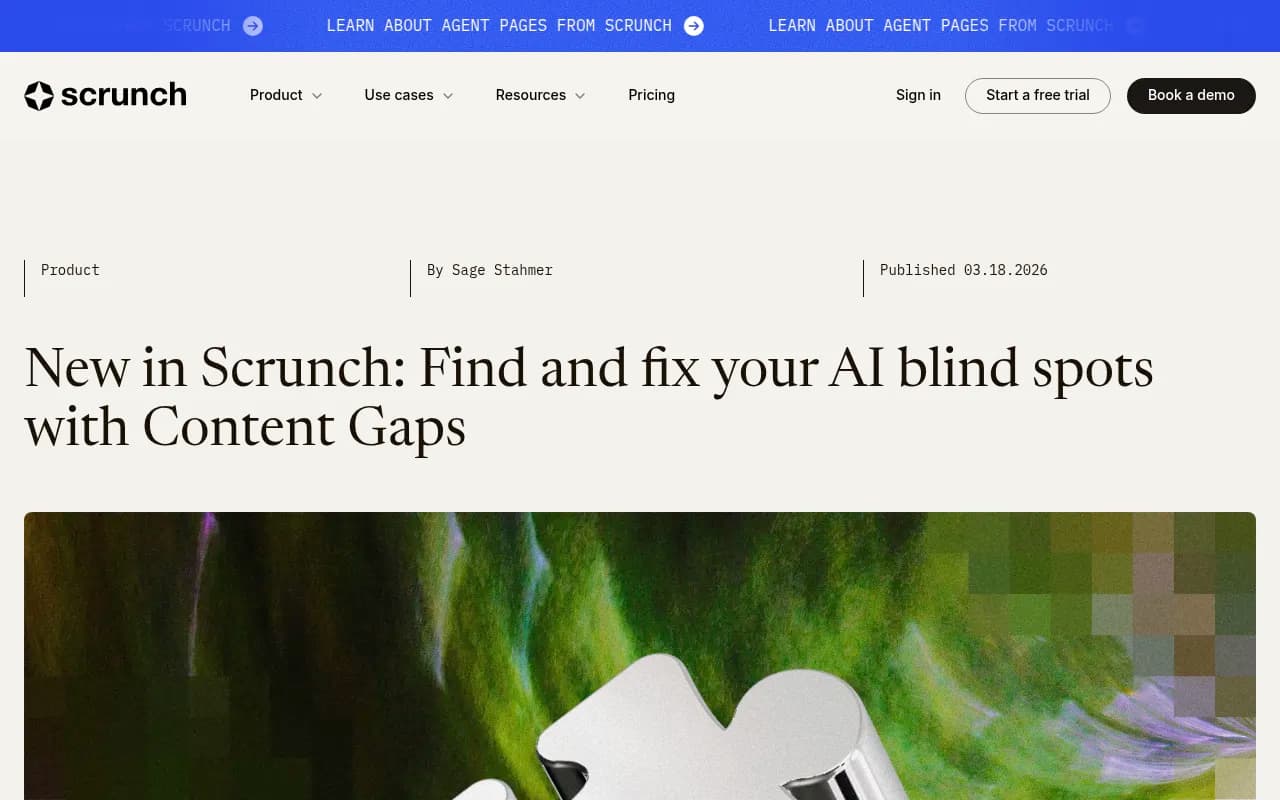
This is worth asking about specifically because a lot of teams signed up for Scrunch before this existed and never went back to check it out. If nobody on your team has opened Content Gaps in the last quarter, you're paying for a feature you're not using, and that's either a training problem or a sign the platform's UX doesn't surface it well enough on its own.
7. Does our team actually use the prompt data, or are we just checking a box?
One of the more pointed third-party critiques is that Scrunch doesn't share prompt-volume data for most prompts, meaning you can see which prompts you're tracked against but not how often real users actually ask them. That's a meaningful gap if you're trying to prioritize content work by actual demand rather than guesswork.
Ask your renewal contact directly whether prompt volume and difficulty scoring is on the roadmap, and when. If the answer is vague, that's a real product gap, not a sales objection you can talk your way past.
8. Who's actually winning the citations we care about, and how do we know?
Competitive citation tracking is genuinely one of Scrunch's most-used features, and it runs on the same prompt set as your own brand tracking, which keeps the comparison apples-to-apples according to Scrunch's own FAQ content. That part is solid.
What's worth probing is scope. A third-party comparison claims Scrunch's content scoring looks at surface signals like JavaScript weight, page length, and title match, versus deeper semantic relevance, schema, and backlink analysis from some competitors. Treat vendor-versus-vendor claims skeptically, they're marketing, but it's a fair question to put back to Scrunch: what exactly goes into the score they're showing you, and can they show their work?
9. Are we tracking the AI platforms that matter, or just the ones Scrunch supports by default?
Core plan covers four engines: ChatGPT, Perplexity, Google AI Overviews, and Copilot. Claude, Gemini, Google AI Mode, Meta AI, and Grok only show up at Enterprise, which is custom-priced. That's a meaningful gap if your audience actually lives in Claude or Gemini and you're paying Core prices to monitor engines your customers barely touch.
The broader AI crawler mix is shifting fast too. OpenAI's share of verified AI crawler requests fell from 94.8% in the week of June 8-14, 2026 to 79.8% by early September, as Anthropic, Google, Perplexity, and Mistral picked up share, per Promptwatch's crawler traffic data (https://promptwatch.com/data/ai-crawler-traffic). If your renewal tier only covers four engines and your audience is drifting toward others, ask for a side-by-side of what Enterprise adds versus what it costs, and whether a mid-tier bump exists.
10. What would we lose, and what would we gain, by trying an alternative for one quarter?
This is the question people skip because switching feels like a hassle. But the market has moved a lot in the last few months. Profound launched FactCheck and citation decay tracking. AthenaHQ rolled out a free tier and a predictive citation engine. Peec AI cut annual pricing by 16% while crossing 3,000 customers. If Scrunch's roadmap has gone quiet since the Sitecore deal closed, that tempo gap is worth noticing.

If your team's main need is monitoring plus real execution, prompt volumes, crawler logs, content generation that actually publishes to your CMS, it's worth trialing something built around that from the start rather than bolted on. Promptwatch, for instance, pairs citation and crawler-log monitoring with Content Agents that draft and publish AEO content directly to Webflow, Framer, or WordPress, plus Reddit and YouTube citation tracking and ChatGPT Shopping monitoring that Scrunch doesn't currently offer.
For a fuller side-by-side of where Scrunch, Profound, AthenaHQ, and two dozen other GEO platforms stack up, the GEO software directory at bestgeosoftware.com is a reasonable starting point, and the broader AI rank tracking directory at ai-rank-tools.com is worth a look if your priority is pure monitoring rather than content execution.
What the pattern usually reveals
Step back from the individual questions and a pattern shows up. Scrunch AI isn't a bad product, the G2 rating of 4.6 out of 5 across 73 reviews backs that up, and the ease-of-use and customer-support praise (25 and 12 mentions respectively in G2's pros summary) are real. But it's priced like a premium enterprise tool while several of its most enterprise-grade capabilities, AXP in particular, sit behind a waitlist or an Enterprise tier that costs more than Core.
The honest read: if you're already on Enterprise, using AXP daily, and exporting reports without friction, renewing is probably fine, maybe even a good deal given the acquisition's extra resources. If you're on Core, still waiting on AXP, and manually rebuilding reports every month, you're paying premium pricing for a mid-tier feature set. That's not a reason to panic-cancel, it's a reason to walk into the renewal conversation with a specific ask: either a price adjustment that matches what Core actually delivers, or a trial period with an alternative before you sign another twelve months.
Either way, don't renew on autopilot. The ten questions above take maybe 30 minutes to run through with your Scrunch rep, and the answers will tell you more about whether this is still the right tool than any feature comparison page will.