Key takeaways
- Most AI visibility tools, including Searchable, are monitoring dashboards. They show you where you're invisible but don't help you fix it.
- The tools that actually move the needle combine tracking with content gap analysis, content generation, and crawler intelligence.
- Promptwatch is the only platform in this comparison rated as a "Leader" across all GEO categories -- it tracks visibility AND helps you create content to improve it.
- If you're a solo consultant or small team on a budget, lighter tools like Otterly.AI or Peec AI are reasonable starting points, but expect to hit a ceiling fast.
- The right question when evaluating any alternative isn't "what does it track?" -- it's "what does it help me do after I see the data?"
There's a pattern in the AI visibility tool market right now. A platform launches, promises to show you how often your brand appears in ChatGPT, Perplexity, and Gemini responses, and calls it "GEO tracking." You sign up, get a dashboard full of visibility scores and citation counts, and then... sit there. Knowing you're invisible in AI search doesn't make you visible. That gap between data and action is where most tools leave you stranded.
Searchable is one of those tools. It does what it says on the tin: it tracks AI citations and gives you a picture of your brand's presence across LLMs. For some teams, that's enough. But if you're actually trying to improve your rankings in AI search -- not just measure them -- you'll run into its limits quickly.
This guide ranks 10 alternatives not by feature count or price, but by how much they actually help you rank. The further down the list you go, the more you're paying for a dashboard that tells you what's wrong without helping you fix it.
How we ranked these tools
The ranking criteria here are deliberately different from most comparison guides. We're not just checking which models each tool monitors or whether it has a nice UI. The ranking is based on four questions:
- Does it show you specific content gaps -- the exact prompts you're missing?
- Does it help you create content to fill those gaps?
- Does it track whether that content actually gets cited after you publish it?
- Does it connect AI visibility to real traffic and revenue?
Tools that do all four rank at the top. Tools that only do the first one rank at the bottom.
1. Promptwatch -- the full loop
Promptwatch is the tool that actually closes the loop. Most platforms stop at "here's your visibility score." Promptwatch goes further: it shows you which prompts your competitors are visible for that you're not, generates content to fill those gaps, and then tracks whether that content gets cited after you publish it.
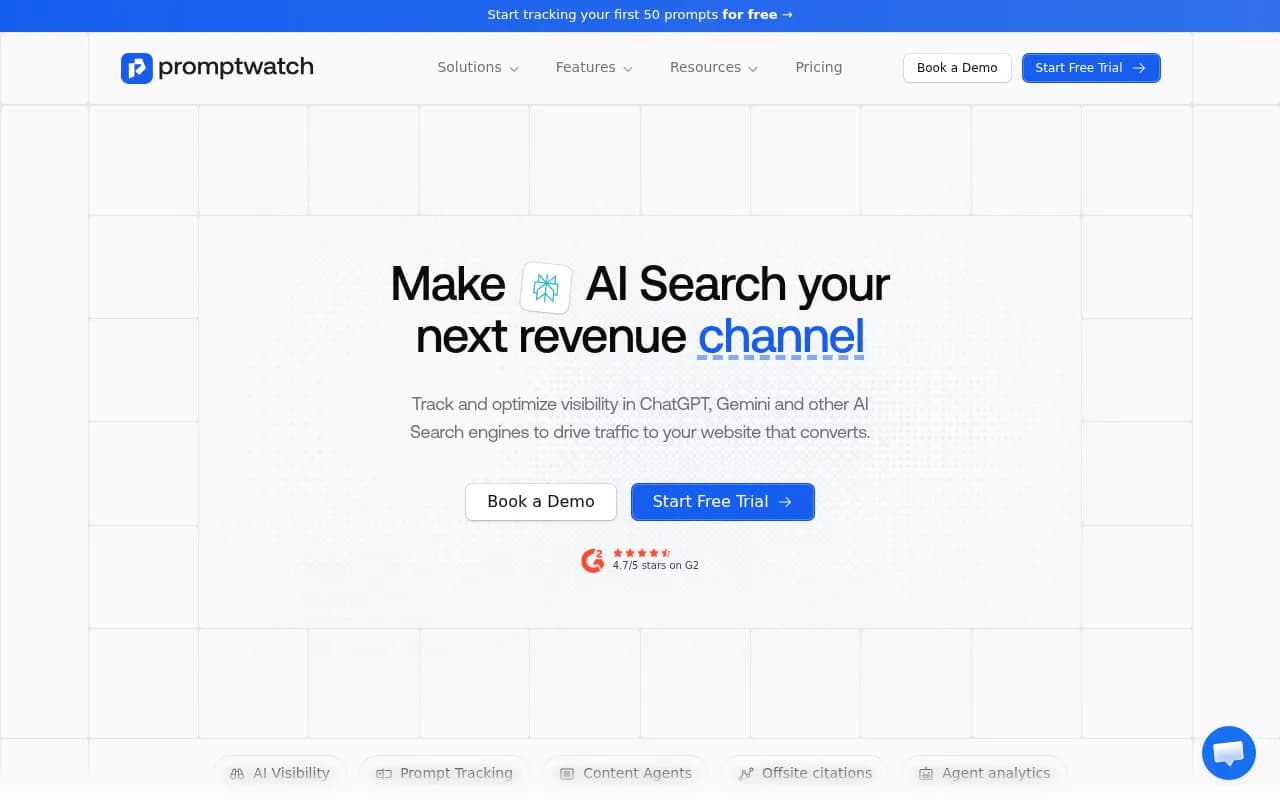
The Answer Gap Analysis is the feature that separates it from everything else in this list. You see the specific questions AI models are already answering -- questions where your competitors show up and you don't. That's not abstract. That's a content brief waiting to happen.
From there, Content Agents generate articles, listicles, and comparisons grounded in real prompt data, citation volumes, and competitor analysis. This isn't generic AI writing -- it's content built around the exact gaps the data surfaces. After publishing, page-level tracking shows which pages are being cited, by which models, and how often. The AI Crawler Logs show when ChatGPT or Perplexity crawled your page and when it moved from "crawled" to "cited."
Promptwatch monitors 10 AI models (ChatGPT, Perplexity, Google AI Overviews, Google AI Mode, Claude, Gemini, Meta/Llama, DeepSeek, Grok, Mistral, Copilot) and has processed over 4.5 billion citations, clicks, and prompts. It also tracks ChatGPT Shopping appearances, Reddit and YouTube discussions that influence AI recommendations, and offsite citations from third-party pages.
Pricing starts at $99/month (Essential: 1 site, 50 prompts, 5 articles), $249/month (Professional: 2 sites, 150 prompts, 15 articles, crawler logs), and $579/month (Business: 5 sites, 350 prompts, 30 articles). Free trial available.
The one honest caveat: if you just want a lightweight tracker and have no interest in content production, Promptwatch is more tool than you need. But if you're serious about improving AI visibility, not just measuring it, nothing else in this list comes close.
2. Writesonic GEO -- tracking with a content engine attached
Writesonic's GEO module takes a "Track -> Act -> Win" approach that puts it solidly in the "helps you rank" category. You get AI visibility monitoring across major LLMs plus an integrated content generation workflow that uses the tracking data to inform what you write.
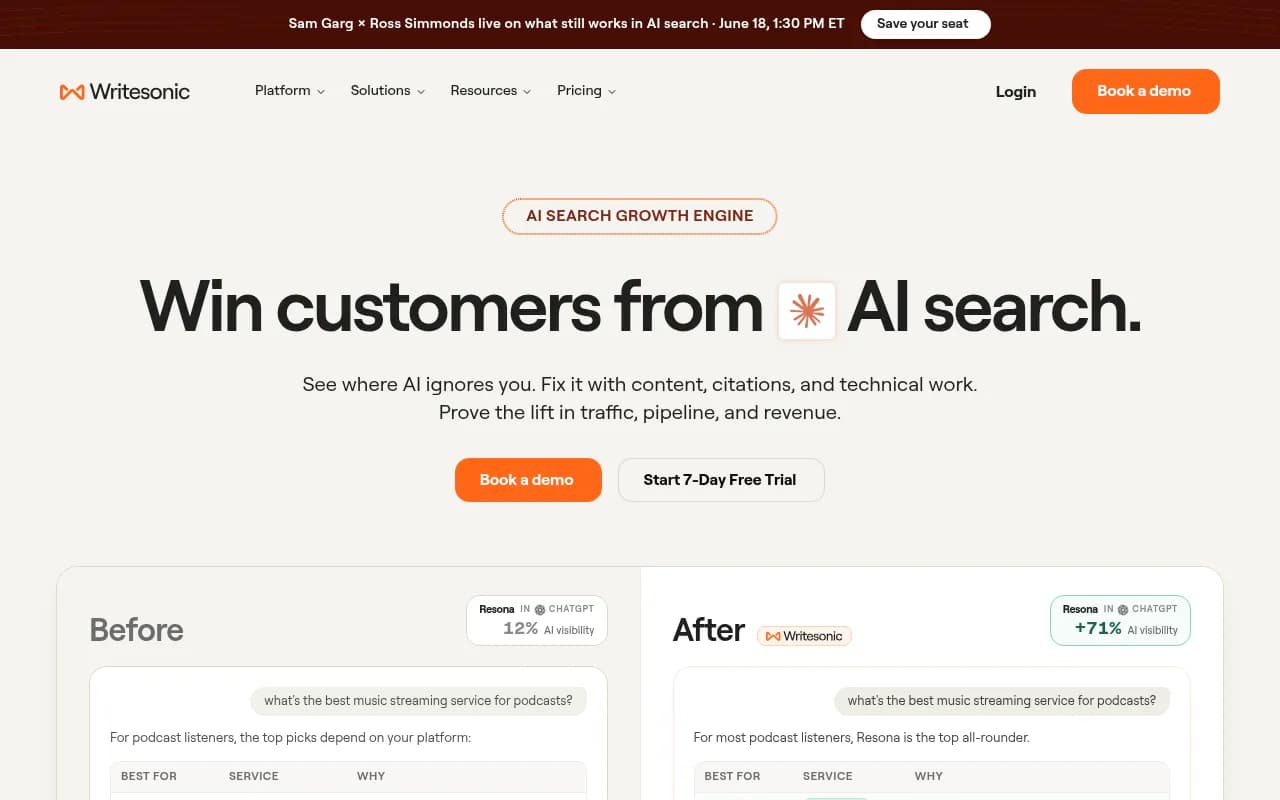
It's not as deep as Promptwatch on the analytics side -- the crawler log intelligence and prompt volume data aren't there -- but for teams that already use Writesonic for content and want to add AI visibility tracking without switching platforms, it's a reasonable choice. The integration between what you're tracking and what you're writing is tighter than most standalone GEO tools.
3. AirOps -- content workflows at scale
AirOps sits at the intersection of AI content production and SEO workflows. It's less of a visibility tracker and more of a content operations platform, but the reason it ranks this high is that it actually helps you ship content -- which is the thing most GEO tools fail to do.
You can build automated workflows that pull in keyword data, competitor analysis, and brand guidelines, then generate content at scale. The SEO visibility features are newer and less mature than the content tooling, but if your bottleneck is execution rather than data, AirOps addresses it directly.
4. Scrunch AI -- enterprise monitoring with strong segmentation
Scrunch AI is one of the more serious enterprise-grade options in the GEO space. Its segmentation capabilities are genuinely good -- you can slice visibility data by topic cluster, competitor, region, and model in ways that most tools don't support.
The Agent Experience Platform framing is interesting: it's built around the idea that AI agents are a new kind of audience you need to optimize for, not just a new kind of search engine. That's a useful mental model. The limitation is price ($300/month entry) and the fact that content generation isn't native -- you're still taking the insights and going elsewhere to act on them.
5. AthenaHQ -- solid monitoring, limited action
AthenaHQ does AI visibility monitoring well. The interface is clean, the model coverage is good, and the share-of-voice tracking across LLMs is useful for competitive benchmarking.

Where it falls short is the same place most monitoring tools fall short: it tells you what's happening but doesn't help you change it. There's no content gap analysis, no content generation, no crawler logs. If you're a brand that has a separate content team and just needs reliable tracking data to hand off, AthenaHQ works. If you need the full loop, it's half a solution.
6. Peec AI -- good for multi-region teams
Peec AI's strength is geographic precision. If you're tracking AI visibility across multiple countries and need daily, accurate data by region, it's one of the better options at its price point.
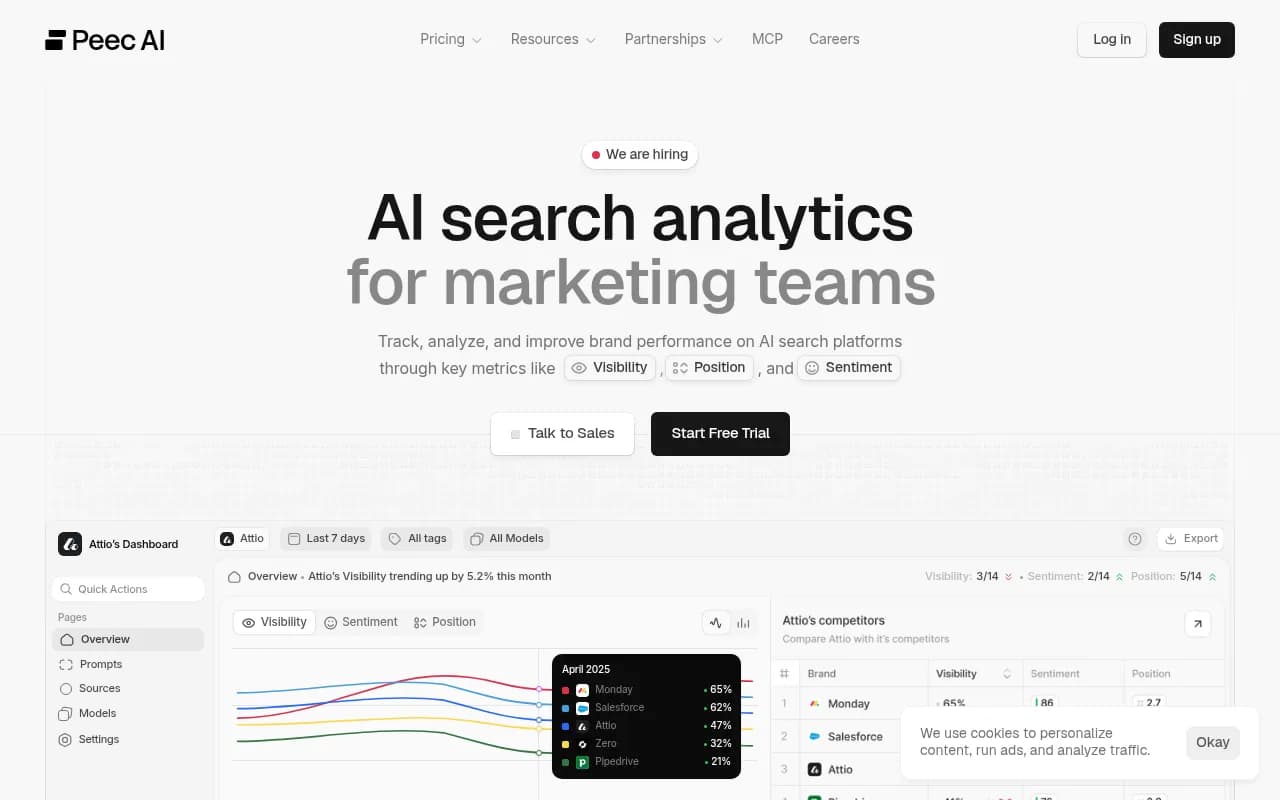
The trade-off is that it's primarily a tracking tool. The "smart suggestions" it surfaces are helpful for prioritization but don't extend into content creation. For a multi-country brand that wants to understand regional AI visibility patterns and has a content team to act on the data, Peec AI is a reasonable fit. For a team that needs the whole loop in one platform, it's not.
7. Otterly.AI -- affordable entry point, monitoring only
Otterly.AI is the budget-friendly option in the AI visibility space. It covers the major LLMs, the UI is approachable, and the pricing is accessible for smaller teams and freelancers.
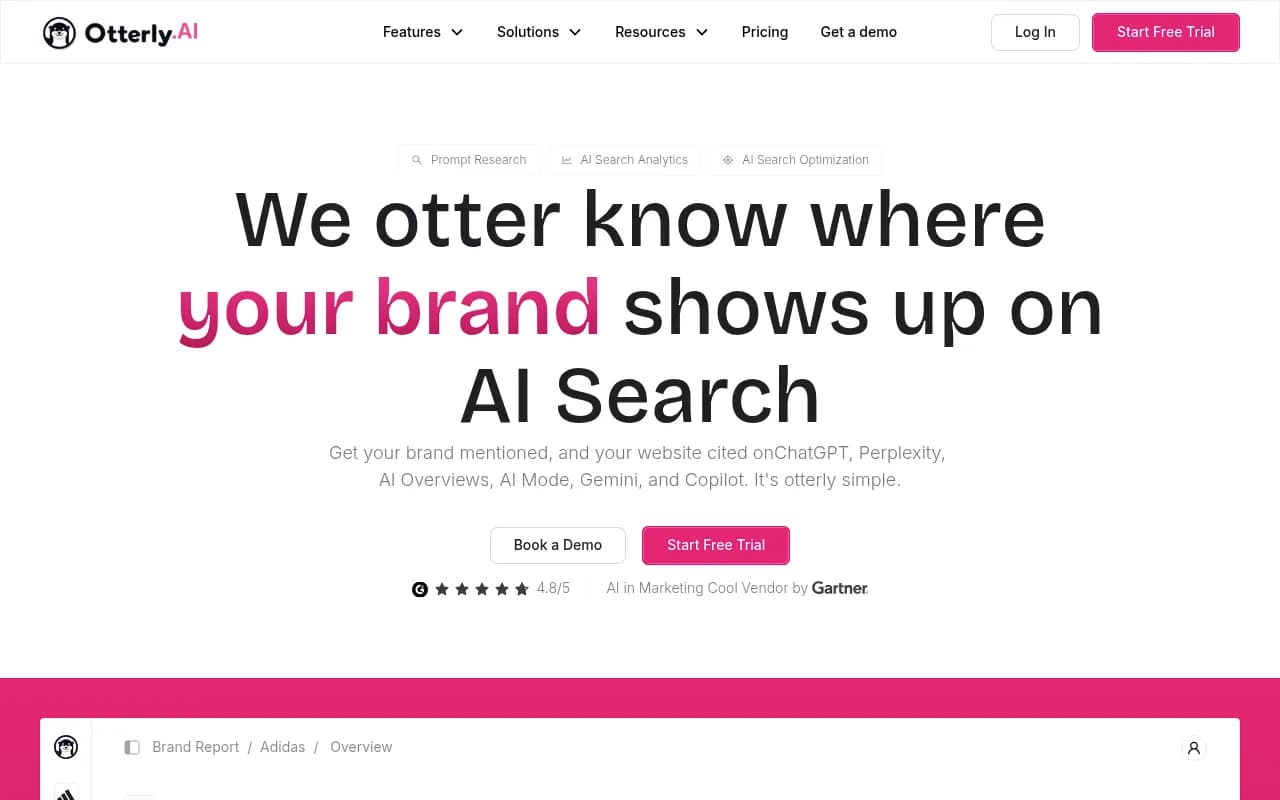
But it's firmly in the monitoring-only category. No crawler logs, no visitor analytics, no content generation, no gap analysis. You get a dashboard that shows your brand mentions across AI models. That's useful context, but it's not a ranking strategy. Think of it as a starting point for teams that are new to GEO and want to understand the basics before investing in a more complete platform.
8. SE Ranking -- traditional SEO with AI visibility bolted on
SE Ranking is a well-established SEO platform that has added AI visibility features over time. For teams already using it for rank tracking, site audits, and content optimization, the AI visibility module is a convenient addition.
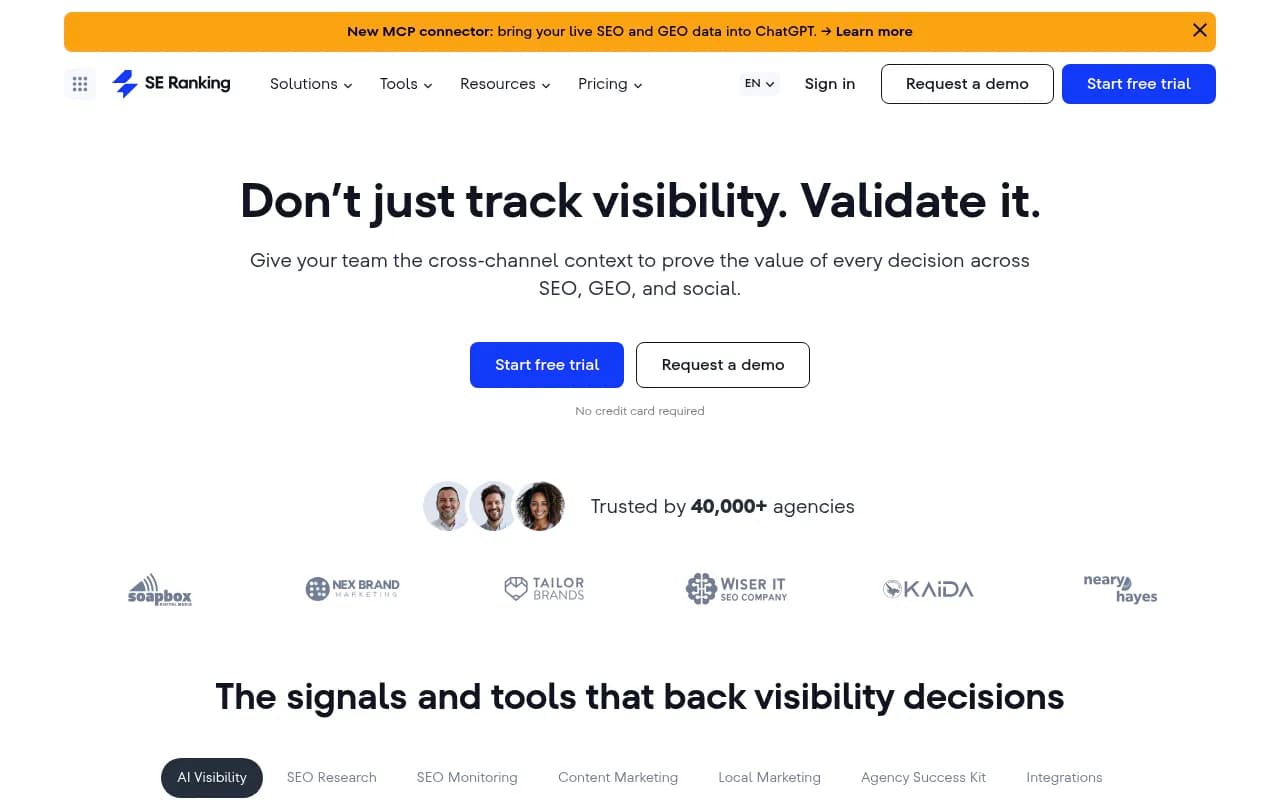
The honest assessment: the AI visibility features feel like an add-on rather than a core capability. The traditional SEO tooling is strong and the value density at $59/month is hard to argue with for freelancers and small agencies. But if AI search visibility is your primary concern, SE Ranking isn't built around it the way purpose-built GEO platforms are.
9. Ahrefs Brand Radar -- brand tracking from a traditional SEO giant
Ahrefs Brand Radar extends Ahrefs' existing SEO toolset into AI brand monitoring. If you're already an Ahrefs subscriber, it's worth exploring what's available in Brand Radar.
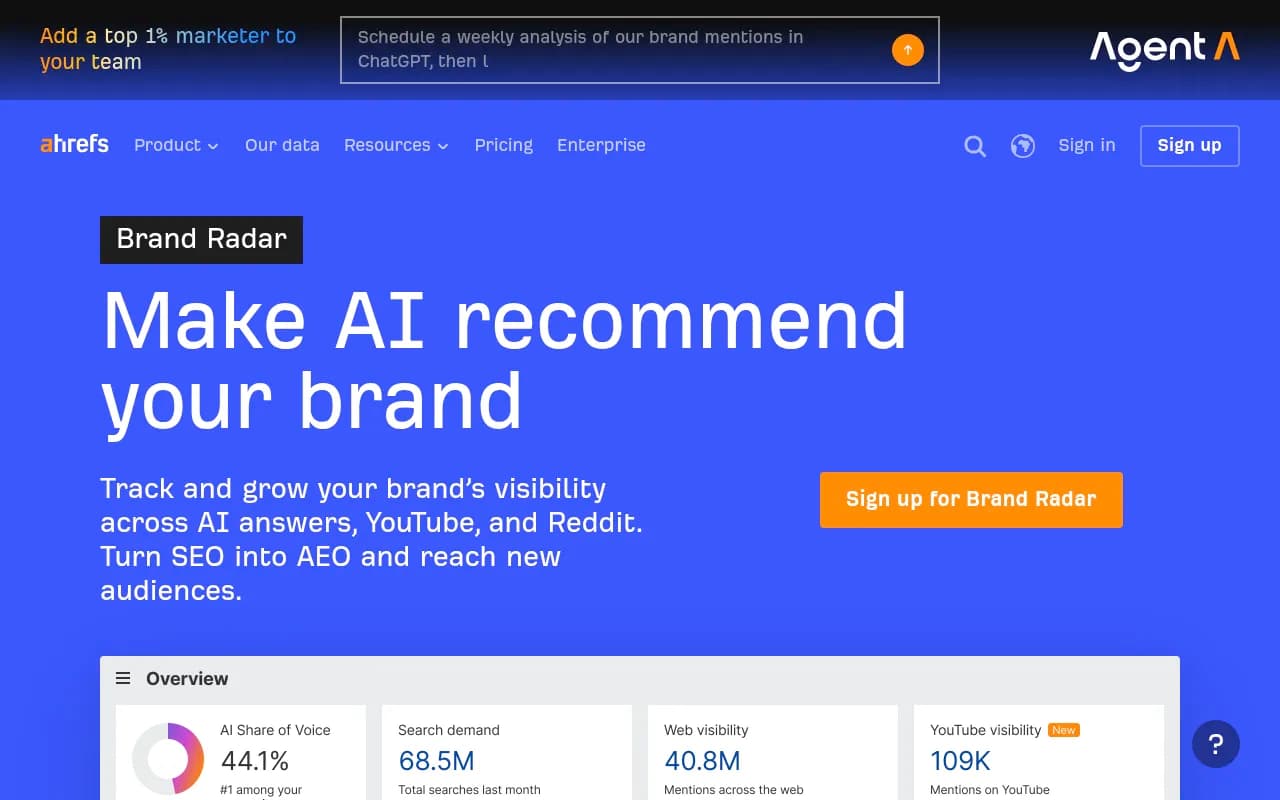
The limitations are real though: the prompts are fixed (you can't customize them to your specific use case), and there's no AI traffic attribution. You're getting a snapshot of brand mentions across AI models, not a system for improving them. For teams that live in Ahrefs and want a basic AI visibility layer without switching platforms, it's fine. For anything more serious, you'll outgrow it quickly.
10. Semrush AI Visibility Toolkit -- broad but shallow
Semrush has the brand recognition and the existing user base, and the AI Visibility Toolkit is a natural extension of its platform. The problem is the same as Ahrefs Brand Radar: fixed prompts, no customization, and no real path from "here's your visibility score" to "here's what to do about it."
At $139.95/month for the Pro plan (before you add any AI visibility features), you're paying a lot for a tool that treats AI search as a secondary concern. Teams that need Semrush for paid search, competitor research, and traditional SEO can treat the AI visibility features as a bonus. Teams that are primarily focused on GEO should look elsewhere.
How these tools compare
Here's the honest comparison across the dimensions that actually matter for ranking improvement, not just tracking:
| Tool | AI models tracked | Content gap analysis | Content generation | Crawler logs | Traffic attribution | Starting price |
|---|---|---|---|---|---|---|
| Promptwatch | 10 | Yes | Yes (Content Agents) | Yes | Yes | $99/mo |
| Writesonic GEO | 5+ | Partial | Yes | No | No | $249/mo |
| AirOps | Limited | No | Yes (workflows) | No | No | Custom |
| Scrunch AI | 5 | Partial | No | No | No | $300/mo |
| AthenaHQ | 5+ | No | No | No | No | Custom |
| Peec AI | 4+ | No | No | No | No | Custom |
| Otterly.AI | 5+ | No | No | No | No | ~$29/mo |
| SE Ranking | 3+ | No | Partial | No | No | $59/mo |
| Ahrefs Brand Radar | 4+ | No | No | No | No | Included w/ Ahrefs |
| Semrush AI Toolkit | 4+ | No | No | No | No | Included w/ Semrush |
The pattern is obvious when you lay it out like this. Most tools cluster in the "tracking only" category. The gap between tracking and acting is where most teams get stuck.
The real question to ask before switching
Before you evaluate any of these tools, it's worth being honest about where your actual bottleneck is.
If you don't know which prompts matter for your category, you need prompt intelligence and gap analysis first. If you know the gaps but can't produce content fast enough to fill them, you need a content generation workflow. If you're publishing content but can't tell whether it's getting picked up by AI models, you need crawler logs and page-level citation tracking.
Most teams are stuck at all three stages simultaneously, which is why monitoring-only tools feel frustrating. You get the data, you see the gaps, and then you're back to square one trying to figure out what to write and whether it worked.
The tools at the top of this list -- particularly Promptwatch -- are built around that full cycle. The tools at the bottom are built around the first step only.
Who should use what
A few practical recommendations based on team type:
Enterprise marketing teams that need to improve AI visibility at scale, track results, and connect visibility to revenue: Promptwatch is the clear choice. The crawler logs, Content Agents, and traffic attribution are built for this use case.
Agencies managing multiple client brands: Promptwatch's agency/enterprise pricing and multi-site tracking make it the most complete option. Search Party is worth evaluating too if your workflow is heavily client-reporting-focused.
Mid-size brands with a content team but no dedicated GEO tool: Writesonic GEO or Promptwatch Professional depending on whether you want content generation integrated or prefer to keep writing separate from tracking.
Solo consultants and freelancers who just want to understand AI visibility basics: Otterly.AI or Peec AI as a starting point. Budget for an upgrade once you've confirmed AI search is a meaningful channel for your clients.
Teams already deep in traditional SEO tools: SE Ranking's AI features or Ahrefs Brand Radar are low-friction additions, but treat them as supplementary data, not a GEO strategy.
The bottom line
Searchable tracks. That's what it does. For some teams, that's genuinely useful -- knowing where you stand is the first step. But if you're evaluating alternatives, the question worth asking is: after I see the data, then what?
The tools that answer that question well are the ones worth paying for. Most of the market doesn't answer it at all.