Key takeaways
- Prompt tracking samples AI answers to show outcomes: whether your brand is mentioned, where it sits, and which sources get cited.
- Agent tracking (AI crawler logs) shows access: which bots fetched which pages, how often, and where they hit errors.
- Each one misdiagnoses problems alone. A missing mention could be a content problem or a blocked-bot problem, and only both datasets together tell you which.
- The AI crawler mix changes fast. In Promptwatch Data, OpenAI fell from 94.8% to 79.8% of verified crawler requests in about three months, so static robots.txt assumptions go stale.
- Pair both with traffic and conversion data, or visibility numbers turn into a vanity metric.
The two terms, defined plainly
People use "tracking" loosely in AI search, so let me pin the words down first.
Prompt tracking means running a fixed set of questions through AI engines on a schedule and recording what comes back: which brands appear, in what order, with what framing, and which sources get cited. KIME's glossary describes it as turning noisy single answers into trends. It is a sampling method. You are measuring how often you show up, not reading a leaderboard.
Agent tracking is the other side of the same conversation. Instead of asking AI what it says, you look at your own server or CDN logs to see which AI agents visited your site. That includes training crawlers, search-index bots, and the fetchers that grab a page in real time when a user asks a question. It tells you who came, what they read, and what went wrong.
One measures the output. The other measures the input. That is the whole distinction, and most of the confusion about whether you need both comes from treating them as competing answers to the same question.
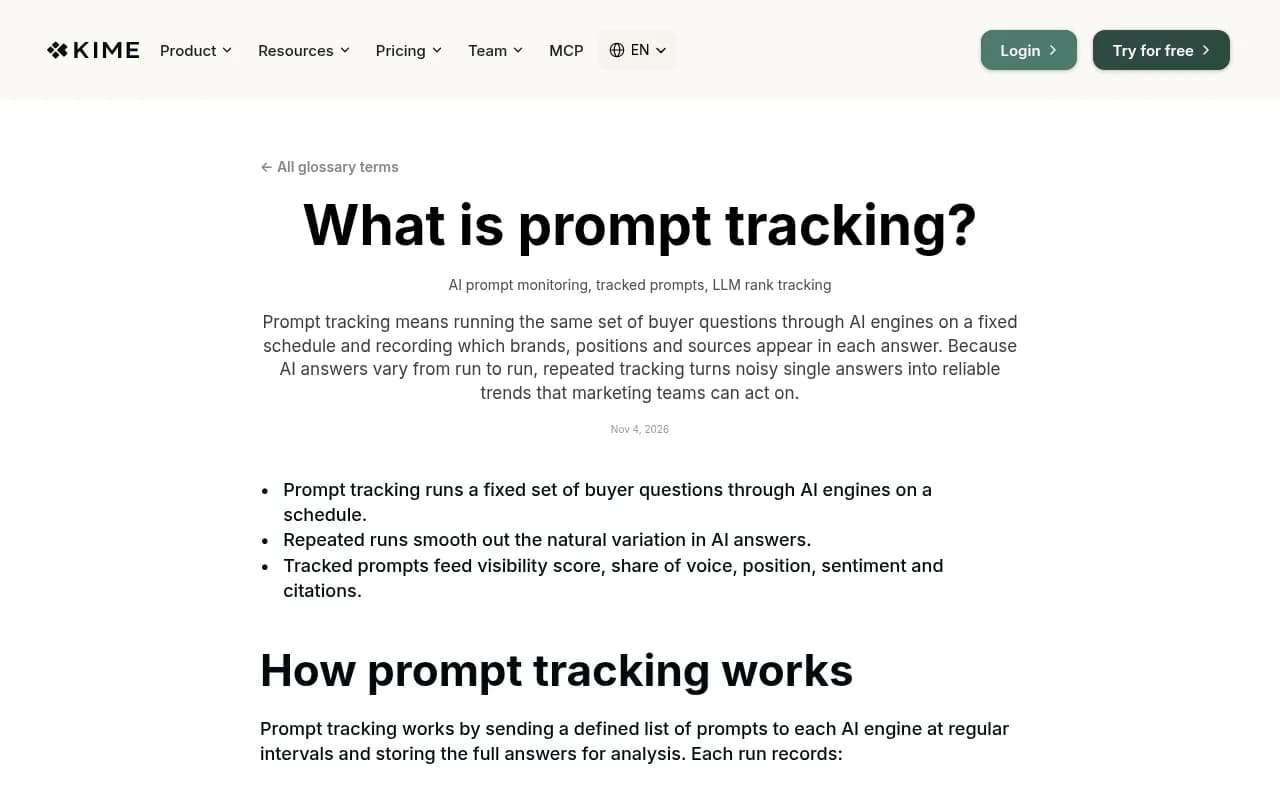
What prompt tracking actually measures
A good prompt tracking setup gives you a handful of metrics: mention rate, share of voice, average position, sentiment, and citations. Run the same 80 prompts across five engines weekly and you get 400 answers to compare against last week.
The important caveat is variability. SparkToro analyzed 2,961 prompts across ChatGPT, Claude, and Google AI and found less than a 1-in-100 chance that the same brand list appears in two runs of the same query. SE Ranking found only 35% of domains repeat between runs in AI Mode local queries. So a single check is close to meaningless.
seoClarity makes the useful framing point: prompt tracking is valid when you treat it as sampling, not surveillance. If you appear in eight of ten observations, your observed mention rate is 80% within that sample. It is not an 80% chance that any given user sees you. That is a directional signal about presence, consistency, and competitive position.
seoClarity's argument also includes a chain worth memorizing: presence, citation, referral, engagement, conversion, revenue. Prompt tracking sits on the left end of that chain.
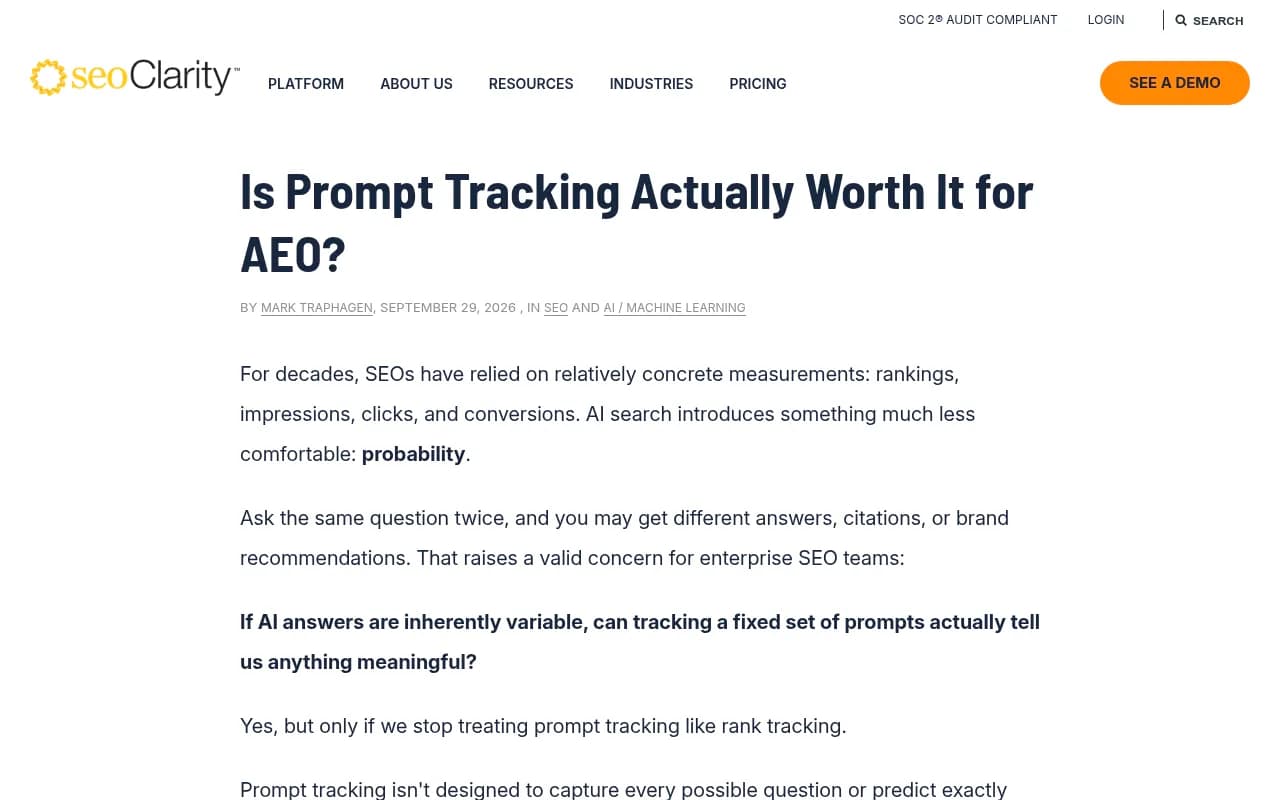
Where prompt tracking misleads
- It cannot tell you why you are missing. Weak content, a blocked crawler, and a thin third-party reputation all look identical in a mention-rate chart.
- Branded prompts inflate scores. Any question naming you will mention you.
- It is a sample. Ryan Robinson's video makes the sceptic's case that prompt-level rankings are noisy and that content and cross-platform authority should come first. He is right that tracking should not be your whole strategy. I would not conclude it is a waste, though, because without it you are optimizing blind.
- Prompts are not keywords. There is no volume or position data in the traditional sense, and one prompt fans out into several retrieval queries.
What agent tracking actually measures
Agent tracking works from raw logs. Every time GPTBot, OAI-SearchBot, ChatGPT-User, ClaudeBot, Claude-User, PerplexityBot, or a Meta crawler requests a page, there is a line in your logs. Verified properly (matching each request's IP against the operator's published ranges so spoofed user agents are filtered out), those lines answer questions prompt tracking cannot:
- Is this engine reaching my site at all?
- Which pages do answer-time fetchers read, as opposed to training crawlers?
- Are bots hitting 403s, 404s, timeouts, or redirect loops?
- Did a robots.txt or WAF change quietly cut off a provider?
The distinction between bot types matters. Training crawlers feed future models. Search bots build an index. User-triggered fetchers (the ChatGPT-User and Claude-User types) fire when a person asks something and the model goes to look. Provider totals hide that split, which is why a crawler view that breaks out the individual bot is more useful than a headline number.
Before relying on any user-agent name, check the operator's current documentation. These names change.
The mix moves quickly
Promptwatch's AI crawler traffic report (IP-verified requests, June 8 to September 6, 2026) shows OpenAI at 79.8% of requests in the week of Aug 31 to Sep 6, down from 94.8% in early June. The shares are relative, so a shrinking slice does not necessarily mean fewer requests. Still, other providers are taking a bigger share of the pie.
Two other reports show how quickly things shift. Meta-WebIndexer went from about 2% to nearly 38% of tracked AI crawler requests between mid-July and August 9, 2026. And Claude's citation crawler grew more than 100x between December 2025 and April 2026, to roughly 1% of tracked citation crawler traffic. If your robots.txt was written in 2025, it may not describe your 2026 reality.
Where agent tracking misleads
- A bot visit is not a citation. Being crawled does not mean being used.
- Volume can come from training crawlers that never influence a live answer.
- It says nothing about sentiment, competitors, or what the model actually writes about you.
Side-by-side comparison
| Dimension | Prompt tracking | Agent tracking |
|---|---|---|
| Data source | Sampled outputs from AI interfaces | Server and CDN logs |
| Question answered | Do AI answers mention or cite us? | Can AI bots reach and read our pages? |
| Position in the chain | Outcome | Input and access |
| Typical metrics | Mention rate, share of voice, position, sentiment, citations | Requests by bot, pages crawled, error rates, crawl frequency |
| Main weakness | Variable, can't explain causes | Visits don't equal citations |
| Typical fix it points to | Content gaps, authority, third-party mentions | robots.txt, CDN/WAF rules, rendering, broken pages |
| Setup effort | Define prompts, pick engines | Connect logs via CDN, host, or plugin |
Why you need both: three diagnostic scenarios
The value shows up when you cross the two datasets.
Scenario 1: you're missing from one engine
Prompt tracking shows near-zero mentions in Claude or Perplexity. Is your content weaker there, or is the bot blocked? Check the logs. Promptwatch's crawler report gives the practical test: if a provider is a large share of the overall mix but near zero in your logs, you are probably blocked or unreachable for that provider. Without logs, you would spend weeks rewriting content that was never read.
Scenario 2: bots visit but you're not cited
Logs show answer-time fetchers hitting your pricing page every day. Prompt tracking says competitors get cited for pricing questions and you do not. Access is fine, so this is a content problem: structure, specificity, or missing sub-questions. ChatGPT's own query fan-out matters here. Promptwatch's query fanout data notes that your page needs to match one of the queries ChatGPT generates, not the user's literal prompt. Tracked prompts measure the output. Fan-outs are the retrieval layer.
Scenario 3: cited but no traffic
Both tracking types look healthy, yet nothing arrives. That is where visitor analytics comes in. Visibility metrics have to be tied to referral traffic, conversions, and revenue, or they drift into vanity territory. Note too that ChatGPT stopped sending a referrer on October 8, 2026, so tagging with utm_source=chatgpt.com is now worth doing.
How to set up both without overbuilding
Prompt tracking
- Start from buyer questions, not brand terms. Strip branded prompts, which cause false positives.
- Map prompts to personas and journey stages. Kevin Indig suggests about 15 prompts per persona, measured over roughly five runs weekly.
- Keep the set intentional. Cost scales with prompts times models times rerun frequency, so a bloated list is expensive and hard to read.
- Judge trends over 3 to 4 weeks, not days.
Agent tracking
- Connect logs from your CDN, host, or CMS plugin. Cloudflare, Vercel, Fastly, and raw server logs are common routes.
- Verify IPs against published operator ranges.
- Baseline each bot, then review monthly.
- Audit robots.txt, CDN, and WAF rules for every provider, not only the one you think matters. Free helpers like a robots.txt generator for AI and the AI bots directory make this faster.
Tools worth knowing
Most tools in the category cover prompt tracking only. A few cover logs. Fewer still connect the two.
Promptwatch is the one I would look at first if you want both in one place. It tracks prompts through the real interfaces of ChatGPT, Gemini, Perplexity, Google AI Overviews and others, and its AI crawler logs show IP-verified bot visits with crawl-to-citation paths per page, so you can separate an access problem from a content problem. Visitor analytics close the loop on traffic.

On the prompt-tracking side, several tools in the catalog are worth comparing:



Similarweb AI Brand Visibility
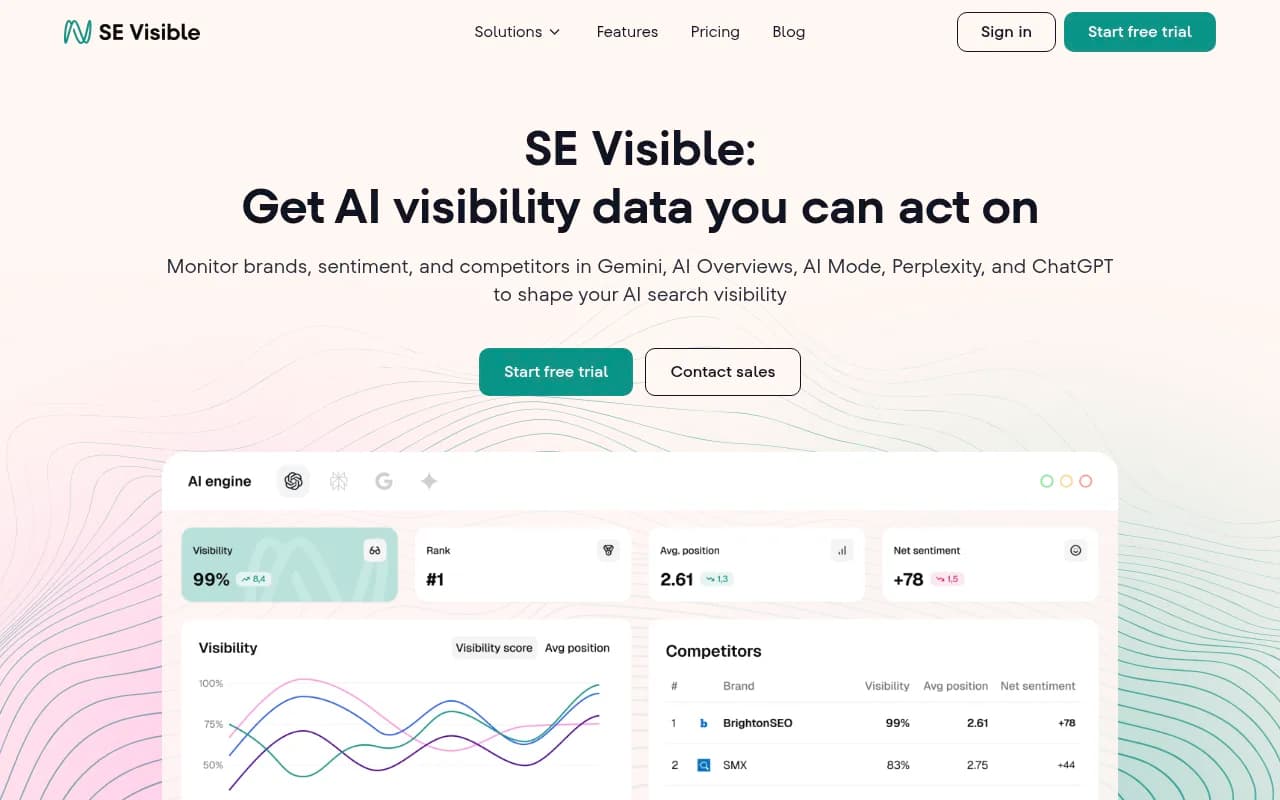
For crawl-side and technical visibility, enterprise SEO platforms add log-level data:
If you want a wider survey, the GEO software directory at bestgeosoftware.com lists far more options than I can cover here.
| Need | What to look for |
|---|---|
| Mentions and citations only | Any prompt tracker with real-interface data and multi-run sampling |
| Bot access diagnosis | IP-verified crawler logs, per-bot breakdown |
| Both plus traffic | A platform that joins crawls, citations, and visits per page |
| Fixing gaps, not just seeing them | Content gap analysis and publishing workflows |
A practical weekly routine
Here is a loop that fits in an hour.
- Check the prompt dashboard for movement in mention rate and citations. Ignore single-run swings.
- Open crawler data and look for any provider whose share in your logs diverges from the overall mix.
- For every prompt where you lost ground, ask: were relevant pages crawled? If no, fix access. If yes, fix content.
- Check AI-referred visits and conversions for the pages you changed.
- Re-test a month later. Content type matters too: Promptwatch's content half-life data found that landing pages and docs stayed cited longest while news lost half its pages within 36 days.
On priorities, I agree partly with the sceptics. If you must pick one thing to spend money on, improve your content and authority first. But you cannot tell whether that work landed without some measurement, and the cheapest version of that measurement is a modest prompt set plus crawler logs.
Common mistakes
- Treating a mention-rate drop as a content failure before checking whether a bot was blocked.
- Treating high crawl volume as proof of visibility.
- Tracking hundreds of prompts you never act on.
- Never revisiting robots.txt after the crawler mix shifts.
- Reporting visibility without traffic or conversions next to it.
Bottom line
Prompt tracking tells you what AI says about you. Agent tracking tells you whether AI can read you. When the two disagree, you have found your most useful problem to fix. Start with a small, deliberate prompt set, connect your logs, and review them together every week.
If you want help building this measurement layer as part of a wider GEO program, the team at 1001 SEO Media runs audits and ongoing AI search work. To see how your brand currently shows up, Promptwatch's free AI visibility report is a no-login place to start.