Key takeaways
- AI systems do not simply look up your average star rating. They read review text, owner replies and surrounding pages, then summarize the patterns they find.
- Reviews are a small slice of ChatGPT citations overall (1.7%), but they jump to 5.6% on branded prompts like "is [brand] good for X". That is exactly where a wrong rating hurts.
- Fix the source, not the symptom: resolve recurring complaints, reply with specifics, keep third-party profiles current, and publish plain-text facts on your own site.
- Audit what each AI engine says about you first. A wrong rating in one engine is often a stale profile, and a bad sentiment summary is often one repeated complaint.
- Some of the advice floating around is vendor claims, not independent data. I flag those below.
Why AI gets your ratings wrong
You have a 4.7 on Google. Someone asks ChatGPT whether you are any good, and the answer says "mixed reviews, some customers report slow support." Or it quotes a rating you have not had in two years. It feels like a bug. It mostly isn't.
Large language models do not treat a star average as a ranking input the way older local algorithms did. Reputation.com makes this argument in its piece on review quality: gather enough four and five-star reviews and you used to climb local rankings, but a language model has nothing to work with in a vague "great service!" review. That is a vendor view, but it matches what you see when you read AI answers about brands. They quote phrases, not averages.
A few things go wrong in practice:
- Stale data. The model or its search layer pulled a cached page, an old directory listing or an outdated app-store snapshot.
- Pattern over-weighting. Three similar complaints in a pile of hundreds can become the headline, because they are specific and quotable while the praise is generic.
- Source mismatch. The AI cites a review site you never claimed, where the rating is lower or the profile is half empty.
- Unanswered friction. Complaints with no owner reply read as unresolved.
- Mixing entities. Similar business names, old brand names or multi-location chains get blended into one summary.
You can rarely edit the AI answer directly. You can change the inputs. That is the whole game.
Where AI actually gets review signals
Before chasing every review platform, look at where citations really land. Promptwatch Data's ChatGPT citation share by content type report (Sep 28 to Oct 4, 2026) shows reviews are only 1.7% of classified ChatGPT citations. Product pages are 22.4% and landing pages 16.8%, so almost 39% of citations go to pages describing what a company sells.
Branded prompts change the picture. For questions like "is HubSpot good for startups":
- reviews rise to 5.6%, more than three times their overall share
- social posts rise to 3.0%
- FAQ pages rise to 4.8%
- product pages (23.3%) and landing pages (22.8%) still make up almost half
Translation: when someone asks about you by name, reviews matter much more, but your own pages still carry the largest share. If your site says nothing clear about pricing, who the product is for or how support works, the AI fills the gap with whatever reviewers said.
Review sites and app stores
In software, Promptwatch's ChatGPT software citation data (same week) shows G2 as the most cited review site at 0.73% of citations, with Gartner at 0.34% and Capterra at 0.32%. Together the review sites and analysts earn 1.57%. Docs, help centers and vendor pages together earn 4.65%, about three times as much. App stores earn 0.47%, and both apps.apple.com and play.google.com sit in the top 23 domains, so app ratings are a real citation surface.
Two lessons. Review profiles matter, but they are not the main event. And your own documentation is probably doing more to shape the answer than your G2 page.
Reddit and social complaints
This changed fast. Promptwatch Data's social media citations by AI model report found all seven tracked social platforms make up just 0.46% of ChatGPT citations (Sep 28 to Oct 4, 2026), with Reddit down to 0.09%. That follows the collapse in Reddit citations from about 4% to 0.5% on August 14, 2026.
Google AI Overviews is different: 12.2% of its citations come from social platforms, including YouTube at 4.28%, Facebook at 2.38% and Reddit at 2.15%. Perplexity sits at 2.7%.
So a nasty Reddit thread is less likely to color ChatGPT's answer now, but it can still shape what Google AI Overviews and Perplexity say. Fix priorities should depend on which engine is misrepresenting you.
Step 1: Audit what each AI engine says
Don't guess. Run the same set of prompts across engines and write down what comes back.
Use prompts a real buyer would use:
- "Is [brand] any good?"
- "What do customers say about [brand]?"
- "[brand] reviews and complaints"
- "[brand] vs [competitor]"
- "What is [brand]'s rating?"
For each answer, log four things: the rating quoted, the sentiment tone, the complaints or praise named, and which sources are cited. Do it for ChatGPT, Google AI Overviews, Google AI Mode, Gemini and Perplexity. They disagree with each other more than you would expect.
Doing this by hand works for a day. After that you want tooling. Promptwatch is an AI visibility platform that tracks real-interface responses across these engines, scores sentiment per prompt and topic, and pulls the individual claims AI makes about you into Brand Narrative (for example "slow support" or "affordable for small teams"), with a score per theme against competitors. That claim-level view is what you need here, because a vague sentiment number does not tell you which complaint to fix.

If you want to compare options first, the directory at bestgeosoftware.com lists GEO tools by category. A few from our catalog worth a look for brand perception specifically:
| Tool | Angle | Good for |
|---|---|---|
| Promptwatch | Sentiment, Brand Narrative claims, citations, plus content fixes and tracking | Teams who want to find and fix the issue in one place |
| Waikay | Brand perception tracking | Seeing how AI describes you |
| LLM Pulse | Visibility and reputation | Reputation-focused monitoring |
| Yotpo Discover | AI visibility tied to ecommerce catalogs and reviews | Product and review-heavy retailers |
| Birdeye Search AI | Location-level local AI visibility | Multi-location businesses |


Yotpo Discover
Check the claims against reality
Once you have the answers, sort every wrong statement into one of three buckets:
- Factual error: wrong rating, wrong pricing, outdated feature, wrong location.
- Fair but fixable: a complaint that real customers raised and that you can resolve.
- Noise: a one-off the model overweighted.
Fact Check in Promptwatch's higher plans lets you mark a claim Accurate or Inaccurate and then finds the pages on your site that state it or its opposite, so you know which page is teaching the model the wrong thing. By hand, you can do a similar thing by searching your own site for the claim.
Step 2: Fix the source of the wrong star rating
If an AI quotes a wrong rating, trace it. Look at the cited sources in the answer and open each one.
Common causes and fixes:
- Unclaimed or duplicate profiles. Claim them, merge duplicates, update name, address, hours and category. For multi-location chains, tools like BrightLocal, Reputation.com, Chatmeter and Synup manage listings and reviews at scale.
- Old brand or product names. Update every profile, and add a clear "formerly known as" line on your own About page.
- App store snapshots. Ratings reset per version on some stores, so a recent version can show a lower number than the lifetime average. Check what is actually displayed.
- Stale cached pages. Make sure your own pages state current facts in text and that AI crawlers can reach them. Promptwatch's AI crawler logs show whether bots like GPTBot or PerplexityBot read a page and where they hit errors, which helps tell an access problem from a content problem.

One caution. Do not mark up your own reviews with schema and expect a rating to appear. Search engines restrict self-serving review markup, and I have not verified the current rules for AI surfaces, so check Google's documentation before you touch it. The safer move is to publish the rating context as plain text: "4.7 from 2,300 verified reviews on Google, updated October 2026." As one Reddit practitioner put it, make the improvement findable as text, not just a star rating.
Step 3: Fix the sentiment story
This is where most brands spend too little. A star rating is a number. Sentiment is what the reviews say, and models quote that.
Find the recurring themes
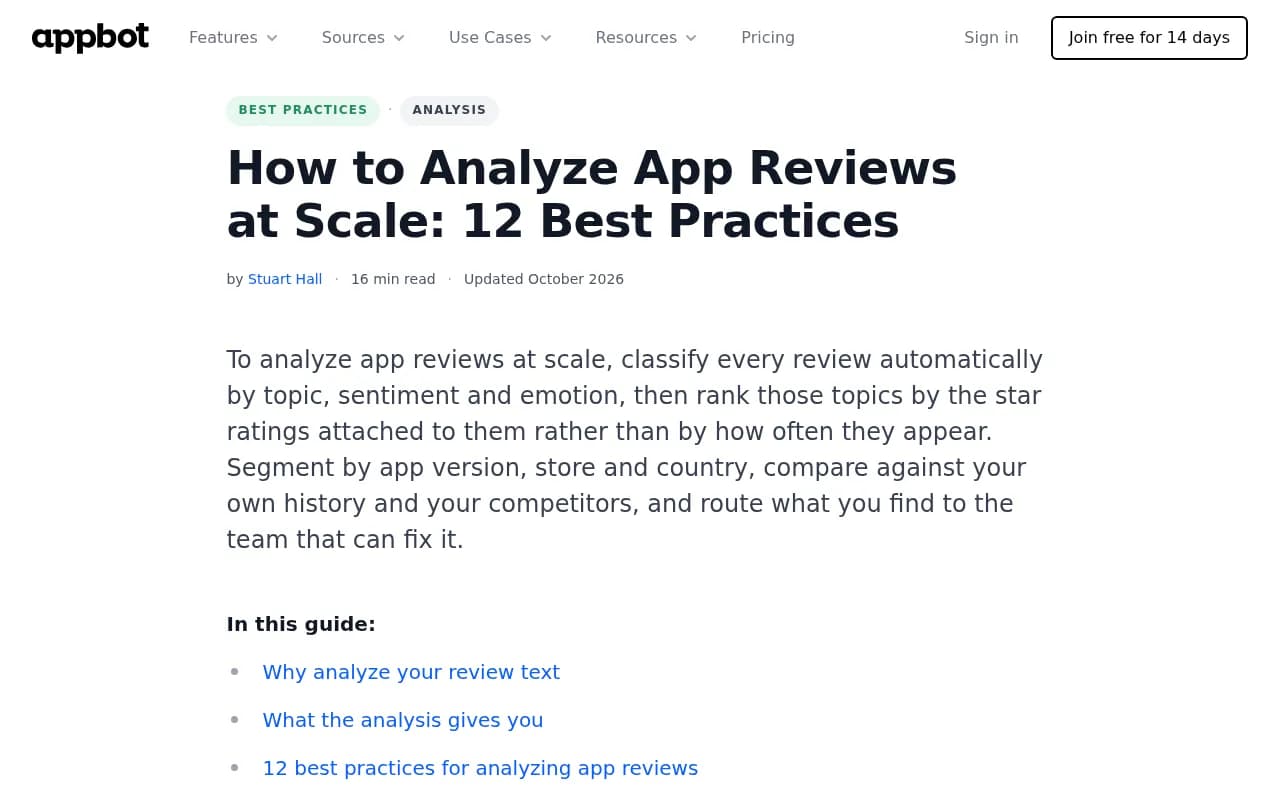
Export your reviews and cluster them by topic. For app reviews, Appbot's guide to analyzing app reviews recommends classifying every review by topic, sentiment and emotion, then ranking topics by the star ratings attached to them rather than by how often they appear. That ordering matters: a rare topic with one-star reviews attached can hurt more than a common neutral one.
Then compare against the AI answer. If the AI says "support is slow" and your review analysis shows 18% of recent negatives mention support wait times, you have found the real problem, not an AI hallucination.
Fix the problem, then say so publicly
There is no shortcut. If a recurring complaint is true, resolve it. Then:
- Reply to the older reviews that raised it, noting what changed.
- Publish a dated page or changelog entry explaining the fix, in plain text.
- Ask recent customers to review, without scripting what they say.
That last point deserves a note. Specific reviews help a model more than vague ones, but do not coach or incentivize review content. Platforms ban it, and it looks bad if it surfaces. Ask open questions like "what did you use us for, and how did it go?" and let people answer in their own words.
Reply like a person
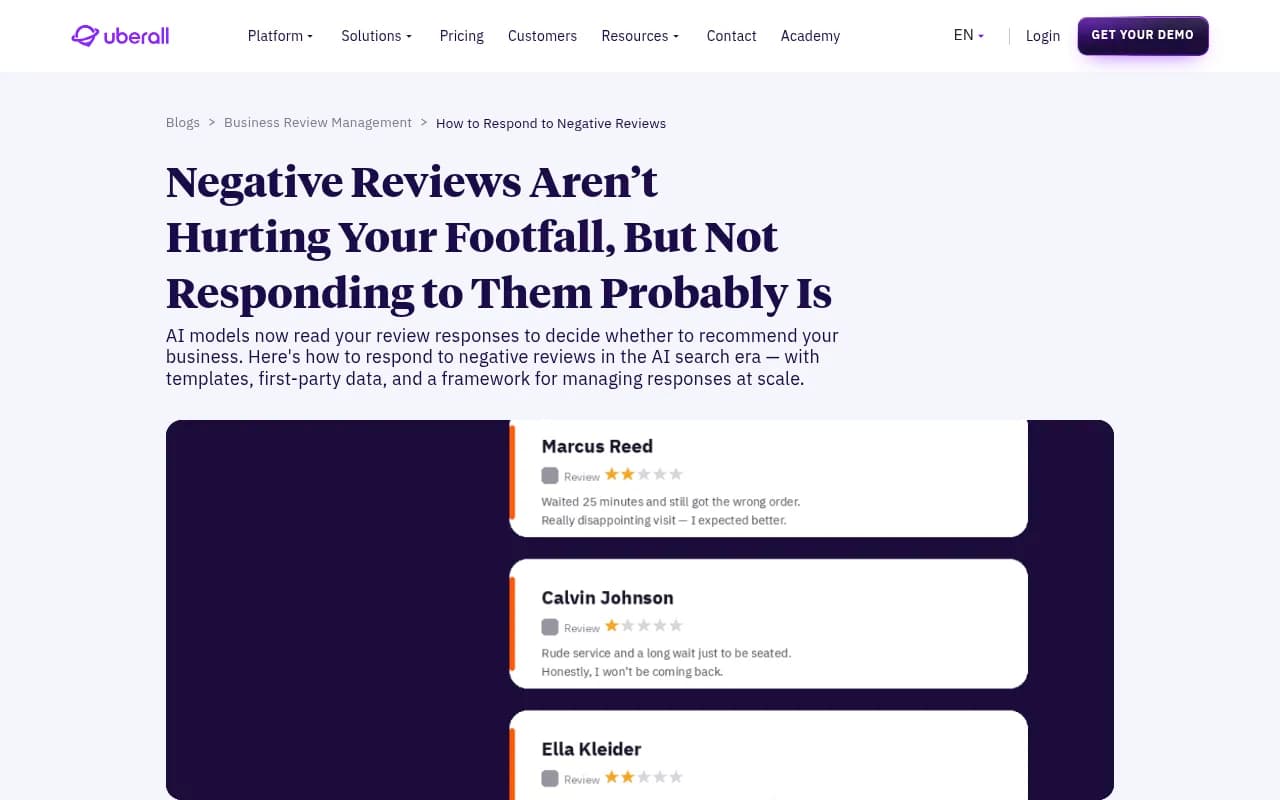
Owner replies are text, and AI reads the whole page. Uberall's recent post on responding to negative reviews (Nov 3, 2026) argues that models read your responses to decide whether to recommend you. Its senior product marketing manager is quoted saying an unresolved negative review is riskier in AI systems than one with a thoughtful, specific response. Uberall also says its clients with active response programs saw 37.5% more Google Business Profile impressions.
Treat both as vendor claims. Uberall sells review management and did not publish methodology I could check, so this is not independent measurement. The advice itself is cheap and sensible even if the number is soft: specific replies cost nothing and help the human reader too.
What a good reply has:
- the specific issue named ("the delayed refund on your March order")
- what you did or changed
- a way to follow up that is not a generic support email
- no copy-pasted template wording across fifty reviews
What a bad one has: "We're sorry for your experience. Please contact us." Repeated forty times, it tells a model nothing and tells a reader you are not listening.
Step 4: Strengthen your own pages
Since product and landing pages carry the largest citation share even on branded prompts, your site is the biggest lever you control. Promptwatch's content-type report recommends collecting reviews on the sites people trust in your category, adding a plain-language FAQ about your brand, and keeping specs and prices on product pages complete and factual, because ChatGPT quotes them directly.
Practical version:
- Add a "What customers say" section that quotes real reviews with source and date, including a candid line about the common complaint and what you did about it.
- Write an FAQ that answers the questions AI keeps getting wrong: pricing, support hours, cancellation, who it is not for.
- Keep review counts and averages in text, updated regularly, with the source named.
- Fix contradictions. If your pricing page and an old blog post disagree, the model may pick either.
If you need to produce this content at volume, content tools in the catalog like Surfer SEO and Clearscope help with on-page optimization. Promptwatch's Content Agent plans, writes and publishes against the visibility gaps it finds, and tracks whether the published page gets crawled and cited.

Step 5: Re-measure
AI answers shift, so one clean check is not proof. Re-run your prompt set weekly for a month and compare. You are looking for:
- the quoted rating matching reality
- the named complaint disappearing or being framed with the fix
- cited sources shifting toward your own pages and updated profiles
A visibility platform automates this, with prompts running daily on every Promptwatch plan and faster on Business and above. You can also use the free AI visibility report for a quick baseline of how ChatGPT, Gemini and Perplexity describe your brand. For more rank and visibility tracking options, see the directory at ai-rank-tools.com.
A quick triage table
| What the AI gets wrong | Likely cause | First fix |
|---|---|---|
| Quotes an old star rating | Stale or duplicate profile, cached page | Claim and update the cited profile, state the current rating in text on your site |
| Says "mixed reviews" despite a high average | One repeated complaint dominates the text | Resolve the issue, reply specifically, publish what changed |
| Cites a review site you never touched | Unclaimed listing | Claim it, complete every field, add recent reviews |
| Pulls from a Reddit complaint thread | Mostly Google AI Overviews and Perplexity behavior | Engage honestly in the thread, publish a clarifying page |
| Mixes you up with another business | Name collision or old brand name | Consistent naming, About page clarification, structured business info |
| Quotes wrong pricing or features | Outdated page on your own site | Update the page, remove conflicting old content |
What not to do
- Do not buy or fake reviews. Platforms detect it, and a flagged profile is worse than a mediocre rating.
- Do not argue with a reviewer in public. The thread becomes text AI can read.
- Do not obsess over one engine. They pull from different sources, so a fix that works for Google AI Overviews may do nothing in ChatGPT.
- Do not assume the model will correct itself. Wrong claims persist until the sources change.
What I would do first
If I had one afternoon, I would run the five branded prompts across four engines, list every wrong claim, and open each cited source. Nine times out of ten, two or three profiles or pages explain most of the problem. Fix those, reply to the most visible unanswered negatives with specifics, update your own FAQ, and check again in a week. Not glamorous. It works because it changes what the models read.
And if you would rather have help running this at scale, a GEO-focused agency like 1001 SEO Media handles AI visibility audits and content fixes for brands that do not have the in-house time.