Key takeaways
- An AI perception audit checks what ChatGPT, Gemini and Perplexity say about your brand when a buyer asks, not just whether you show up.
- Run the same 15 prompts in each engine, in fresh sessions, and save the verbatim answers. Engines cite different numbers of sources, so you need to measure each one separately.
- Score every answer on four things: visibility, prevalence, perception and topic adjacency.
- Wrong claims usually trace back to a specific source. Find the source, then fix the page or the third-party mention.
- Manual audits are good for a baseline. Once you want to repeat them weekly across markets, a tracking platform is cheaper than your time.
What an AI perception audit is (and what it is not)
Most AI visibility advice stops at "are you mentioned?" That is half the question. If ChatGPT names you but says your product lacks an integration you shipped two years ago, a mention is hurting you.
A perception audit asks four things. Do the engines know you exist? Do they place you next to the right competitors? What do they claim about you? And which sources are they leaning on to say it?
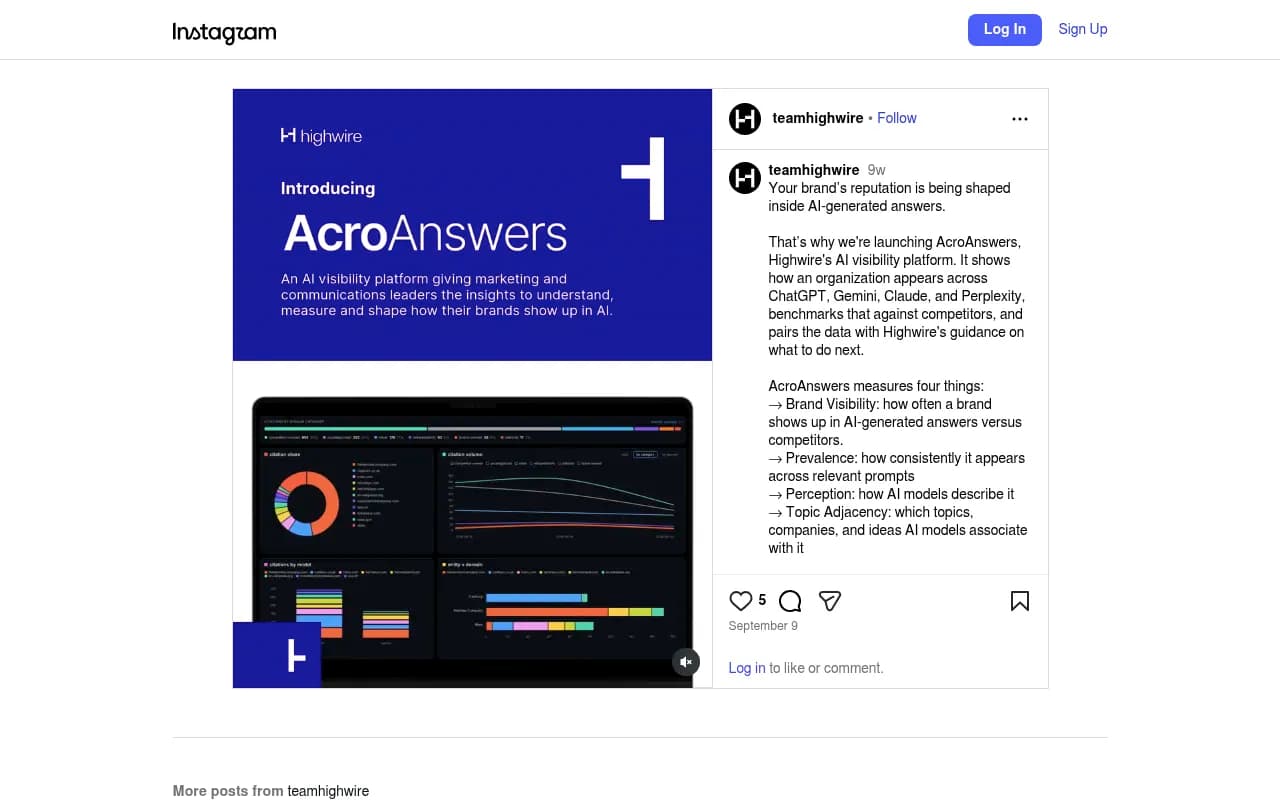
The framework I use borrows from the metrics Highwire describes for its AcroAnswers product: brand visibility, prevalence, perception and topic adjacency. Highwire says it tracks more than 265 prompts and 30,000 responses per brand every month. You do not need that volume for a first audit. You need 15 good prompts and the discipline to record answers properly.
Why you need to run it on three engines
The engines do not behave alike. According to Promptwatch Data on average sources per response, ChatGPT cites about 5 sources per web-search answer, while Google AI Overviews and Perplexity each cite roughly 10. Perplexity's count barely moves day to day. A brand missing from ChatGPT's five slots can still sit in Perplexity's ten.
Source mix differs too. In Promptwatch's social citation data for 11 October to 9 November 2026, social platforms made up 13.16% of AI Overviews citations, 1.94% of Perplexity's and 0.64% of ChatGPT's. On Perplexity, Reddit (0.82%) and LinkedIn (0.66%) led. On ChatGPT, Reddit was top at 0.40%. So a bad forum thread might shape Perplexity's description of you and never touch ChatGPT's.
And answers are not stable. A Washington State University study led by Mesut Cicek found that when the same question was asked ten times, ChatGPT was consistently accurate on only about 73% of statements. One run proves nothing. Run each prompt at least three times.
How to set up the audit
Before the prompts, fix your method. Sloppy method gives you noise.
- Use a logged-out or fresh session where possible, so your history does not bias the answer. Memory and personalization are real in all three engines.
- Turn web search on in ChatGPT and Gemini so you see citations. Perplexity searches by default.
- Pick one country and language per audit. Running the same prompt from different markets is a separate pass.
- Paste answers verbatim into a spreadsheet: engine, prompt, run number, date, full answer, cited URLs.
- Replace the placeholders: [Brand], [Competitor], [Category], [Audience] and [Use case].
If you use a personal account, note the model version shown in the interface. When a model changes, your numbers shift, and you will want to know why.
The 15 prompts
They fall into five groups. Run all 15 in each engine.
Group 1: Brand awareness (prompts 1 to 3)
- "What is [Brand]? Describe what it does, who it is for, and who founded it."
- "What are the main products or services offered by [Brand]?"
- "Is [Brand] a legitimate company? What is its reputation?"
These test whether the engine knows the basics. Check the facts line by line: founding year, headquarters, product names, pricing model. Small errors here repeat everywhere else.
Group 2: Category discovery (prompts 4 to 6)
- "What are the best [Category] tools or providers in 2026?"
- "I am a [Audience]. Which [Category] option should I choose for [Use case]?"
- "List 10 [Category] companies and say what each is best at."
This is where visibility is won or lost. Note whether you appear, at what position, and in what company. Prompt 6 is useful because it forces a long list, so you see how far down you land.
Group 3: Comparison (prompts 7 to 9)
- "[Brand] vs [Competitor]: which is better and why?"
- "What are the main differences between [Brand], [Competitor] and [Competitor 2]?"
- "Which is cheaper, [Brand] or [Competitor]?"
Expect the most damage here. Engines love confident verdicts, and they pull pricing from stale pages. Record every pricing claim and check it against your site.
Group 4: Weaknesses and trust (prompts 10 to 12)
- "What are the downsides or common complaints about [Brand]?"
- "Is [Brand] worth the money? What do customers say?"
- "What alternatives to [Brand] should I consider, and why would someone switch?"
These surface perception problems. Look for repeated claims such as "limited support" or "steep learning curve" and check whether they appear in all three engines. A claim that shows up everywhere is coming from a source you can probably find.
Group 5: Purchase intent and sources (prompts 13 to 15)
- "I need [Use case]. Recommend one specific product and explain why."
- "What sources did you use to describe [Brand]? Link them."
- "What would you need to see to recommend [Brand] more confidently?"
Prompt 13 forces a single pick, which is the closest thing to a conversion moment. Prompt 14 is not perfectly reliable since the model may reconstruct sources, so cross-check against the citations the interface actually shows. Prompt 15 is oddly useful: the answers read like a content brief written by the engine.
How to score the answers
For each answer, give a score from 0 to 2 on four dimensions. Then average across runs.
| Dimension | What you check | 0 | 1 | 2 |
|---|---|---|---|---|
| Visibility | Are you named at all? | Absent | Mentioned late or in passing | Named early or as a top pick |
| Prevalence | How often across runs and prompts? | Under a third | About half | Nearly every run |
| Perception | Accuracy and tone of claims | Wrong or negative | Neutral or vague | Accurate and favorable |
| Topic adjacency | Right topics and competitors alongside you | Wrong category | Partly right | Correct peer set and topics |
Add a separate column for factual errors. Count them, and tag each as pricing, features, company facts, or reputation. That tag tells you who owns the fix.
Reading the results
The pattern of scores points to the cause.
- Low visibility in group 2 but fine awareness in group 1: a coverage problem. The engines know you but do not think of you for the category. You need content that matches category-level queries.
- Visible but wrong claims: a source problem. Find which page the claim came from.
- Fine in Perplexity, absent in ChatGPT: check crawler access and how many citation slots you are competing for.
- Good in prompts 1 to 3, bad in 10 to 12: a reputation problem, usually driven by reviews, forums or old comparison articles.
ChatGPT also does not search with your prompt. Promptwatch's query fanout data shows a single prompt can trigger several separate searches, and the average query length has fallen to short keyword-style strings. So your pages need to match the short queries the engine generates, such as "best CRM for small agencies 2026", not the long prompt you typed. And since ChatGPT began using the site: operator at scale on 8 August 2026, jumping from about 0.4% to about 17% of fanout queries, it is also going straight to specific domains more often.
Tracing wrong claims back to a source
For every error, do this:
- Open the citations the engine showed for that answer.
- Search those pages for the claim or its opposite.
- If it is your own page, fix and republish it. Stale pricing and old feature lists are the usual culprits.
- If it is a third-party page, decide whether to request a correction, publish a stronger first-party page, or accept it.
- Re-run the prompt after a few weeks. Changes are not instant.
Content type matters when choosing what to publish. Promptwatch Data on ChatGPT citations by content type found product pages were the most cited at 22.4% (28 September to 4 October 2026), followed by landing pages and listicles. A clear, factual product page with current pricing beats another blog post for correcting a pricing claim. Staying power differs as well: in the content half-life report, landing pages and docs stayed cited longest while news lost half its pages within 36 days.
Manual audit vs tools
A spreadsheet audit is fine once. It breaks down when you want weekly repeats, several countries, competitors, and proper citation analysis. Some of the options:
| Approach | Cost | Strength | Limit |
|---|---|---|---|
| Manual (this guide) | Your time | Full control, verbatim answers | Does not scale, small samples |
| Otterly.AI | From $29/mo (Lite, 15 prompts), per vendor pricing | Cheap entry point | Monitoring-focused |
| Semrush AI Visibility Toolkit | From $99/mo per domain, billed annually, 25 prompts | Fits existing Semrush workflows | Your team does the fixing |
| Promptwatch | From $95/mo, see promptwatch.com/pricing | Tracks, explains and fixes | More than you need for a one-off check |
Prices are as published by each vendor at the time of research and change often, so confirm before buying.
Promptwatch is the one I would pick if you want to go beyond the baseline. It collects answers from the real interfaces of ChatGPT, Gemini, Perplexity and others in each country and language, scores them with Visibility Score, Share of Voice and Sentiment, and its Brand Narrative feature extracts the individual claims AI makes about you and your competitors, grouped by theme like pricing or support. That is the perception audit, automated. Fact Check (Business plan and up) then lets you mark a claim inaccurate and finds which crawled pages of yours state it.

On the fixing side, the Action Board lists prioritized gaps and the Content Agent can write and publish pages to WordPress, Webflow or Framer. The free AI visibility report gives a no-login scan of how ChatGPT, Gemini and Perplexity describe you, which is a decent warm-up before the 15 prompts.
Otterly.AI is a reasonable low-cost starting point if you only want monitoring.

If your team already lives in Semrush, the add-on is the lowest-friction route.
For a smaller, perception-specific option, Waikay is built around how AI describes a brand.

There are plenty more. The directories at bestgeosoftware.com and ai-rank-tools.com list them by category. For a sense of how crowded the market is, the Shortlist roundup compares ten of them.

Making it repeatable
A one-off audit goes stale. Models change. Reddit's share of ChatGPT citations, for instance, collapsed from about 4% to 0.5% on 14 August 2026, and any perception that depended on Reddit threads moved overnight. Set a schedule:
- Monthly: run all 15 prompts, three runs each, in all three engines.
- Weekly: spot-check prompts 4, 7 and 13 (discovery, comparison, purchase).
- After any product, pricing or rebrand change: re-run groups 1 and 3 within two weeks.
- After a major model update: re-run everything, since baselines shift.
Keep every dated spreadsheet. The trend across months is more useful than any single snapshot.
Common mistakes
Do not judge from one run. Variability is built into these systems. Do not mix markets in a single pass. Do not ask leading questions, such as "Why is [Brand] the best?", because the engine will go along with the premise. And do not treat the engine's description of its own sources as proof. Check the cited URLs.
If you would rather have a team own the whole process, audit, content fixes and PR included, 1001 SEO Media runs generative engine optimization alongside traditional SEO for clients. But the 15 prompts above cost nothing and take an afternoon, which is the right place to start.
Quick checklist
- Fill in the placeholders and open fresh sessions in ChatGPT, Gemini and Perplexity.
- Run all 15 prompts, three times each, and save verbatim answers and citations.
- Score visibility, prevalence, perception and topic adjacency from 0 to 2.
- Tag every factual error by type and trace it to a source.
- Fix first-party pages first, then work on third-party sources.
- Re-run monthly and compare against your baseline.