Key takeaways
- AirOps is a content production and refresh system. Its strength is Grids, Workflows and brand-aware drafting at scale, not deep AI visibility research.
- Workflow automation alone will not get you cited. ChatGPT sends most citations to product pages, landing pages and third-party roundups, not to a steady stream of blog posts.
- Content decays. Product pages and how-tos in ChatGPT lose half their citations in roughly 74 to 77 days, so scheduled refreshes matter more than raw volume.
- AirOps has added answer-engine insights (10+ engines on Pro, per its pricing page), but its critics, mainly competitors, say the monitoring is shallow. Verify against your own prompts before you rely on it.
- The practical setup is AirOps (or a similar workflow tool) for execution, plus a dedicated AI visibility platform for measurement and gap analysis.
What AirOps actually is
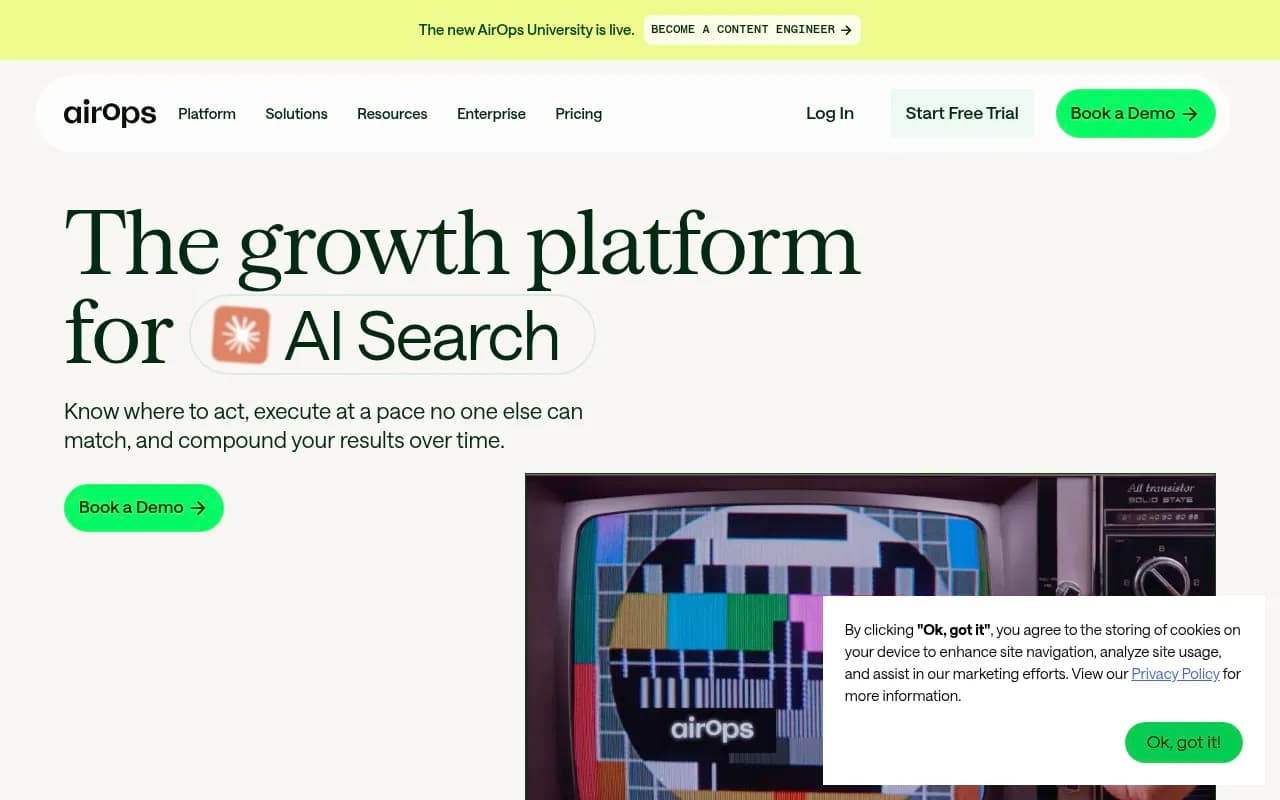
AirOps started as a no-code workflow builder for AI tasks and has been rebranded a few times. Today it sells itself as a system that turns prompts into ranking pages. The core pieces are Grids (spreadsheet-style bulk content operations), Workflows and Playbooks, a Brand Kit and Knowledge Bases, Quality Scores, human review steps, and an agent called Quill that runs the execution.
The interesting design choice is that AirOps forces you to break SEO and AEO into atomic tasks: SERP analysis, gap finding, briefing, drafting, optimization. One Reddit user in r/AI_SearchOptimization described exactly that as the main benefit, and I think it's right. Most teams do these steps in a messy, inconsistent way. Turning them into repeatable workflows is where the value is.
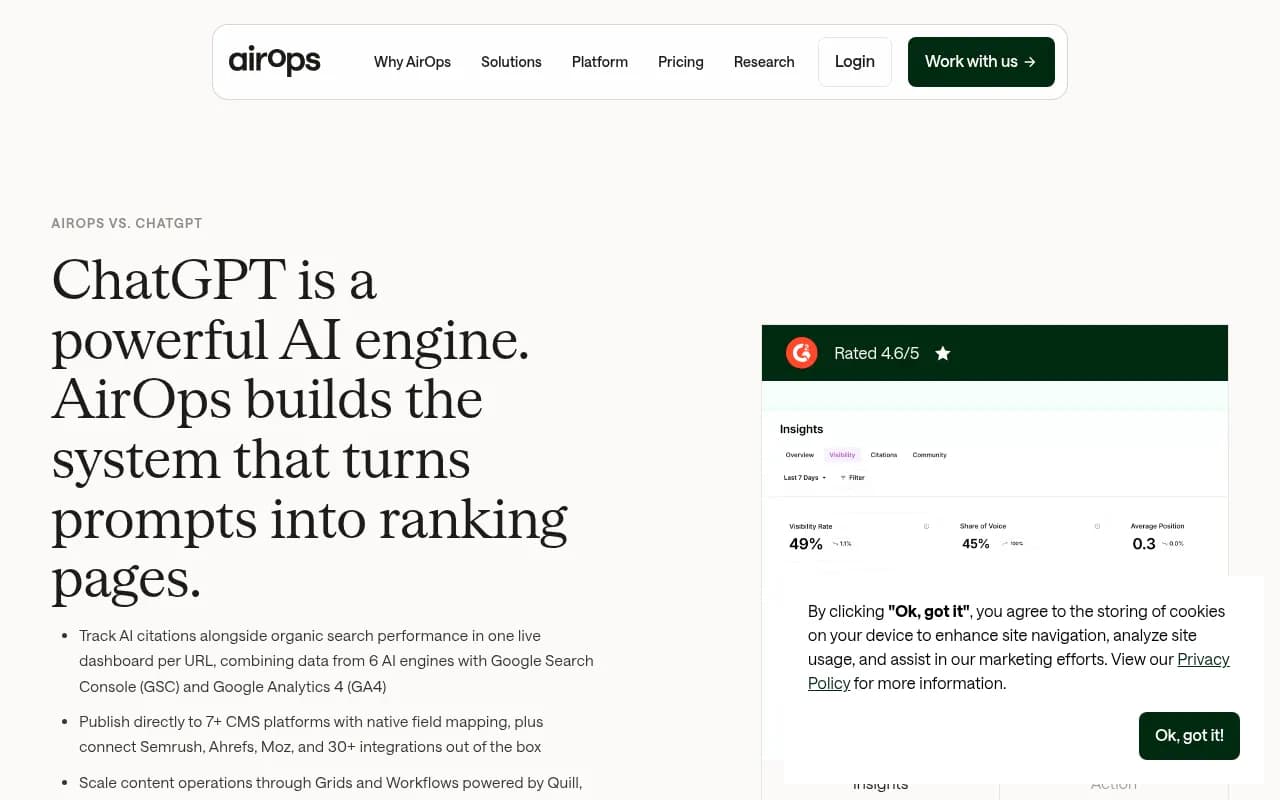
The vendor's own claims, which you should treat as claims: a live dashboard per URL combining six AI engines with Google Search Console and GA4, publishing to 7+ CMS platforms, 30+ integrations including Semrush, Ahrefs and Moz, and support for 20+ AI models with bring-your-own API keys. Its comparison page shows a 4.6/5 rating.
Plans in brief
The scraped pricing page did not show dollar amounts, so check airops.com/pricing directly. The structure looks like this:
| Plan | Answer engine insights | Content tasks | Seats | Notes |
|---|---|---|---|---|
| Solo | ChatGPT only | 35,000 | Single user | 1 Brand Kit, 3 Knowledge Bases, free start |
| Pro | 10+ answer engines | 100,000 | Unlimited | 1 Brand Kit, 5 Knowledge Bases, CMS, SEO and AEO integrations |
| Enterprise | Custom | Custom | Custom | Custom agent builds, unlimited Brand Kits, dedicated account manager |
The honest case for AirOps
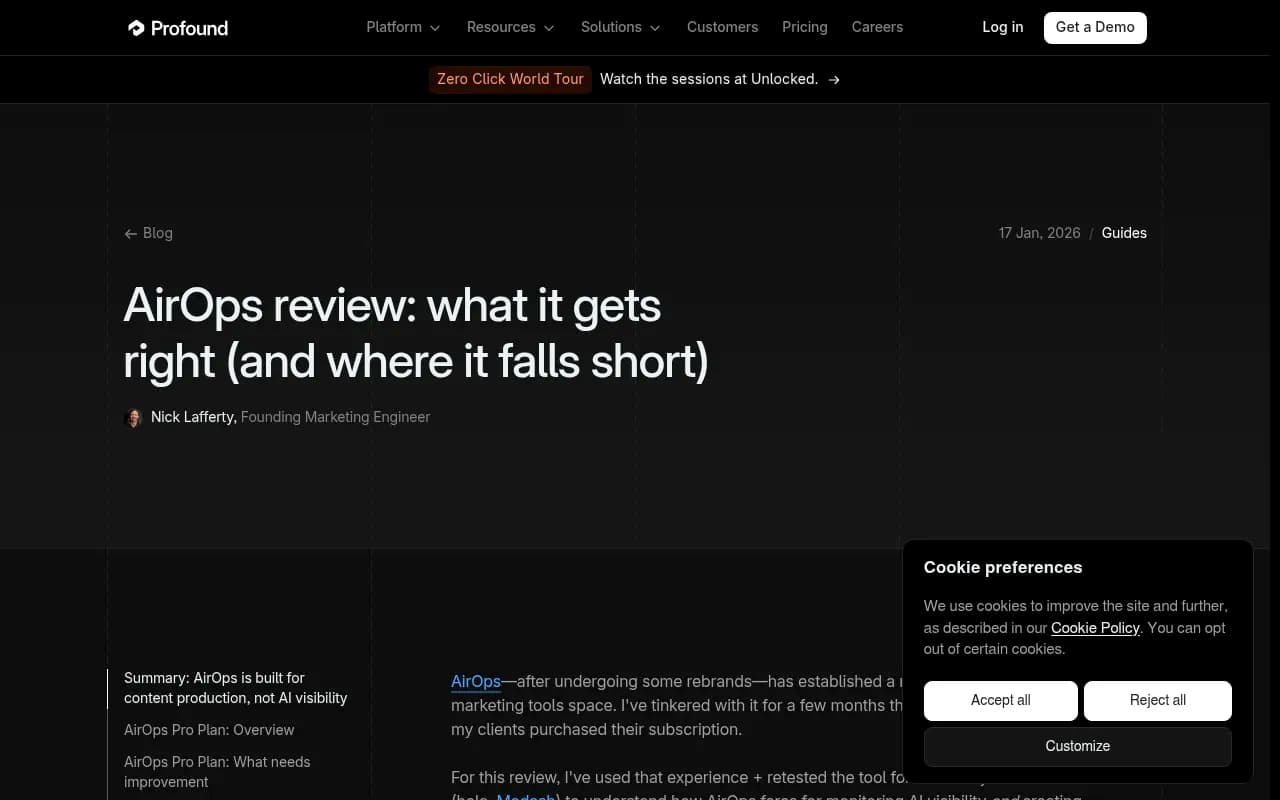
A fair reading of the independent criticism helps here. Profound published an AirOps review in January 2026 and landed on this verdict: AirOps is built for content production, not AI visibility. Keep in mind Profound sells a competing visibility product, so weigh the source. Even so, the pros it lists match what other reviewers say:
- Brand-voice-aware drafts that need less cleanup than a raw ChatGPT prompt
- Grids for creating and refreshing a big content library at once
- CMS and SEO integrations that save real hours
The cons are also consistent. There is a significant learning curve, it can be expensive if you don't publish much, and AI visibility insights were described as too thin to build a full AEO strategy on. That review is dated January 2026. AirOps Pro now lists 10+ answer engines, so the coverage complaint may be partly out of date. Whether the regional data gap persists is unverified.
GetMint's review frames AirOps as a platform for established content and SEO teams that need to scale. That fits. If you have no SEO foundation, a workflow engine just automates confusion faster.
Why automation alone does not get you cited
This is the core question, and the data answers it better than opinion does.
Most citations don't go to blog content
Promptwatch's data on ChatGPT citations by content type (Sep 28 to Oct 4, 2026) found that product pages are the most cited type at 22.4% of classified citations, with landing pages next at 16.8%. Together that's about 39% of citations going to pages that describe what a company sells. Editorial formats combined (listicles, how-tos, articles, comparisons, news, reviews) make up 43%. You can read the full breakdown in Promptwatch's ChatGPT citation share by content type report.
The split changes by prompt intent:
| Prompt type | Top content types |
|---|---|
| Commercial | Product pages 26.0%, landing pages 20.6%, listicles 15.0%, comparisons 7.9% (almost 70% combined) |
| Informational | Product pages 19.1%, landing pages 13.9%, listicles 13.6%, how-tos 10.7%, docs 8.5% |
| Branded | Product pages 23.3%, landing pages 22.8%, reviews 5.6% (over 3x their overall share) |
If your AirOps workflows mostly output blog posts, you're aiming at a slice of the surface. The biggest wins sit in product and landing pages you maintain carefully, plus reviews and third-party "best of" lists you don't fully control. A workflow can help you write and refresh the first group. It can't make a review site mention you.
Content decays, which is where Grids earn their keep
Promptwatch's content half-life report tracked pages ChatGPT cited on July 6, 2026 through October 4, 2026. Landing pages held up best, with 78% still cited after 30 days and 69% after 60. Docs were close behind. Product pages, reviews and how-tos sat at about 55% after 60 days, with a half-life of roughly 74 to 77 days. News was the worst: half of cited pages were gone after 36 days. The details are in the content half-life report.
That's the strongest argument for AirOps in a GEO stack. Refreshing specs, prices and facts on a schedule is exactly what bulk workflows are good at. A quarterly Grid run over your product and how-to pages is justified by those decay numbers. Publishing more new posts is much less obviously justified.
Citations depend on things workflows can't touch
Two more issues sit outside any content workflow:
- Crawlability. If AI crawlers hit errors on your pages, great copy doesn't matter. You need crawler logs or an audit to know.
- Off-site presence. ChatGPT often cites many domains per response. Promptwatch's data shows almost half of responses cite 10 or more unique domains (unique domains per response), so you're competing for a slot among a crowd of third-party sources.
Generating articles doesn't solve either.
A practical GEO workflow with AirOps in it
Here's how I'd structure it if I were running content for a mid-sized SaaS team.
- Measure first. Identify the prompts you care about, which brands AI names, and which URLs it cites. Do this in a dedicated visibility tool, not a guess.
- Map content to intent. Commercial prompts need product, landing and comparison pages. Informational prompts need how-tos and docs.
- Audit technical access. Confirm AI crawlers can read your site, and check for errors.
- Build the production workflow in AirOps: brief, draft, brand check, human review, CMS publish. Keep human review on. Quality Scores are helpful, not a substitute for an editor.
- Schedule refreshes. Use Grids to re-run product and how-to pages roughly every 60 days, given the half-life data.
- Go after off-site sources. Pitch for the listicles ChatGPT cites, and collect reviews on trusted sites. This is PR and outreach work, not automation.
- Re-measure. Check whether published pages get crawled, cited and clicked. Feed underperformers back into step 2.
What to pair with AirOps
AirOps does include its own insights layer, but if AI visibility is the goal, a purpose-built platform gives you a second, deeper view. Here are options from our catalog and how they differ.
| Tool | What it does best | Weak spot for GEO |
|---|---|---|
| AirOps | Workflow automation, bulk content and refresh | Visibility depth is debated |
| Promptwatch | Visibility tracking, crawler logs, gap analysis, and agents that write and publish | Heavier than you need for a tiny site |
| Profound | Enterprise monitoring and analytics | No agentic execution, higher price |
| Peec AI | Simple prompt tracking | No crawler logs or content generation |
| Otterly.AI | Affordable monitoring | Monitoring only |
| Surfer SEO | On-page content optimization | Not an AI visibility measurement tool |
| Writesonic GEO | Monitoring plus GEO content generation | Narrower data stack |
Promptwatch
Promptwatch is the closest thing to AirOps' content side plus the measurement side in one product. It tracks real ChatGPT, AI Overviews, Gemini, Perplexity and other interfaces, shows IP-verified AI crawler logs, and ties AI traffic to your site. Its content gap analysis maps your pages against the prompts AI answers, and the Content Agent can write and publish to WordPress, Webflow or Framer, then track whether each page gets cited. For teams who already run AirOps, the more natural use is the measurement layer: find the gaps, decide what to refresh, then execute.

Profound
Profound is a strong monitoring product aimed at enterprise brands, and it is the source of the most pointed AirOps critique. It's worth a look if you have budget and mainly need analytics rather than execution.

Peec AI and Otterly.AI
Both are lighter prompt trackers. They answer "was my brand mentioned?" at a lower price. They don't cover crawler logs or content creation, so you'd still need a production tool next to them.


Surfer SEO and other content optimizers
If your AirOps workflows run a heavy on-page optimization step, tools like Surfer SEO can plug in as a scoring layer. They help with classic relevance signals, not AI citation measurement.

Who should and shouldn't buy AirOps
AirOps makes sense if you publish at volume, already have an SEO strategy, and have someone willing to learn the workflow builder. Agencies and in-house content teams with hundreds of pages to refresh are the sweet spot.
It makes less sense if you publish a few posts a month, because the cost-to-value ratio gets rough. It also isn't the right sole investment if your main need is understanding why AI doesn't mention you. For that, you want crawler data, citation analytics and prompt-level tracking first.
If you're weighing alternatives on the content side, Aiken House has a roundup of 12 AirOps alternatives that is useful for browsing.
For broader browsing, the GEO software directory at bestgeosoftware.com lists visibility and optimization tools side by side.
Common mistakes when using workflows for GEO
- Publishing volume as a goal. Citations follow usefulness and fit with prompt intent, not post count.
- Ignoring product and landing pages. They are the most cited types in ChatGPT.
- Turning off human review. Factual errors on product pages get quoted directly by AI.
- Never refreshing. With half-lives around 74 to 77 days for product pages and how-tos, set a calendar.
- Skipping measurement. If you can't see which pages get crawled and cited, you can't tell whether the workflow works.
The verdict
Can workflow automation alone get you cited in ChatGPT? No. AirOps is good at the production and refresh half of the job, and the refresh half matters more than most teams realize given how fast cited pages decay. But citations depend on which page types you build, whether crawlers can read them, and whether third-party sources name you. Pair AirOps with a visibility platform that shows the gaps, and treat its built-in insights as a starting point to verify rather than the final word. Check current plans and pricing at airops.com/pricing before you commit.