Key takeaways
- Google Search Console, Bing Webmaster Tools, GA4 and a crawler cover most of what a small site needs, at no cost.
- Free AI chatbots (ChatGPT, Claude, Gemini) are good for ideation and drafting, but not a source of search data.
- No free tool fully tracks AI citations over time. What you can do free is check crawler access and run a monthly manual prompt audit.
- Several AI visibility platforms have free scorecards or trials, which are fine for a one-off baseline.
- Free is a starting point. Once you need daily tracking across models, you will outgrow it.
What "free" actually means
Most lists of free SEO tools mix three different things. Some tools are free forever. Some are free with a hard cap, like a crawl limit or a handful of queries a day. And some are free trials with a card on file, which is a sales funnel with a nice label.
I sort them into those three buckets before recommending anything. A 14-day trial is useful for a client audit. It is not a free stack you can build a process on.
The AI part makes this messier. A lot of "free AI SEO tools" are really a paid product with a free scorecard bolted on the front. Those scorecards are handy, but they check a few prompts once. They do not monitor anything.
The foundation: free tools that are actually free
These are the ones I would set up for every site before looking at anything else.
| Tool | What it does | Free limits | Best for |
|---|---|---|---|
| Google Search Console | Queries, clicks, indexing, Core Web Vitals | None, 16 months of data | Everyone |
| Bing Webmaster Tools | Bing indexing, keyword data, site scan | None | Copilot and Bing visibility |
| Google Analytics 4 | Traffic and conversions | None | Measuring outcomes |
| Screaming Frog SEO Spider | Site crawls, broken links, metadata | 500 URLs per crawl | Small and mid-size sites |
| Beam Us Up | Site crawls | No URL limit | Bigger sites on a budget |
| PageSpeed Insights and Lighthouse | Core Web Vitals and performance audits | None | Speed work |
| Google Rich Results Test | Structured data validation | None | Schema checks |
| Google Keyword Planner and Trends | Volume ideas, seasonality | Needs an Ads account | Keyword research |
| AlsoAsked | People Also Ask mapping | Limited free tier | Question research |
Google Search Console
Non-negotiable. It is the only place that shows how Google really crawls and indexes your site: which pages are in, which are excluded and why, and real-user Core Web Vitals. It also now doubles as the starting point for AI Overview work, since the pages that earn impressions there are usually the ones that get pulled into answers.
The catch: 16 months of history, sampled data on very large sites, and no competitor view.
Bing Webmaster Tools
People skip this one, and they shouldn't. Microsoft's index feeds Copilot, and Promptwatch's sources-per-response data notes that Copilot draws on Microsoft's search stack, so having your key pages indexed well in Bing matters. You can import your Search Console setup in a couple of minutes, submit your sitemap, and get a free keyword research feature plus an on-page site scan.
Crawlers: Screaming Frog and Beam Us Up
Screaming Frog's free version crawls up to 500 URLs, which is enough for most small sites or one section of a big one. It catches broken links, redirect chains, missing titles, duplicate metadata and stray noindex tags. If you are over the cap, Beam Us Up has no URL limit on Windows, Mac and Linux. It is less polished, but it works, and recent versions reportedly added AI-crawler and llms.txt checks. I have not verified current limits on either, so check their sites before you commit to a workflow.
Free AI assistants for SEO work
ChatGPT, Claude and Gemini all have free tiers, and they are genuinely useful for the grunt work of SEO: clustering keywords, drafting meta descriptions, rewriting a clumsy intro, generating FAQ ideas, writing schema snippets you then validate.
What they are not: a source of search volume or ranking data. Ask a chatbot how many people search for something and you will get a confident guess. Use Keyword Planner and Search Console for numbers, and the chatbot for words.
For editing, Grammarly has a free tier that catches the dull errors, and Hemingway Editor is good for flagging bloated sentences.

A related point on content tools. Plenty of AI writing products have free trials, but a trial that produces 20 mediocre articles is worse than none. If you try one, test it on a single page you care about and compare it against what is already ranking.
Free AI search visibility: what you can really do
Here is the honest part. A few tools give you limited free AI-mention checks, but no free tool fully tracks your citations over time. Serious share-of-voice monitoring across ChatGPT, Perplexity and AI Overviews is paid. What you can do for free is make sure you are eligible to be cited and spot-check what the models say.
Step 1: check that AI crawlers can reach you
Open your robots.txt and look at the rules for the main AI user agents: GPTBot, OAI-SearchBot, ChatGPT-User, ClaudeBot, PerplexityBot, Google-Extended and so on. Then check whether your CDN or firewall is blocking them separately, because a permissive robots.txt does nothing if Cloudflare is returning 403s.
A minimal robots.txt that allows the main search-time fetchers looks like this:
User-agent: OAI-SearchBot
Allow: /

User-agent: ChatGPT-User
Allow: /

User-agent: PerplexityBot
Allow: /
Promptwatch Data's AI crawler traffic report (June 8 to September 6, 2026) is a useful benchmark here. OpenAI made up 79.8% of verified AI crawler requests in the week of Aug 31 to Sep 6, down from 94.8% in early June. Its advice is simple: if a provider is a large share of the mix but near zero in your own logs, you are probably blocked or unreachable for that provider.
That gives you a free log check. Search your server access logs for those user agents. If you see nothing, find out why before you write another word of content.
Promptwatch also offers free utilities for this: an Agentic Readiness Check, an AI Crawler URL Inspector and a Robots.txt Generator for AI. They are the quickest way to get a read without touching your logs.
Step 2: run a monthly manual prompt audit
Take your 10 to 20 most important queries. Run each through ChatGPT, Perplexity, Google AI Overviews and Gemini. Log in a spreadsheet:
- Whether your brand is mentioned
- Whether your domain is cited
- Which competitors and sources show up
- Whether the description of you is accurate
Repeat monthly. It is tedious, and it is also one of the highest-value free habits in SEO right now. Perplexity is a good test bench because it cites close to 10 sources per answer consistently, according to Promptwatch Data's sources per response report (that page is dated September 2025, so treat the exact figures as directional). ChatGPT averaged about 5 sources on web-search answers in the same report.
One caveat: answers vary run to run, and what you see logged in your own account can differ from what a user in another country sees. Treat a single run as a sample, not a measurement.
Step 3: make pages easy to extract
Free and unglamorous. Put a clear definition near the top, write self-contained answers under question-style headings, cite your statistics, add a short FAQ. Product and landing pages tend to be what ChatGPT cites most, per Promptwatch Data's content type report (22.4% of citations for product pages, Sep 28 to Oct 4, 2026), so your commercial pages deserve the same care as your blog.
Free AI visibility scorecards and trials
Several AI visibility vendors let you try a limited check before paying. These are useful as a baseline snapshot, not a monitoring setup.
| Tool | Free option | What you get | Catch |
|---|---|---|---|
| Promptwatch | Free Explore plan, plus a free AI Visibility Report | 10 prompts on ChatGPT in the plan; no-login scan of how ChatGPT, Gemini and Perplexity describe your brand | Explore is ChatGPT only; all models need a paid plan |
| SourceSignal | Free AI Visibility Scorecard, 14-day trial | Checks up to three buyer questions | Three questions is a snapshot |
| xSeek | Free workspace | 15 questions, run once | One run |
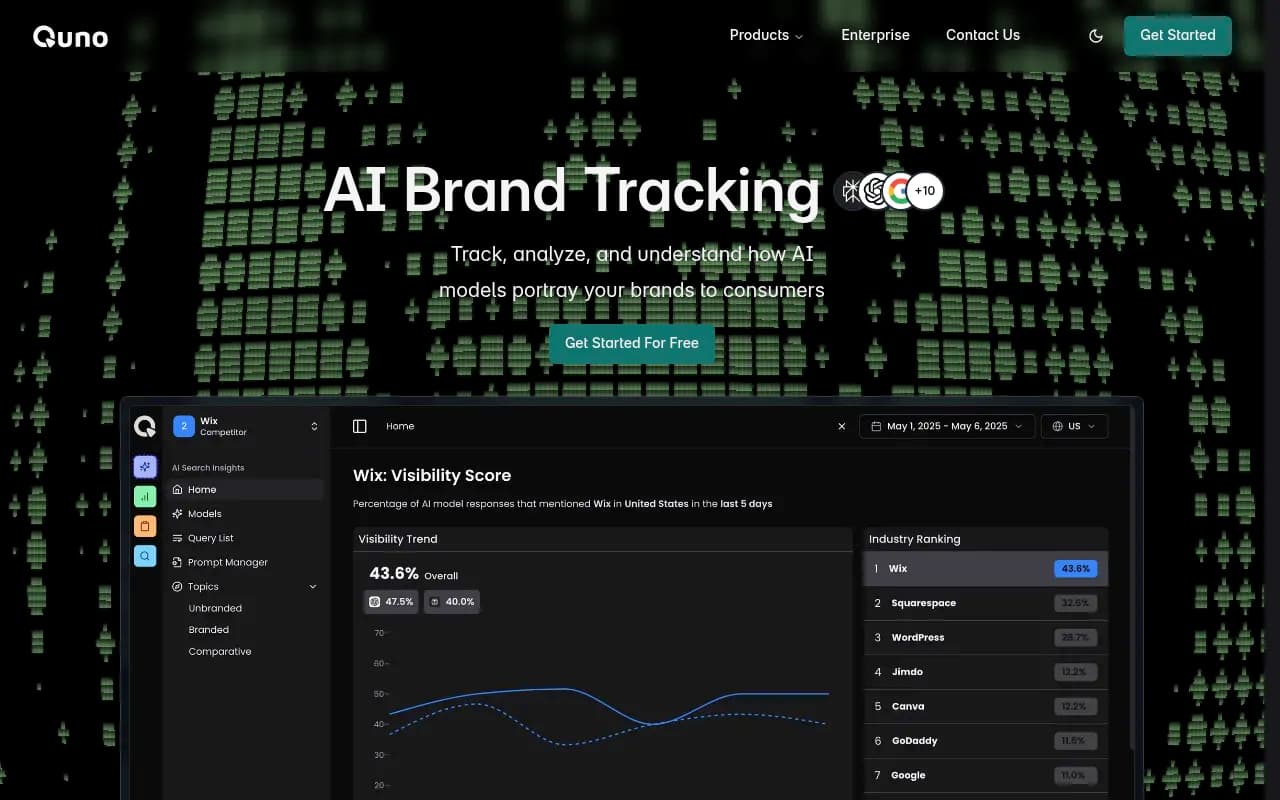
| Quno.ai | Visibility scorecard and prompt tester | Quick brand check | Limited depth |
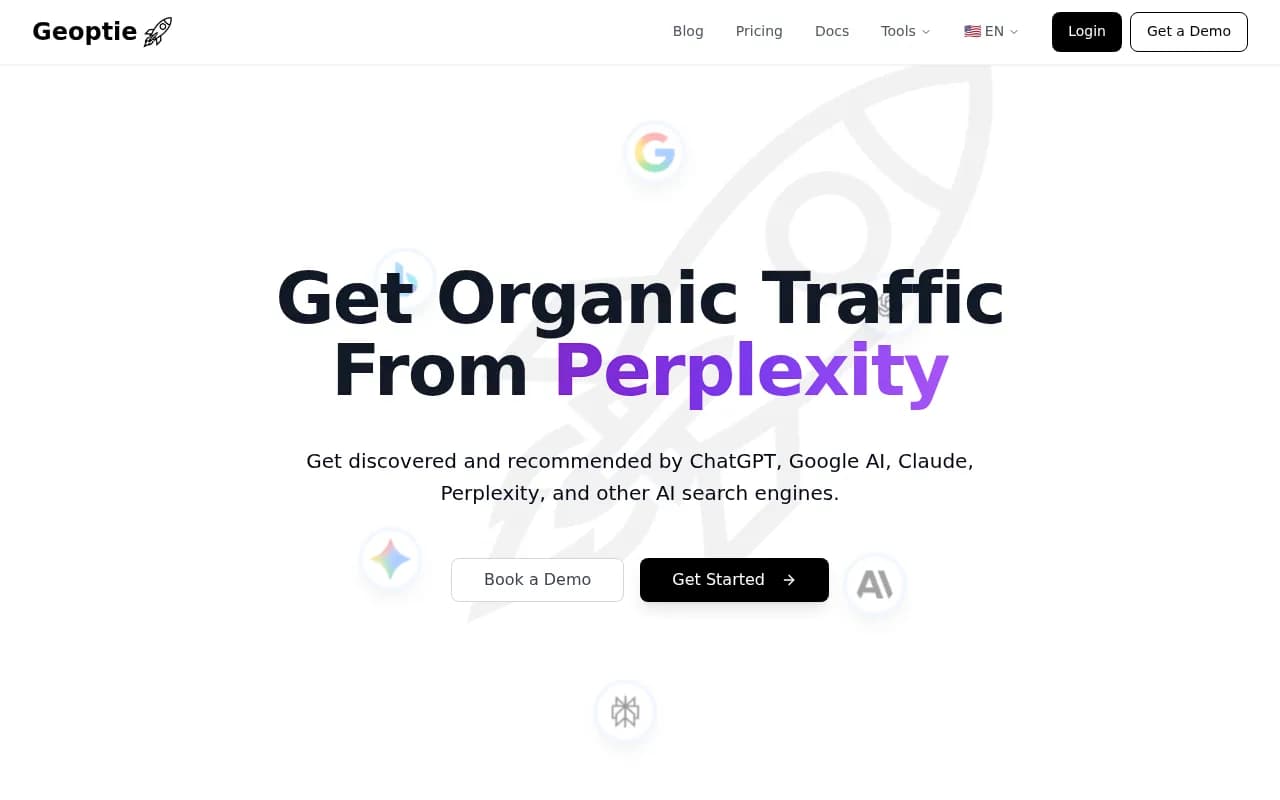
| Geoptie | Free GEO audit tools | Audits plus some tracking | Verify current limits |
Those trial terms come from third-party roundups and I have not confirmed them directly, so check each vendor's site.
Promptwatch is the one I would point to if you expect to outgrow the free stage, since the free report and Explore plan lead into a platform that adds crawler logs, visitor analytics and content tooling. Paid plans start at $95 a month; confirm on promptwatch.com/pricing.

If you want to look at the wider field of paid trackers, the GEO software directory at bestgeosoftware.com lists most of them.
Free tiers and trials from established SEO suites
A few bigger platforms let you try them for nothing or close to it.
| Tool | Free offer | Notes |
|---|---|---|
| Ahrefs Webmaster Tools | Free forever for verified sites | Site audit and backlink data for your own domain |
| Ubersuggest | Limited free version | Keyword research with AI visibility features |
| SE Ranking | 14-day trial, no card (per xSeek's roundup) | Full-access trial |
| Semrush | 7-day trial | Good for a one-off competitor deep dive |
| Search Atlas | Trial offers vary | Positioned as a cheaper Ahrefs/Semrush alternative |
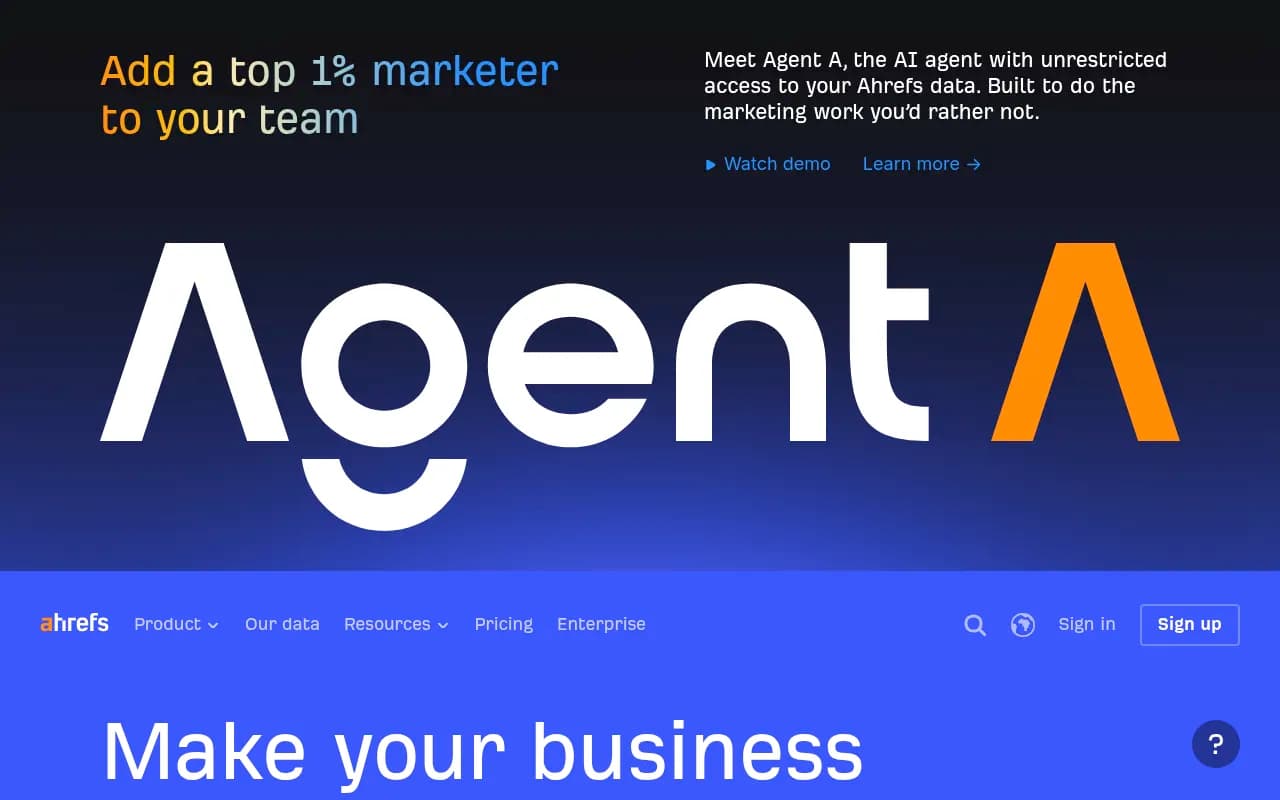
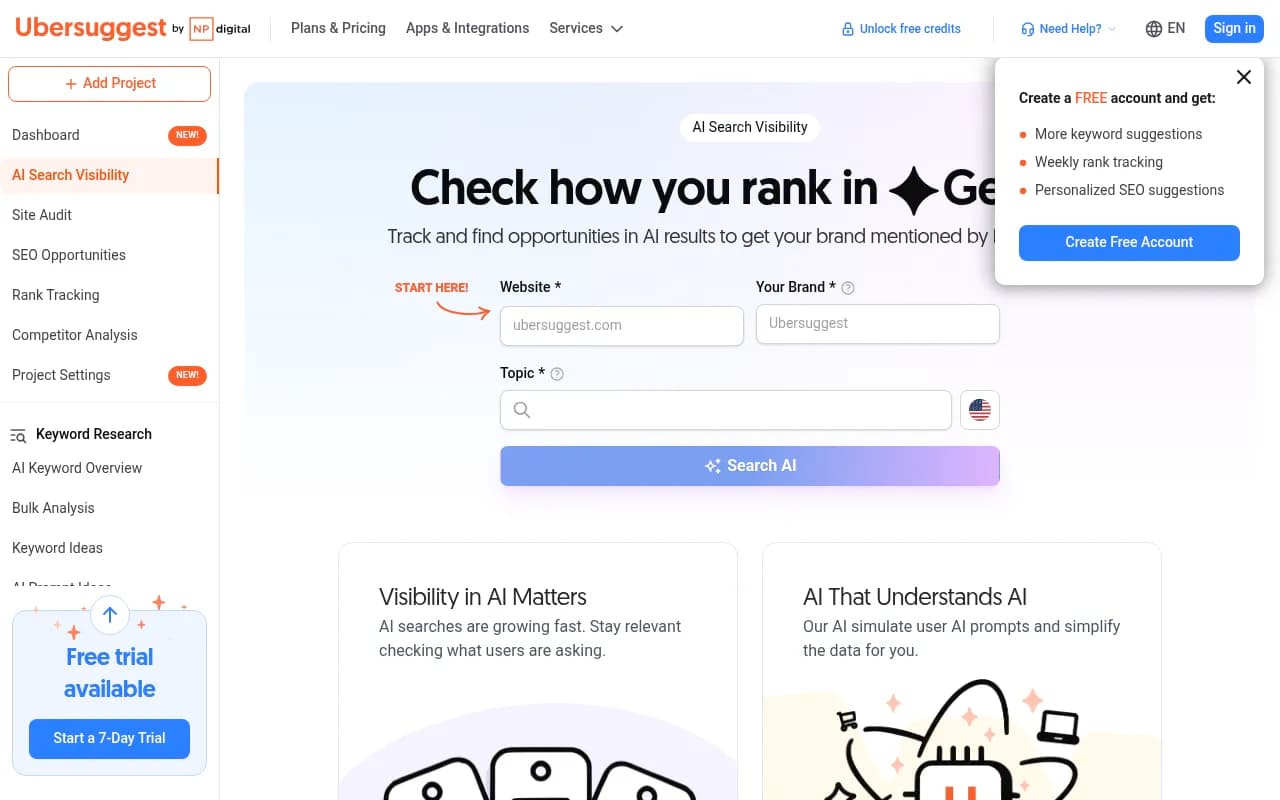
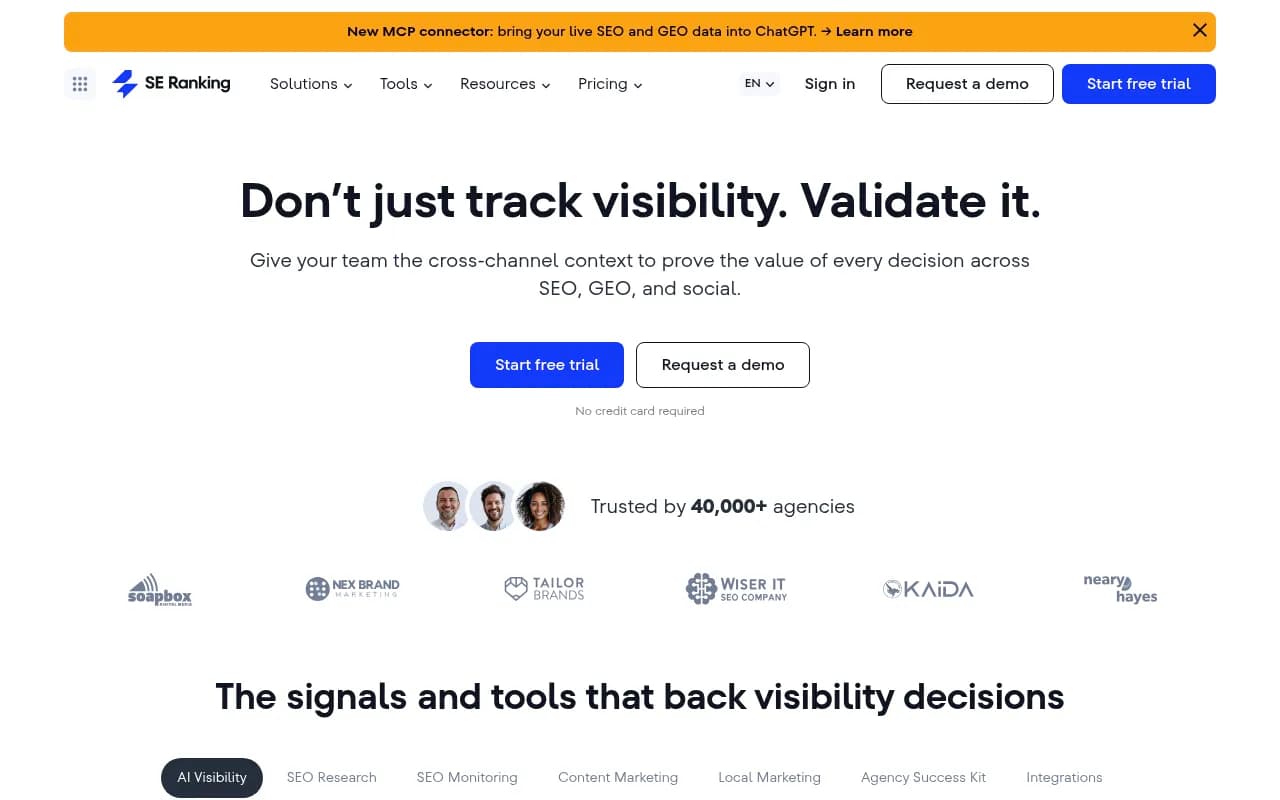
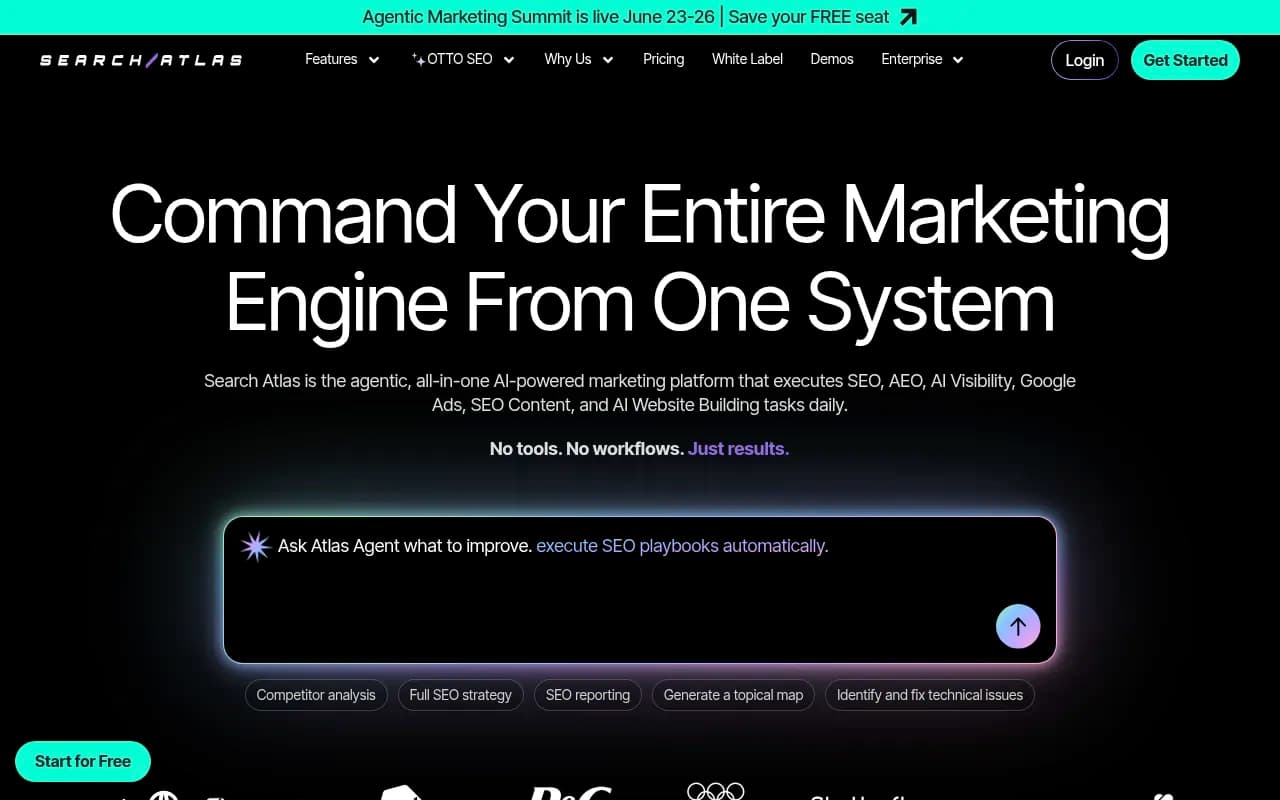
Ahrefs Webmaster Tools is the standout, because it is free permanently and gives you real backlink and audit data, but only for sites you own and can verify. For competitor research you will hit a wall quickly. A common move is to use a trial strategically: pick one week, run every competitor analysis you will need for the quarter, export the data, and let it lapse.
A sensible free stack by job
| Job | Free pick | Upgrade trigger |
|---|---|---|
| Indexing and queries | Google Search Console | Need competitor data |
| Bing and Copilot | Bing Webmaster Tools | Rarely |
| Analytics | GA4 | Need AI-referral attribution |
| Technical audit | Screaming Frog or Beam Us Up | Site over 500 URLs and you want support |
| Page speed | PageSpeed Insights, Lighthouse | Ongoing monitoring |
| Keywords | Keyword Planner, Trends, AlsoAsked | Need accurate volumes and difficulty |
| Backlinks | Ahrefs Webmaster Tools | Need competitor links |
| Content drafting | ChatGPT, Claude, Gemini free | Need briefs grounded in SERP data |
| AI crawler access | robots.txt review, log search | Need verified bot logs at scale |
| AI visibility | Manual prompt audit, vendor scorecards | Need daily, multi-model tracking |
Where free stops working
The cracks show in four places.
First, tracking over time. A manual audit tells you where you stood on one day. AI answers shift constantly. Promptwatch Data found ChatGPT's reddit.com citation share fell from about 4% to 0.5% on one day in August 2026 (report), and you would never catch a swing like that with a monthly spreadsheet.
Second, scale. Twenty prompts across four models is 80 manual checks a month. At 200 prompts, it is a part-time job.
Third, attribution. GA4 will lump a lot of AI traffic in with referral or direct. Paid tools that install their own script can separate AI-referred visits and conversions.
Fourth, action. Knowing you are invisible is only half of it. Tools in the paid tier, like Promptwatch, also help find content gaps and publish fixes, which a free scorecard will not.
For more options in the tracking category, the AI rank tracking directory at ai-rank-tools.com is a good place to compare.
What I would do this week
- Verify Search Console and Bing Webmaster Tools for every site, and submit your sitemap to both.
- Run a crawl and fix broken links, redirect chains and accidental noindex tags.
- Check robots.txt and your CDN rules for AI crawlers, then confirm in your logs that they are actually visiting.
- Write down 15 buyer-style prompts and run them through ChatGPT, Perplexity and AI Overviews. Save the results.
- Run one or two free AI visibility scorecards to compare against your manual notes.
- Rewrite your three most important pages so each answers its core question in the first paragraph.
That costs nothing but time. If the results show you are being cited and your traffic is moving, stay free. If they show you are invisible and you cannot tell why, that is when a paid tracker starts to earn its price.
FAQ
Can you do SEO for free in 2026?
Yes, for a small site. Search Console, Bing Webmaster Tools, GA4, a free crawler and a free AI assistant cover the basics. What you give up is competitor data and automated AI monitoring.
Are free AI SEO tools any good?
The Google ones and Ahrefs Webmaster Tools are excellent. Free AI writing tools are fine for drafts and need a human edit. Free AI visibility scorecards are a useful snapshot but check only a few prompts.
Is there a free tool that tracks ChatGPT citations?
Not one that does it properly over time. Promptwatch's Explore plan tracks 10 prompts on ChatGPT for free, and several vendors offer one-off scorecards. Full multi-model tracking is a paid feature everywhere I have looked.
What is the first free thing to check for AI search?
Whether AI crawlers can reach your site. If they are blocked, nothing else you do on content will matter.