Key takeaways
- A thin wrapper is a text box, a system prompt and a template library on top of someone else's model. If you can reproduce the output by pasting a good prompt into ChatGPT or Claude, you are paying for convenience only.
- Wrappers are not automatically bad. The test is whether the product adds something you cannot cheaply rebuild: live data, your own brand knowledge, publishing, measurement.
- Run a 30-minute test: same brief, same model, side by side. Check price per word, what the tool knows that the model does not, and whether it can publish and measure.
- Pay for grounding (SERP, citations, your own facts), workflow (briefs, refresh, CMS publishing) and feedback (did the page get crawled, cited, clicked). Do not pay for 90 templates.
- Content that gets cited by AI is mostly product pages, landing pages, docs and comparisons, so factual accuracy and freshness matter more than volume.
What a GPT wrapper actually is
An AI wrapper is a product built on a foundation model through API calls rather than a model trained from scratch. The value sits at the application layer: interface, prompts, data injection, workflow. CRV's explainer makes the point that the label alone tells you almost nothing about whether a product is durable. Some wrappers are deeply integrated tools that accumulate proprietary data with every customer. Others are a chatbot skin.
The Reddit r/SaaS definition is blunt and useful: a GPT wrapper is a text generator you could replace by typing a prompt into ChatGPT. That is the standard I would hold every AI writer to.
Investors have noticed too. Google VP Darren Mowry said in February 2026 that the industry has lost patience for startups that wrap "very thin intellectual property" around someone else's model (TechCrunch). If investors are impatient, you should be too before you sign an annual plan.
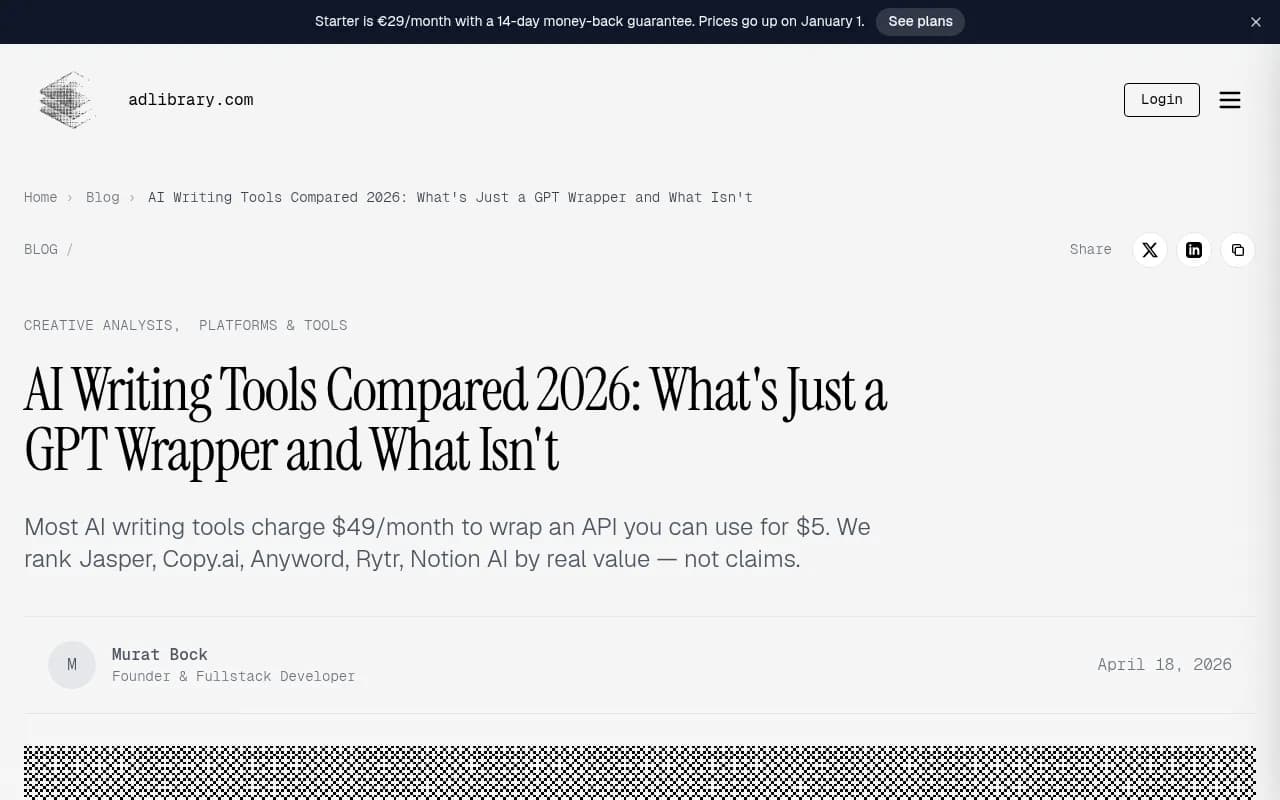
Ad Library's April 2026 comparison claims several writing tools charge around $49 a month for API access you could get for about $5. That is a vendor blog's number, so verify it against current pricing before you quote it. Its own conclusion is still sensible: occasional writers are usually better off with a native LLM interface, while high-volume teams with strict brand standards can justify the premium.
The wrapper spectrum
It helps to stop thinking in binary. Most tools sit in one of three tiers.
| Tier | What it adds | Typical tell | Worth paying for? |
|---|---|---|---|
| Thin wrapper | Text box, templates, a system prompt | 50+ templates, no data sources, no publishing | Rarely |
| Orchestration layer | Briefs, SERP research, brand voice, editor, scoring | Pulls live data into the prompt, has a real editor | Often, if you write at volume |
| Workflow plus feedback | Planning, writing, publishing and measuring results | Connects to your CMS, analytics and visibility data | Yes, if it closes the loop |
The middle tier is where most useful products live. The top tier is where most of the complaints come from.
A 30-minute test to spot a thin wrapper
You do not need to be technical. You need one brief and a free afternoon slot.
Step 1: Run the same brief in both places
Pick a real article you need. Write a decent brief: audience, angle, three facts you want included, tone. Paste it into ChatGPT or Claude. Then run the same thing through the tool. Compare the two drafts without looking at which is which, ideally with a colleague.
If you cannot tell them apart, or the raw model wins, you have your answer. A wrapper with a nicer interface still gave you the same words.
Step 2: Ask what the tool knows that the model does not
This is the question that separates tiers. Concretely, check whether the tool:
- pulls live search results or competitor pages into the draft
- accepts your own documents, product facts and tone rules and actually uses them
- cites sources you can click and verify
- links internally to your own pages
If the answer to all four is no, the product knows exactly what the base model knows. Koala Writer, for example, markets live SERP and product data in its articles, which is the kind of claim you can test directly.

Step 3: Do the price per word math
Take the monthly price, divide by the words you realistically produce, and compare against API cost for the same volume. A tool that costs $49 and produces 20,000 words a month is charging about 0.25 cents a word. Raw API usage for the same output is a small fraction of that. The gap is what you pay for the tool, so ask yourself what it did for you. Time saved on briefs and publishing can easily justify it. A template picker cannot.
Step 4: Check what happens after the draft
A draft is the easy part. Look for a real editor, scoring against live search data, one-click publishing to WordPress or Webflow, and some way to see whether the page worked. If the product ends at "copy to clipboard," it is a text generator.
Step 5: Look for the tells in the marketing
A few patterns show up repeatedly with thin wrappers:
- The pitch lists the model name but not the data or process.
- A huge template count ("90+ tools") instead of a few deep workflows.
- Unlimited words at a flat price with no mention of quality control or fact-checking.
- No way to bring your own knowledge base.
- Claims about beating AI detectors. There is no reliable AI writing detector, so any product built around that promise is selling something shaky.
Examples across the market
I will keep this honest: I have not run every tool below through a controlled test for this guide, so treat the placement as a starting hypothesis and run Step 1 yourself.
Jasper built its name on brand voice and marketing team workflows. The question is whether the brand voice memory and campaign tooling save your team enough time over a well-maintained prompt library.
Copy.ai has moved toward go-to-market workflows, which is an orchestration play rather than a pure writer.
Rytr is cheap and aimed at solo creators. At that price point the wrapper question matters less because the markup is small.

Anyword adds performance prediction scoring to copy, which is one of the few differentiators that is not just a prompt.

Writer targets enterprises with brand and compliance controls, where governance is the product.

On the SEO side, Surfer and Clearscope score drafts against what ranks, which is real data a chat window does not have.


At the bulk end, tools like Article Forge and Autoblogging.ai sell volume. Volume is exactly what a raw model already gives you for free, so be skeptical unless they show a quality layer.


| Tool | Main claimed edge | What to verify in a trial |
|---|---|---|
| Jasper | Brand voice and team workflows | Does voice hold across 10 articles? |
| Copy.ai | GTM workflows | Do workflows beat a saved prompt? |
| Rytr | Low price | Is output better than a free chat model? |
| Anyword | Predictive scoring | Do scores match your real results? |
| Writer | Governance and brand controls | Are rules enforced, not suggested? |
| Surfer SEO | Live SERP scoring | Does the score change outcomes? |
| Koala Writer | Live SERP and product data | Are cited facts correct? |
| Article Forge | Bulk output | Who checks the facts? |
What to pay for instead
If the draft itself is a commodity, the money belongs elsewhere. Here is where I would spend.
Grounding in real data
The most useful thing a writing tool can do is feed the model things it does not have: current search results, your pricing, your product specs, your customer language. The output quality jump from grounded input is bigger than the jump between any two frontier models.
Content that AI search actually cites
This matters more than it did two years ago. According to Promptwatch Data for Sep 28 to Oct 4, 2026, product pages were 22.4% of ChatGPT citations and landing pages 16.8%, so roughly 39% of citations go to pages describing what a company sells. Listicles got 13.6%, how-tos 8.7% and comparisons 5.9%. For commercial prompts, product pages, landing pages, listicles and comparisons made up almost 70% of citations.
That should change what you ask a writer to produce. Generic 1,500-word blog posts are a small slice. Complete, factual product pages, comparisons and step-by-step guides are the formats that get picked up, and a thin wrapper has no idea what your specs and prices are unless you paste them in every time.
Refresh workflows
Evergreen assets last. In Promptwatch's data tracking pages ChatGPT cited on July 6, 2026, landing pages and docs were still cited at 78% and 76% after 30 days, while news lost half its pages within 36 days. Product pages, reviews and how-tos reached their half-life after roughly 74 to 77 days. So paying for a tool that keeps existing pages accurate is usually a better deal than paying for more first drafts.
Publishing and measurement
The feature gap between a wrapper and a real platform is the loop: plan, write, publish, then find out whether the page got crawled, cited and clicked. Most writing tools stop at step two.
Promptwatch is built around that loop for AI search. Its Content Agent plans and writes against prompts where you are not visible, publishes to Webflow, Framer or WordPress, then tracks the page through crawler logs, citations and AI traffic. Underperformers come back as actions. That is the opposite of a text box: the writing is the cheap part, and the data around it is the product.

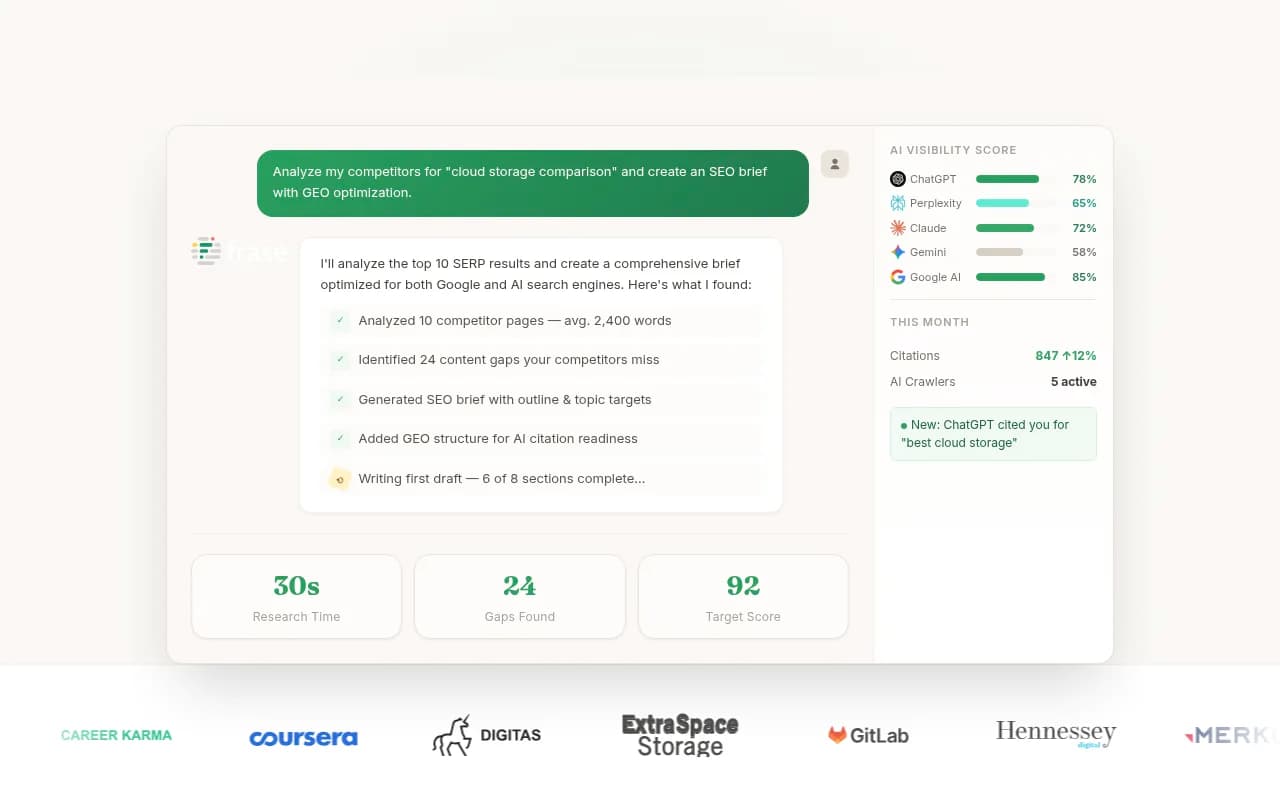
If you want to compare other options before committing, the GEO software directory at bestgeosoftware.com lists a lot of them. Content-focused platforms worth a look in the same neighborhood include AirOps for workflows, Frase for research-led briefs and MarketMuse for planning.
A simple buying checklist
Before you pay for any AI writer, ask these questions and write down the answers.
- Can it use my own facts, documents and tone rules, and does the output prove it?
- Does it pull live data, and are the sources visible?
- Does it publish to my CMS without copy and paste?
- Can it refresh existing pages, not only create new ones?
- Can I see whether a published page was crawled, cited or clicked?
- What is my price per word versus raw API cost, and is the gap justified by time saved?
- Can I export my brand knowledge if I leave?
Three or more "no" answers and you are looking at a wrapper. That is fine if the price is $10 a month. It is not fine at $200.
When a wrapper is the right call
I would not talk anyone out of a cheap wrapper if the situation fits. You write a few posts a month, you edit heavily, and you just like a tidy interface. Or you are a solo creator and the markup is a few dollars. In those cases, pay for convenience and move on.
The trouble starts when a team buys a wrapper expecting strategy, and gets a faster way to produce the same generic text everyone else produces. Faster generic text is not an advantage.
Bottom line
Run the side-by-side test before you buy. If the tool cannot show you something the raw model cannot, such as live data, your own knowledge, publishing or measurement, treat it as a convenience purchase and price it like one. Spend the real budget on grounded content, refreshes of evergreen pages and tools that tell you whether the work got cited. For current pricing on any tool above, check the vendor's own site.