Key takeaways
- These are three different categories. AirOps is a self-serve content operations platform, Gushwork is a managed done-for-you service, and Peakfai is a low-cost pipeline with a human manager.
- No independent head-to-head citation benchmark exists for the three. Most comparison pages are written by the vendors themselves, so treat every performance claim as vendor-reported.
- Pricing is the least stable fact. AirOps is reported at roughly $200/mo to $2,000/mo, Gushwork between about $700 and $1,999/mo depending on the source, and Peakfai from $129/mo. Confirm on each vendor's site.
- What gets cited depends on content type as much as on the engine. Product pages, landing pages and listicles earn most ChatGPT citations, so a good engine should produce more than blog posts.
- Whichever you pick, you still need independent measurement of whether the content is cited.
Why this comparison is awkward
I want to be upfront about the problem. Comparing AirOps, Gushwork and Peakfai on citation performance would be easy if anyone had run the test. Nobody has. I found no head-to-head benchmark, and almost every comparison page out there is authored by one of the vendors or by a site with an affiliate interest. Peakfai has no independent reviews that I could find at all.
So this guide compares what each product is built to do, how it handles quality, what it says about citations, and what you should check before paying. Where a number comes from a vendor, I say so.
The three tools at a glance
| AirOps | Gushwork | Peakfai | |
|---|---|---|---|
| Model | Self-serve platform | Managed service | Software plus human SEO manager |
| Content agent | Quill, plus Power Agents workflows | Gushwork agents with strategist oversight | AI writing with auto-publish |
| Quality control | Brand Kit and human review checkpoints | AI drafts reviewed by humans | Human manager reviews strategy |
| AI citation tracking | Yes, per prompt and per URL | Visibility tracking across ChatGPT, Perplexity, Gemini (per a third-party review) | Built-in AI-search tracking (self-claimed) |
| Backlinks | Not automated | Included | Not stated |
| Reported price | $200/mo Solo, $2,000/mo Pro, custom Enterprise | $800-$900/mo on its own pages, other sources differ | From $129/mo |
| Best for | Teams with 100+ pages and editors | Businesses that want it done for them | Small teams on a budget |
AirOps: the platform for teams that run content
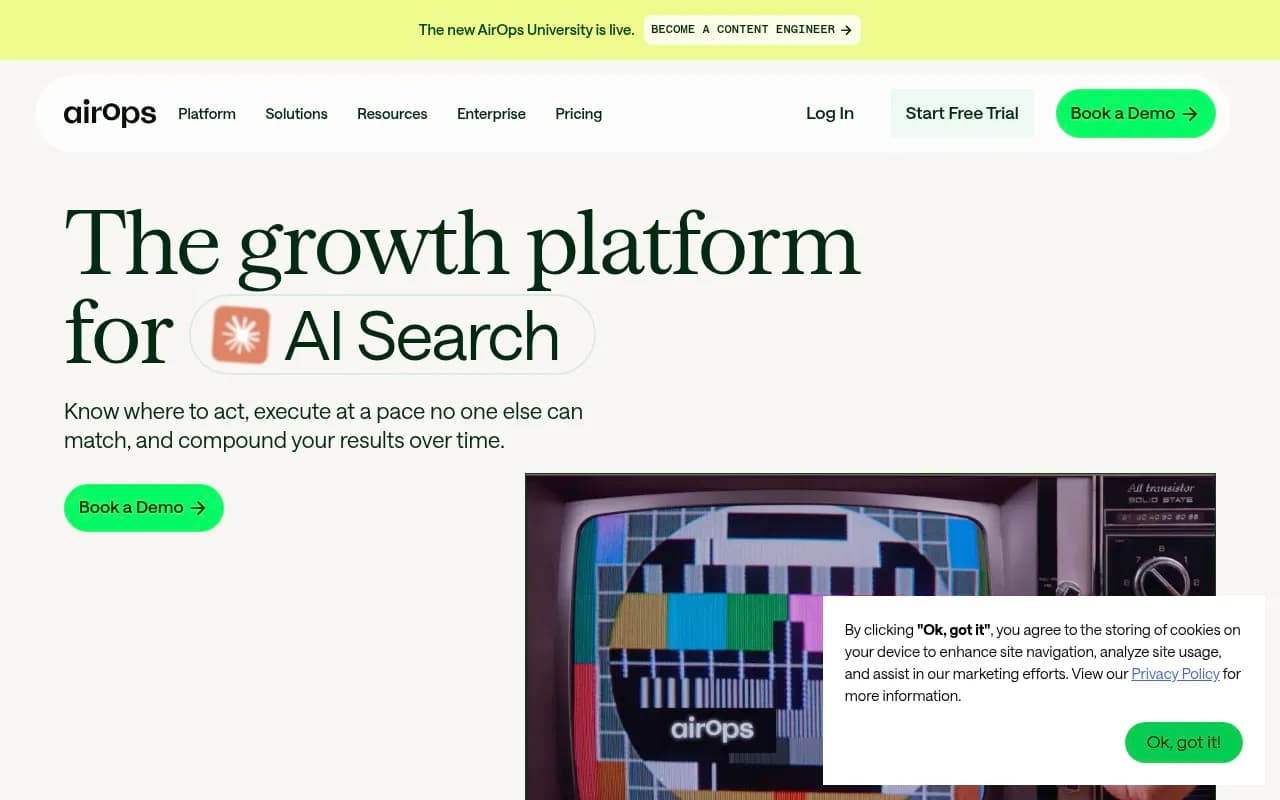
AirOps describes itself as a content operations platform. Its agent, Quill, acts on findings from its visibility tracking, and Power Agents chain research, drafting, optimization and publishing into pipelines.
How it handles quality
This is AirOps' strongest argument. Its Brand Kit has five context dimensions: foundations, product lines, content types, audiences and regions. Every piece produced through its workflows is grounded in those guidelines, and there are human review checkpoints before anything publishes. That is a sensible design. Generic output is the main failure of automated content, and encoding your positioning once and reusing it is the right fix.
One reviewer put it neatly: Clearscope helps improve the article, while AirOps helps run the factory. That fits. It is a system for repeatable processes, not a text box.
How it handles citations
AirOps tracks citation rate, mention rate, share of voice and sentiment per tracked prompt, and flags where competitors are cited and you are not. It also shows content age and performance decay, which matters for freshness. Third-party write-ups mention Smart Filters such as Almost Page One, Declining Citations and Rankings Slipping, plus Page360 views that combine citations, rank and AI-referred traffic per URL. It also covers offsite work, identifying third-party publishers that AI systems reference.
Where it falls short
Maintouch lists gaps: no automated backlink procurement, no strategic keyword research, and no self-learning from your edits. Pricing is also unclear. Omnia reported Solo at $200/mo and Pro at $2,000/mo, while Maintouch describes usage-based pricing with a free Insights tier of 1,000 tasks a month. The Pro tier and its name are not confirmed on airops.com, so verify before budgeting. And it needs people. If nobody on your team owns the workflows, the platform sits idle.
Gushwork: the managed service
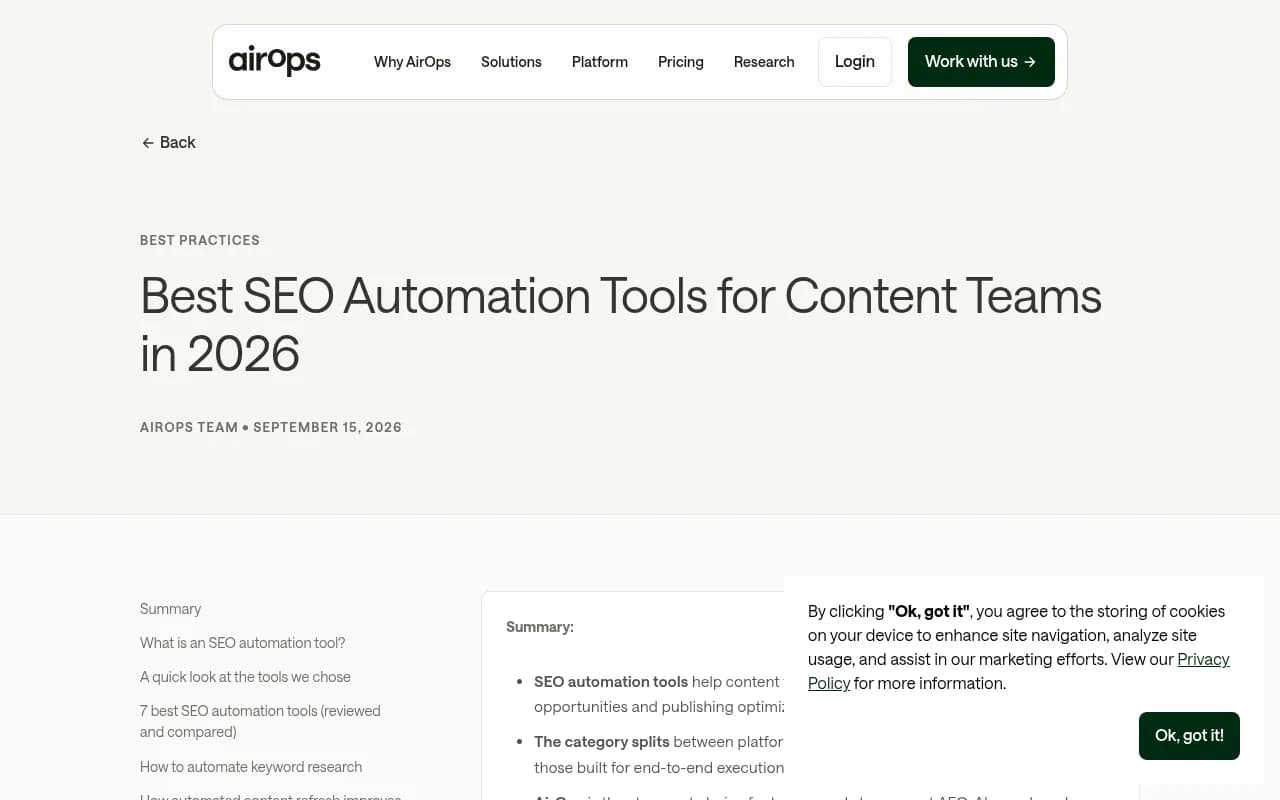
Gushwork is closest to an agency with software inside. Its pricing page shows $900/month, covering done-for-you setup, its agents, an "AI Feed" of 100+ pages published over six months, and backlinks. A landing page says "from $800/mo" and positions that against traditional agencies at $5,000 to $20,000 a month. A third-party listing shows $699, $999 and $1,999 tiers, which conflicts with Gushwork's own figures and may be stale. Another review says pricing is quote-based. Treat the price as variable and ask for a written quote.
How it handles quality
Per one review (affiliate-style, so weigh it accordingly), content is AI-drafted and reviewed by humans, with dedicated strategists. You hand over the work. That is attractive if you have no editor, and a risk if you care about every sentence. You are trusting someone else's process, so ask for sample pages in your niche before you sign.
How it handles citations
Gushwork reportedly tracks AI visibility across ChatGPT, Perplexity and Gemini. The included backlink building helps with the traditional side of authority. I could not find published citation data from Gushwork customers, so ask for case studies with named prompts and dates.
Peakfai: the budget pipeline
Peakfai starts at $129 a month and says it covers keyword research, AI writing, auto-publish and AI-search tracking, with a human SEO manager on top. Its own comparison page claims it is the only tool in its table with built-in AI-search tracking, and says it has 100+ businesses and a setup that is live in under five minutes. All of that is self-reported.
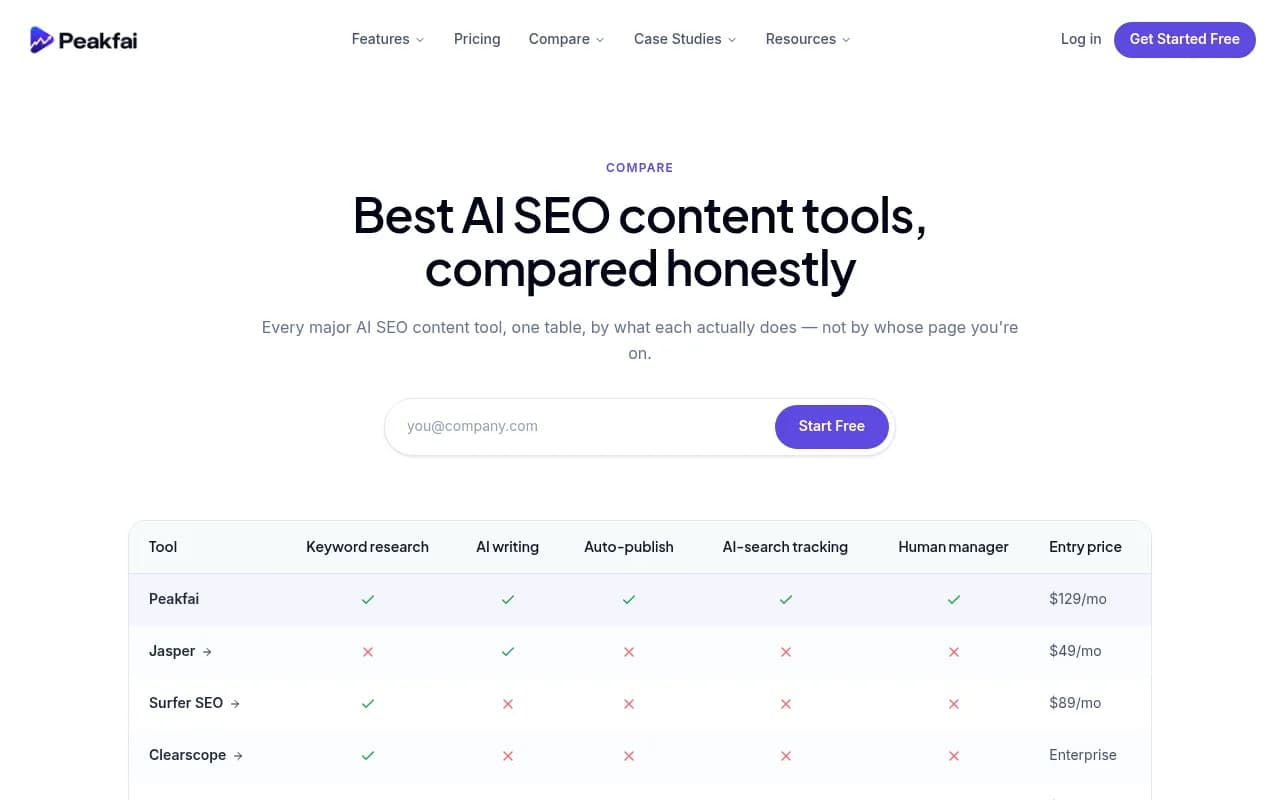
The pitch is sensible: the category is fragmented, and many teams stack two or three tools. A single pipeline at $129 is cheaper than stacking. But the independent evidence is thin. If you try it, run a short trial and judge the first ten pages against your own standards before scaling.
What actually earns citations
Here is the part that matters regardless of vendor. Promptwatch's data on which content types ChatGPT cites (Sep 28 to Oct 4, 2026) shows product pages at 22.4% of classified citations, landing pages at 16.8% and listicles at 13.6%. How-tos are 8.7%, documentation 7.5%, comparisons 5.9%, news 5.7% and FAQs 3.3%.
For commercial prompts, product pages rise to 26.0%, landing pages to 20.6%, listicles 15.0% and comparisons 7.9%. A content engine that mostly emits blog posts is aiming at the wrong targets. Whichever tool you choose, point it at product pages, landing pages, comparisons and FAQs.
Freshness matters too. In Promptwatch's content half-life data, tracking pages cited on July 6, 2026 for 90 days, 78% of landing pages and 76% of docs were still cited after 30 days. Product pages, reviews and how-tos hit their half-life after 74 to 77 days. News lost half its pages within 36 days. So schedule refreshes for product and news pages, and expect landing pages and comparisons to last.
Comparison by what you need
| Your situation | Likely fit | Why |
|---|---|---|
| In-house editors, 100+ pages, want control | AirOps | Brand Kit, review checkpoints, workflows you own |
| No content team, want hands-off | Gushwork | Done-for-you with strategists and backlinks |
| Tight budget, small site | Peakfai | Lowest entry price, includes a human manager |
| Need proof of AI citations | Any, plus an independent tracker | None has published benchmarks |
How to test them fairly
- Pick 20 prompts your buyers actually ask, split across commercial and informational intent.
- Record a baseline: which brands ChatGPT, Perplexity and Google AI Overviews cite today.
- Have each vendor produce the same mix of page types, including product, comparison and FAQ pages.
- Check crawl access. If AI bots cannot read the pages, nothing else matters.
- Re-run the prompts after 30 and 60 days and compare citation and mention rates.
- Edit a sample of output by hand and count how many changes were needed. That is your real quality score.
Measure outside the vendor's dashboard
Every one of these tools grades its own homework. An independent tracker avoids that. Promptwatch monitors real ChatGPT, AI Overviews and Perplexity interfaces, shows IP-verified AI crawler logs so you can see whether the pages these engines publish are being read, and tracks whether new pages get cited. It also has its own Content Agent if you decide you want tracking and generation in one place.

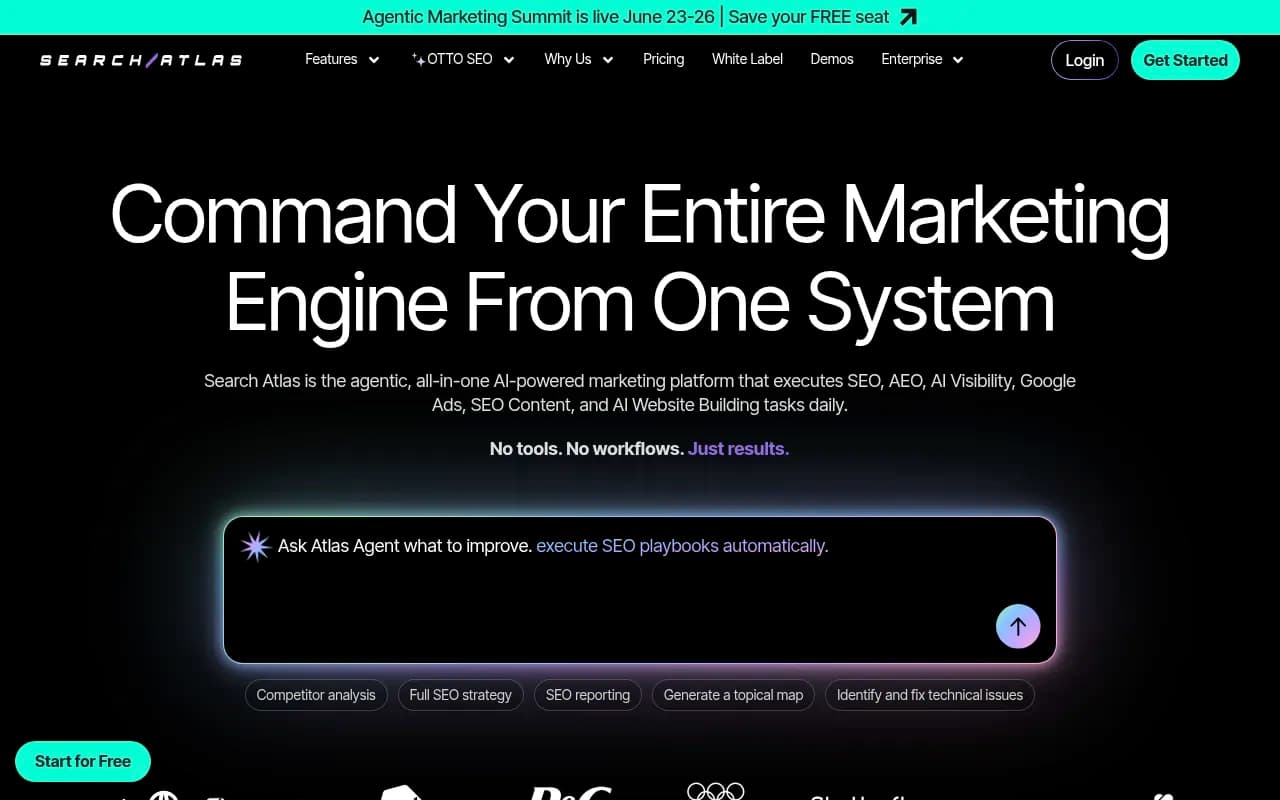
If you are comparing the wider field, the GEO software directory lists more trackers and content tools, and other options in our catalog include Slate and Search Atlas.

My take
If you have editors and a content library, AirOps is the most coherent product here because its quality controls are explicit. If you have no capacity and some budget, Gushwork removes the work, at the price of visibility into how it is done. Peakfai is the cheapest experiment, and I would treat it as one: small commitment, hard review of the output, and no scaling until you see citations. None of the three has proven its citation claims in public. Make them prove it on your prompts.