Key takeaways
- AI hallucinations about brands aren't rare. Independent benchmarks put document Q&A hallucination rates anywhere from 3% to over 85% depending on the model, and industry aggregators frequently cite an overall rate around 20%.
- Citation behavior on platforms like ChatGPT can shift overnight. Average citations per response dropped roughly 27% within a day of the GPT-5.3 rollout in March 2026, which means a one-time brand audit tells you almost nothing about next month.
- The strongest tools (Profound, seoClarity, Siftly) go beyond mention-counting and score responses for factual accuracy against a structured brand profile, flagging hallucinations with the specific false claim attached.
- Reddit's share of ChatGPT citations collapsed from roughly 3.8% to under 1% in a single week in August 2026, a reminder that where negative chatter about your brand lives can change fast and without warning.
- Continuous, multi-platform, multi-prompt monitoring beats occasional spot checks every time. The brands that get burned by a hallucinated claim are almost always the ones that weren't watching.
Why this problem is bigger than it sounds
I'll be honest, when I first heard "AI brand monitoring" I pictured something like a Google Alert with extra steps. It isn't. It's closer to reputation management for a system that lies confidently, at scale, and doesn't tell you when it does it.
Here's the part that should worry any marketing or comms team: ChatGPT has more than 900 million weekly users, and a growing share of them are asking it, not Google, which vendor to trust. Gartner has predicted traditional search volume will drop 25% by 2026 because of this shift. When someone asks ChatGPT "is [Your Brand] good for X" and it answers with outdated pricing, a feature you discontinued two years ago, or a competitor's name where yours should be, that's not a ranking problem you can fix with better keywords. It's a factual error being served as truth to a real prospect, and you have no idea it happened.
A 172-billion-token benchmark study on document Q&A found hallucination rates ranging from about 3.4% on one model up to a staggering 85.8% on another, with most models getting worse as the context window grows. Real-world consequences are already showing up in court. Damien Charlotin's public database of AI hallucination legal cases logged a September 2026 filing where Claude, ChatGPT, and Gemini all fabricated case law, resulting in sanctions and mandatory AI-ethics training for the lawyers involved. Separately, ChatGPT once fabricated a bribery accusation against an Australian mayor, nearly triggering a defamation suit against OpenAI. Brands aren't exempt from this kind of fabrication. They're just less likely to notice it happening to them.
What actually needs monitoring
A proper program tracks more than "did the AI mention us." Based on how the better platforms structure their reporting, you want visibility into:
- Mention rate and share of voice across models, not just ChatGPT
- Sentiment and framing (are you the recommended option, or the budget also-ran)
- Factual accuracy, specifically flagged mismatches against your real pricing, features, and positioning
- Citation sources feeding the answer, so you know whether a wrong claim traces back to an outdated blog post, a stale review site listing, or pure model fabrication
- Competitor comparisons inside the same responses
The common mistake, according to practitioners who've built these programs, is treating a single audit as sufficient. It isn't. Citation behavior is a platform-controlled variable that can move overnight with no warning. Promptwatch's data on the GPT-5.3 rollout showed average citations per ChatGPT response falling from about 6.4 to under 5 within a single day, and it never recovered a month later. If you'd run your brand audit the week before that rollout, your numbers would already be stale by the time you acted on them.
The same volatility shows up in where negative or unreliable information can come from. Promptwatch's tracking found Reddit held a steady 3.8% share of ChatGPT Search citations through early August 2026, then collapsed to about 0.5% within a week after ChatGPT changed how it fans out queries. That's the second time this has happened; a nearly identical Reddit citation collapse occurred in September 2025 after Reddit changed third-party data access. If a chunk of the negative chatter about your brand lived on Reddit threads, that exposure can vanish in days, or a new source can just as quickly take its place. You can read more of this citation-source research at promptwatch.com/data.
The tools that actually detect hallucinations, not just mentions
Most "AI visibility" tools count how often you show up. A smaller group specifically scores responses for factual accuracy and flags fabrications. That distinction matters more than any pricing tier.
Profound
Profound lists AI hallucination detection as an explicit feature on its G2 profile, and its "Ask Profound Agents" capability flags issues and benchmarks competitive positioning automatically. It's an enterprise-grade tool with enterprise-grade backing, having raised over $150M across a Series C and D in roughly 18 months. Pricing starts at $99/month (Starter, one seat) up to $399/month (Growth, three seats) with custom enterprise plans above that. Reviewers on G2 consistently say it's powerful but pricey for anyone outside enterprise budgets.
seoClarity (Clarity ArcAI)
seoClarity built hallucination detection into Clarity ArcAI as a named product pillar: "Monitor Accuracy: Detect hallucinations and errors in AI responses." It identifies wrong pricing, wrong features, outdated leadership info, and other factual errors, surfacing them with the specific platform, query, and false claim documented. This is aimed squarely at enterprise brands, especially regulated industries where a wrong claim carries compliance risk, and pricing is quote-based only.
Siftly
Siftly compares every AI response against a structured profile of your actual product (pricing, features, integrations, positioning) and scores each response across six dimensions: mention, position, sentiment, hallucination, competitors, and citations. It's a more accessible entry point for teams that want structured hallucination alerts without an enterprise sales process, though published pricing isn't fully transparent.
Brand24
Brand24 comes from the traditional social listening world, monitoring 25 million-plus sources including social, blogs, news, and review sites, and it added an AI Visibility module for tracking brand exposure across major AI platforms. The catch: that module is a paid add-on on every tier, not bundled in. Plans run from $199/month (Individual) to $599/month (Business), with Enterprise starting around $1,499/month. If you already run social listening and want to bolt on AI visibility without switching vendors, it's a reasonable middle ground, but it's not a hallucination-detection specialist.
Otterly.ai
Otterly is the budget-friendly option, starting at $29/month for a Lite plan with 15 tracked prompts. The trap is that Google AI Mode, Gemini, and Claude tracking are all paid add-ons on every tier. Push a Premium plan ($489/month) to cover every engine and you're closer to $1,226/month in practice, well above what the pricing page implies. It's fine for lightweight monitoring of ChatGPT specifically, less so if hallucination detection across every model matters to you.
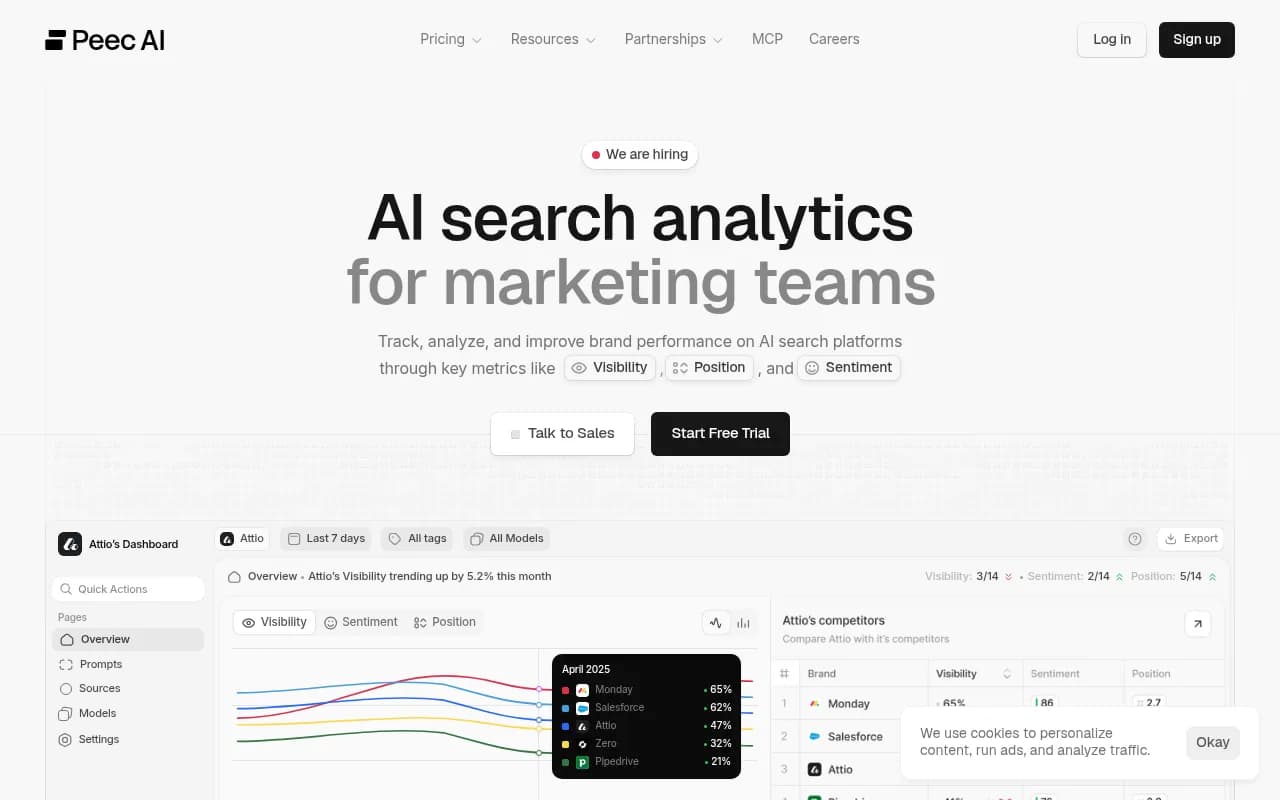
Peec AI
Peec repriced in 2026 to roughly $95-$495/month on annual billing (Starter through Advanced), plus custom Enterprise. Sentiment tracking, described explicitly as "catching misinformation in how AI describes a brand," only kicks in at the Pro tier. One meaningful limitation: even paid tiers cap you at choosing 3 of 6 tracked engines, which undercuts the cross-platform monitoring that practitioners say is non-negotiable.
Comparison table
| Platform | Hallucination detection | Engines tracked | Starting price | Best for |
|---|---|---|---|---|
| Profound | Explicit, named feature | ChatGPT + major LLMs | $99/mo (1 seat) | Enterprise brands with budget |
| seoClarity (Clarity ArcAI) | Explicit, documented claims | Multi-platform | Custom quote | Regulated/enterprise industries |
| Siftly | Six-dimension response scoring | ChatGPT, Claude, Perplexity, AI Overviews | Not published | Mid-market teams wanting structured alerts |
| Brand24 | Sentiment via add-on module | Major AI platforms (add-on) | $199/mo + add-on | Teams already using social listening |
| Otterly.ai | Sentiment tracking, no dedicated hallucination flag | ChatGPT native; others as paid add-ons | $29/mo | Budget ChatGPT-only monitoring |
| Peec AI | Sentiment at Pro tier | 3 of 6 engines (capped) | ~$95/mo (annual) | Small teams, limited engine needs |
| Promptwatch | Citation trends, crawler logs, content gap analysis | ChatGPT, Gemini, Claude, Perplexity, Grok, Copilot, AI Overviews, AI Mode, and more | Free tier; $95/mo Essential | Teams that want monitoring plus the fix |
Where Promptwatch fits in
Most of the tools above stop at telling you something is wrong. Promptwatch takes a different angle: it's built to show you why you're invisible or misrepresented in the first place, then help fix it. Its Agent Analytics feature logs when AI crawlers like ChatGPTBot, ClaudeBot, and PerplexityBot actually visit your site, what they read, and where they hit errors, which is the missing link between "the AI got our pricing wrong" and "the AI never actually crawled our current pricing page." Its citation analytics also track Offsite Mentions, catching your brand named in third-party pages AI cites even without a link back, which is exactly the kind of exposure that turns into a hallucinated claim if nobody's watching.
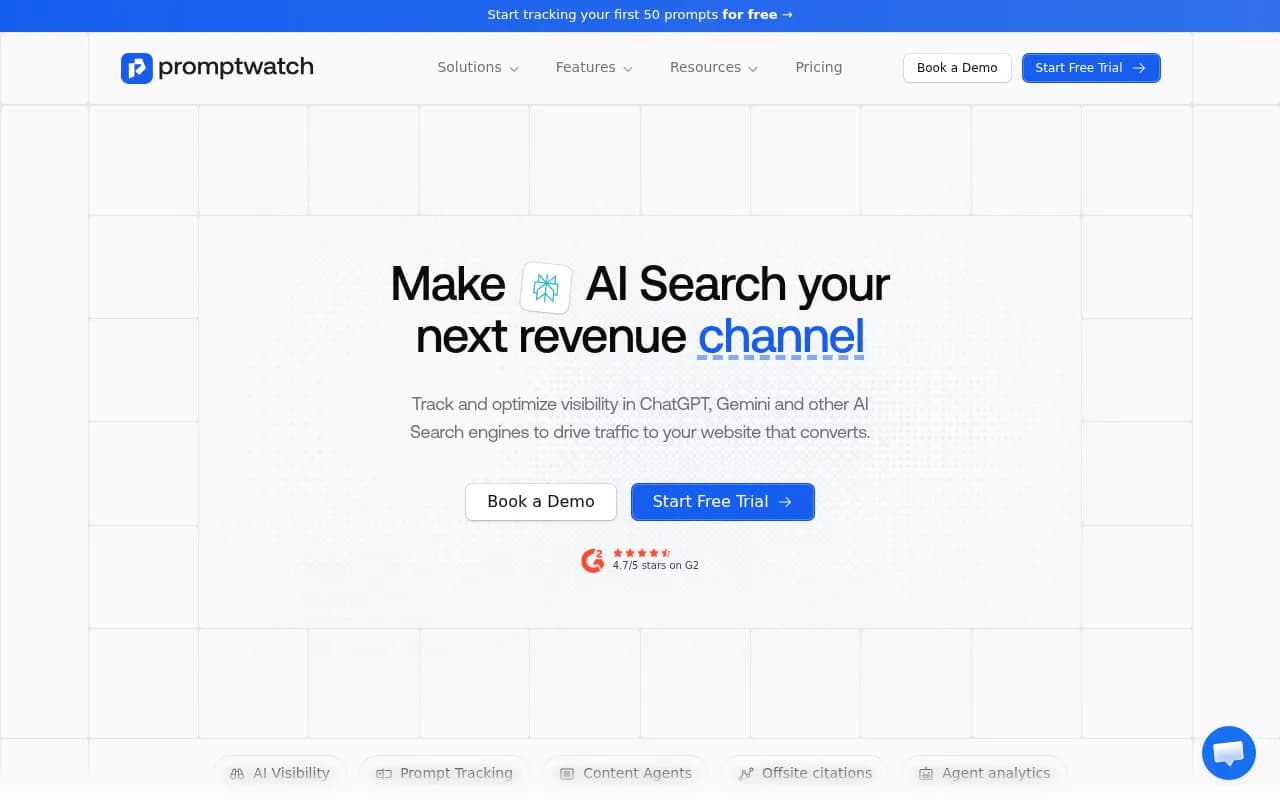
Where it clearly differs from monitoring-only tools like Peec or Otterly is the action layer. Content Agents can plan, write, and publish corrected, GEO-optimized pages straight to your CMS (Webflow, Framer, WordPress), and Unified Actions turns your visibility, citation, and crawler data into a prioritized to-do list rather than a static dashboard you have to interpret yourself. Crisp, one of its customers, scaled to 5-10 published articles a day using this loop and saw AI-driven traffic convert at roughly 2x the rate of traditional channels. Pricing starts free (10 prompts, ChatGPT only) and runs to $95/month for the Essential plan covering all major LLMs, MCP access, and 5 AEO articles a month.
If you're deciding between a pure tracker and something that closes the loop, that's the real question to ask: do you want a tool that tells you the AI got something wrong, or one that also fixes the source content that caused it?
A practical monitoring checklist
- Build a prompt set from actual customer language, not generic category terms. "Best CRM for a 10-person agency" beats "what is CRM software."
- Track at least three AI platforms. ChatGPT and Google AI Overviews frequently diverge in what they say about the same brand, so single-platform monitoring misses half the picture.
- Set up recurring checks, weekly at minimum, not a one-time audit. Citation share and even citation volume can shift within a single day, as the GPT-5.3 rollout and the Reddit citation collapse both demonstrated in 2026.
- Read the flagged responses yourself occasionally. Automated scoring catches the pattern; a human catches the tone and whether a "neutral" mention actually reads as dismissive.
- Fix the source, not just the narrative. AI answers are built from your website, review platforms, press coverage, and third-party profiles collectively. If those sources disagree with each other, that inconsistency is what creates room for a hallucination in the first place.
Choosing the right platform for your situation
If you're an enterprise brand in a regulated space where a wrong pricing claim or outdated compliance detail carries real legal weight, seoClarity or Profound are worth the sales call despite the cost. If you want structured hallucination scoring without an enterprise budget, Siftly is the more accessible middle path. If your primary goal is closing the loop between detection and correction, rather than just accumulating alerts you still have to act on manually, Promptwatch's combination of crawler-level diagnostics and automated content fixes is the more complete stack. And if you're just getting started and want to see what's out there before committing, the GEO software directory at bestgeosoftware.com is a reasonable place to browse the full field before narrowing down.
Whatever you pick, the core lesson from 2026's data holds: this space moves fast enough that a monitoring tool you set up once and forget about is barely better than not monitoring at all.