Key takeaways
- AI search visibility tracking is no longer optional -- Gartner estimated traditional search volume would drop 25% by 2026 as users shift to ChatGPT, Perplexity, and Google AI Overviews
- UK and European brands face specific challenges: multilingual tracking, GDPR compliance, regional AI model behavior, and local citation patterns that differ from US markets
- Most platforms were built with US markets in mind; only a handful offer genuine multi-language and multi-region support
- The biggest gap in the market is between monitoring-only tools and platforms that actually help you fix visibility problems -- most tools stop at showing you data
- Promptwatch is the only platform rated "Leader" across all categories in a 2026 comparison of 12 GEO platforms, and it's the only one with a full action loop: gap analysis, content generation, and result tracking
Why UK and European brands need to think differently about AI visibility
If you're running marketing for a UK or European brand, the AI search visibility problem hits differently than it does in the US. It's not just that ChatGPT might not mention you -- it's that the AI models your customers use may behave differently depending on whether they're searching in English, German, French, Dutch, or Spanish. A prompt about "best accounting software" typed in London returns different citations than the same prompt typed in Munich.
That's the core issue. Most AI visibility platforms were built by US companies, for US markets, with English-language prompts as the default. They track ChatGPT and Perplexity well enough, but ask them to monitor how your brand appears in German-language Gemini responses or French Perplexity queries, and many fall flat.
There's also the GDPR angle. Any platform processing data about European users or operating within EU markets needs to handle data in a way that's compliant. Some tools are vague about where data is stored and processed -- worth checking before you commit.
And then there's the practical reality: European markets are fragmented. A UK travel brand might care deeply about Google AI Overviews (still dominant in the UK) but less about Grok. A Dutch e-commerce company might prioritize Bing Copilot because it's embedded in Microsoft 365, which dominates enterprise software in the Netherlands. The right platform for your market depends on which AI models your customers actually use.
What to look for in an AI visibility platform for UK/EU markets
Before comparing specific tools, it helps to know what actually matters for European use cases.
Multi-language support. Can the platform track prompts in languages other than English? Can it monitor AI responses in German, French, Spanish, Italian, Dutch? This is table stakes for any brand operating across multiple European markets, but many platforms don't support it at all.
Multi-region tracking. AI models don't return the same results everywhere. A platform that only tracks from US-based servers will miss how AI engines respond to UK or EU users. Look for platforms that can simulate queries from specific countries or cities.
Coverage of relevant AI models. In Europe, Google AI Overviews and Gemini are significant. Bing Copilot has strong enterprise penetration. Perplexity is growing fast among tech-savvy users. ChatGPT is everywhere. Any platform that only tracks one or two of these is leaving blind spots.
Content gap analysis and optimization. Knowing you're invisible is only half the problem. The more useful question is: what content do you need to create to become visible? Platforms that answer this question are worth significantly more than those that just show you a visibility score.
GDPR and data handling. Check where data is processed and stored. For EU brands especially, this matters both for compliance and for peace of mind.
Pricing that makes sense for European budgets. Many enterprise-tier US platforms price in ways that don't fit mid-market European companies. Look for transparent pricing with clear tiers.
The platforms worth considering
Promptwatch
Promptwatch is a Dutch company (Promptwatch B.V.), which makes it the only major GEO platform that's actually European-headquartered. That matters for GDPR considerations, and it also means the platform was built with European market realities in mind from the start.

It monitors 10 AI models: ChatGPT, Perplexity, Google AI Overviews, Google AI Mode, Claude, Gemini, Meta/Llama, DeepSeek, Grok, Mistral, and Copilot. Multi-language and multi-region tracking is built in, with customizable personas that let you simulate how different types of customers prompt AI engines in different countries.
What separates Promptwatch from most competitors is the action loop. Most tools show you a visibility score and leave you to figure out what to do next. Promptwatch's Answer Gap Analysis shows you the specific prompts your competitors are visible for that you're not -- and then Content Agents generate articles, listicles, and comparisons designed to close those gaps. Page-level tracking then shows you when AI models start citing your new content. It's a closed loop: find gaps, create content, track results.
For UK and European agencies, the multi-site support and white-label options at agency/enterprise tier are worth noting. The platform is used by Booking.com and Center Parcs, among others -- both brands with significant European footprints.
Pricing starts at $99/month for the Essential tier (1 site, 50 prompts, 5 articles), $249/month for Professional (2 sites, 150 prompts, crawler logs, city-level tracking), and $579/month for Business (5 sites, 350 prompts, 30 articles).
Profound
Profound is frequently cited as the enterprise standard for AI visibility tracking, and for good reason -- it tracks 10+ AI engines with strong depth of data. It's well-suited to large brands with dedicated analytics teams who want granular data.
The trade-off is price and complexity. Profound sits at a higher price point than most mid-market European brands will want to pay, and it's primarily a monitoring platform. It shows you what's happening but doesn't generate content to fix it. For a European enterprise with a large in-house team, that's fine. For a mid-market brand or agency that needs the full workflow, it leaves a gap.
Otterly.AI
Otterly.AI is one of the more affordable options in the market and has a reasonably clean interface for tracking brand mentions across AI platforms.
It's a monitoring-only tool -- no content generation, no crawler logs, no gap analysis. For a small UK brand that just wants to know whether ChatGPT mentions them, it's a reasonable starting point. But if you want to actually improve your visibility rather than just measure it, you'll hit the ceiling quickly.
Peec AI
Peec AI offers AI visibility tracking with some smart suggestions layered on top. It's positioned as a more accessible alternative to enterprise tools.
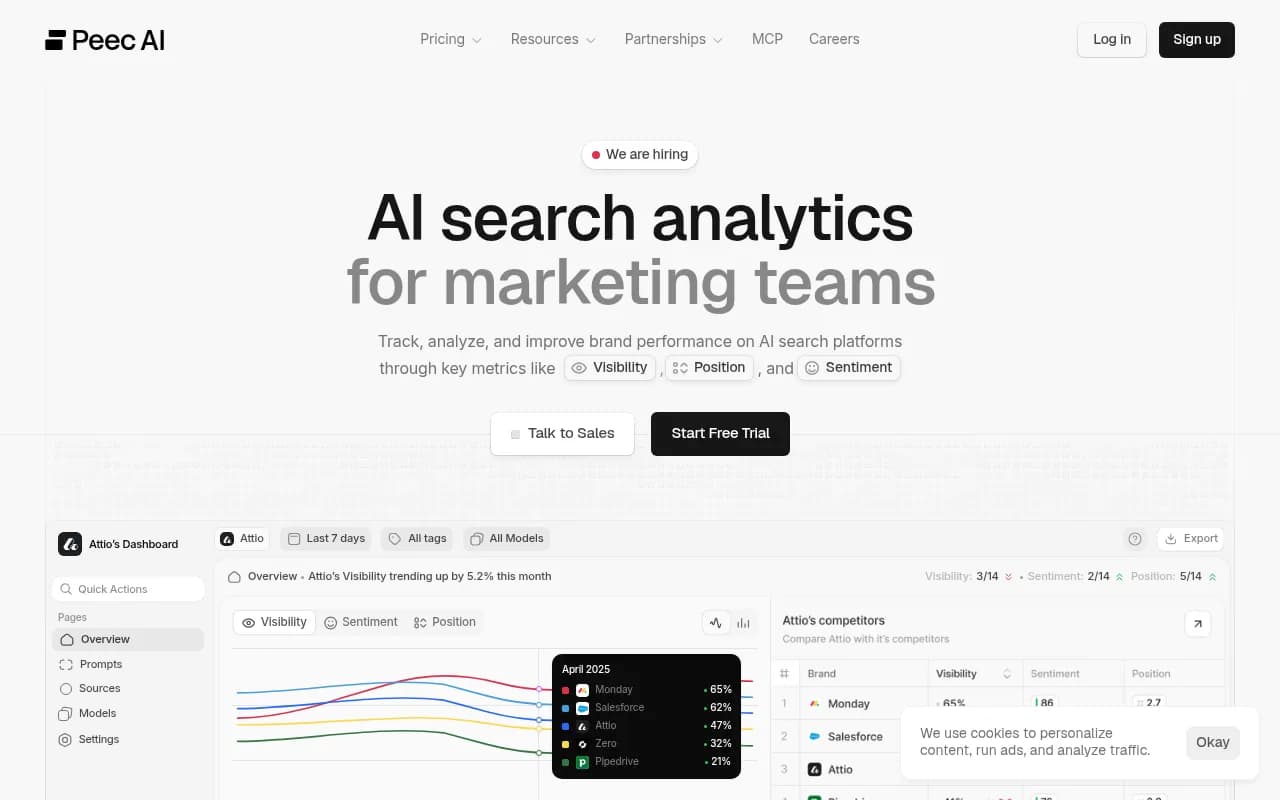
Multi-language support exists but is limited compared to what European brands with broad market coverage need. Like Otterly.AI, it's primarily a monitoring tool -- the "smart suggestions" are helpful pointers but don't replace a proper content workflow.
AthenaHQ
AthenaHQ focuses on AI search visibility monitoring with a clean, structured approach to tracking brand mentions and citations across models.
It's monitoring-focused, which means it's good at showing you where you stand but doesn't help you move. No content generation, no crawler logs. For European brands, the multi-region support is worth checking before committing -- it's not as robust as Promptwatch's.
SE Ranking
SE Ranking is a well-established SEO platform that has expanded into GEO and AI visibility tracking. It's popular in European markets partly because of its competitive pricing and strong traditional SEO feature set.
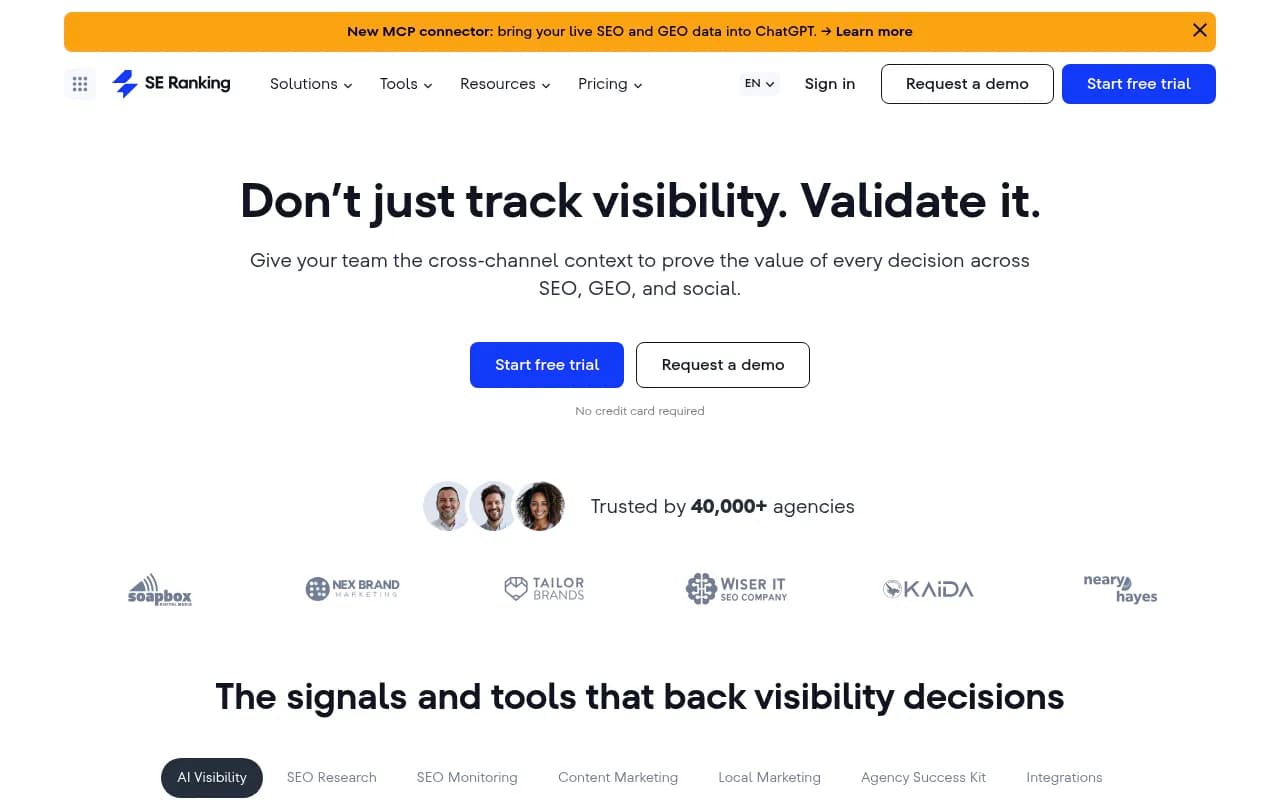
The AI visibility features are newer additions rather than core capabilities, so depth is more limited than dedicated GEO platforms. That said, if you're already using SE Ranking for traditional SEO and want basic AI visibility monitoring without adding another tool, it's a reasonable option.
Scrunch AI
Scrunch AI is aimed at brands and agencies that want AI search monitoring with a focus on brand safety and sentiment alongside visibility.
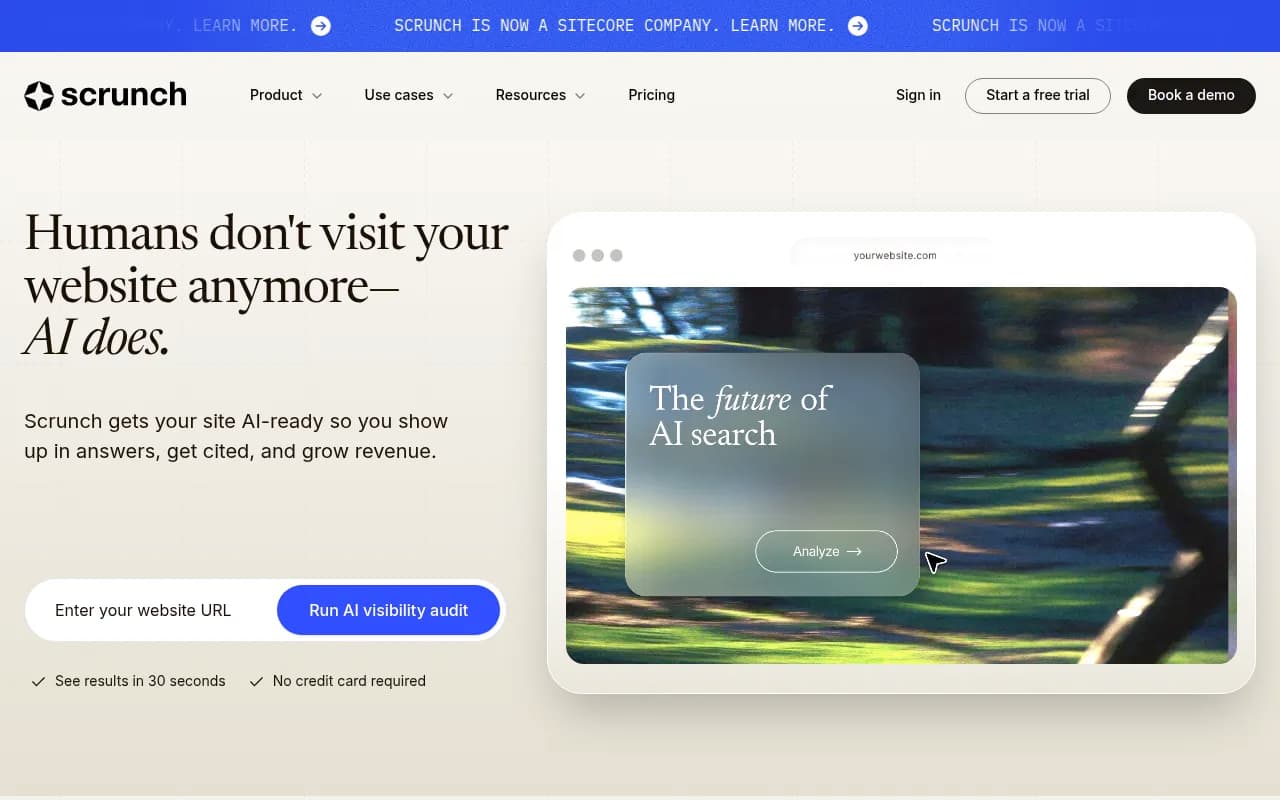
It has decent coverage of major AI models and a clean reporting interface. Like most competitors, it's primarily a monitoring tool -- strong on showing you data, weaker on helping you act on it.
Search Party
Search Party is built with agencies in mind and has a reasonable feature set for tracking client visibility across AI platforms.
The agency-oriented workflow is genuinely useful if you're managing multiple clients. The limitation is that prompt metrics and content gap analysis are less developed than what Promptwatch offers. For agencies that want to go beyond reporting and actually improve client visibility, that's a meaningful gap.
Ahrefs Brand Radar
Ahrefs is a tool most European SEOs already know well. Brand Radar is their AI visibility add-on, which tracks how your brand appears in AI search responses.
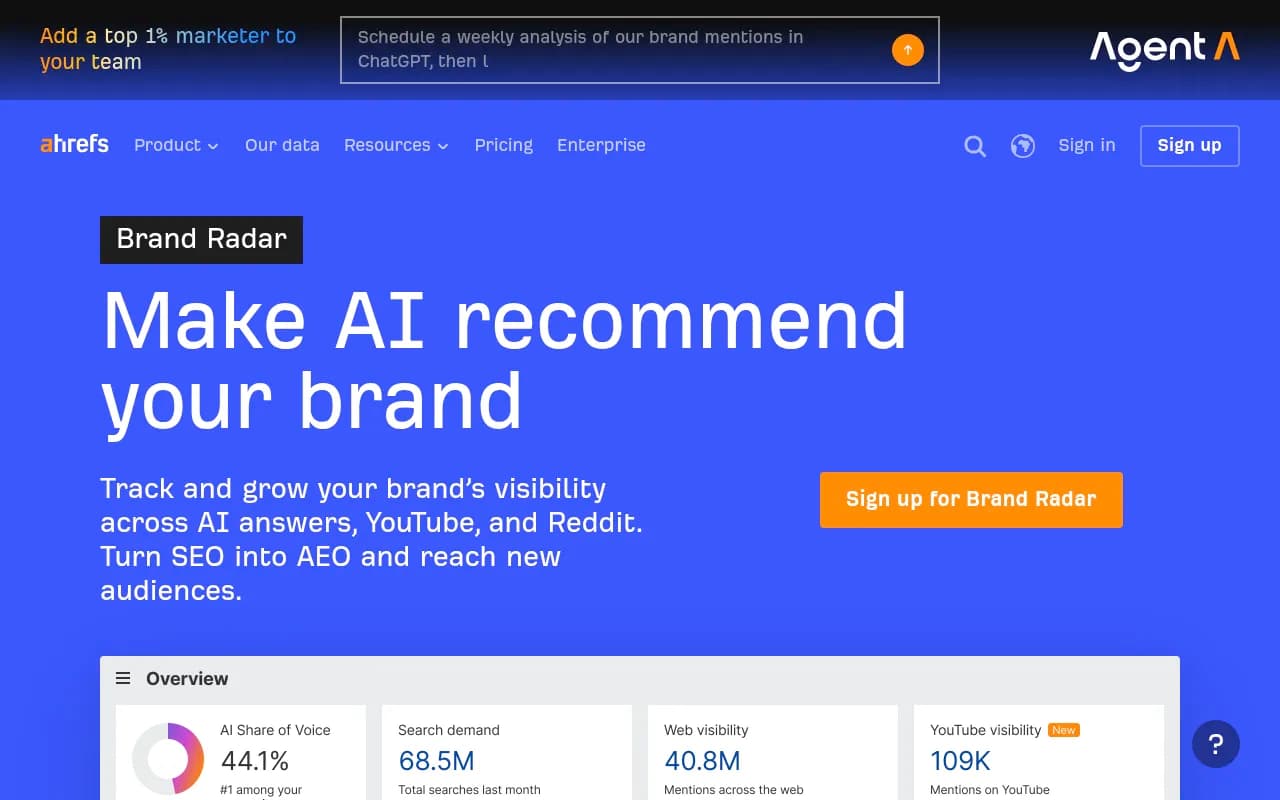
The integration with Ahrefs' existing backlink and keyword data is genuinely useful -- you can connect traditional SEO signals with AI visibility in one platform. The limitations: fixed prompts (you can't fully customize what you track), no AI traffic attribution, and no content generation. It's a solid addition to the Ahrefs toolkit but not a standalone GEO platform.
Semrush AI Visibility Toolkit
Semrush has added AI visibility features to its existing platform, which means European brands already using Semrush for traditional SEO can extend into AI tracking without switching tools.
The limitation is similar to Ahrefs: fixed prompts, no deep content gap analysis, and no content generation. It's a useful layer on top of Semrush's existing capabilities, not a replacement for a dedicated GEO platform.
Nightwatch
Nightwatch has extended its rank tracking capabilities into AI search, making it a reasonable option for brands that want traditional and AI visibility in one place.
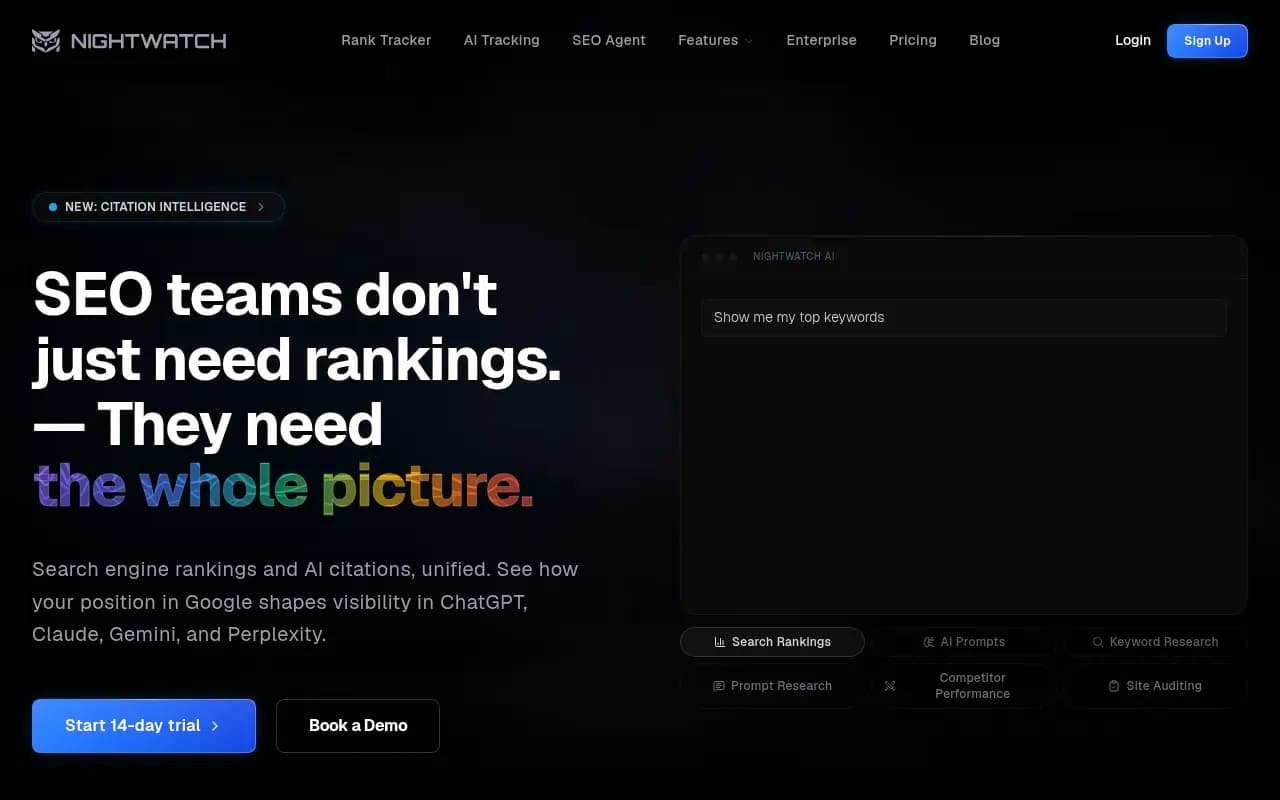
It's particularly popular in European markets because of its clean interface and competitive pricing. AI visibility features are growing but not yet at the depth of dedicated platforms.
Rankscale
Rankscale focuses specifically on AI search rank tracking and monitoring, with a straightforward approach to measuring visibility across models.
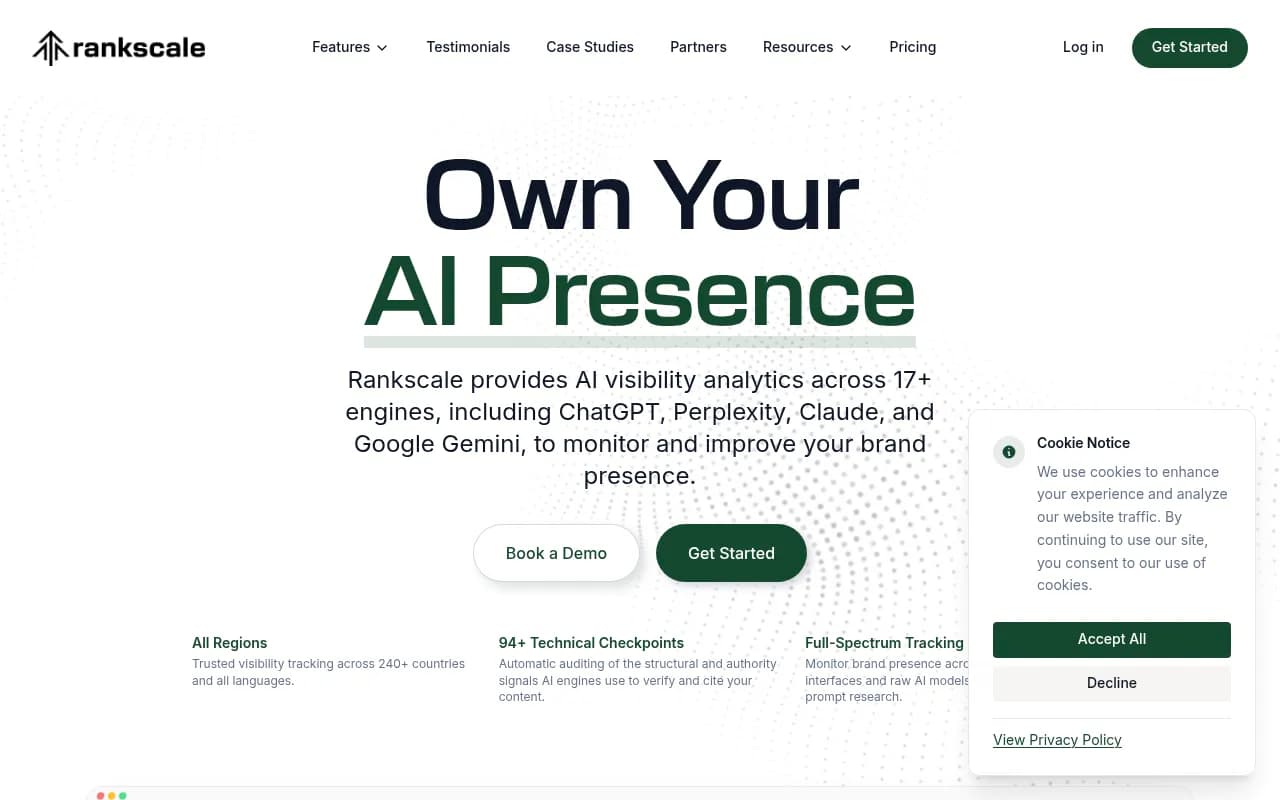
Worth considering for brands that want a focused, no-frills tracking tool without the complexity of larger platforms.
How the major platforms compare
Here's a direct comparison across the dimensions that matter most for UK and European use cases:
| Platform | Multi-language | Multi-region | AI models tracked | Content generation | Crawler logs | GDPR-friendly HQ | Starting price |
|---|---|---|---|---|---|---|---|
| Promptwatch | Yes | Yes | 10+ | Yes (Content Agents) | Yes | Yes (Netherlands) | $99/mo |
| Profound | Limited | Yes | 10+ | No | No | No (US) | Enterprise |
| Otterly.AI | Limited | Limited | 5-6 | No | No | No | ~$49/mo |
| Peec AI | Limited | Limited | 6-8 | No | No | No | ~$79/mo |
| AthenaHQ | Limited | Limited | 6-8 | No | No | No | ~$99/mo |
| SE Ranking | Yes | Yes | 4-6 | No | No | No | ~$65/mo |
| Scrunch AI | Limited | Limited | 6-8 | No | No | No | Custom |
| Ahrefs Brand Radar | Limited | Limited | 4-6 | No | No | No | Add-on |
| Semrush AI Toolkit | Limited | Limited | 4-6 | No | No | No | Add-on |
| Nightwatch | Limited | Yes | 4-6 | No | No | No | ~$39/mo |
The monitoring-only problem
One thing worth saying plainly: most of these platforms are dashboards. They show you a number -- your visibility score, your citation rate, your share of voice -- and then leave you to figure out what to do with it.
That's useful for reporting. It's not useful for actually improving your position.
The question for any European brand investing in AI visibility is: do you want to know how invisible you are, or do you want to become visible? Those are different products.
Platforms like Otterly.AI, Peec AI, and AthenaHQ are good at the first. Promptwatch is built around the second -- the Answer Gap Analysis shows you which specific prompts you're missing, Content Agents generate the content to fill those gaps, and page-level tracking shows you when it's working. That closed loop is what makes it an optimization platform rather than a monitoring tool.
Recommendations by use case
For UK/EU agencies managing multiple clients: Promptwatch's agency tier gives you multi-site management, white-label reporting, and the content generation workflow to actually improve client visibility -- not just report on it. Search Party is worth a look if you want a simpler monitoring setup.
For mid-market European brands (in-house teams): Promptwatch Professional at $249/month covers most needs: multi-language tracking, 150 prompts, crawler logs, and 15 articles per month from Content Agents. SE Ranking is a reasonable budget alternative if you're already in their ecosystem and just want basic AI monitoring added on.
For enterprise European brands: Promptwatch Business or enterprise tier, or Profound if you have a large analytics team and primarily need data depth rather than content workflow. Budget for both if you can -- Profound for data, Promptwatch for action.
For small UK businesses just getting started: Otterly.AI or Nightwatch to get a baseline understanding of where you stand. Plan to upgrade once you've confirmed AI visibility is worth investing in for your category.
For e-commerce brands: Promptwatch's ChatGPT Shopping tracking is particularly relevant -- it monitors when your products appear in ChatGPT's shopping recommendations and carousels, which is increasingly important as AI-driven product discovery grows.
A note on regional AI model behavior
One thing that often gets overlooked: AI models don't behave identically across regions. Google AI Overviews in the UK pulls from different sources than in the US. Perplexity's responses in German differ from its English responses not just in language but in which sources it cites. ChatGPT's recommendations for "best CRM software" vary between a user in Amsterdam and a user in Austin.
This means tracking from a single US-based server gives you an incomplete picture if your customers are in Europe. The platforms that let you specify country, language, and persona when setting up prompt tracking give you data that actually reflects your market. Promptwatch's multi-region and multi-language support, combined with customizable personas, is one of the more complete implementations of this.
Getting started
If you're a UK or European brand that hasn't started tracking AI visibility yet, the first step is simply understanding your current position. Pick a tool, set up 20-30 prompts that reflect how your customers actually search for what you sell, and run them for a few weeks. The data will tell you whether you have a visibility problem worth solving.
If you already know you have a problem and want to fix it, the monitoring-only tools won't get you there. You need a platform with content gap analysis and content generation built in -- and in 2026, Promptwatch is the clearest option for that in the European market.