Key takeaways
- Brand managers need three numbers from an AI visibility platform: share of voice, sentiment, and the sources AI cites when it talks about you. Mention counts alone are not enough.
- Sources of reputation differ sharply by engine. Per-engine monitoring beats a single blended score.
- Most platforms monitor. A smaller group also helps you fix what you find. Decide which one you need before you shortlist.
- Traditional social listening tools (Brandwatch, Talkwalker, Brand24) and AI visibility tools answer different questions. Many teams need one of each.
- Compare share of voice only with the same prompt set, markets, and competitor group. Vendor formulas differ.
Why brand managers should care about AI answers
Your brand now has a second reputation. The first lives in search results, reviews, and social feeds. The second is assembled on the fly by ChatGPT, Gemini, Perplexity, Copilot, and Google AI Overviews, and it can be wrong, outdated, or quietly dominated by a competitor.
The awkward part is that you cannot see it without tooling. One shopper asks "best project management software for agencies" and gets five brands. Another asks the same thing an hour later and gets four, in a different order. Nobody sends you a report on that.
A 2026 roundup from Indexly cites Semrush's AI Visibility Index finding that only 36 of 1,200 studied brands appeared consistently across ChatGPT, Gemini, AI Mode, and AI Overviews every month. I would treat that as a vendor-cited stat, but the direction matches what most teams see: visibility is patchy and unstable.
This guide is written for people who own brand perception, not just rankings. So we focus on sentiment, share of voice, and reputation, then look at which tools handle each.
The three metrics that matter
Share of voice
Share of voice is your slice of mentions or citations across a defined set of prompts, compared with competitors. Simple in theory. In practice, every vendor calculates it a little differently, which is why Dageno's comparison guide advises using the same prompt set, date range, markets, and competitor group when you compare scores.
There is a second trap. The number of citation slots differs by engine. Promptwatch Data on average sources per response shows ChatGPT citing about 5 sources per web-search answer, while Google AI Overviews and Perplexity sit near 10. Copilot swung from under 2 to nearly 17 within a few weeks before settling low. A 20% share in ChatGPT, with five slots, is a different achievement than 20% in Perplexity. Normalise before you compare engines, and judge Copilot on monthly trends rather than weekly snapshots.
Sentiment
Sentiment tells you how the engine describes you, not just whether it does. Good tools score each response, show trends, and surface the attributes AI associates with your brand ("affordable", "hard to set up", "enterprise-only"). A score near neutral is not necessarily bad. A sudden drop is the thing to chase.
Source attribution
Reputation in AI is built from sources. If you cannot see which pages the engine pulled from, you cannot change the narrative. This is where per-engine data matters most. Per Promptwatch's social citation data for Sep 28 to Oct 4, 2026:
- ChatGPT drew just 0.46% of its citations from social platforms, with LinkedIn its top social source at 0.3%. Reddit fell from 5.19% to 0.09% after the August drop, covered in the Reddit citations report.
- Google AI Overviews drew 12.2% of citations from social, with YouTube at 4.28%, Facebook at 2.38%, and Reddit at 2.15%.
- Perplexity sat at 2.7%, with LinkedIn and Reddit tied at 0.86%.
The practical read: a reputation plan that leans on Reddit threads to shape ChatGPT is aimed at the wrong target in late 2026. A blended "AI sentiment" number would hide that completely.
What to look for in a platform
| Capability | Why a brand manager cares | Question to ask the vendor |
|---|---|---|
| Real interface tracking | Consumer answers can differ from API outputs | Do you capture the actual ChatGPT and AI Overviews UI, or API calls? |
| Sentiment with drivers | Knowing why tone shifted is the useful part | Can I see which sources and attributes caused the change? |
| Per-engine share of voice | Citation slots vary by engine | Can I filter by engine, country, and language? |
| Citation and source reports | Shows where reputation is built | Do you break out Reddit, YouTube, LinkedIn, and news? |
| Accuracy flags | Wrong pricing or features hurt trust | Does it flag factual errors about my brand? |
| Traffic attribution | Ties reputation work to revenue | Can I see visits and conversions from AI engines? |
| Action layer | Monitoring alone does not fix anything | Does it recommend or produce content fixes? |
AI visibility platforms worth shortlisting
Promptwatch
Promptwatch is the one I would start with if the brief is "monitor and then actually change the outcome." It tracks the real interfaces of ChatGPT, AI Overviews, AI Mode, Gemini, Perplexity, Copilot, and Meta AI across countries and languages, and reports Visibility Score, Share of Voice, position, and a 0-100 sentiment score with per-response detail and a weekly AI summary. Heatmaps let you compare brands, models, topics, or countries on any of those metrics, which is handy for the "why are we weak in Germany on Gemini" question.
What separates it from pure trackers is the rest of the loop: IP-verified AI crawler logs, Reddit, YouTube, and LinkedIn citation reports, Offsite Mentions that catch your brand named on third-party pages without a link, visitor analytics for AI-referred traffic, and a Content Agent that writes and publishes fixes to WordPress, Webflow, or Framer. Plans run from a free Explore tier (ChatGPT only) through Essential at $95/mo; confirm current pricing at promptwatch.com/pricing.

Profound
Profound is the usual enterprise name in this category, and it rebuilt its Sentiment product in 2026 to focus on what drives shifts in how AI engines describe a brand, not only the score. A strong fit for large teams with budget and a need for formal reporting.

Evertune
Evertune positions itself on perception rather than mentions: sentiment scores, associated attributes, and perception trends across models. If your question is "what does AI think we are," it is worth a demo.

Scrunch AI
Scrunch pairs AI monitoring with bot-traffic analytics and site audits, and sits in the enterprise tier alongside Profound in most roundups.

Peec AI and Otterly.AI
Both are straightforward monitoring tools. Peec AI is popular with European agencies, and Otterly.AI is the low-cost entry point (KIME's roundup lists it from $29/month). Good for a first look at your numbers, but expect to add other tools for crawler data, traffic attribution, or content production.


KIME and Indexly
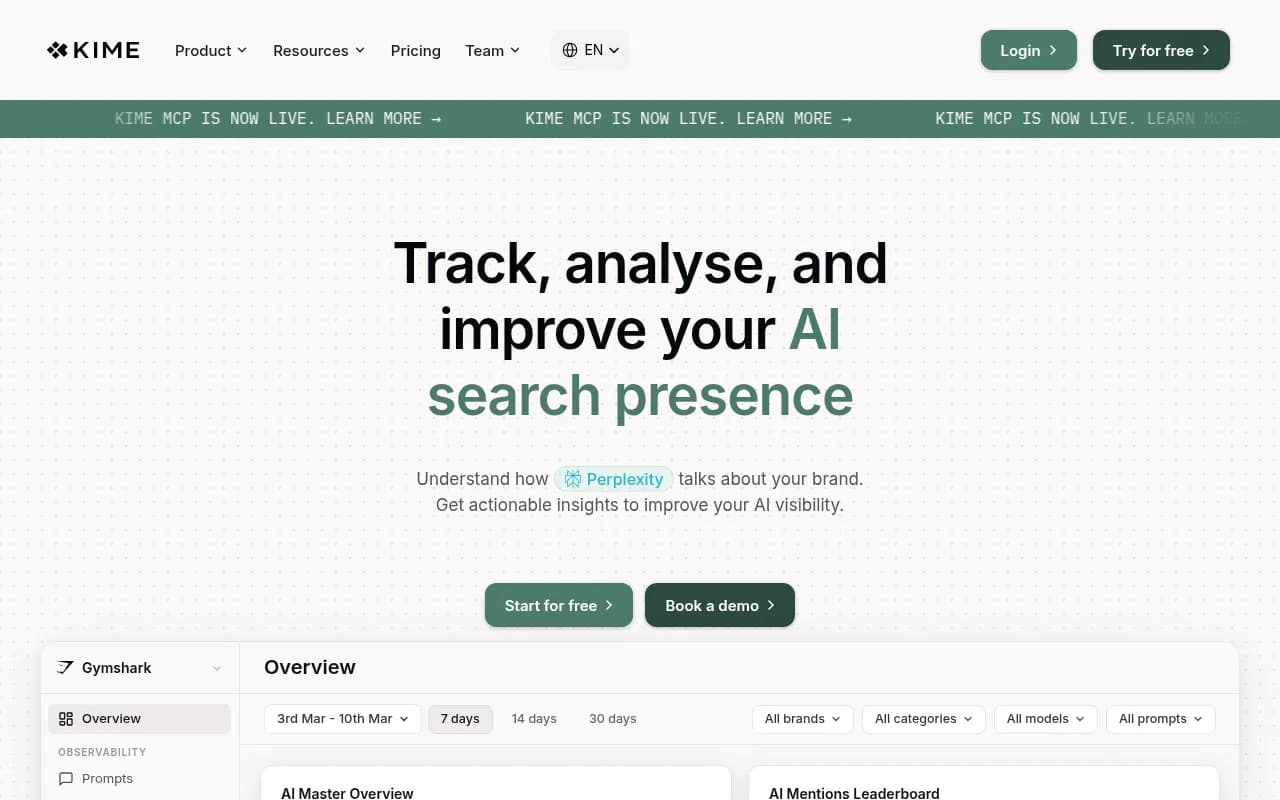
KIME tracks nine engines, reports sentiment and citation-level analytics, and shows which competitors advertise inside ChatGPT, with entry pricing listed at €99/month by the vendor. Indexly leans toward share of voice plus GEO content distribution across blogs, Reddit, and LinkedIn. Both rank themselves first in their own roundups, so read those rankings with a raised eyebrow and run a trial.

Bluefish
Profound's agency roundup describes Bluefish as purpose-built for brand safety and reputation monitoring across AI channels, with the tradeoff of no content generation and limited prompt customization. Relevant if risk is your main concern.

SEO suite add-ons
Ahrefs Brand Radar, Semrush's AI Visibility Toolkit, and SE Ranking's AI add-on make sense if you already live in those products. They are convenient, but prompt sets are often fixed and the AI-specific depth is thinner than in dedicated platforms.

Comparison table
| Platform | Best for | Sentiment | Acts on findings | Notes |
|---|---|---|---|---|
| Promptwatch | End-to-end monitoring plus fixes | Yes, per response, with heatmaps | Yes (Content Agent, Action Board) | Crawler logs, AI traffic, Reddit/YouTube/LinkedIn data |
| Profound | Enterprise intelligence | Yes, rebuilt in 2026 | Partly | Higher price point |
| Evertune | Perception and attributes | Yes | Limited | Perception-first |
| KIME | Multi-engine plus ad visibility | Yes | Agentic executions, MCP, API | From €99/mo per vendor |
| Indexly | Share of voice plus distribution | Yes | Content agents | Custom pricing |
| Bluefish | Brand safety | Yes | No content generation | Reputation focus |
| Otterly.AI | Budget monitoring | Basic | No | From $29/mo per KIME's roundup |
| Peec AI | Agencies, monitoring | Basic | Limited | Simple UI |
| Ahrefs / Semrush add-ons | Existing suite users | Light | No | Fixed prompt sets |
Prices come from vendor claims in third-party roundups and move often. Verify before you buy.
Where social listening still fits
AI visibility tools do not replace classic listening. Brandwatch and Talkwalker track mentions and sentiment across social, news, and communities, and Talkwalker is pitched at real-time reputation monitoring across global media. Brand24 now adds an AI chatbot share-of-voice score on top of its listening dashboard, with listed plans at $199, $299, and $399 per month (vendor figures, unverified here).
My take: if a crisis starts on X or in the press, listening tools catch it first. If the crisis is that ChatGPT keeps telling buyers your product lacks a feature it has, you need an AI visibility tool. Separately, Promptwatch Data shows X barely registers in AI citations at all, so a loud social problem may never reach AI answers, and the reverse is also true.
A practical evaluation process
Step 1: Build the prompt set before the demo
Write 30 to 50 prompts across three types: category ("best CRM for small agencies"), brand-specific ("is [Brand] worth it"), and comparison ("[Brand] vs [Competitor]"). Brand-specific prompts are where reputation problems show up. Run the same set in every trial.
Step 2: Check accuracy on a known fact
Pick three facts you know: pricing, a core feature, and your founding year. See how each tool surfaces wrong answers. Tools with accuracy flags save real time here.
Step 3: Separate engines
Ask each vendor to show sentiment and share of voice by engine and by country. If they can only give a blended number, that is a red flag given how differently engines cite sources.
Step 4: Follow the sources
For any negative or missing result, find the pages the engine cited. Then decide whether the fix is new content, a corrected third-party page, a stronger LinkedIn or YouTube presence, or a crawlability problem on your own site. A mention without a citation to your own domain often points to the last one.
Step 5: Decide who does the fixing
If you have a content team and the capacity, a monitoring tool plus your own workflow can work. If you do not, favour a platform with an action layer. Otherwise the dashboard becomes a monthly slide nobody acts on.
Reading the numbers without fooling yourself
A few habits keep reporting honest:
- Report share of voice per engine, then roll up with a stated weighting.
- Track sentiment as a trend. One response can swing on phrasing alone.
- Treat citations as a different metric from mentions. A mention names you; a citation links to a source.
- Watch for platform shifts. ChatGPT's use of the site: operator jumped from roughly 0.4% to 17% of fanout queries on August 8, 2026, per Promptwatch's report. Sudden moves in your numbers sometimes come from the engine, not from anything you did.
- Annotate your charts when you publish content or fix a page, so you can tell cause from coincidence.
Do you need an agency?
If you do not have the people to run prompts, interpret the data, and ship fixes, an agency that works on GEO can help. 1001 SEO Media offers AI search and GEO services and runs its own programmes on Promptwatch. For more tool options, the directory at bestgeosoftware.com lists GEO platforms by category.
Which one should you pick?
- You want monitoring and execution in one place: Promptwatch.
- You have enterprise procurement and a large reporting remit: Profound or Scrunch AI.
- Your concern is perception and attributes: Evertune.
- Brand safety is the main worry: Bluefish.
- You just want a cheap first look: Otterly.AI or Peec AI.
- You already pay for Ahrefs or Semrush: try their add-ons first, then reassess.
Whatever you choose, run the same 40 prompts through a two-week trial and compare what each tool tells you about your weakest engine. The one that explains why you are weak there, and helps you change it, is the one to keep.