Key takeaways
- Product pages became ChatGPT's most-cited content type in July 2026, at roughly 32.8% of daily citations, up from about 18% in March, according to Promptwatch's citation type data. Your PDPs are now a visibility asset, not just a checkout page.
- ChatGPT only surfaces about 5 sources per web search response, half of what Google AI Overviews and Perplexity show, per Promptwatch's source-count analysis. Fewer slots means more competition for every citation.
- Ads started showing up in ChatGPT Search in late May 2026 and now appear in around 20-30% of responses, so tracking who's buying placement on your category terms matters as much as tracking organic mentions (Promptwatch's ad frequency data).
- Feed-level tools (Ranketta, Alhena AI, Peec AI's shopping module) matter more for e-commerce than generic brand-mention trackers, because AI shopping answers are built from product feeds, not blog posts.
- Pricing across the category averages around $337/month, but usable e-commerce plans start closer to $30-100/month and scale into the thousands for enterprise catalogs.
Why this category looks different for e-commerce
Most AI visibility guides are written for B2B SaaS brands trying to get name-dropped in a ChatGPT answer about "best project management tools." E-commerce is a different game. Shoppers ask AI assistants things like "what's a good pair of running shoes under $150" and get back a shortlist of actual products with prices, not a paragraph with a brand name buried in it. If your SKU isn't structured correctly, you don't get partial credit. You just don't show up.
That's the reason a generic GEO tool built for tracking brand sentiment doesn't map cleanly onto e-commerce needs. What you actually want is visibility into three things: whether your product pages are getting cited, whether your catalog data is clean enough for AI shopping features to pull from, and whether competitors are buying ad placement on the exact prompts your customers are typing.
What actually moved in 2026
A few shifts changed how e-commerce brands need to think about this:
Product pages overtook listicles as the most-cited format in both ChatGPT Search and Google AI Overviews by late July 2026, per Promptwatch's AI Overviews citation type breakdown. That's a real change from earlier in the year, when "best of" roundups dominated. It means your own PDP, with clear specs, accurate pricing, and current availability, is now competing directly for citation slots that used to go almost exclusively to third-party listicle sites.
Ads arrived in ChatGPT Search for the first time on May 27, 2026, and by early July were appearing in over 30% of responses on some days. Most of those ad-bearing responses, about 73%, come from ordinary organic prompts rather than brand or comparison searches. If a competitor is bidding on "best wireless earbuds" and you're only tracking organic citations, you're missing half the picture.
And citation inventory is scarce and uneven across engines. ChatGPT cites roughly 5 sources per response, Google AI Overviews and Perplexity cite about 10, and Microsoft Copilot swings wildly, sometimes under 2, sometimes near 17. This matters for tool selection: a platform that only tracks ChatGPT is watching the tightest, most competitive channel while ignoring the more forgiving ones.
What to look for in an e-commerce AI visibility tool
Before ranking anything, here's the checklist worth applying to any platform you're evaluating:
- Product-level or SKU-level tracking, not just brand-level share of voice
- Feed enrichment or at least feed auditing, since AI shopping answers pull from structured data, not prose
- Coverage across ChatGPT, Google AI Overviews/AI Mode, Perplexity, and ideally Gemini and Copilot
- Ads visibility on competitor and category prompts, not just brand-specific queries
- Some path from insight to action: content generation, feed fixes, or a prioritized to-do list, rather than a dashboard you have to interpret yourself
The ranked list
1. Promptwatch
Promptwatch is built as an end-to-end AI visibility and GEO platform rather than a pure tracker, and that distinction matters a lot for e-commerce teams who need to act on findings, not just admire them. It monitors ChatGPT, Gemini, Claude, Perplexity, Grok, DeepSeek, Copilot, Mistral, Meta Llama, and both Google AI Overviews and AI Mode, using real UI data rather than APIs, which matters because shopping cards and citations often differ from what an API call returns.

For e-commerce specifically, its ChatGPT Shopping and Ads Radar tracks product recommendations and sponsored placements, which is exactly the ads-on-organic-prompts problem described above. Its crawler logs (Agent Analytics) show when ChatGPTBot, ClaudeBot, PerplexityBot, and 400+ other bots hit your PDPs and whether they encounter errors, connecting the technical "why" to your visibility scores. Content Agents can then plan, write, and publish GEO-optimized product content directly to Webflow, Framer, or WordPress, and Unified Actions turns all of it into a prioritized to-do list rather than a raw dashboard.
It's used by 1,840+ brands and agencies, rated 4.7/5 on G2, and its dataset of 4.5 billion+ citations has been cited by outlets including the Wall Street Journal and Axios. Pricing starts at $95/month for a single site with 50 prompts, scaling to $245/month for the Professional tier that adds shopping insights and state/city-level tracking, useful for multi-location retailers.
2. Ranketta
Ranketta is the closest thing to a pure-play e-commerce GEO tool on this list. It's the only platform combining SKU-level tracking with actual feed enrichment: rewriting weak titles and descriptions, mapping products to Google's taxonomy, filling missing GTINs, and flagging broken fields like condition or currency, each with a confidence score. It exports cleaned feeds straight to Google Merchant Center, Shopify, Heureka, and generic XML/JSON. Plans start at €29/month for pure tracking and scale to €449/month for the Scale tier with 45,000 enrichment credits and 15 articles a month. It claims 1,200+ e-commerce customers and a 4.9/5 on G2, though it's a much younger company (founded 2025) than most of the enterprise names on this list.
3. Peec AI
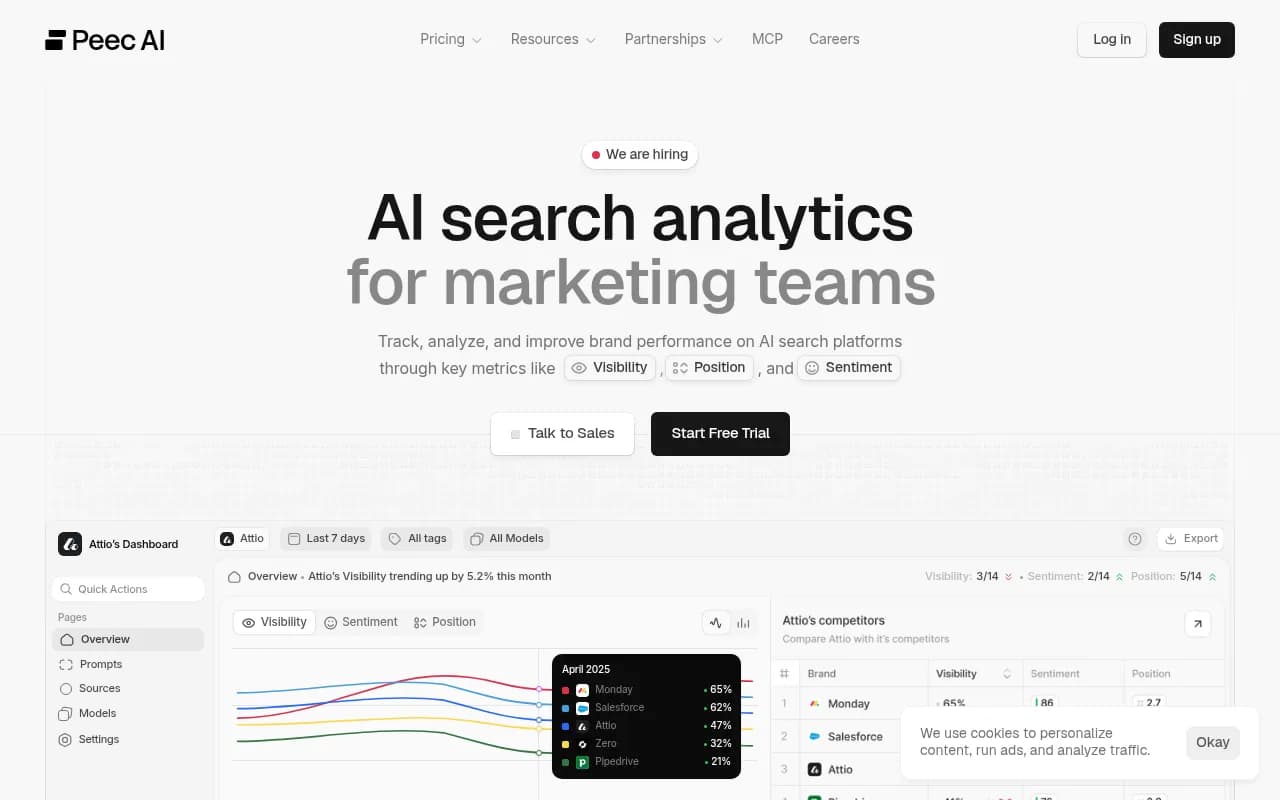
Peec has a dedicated AI Shopping Analytics module that checks the price AI models quote against your actual catalog price, catching stale citations before a customer shows up expecting a discount that no longer exists. Onboarding is fast (catalog live in minutes, no file upload required for the basic path), and the UI is clean with unlimited seats across plans. It's largely report-only though, with no content-fix layer, so pair it with a writing tool if you go this route. Pricing sits around $245/month for Pro and $495/month for Advanced, though sources vary on exact figures, so confirm on their pricing page before committing.
4. AthenaHQ
Athena has a genuinely useful permanent free tier ($25 in credits, covering ChatGPT, Perplexity, AI Overviews, Gemini, and Claude), which makes it a reasonable first stop for a small DTC brand testing the waters. Its Starter tier at $295/month (or $245 billed annually) covers 11 models with unlimited seats. It's positioned well for Shopify brands chasing revenue attribution but doesn't do feed enrichment, so you'll still need a separate tool or manual process to fix what it finds.

5. Alhena AI
Alhena is built specifically for ecommerce catalogs and is worth a look if you want visibility tracking that speaks the language of PDPs and merchant feeds from day one, rather than a generic brand tracker retrofitted for retail.
6. Yotpo Discover
Yotpo's angle is pairing AI visibility with the review and UGC data it already collects, on the theory that generative engines weigh authentic sentiment when deciding what to recommend. If you're already a Yotpo customer for reviews, Discover is a logical add rather than a separate integration project.
Yotpo Discover
7. Scrunch AI
Scrunch pairs multi-LLM monitoring with site audits and AI content delivery, and its Core plan at $250/month covers 4 engines and 125 prompts across 3 personas. Enterprise unlocks 9 engines including Claude, Gemini, and Grok. It's a strong enterprise pick generally, though not built around product feeds the way Ranketta or Alhena are.

8. Otterly.AI
Otterly's Lite plan at $29/month is genuinely useful for a small brand that just wants daily tracking across ChatGPT, AI Overviews, Perplexity, and Copilot without committing to anything expensive. The jump from Lite to Standard ($189/month) is steep, 6.5x with no middle tier, which is a fair complaint if you outgrow the entry plan quickly.
9. Profound
Profound is a strong enterprise research and monitoring tool but doesn't do product feed or catalog enrichment, so treat it as a monitoring layer to pair with an execution tool rather than a complete e-commerce solution. Starter is $99/month billed annually, ChatGPT only, capped at 50 prompts.
Comparison table
| Tool | Starting price | Feed enrichment | Model coverage | Best for |
|---|---|---|---|---|
| Promptwatch | $95/mo | Content Agents + Unified Actions | ChatGPT, Gemini, Claude, Perplexity, Grok, Copilot, AI Overviews, AI Mode + more | Brands that want tracking and actual content/technical fixes in one platform |
| Ranketta | €29/mo | Yes, dedicated feed enrichment | 5-9 engines by tier | Pure-play product feed cleanup |
| Peec AI | ~$245/mo | Price-mismatch detection only | ChatGPT, Perplexity, AIO, Copilot | Catching stale AI-quoted prices |
| AthenaHQ | Free tier / $295/mo | No | 5-11 models | Shopify brands starting from zero |
| Alhena AI | Custom | Catalog-focused tracking | Multiple | Catalog-first e-commerce teams |
| Scrunch AI | $250/mo | No | 4-9 engines | Enterprise audits and personas |
| Otterly.AI | $29/mo | No | 4 core engines | Budget-conscious small brands |
| Profound | $99/mo (annual) | No | ChatGPT only at entry | Enterprise research, not e-commerce execution |
Getting your feed ready before you buy anything
No visibility tool matters if your product data can't be read by AI shopping features in the first place. OpenAI's Agentic Commerce Protocol requires specific fields: a stable item_id, a title under 150 characters without all-caps, plain factual description text (no marketing fluff, up to 5,000 characters), ISO currency codes for price, and an availability enum (in_stock, out_of_stock, pre_order, backorder, unknown). A standard Google Shopping feed will not work as-is here; it's a genuinely different schema.
On-page schema.org markup should carry name, description, image, brand, and an Offer block with price, currency, and availability. GTIN absence is a known cause of invisibility specifically in Perplexity, and strongly recommended everywhere else too.
The most common mistake brands make is treating GEO like a keyword project. AI models evaluate structured attributes, PDP content quality, and entity signals across the web, not isolated phrases. The second most common mistake is overproducing generic blog content while under-optimizing the PDPs and collection pages that actually carry commercial intent.
Reddit, YouTube, and review signals
ChatGPT is what Promptwatch calls a "Reddit specialist": 5.19% of its citations point to Reddit, more than 20 times its next-best social source, according to Promptwatch's social media citation breakdown. If your product category gets discussed on Reddit at all, that's worth monitoring and, where appropriate, participating in authentically. Google AI Overviews and Grok lean toward YouTube instead, at roughly 4-5% citation share each. X barely registers anywhere, under 0.25% on every engine tracked, so don't over-invest there for AI visibility purposes even if it's still useful for other reasons.
Final recommendation
If you're running a catalog with more than a handful of SKUs and want one platform that tracks visibility, explains the crawler and technical reasons behind gaps, and actually generates and publishes fixes, Promptwatch is the strongest all-around pick, particularly given its shopping and ads tracking. If your budget is under $100/month and your main pain point is specifically feed quality, Ranketta is worth a serious look given how narrowly it's built for that exact problem. Everything else on this list is either a good monitoring layer to pair with a separate execution tool, or a fine starting point if you're not ready to commit budget yet.
For a broader look at GEO software beyond the e-commerce angle, the directory at bestgeosoftware.com is a reasonable place to keep browsing.