Key takeaways
- ChatGPT has no results page, so "rank tracking" really means running a fixed prompt set on a schedule and recording mentions, citations, and position within the answer.
- Single snapshots lie. Rework cites SparkToro research in which the same brand list in the same order appeared under 0.1% of the time across 2,961 prompts run 60 to 100 times each.
- Platform changes can move your numbers overnight. Promptwatch Data shows citations per search-enabled response fell from about 6.4 to roughly 4.7-4.9 after the GPT-5.3 rollout on March 4, 2026.
- Pick a tracker by how it collects answers (real interface or API), how often it re-runs prompts, and whether it helps you act on what it finds.
- Most ChatGPT rank tracker listicles online are written by vendors, including the ones ranking themselves first. Treat "best overall" claims with suspicion and trial two tools on your own prompts.
Why "ChatGPT rank tracking" is a slightly misleading phrase
Google rank tracking gives you a number: you're #4 for a keyword. ChatGPT doesn't work that way. It writes a synthesized answer, mentions some brands, cites some pages, and does something different next time you ask.
So what these tools actually do is sampling. They run your prompts repeatedly, log whether your brand shows up, where in the answer it appears, which sources get cited, and how your competitors fare. Done well, that gives you a share-of-voice trend. Done badly, it gives you a pretty chart of noise.
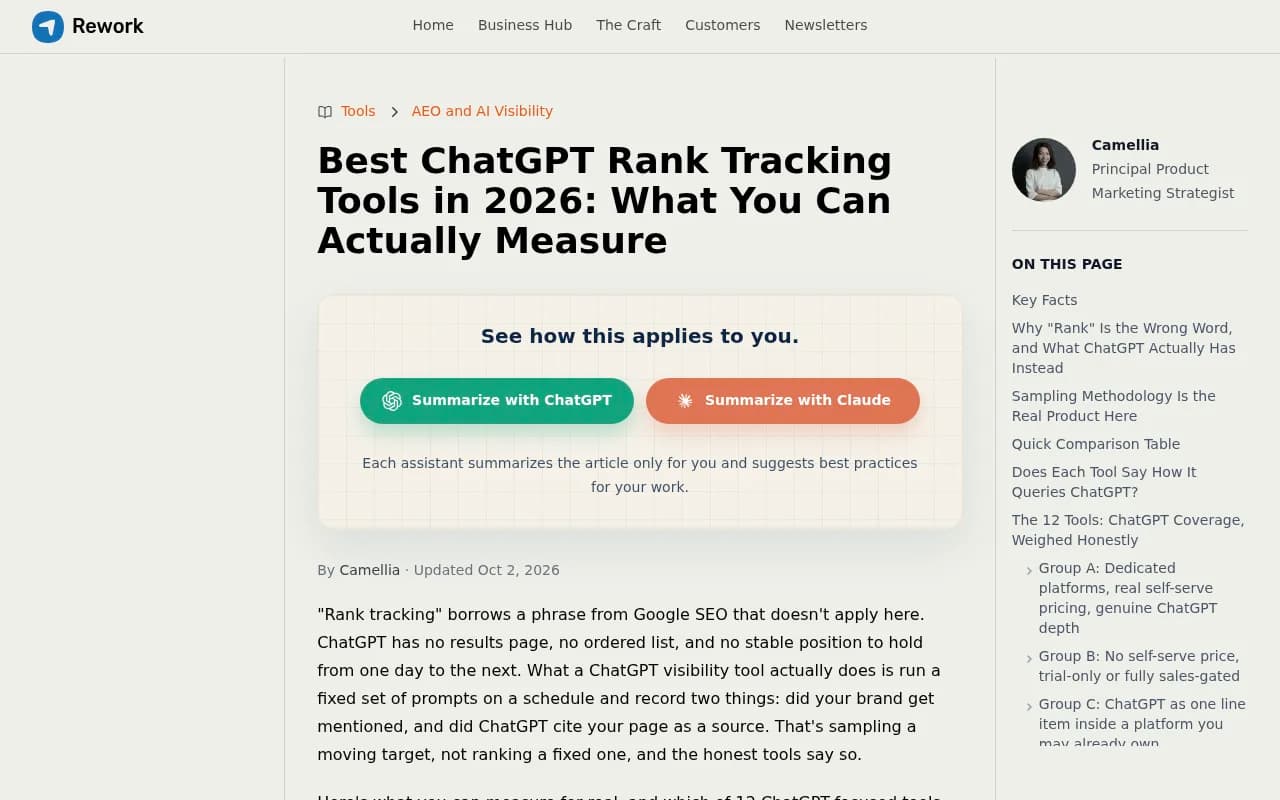
The Rework guide says this bluntly, and I agree with it. The vendors that admit they sample are the ones I'd trust more.
Why snapshots mislead you
Two pieces of Promptwatch Data explain why one-off checks are close to useless.
First, citation behaviour is controlled by the platform. In Promptwatch's citation drop report, the week before the GPT-5.3 rollout on March 4, 2026, ChatGPT cited about 6.4 sources per search-enabled response. By late March that had settled around 4.7 to 4.9, roughly 27% fewer citation slots, hitting GPT-5.3, GPT-5.4, and GPT-5-Mini within a day. If your tracker only tells you "you were cited less," you can't tell whether you lost ground or everyone did. Track citations per response alongside your own numbers.
Second, answers are crowded. In Promptwatch's unique domains report (Sep 28 to Oct 4, 2026), 47.6% of responses cited 10 or more domains, and 66.1% cited at least 8. For organic prompts like "best project management software for small teams," 52.5% cited 10 or more. For brand-specific prompts like "is Asana good for small teams," only 21.3% did. One prompt tells you very little. You need many prompts, tracked over time, and you should watch position and description, not just whether you were mentioned.
Query fanouts change what you should track
ChatGPT doesn't search the web with your exact prompt. A single prompt can trigger several separate searches, and those searches are short and keyword-like. Promptwatch's query fanout data measured average fanout query length falling from about 117 characters in December 2025 to about 53 characters by April 2026. On August 8, 2026, ChatGPT also began using the site: operator at scale, jumping from about 0.4% to about 17% of fanout queries. A prompt set you wrote last quarter may be testing behaviour that no longer exists.
What to check before you buy
Forget feature checklists for a minute. Five questions separate the tools.
- How are answers collected? Real ChatGPT interface scraping and API calls can produce different answers and different citations. The interface is what your customers see.
- How often are prompts re-run? Daily is better than every 48 hours, which is better than weekly. Noise needs volume.
- What does the cheapest ChatGPT-capable plan include? Many tools advertise one price but gate ChatGPT behind a higher tier.
- Does it show citations and sources, or just mentions? Mentions without sources leave you guessing what to fix.
- Does it help you act? A dashboard that says you're invisible is the easy half of the job.
The 12 ChatGPT rank trackers worth shortlisting
A note on method: I'm drawing on vendor documentation and the published reviews we could verify, not a fresh lab test of every product. Prices change often, so confirm each one on the vendor's own pricing page before you commit.
1. Promptwatch
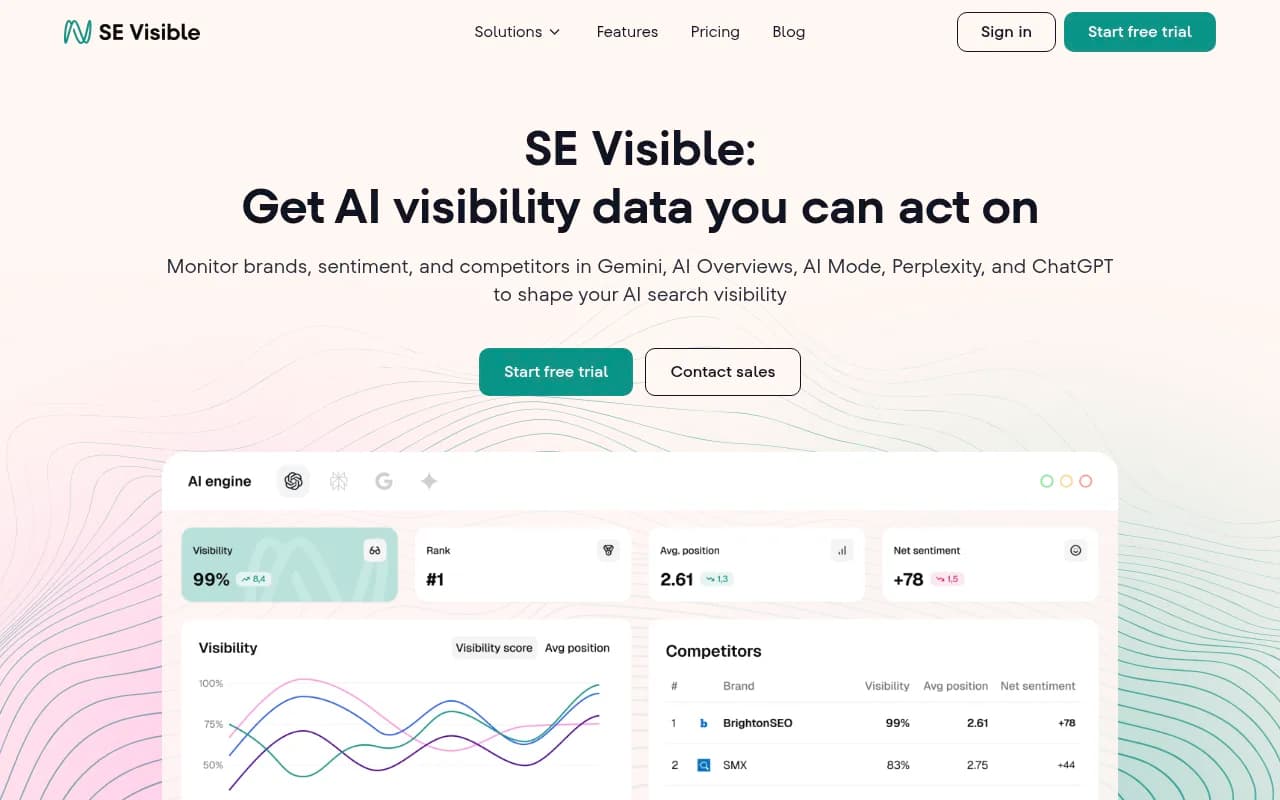
Promptwatch is the one I'd put first for teams that want to fix visibility rather than just watch it. It collects from the real ChatGPT interface (plus Google AI Overviews, AI Mode, Gemini, Perplexity, Copilot, Claude, and others) by country and language, and gives you visibility score, share of voice, position, and sentiment. What sets it apart from pure trackers: IP-verified AI crawler logs that show whether ChatGPT's bots are actually reading your pages, prompt volumes and difficulty, query fanouts, and visitor analytics that tie AI traffic to conversions. Its Content Agent and Action Board then turn gaps into articles and to-dos, and published pages get tracked for crawls, citations, and clicks.
Plans start at $95/month (Essential, 50 prompts, all models) and go to $579/month for Business, with a free Explore tier covering 10 ChatGPT prompts. Confirm on promptwatch.com/pricing. Disclosure: 1001 SEO Media, which publishes this site, uses Promptwatch.

2. Peec AI
Peec AI is a clean, popular prompt tracker with good suggestions for what to monitor. It's a solid choice if you mostly need visibility, position, and competitor share of voice without crawler logs or content workflows.

3. Otterly.AI
Otterly.AI is the budget pick. It tracks brand mentions and citations across ChatGPT and other engines at a low entry price. Fine for a small team that wants a baseline; limited once you need to know why you're not cited.

4. Profound
Profound is an enterprise-grade monitoring platform with deep analytics. It's powerful and priced accordingly. Expect a sales process, and weigh it against tools that include execution features.

5. Semrush AI Visibility Toolkit
If your team already lives in Semrush, the AI Visibility Toolkit is convenient. Prompt sets are less flexible than in dedicated trackers, but having AI data beside classic SEO data saves tab-switching.
6. SE Ranking Visible
SE Ranking Visible extends a familiar rank tracker into AI answers. A reasonable fit for agencies and in-house teams already using SE Ranking.
7. Orchly
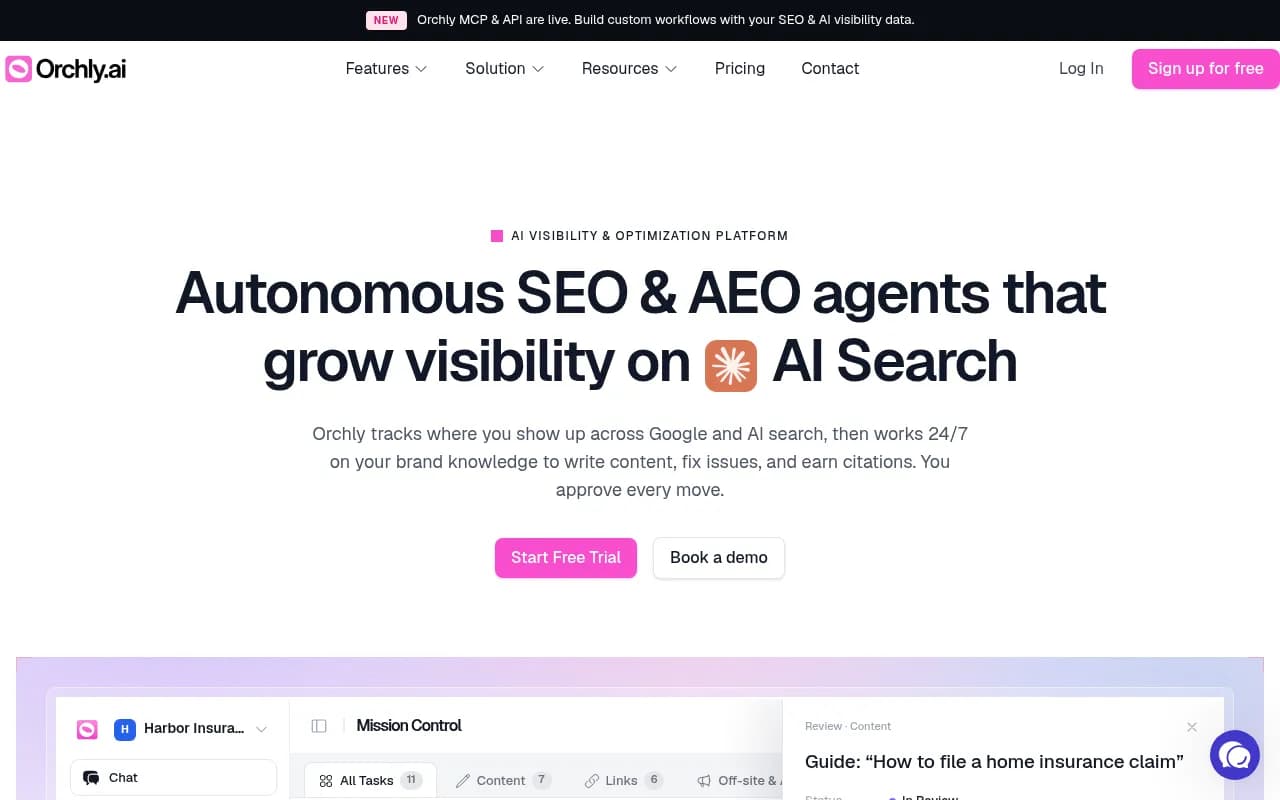
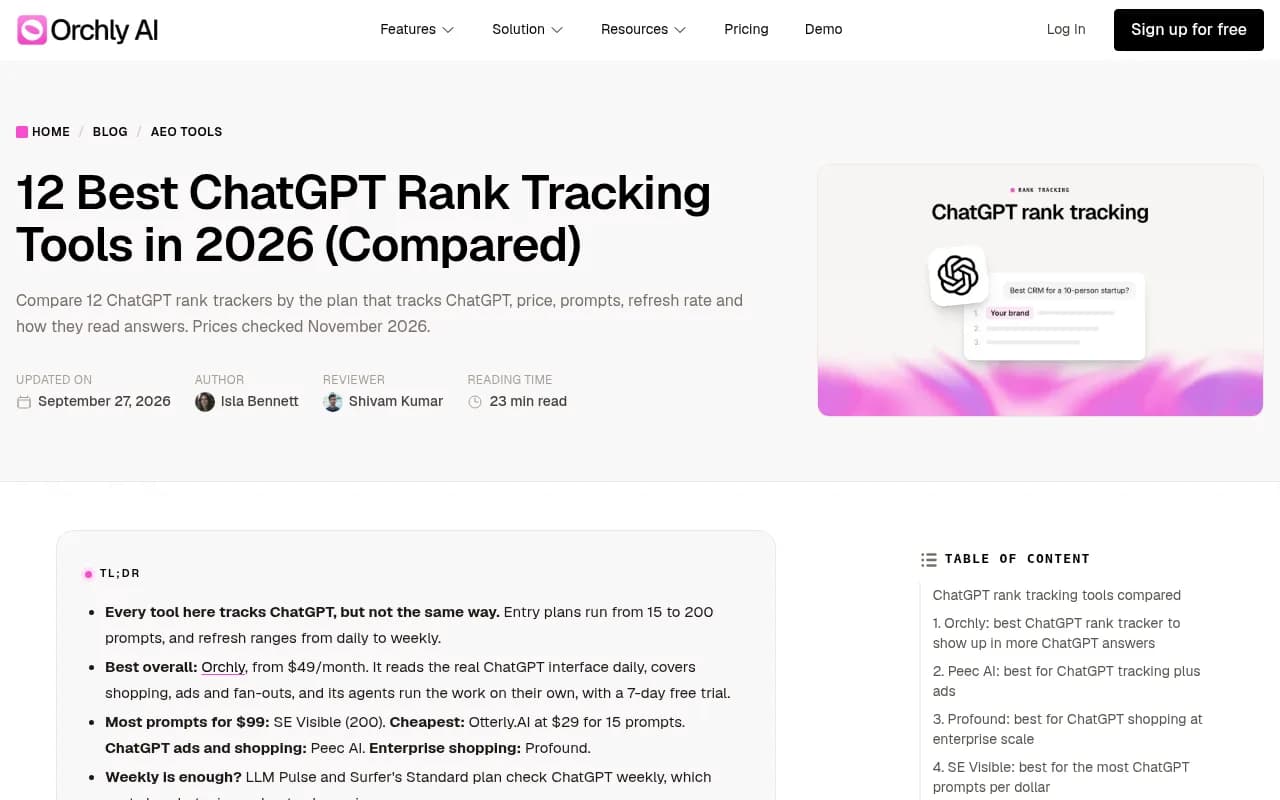
Orchly says it runs prompts through the real ChatGPT interface daily from different locations, and its Essential plan at $49/month covers 25 prompts, per its own comparison page. Note that Orchly publishes that comparison itself, so its ranking of itself should be read with that in mind.
8. LLM Pulse
LLM Pulse is a dedicated AI visibility analytics platform built around tracking and reputation. It's a monitoring-focused option with a clear dashboard.

9. Scrunch
Scrunch pairs monitoring with agent-ready pages for your site. A decent fit for agencies and brands that want to serve AI crawlers a cleaner version of their content.

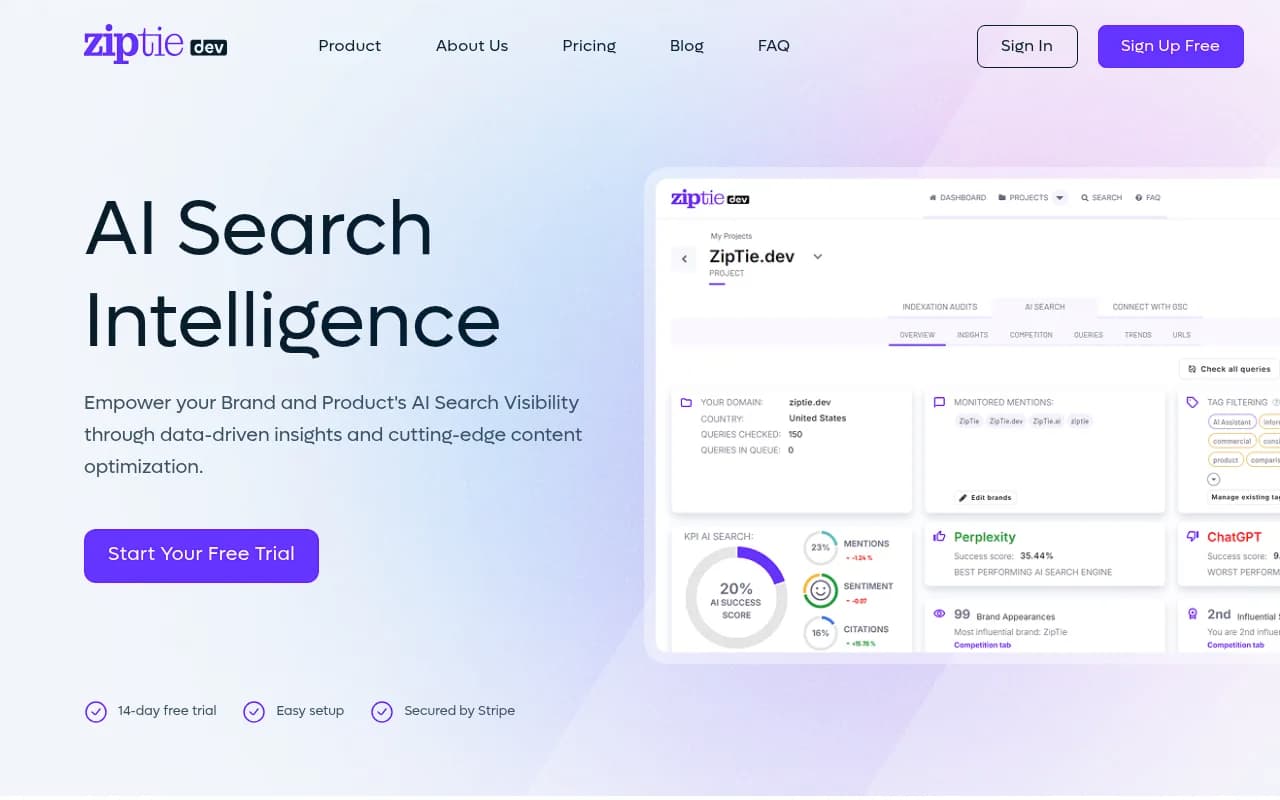
10. ZipTie
ZipTie is a focused, no-frills tracker. It's worth a look if you want a narrow tool rather than a suite.
11. Similarweb AI Brand Visibility
Similarweb's AI visibility module makes sense if you already pay for Similarweb's traffic intelligence and want AI visibility inside the same suite.
Similarweb AI Brand Visibility
12. Surfer SEO
Surfer started as a content optimizer and now adds AI visibility tracking. It's best for content teams who want tracking next to their editor.

Side-by-side comparison
| Tool | Best for | Collects from real UI | Goes beyond monitoring | Starting point |
|---|---|---|---|---|
| Promptwatch | Teams that want to fix gaps, not just see them | Yes | Crawler logs, content agent, action board, traffic analytics | Free tier; paid from $95/mo |
| Peec AI | Clean prompt tracking | Check vendor | Suggestions | Check vendor |
| Otterly.AI | Tight budgets | Check vendor | Limited | Low entry price |
| Profound | Large enterprises | Check vendor | Analytics depth | Sales-led |
| Semrush toolkit | Existing Semrush users | Check vendor | SEO suite integration | Add-on pricing |
| SE Ranking Visible | Agencies using SE Ranking | Check vendor | SEO suite integration | Check vendor |
| Orchly | Daily tracking on a small prompt set | Yes (per vendor) | Content features | $49/mo (vendor-stated) |
| LLM Pulse | Analytics-focused monitoring | Check vendor | Reputation views | Check vendor |
| Scrunch | Agent-ready site pages | Check vendor | Agent pages | Check vendor |
| ZipTie | Focused tracking | Check vendor | Minimal | Check vendor |
| Similarweb | Similarweb customers | Check vendor | Traffic intelligence | Suite pricing |
| Surfer SEO | Content teams | Check vendor | Content editor | Check vendor |
I've marked "check vendor" where I couldn't verify a detail from a primary source. That's deliberate. A confident table full of guessed prices would be worse than an honest gap.
About the "AI recommends these tools" lists
Some roundups, like the one on Mencoro, show how often AI assistants recommend each tracker (Otterly.AI at 83.3% in their sample, for example). That tells you which brands have strong AI visibility, which is a fun irony, but it isn't a measure of tool quality. A tool can be widely recommended and still be wrong for your budget.
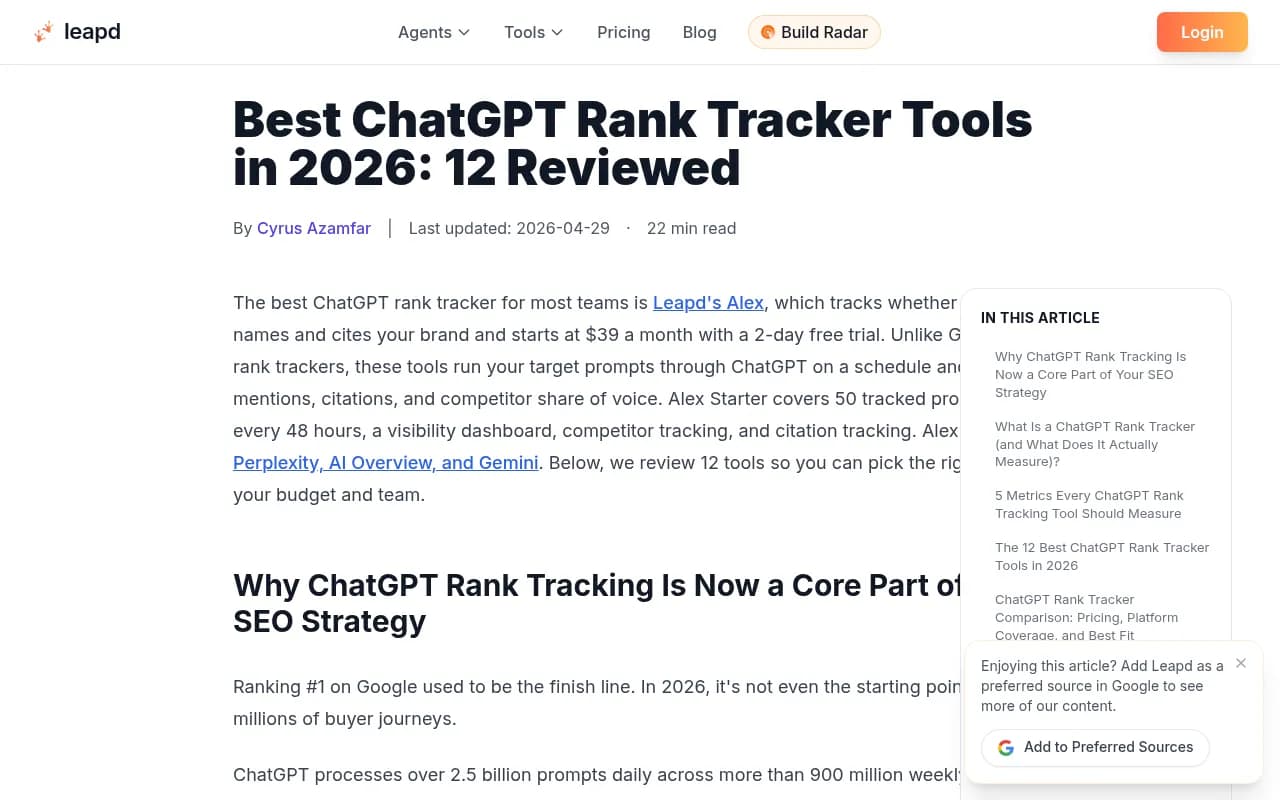
Similarly, vendor roundups from Leapd, Orchly, and others put their own product first. Leapd's list puts Alex first, at $39/month for 50 prompts every 48 hours, with a 2-day trial. That's a legitimate budget option, but it's still a vendor's opinion of itself.
How to run your own two-week test
Here's the process I'd use before paying for anything annual.
- Write 30 to 50 prompts across three types: organic ("best X for Y"), brand-specific ("is [your brand] good for Z"), and competitor comparison ("[you] vs [competitor]"). The Promptwatch Data above shows these behave differently.
- Run the same set in two trackers for 14 days.
- Compare mention rates, not single answers. If the two tools disagree wildly, find out why: collection method and refresh rate are the usual culprits.
- Check the cited sources. If a tool can't show you which pages ChatGPT cited, you'll struggle to act.
- Note citations per response over time so you can spot platform-wide shifts.
- Put the cost per tracked response next to the price. Cheap plans with few prompts and low refresh rates are expensive per usable data point.
Which tool for which team
- Want to fix visibility, not just report it: Promptwatch.
- Small budget, just need a baseline: Otterly.AI or a low-cost plan like Orchly or Leapd.
- Already on an SEO suite: Semrush, SE Ranking Visible, or Similarweb.
- Enterprise reporting at scale: Profound.
- Content team living in an editor: Surfer.
If none of these fit, the directories at bestgeosoftware.com and ai-rank-tools.com list many more options, including smaller trackers like Rank Prompt and Trakkr.
What the data should change in your strategy
Tracking is only useful if it changes what you publish. Promptwatch Data on content types cited by ChatGPT shows product pages at 22.4% of citations (Sep 28 to Oct 4, 2026), followed by landing pages and listicles. And content half-life data shows that landing pages and docs stay cited longest, while news lost half its pages within 36 days. If your tracker shows you're not cited, those are the page types to build or refresh first.
Also keep in mind that sources shift. reddit.com's share of ChatGPT citations fell from about 4% to 0.5% on August 14, 2026, so a Reddit-heavy strategy built on 2025 assumptions needs a second look. For more reports like these, browse the Promptwatch Data hub.
Bottom line
Pick a tracker that collects from the real ChatGPT interface, re-runs prompts often, shows citations, and helps you do something with the findings. Trial two on the same prompts for two weeks, compare mention rates rather than single answers, and ignore any list that ranks its own author first without showing its work.