Scrunch Review 2026
Scrunch is an AI customer experience platform that monitors brand visibility across ChatGPT, Perplexity, Google AI Overviews and more, audits your site for AI readability, and serves agent-optimized pages through its AXP. Built for enterprise brands and agencies.
Key takeaways
- Scrunch pairs AI search monitoring with an unusual extra: Agent Pages, which serve a stripped-down version of your site to AI agents without touching the human experience.
- It lacks the end-to-end optimization loop that Promptwatch provides, including IP-verified crawler logs on every plan, a Content Agent with CMS publishing, an Action Board, Reddit/YouTube/LinkedIn citation tracking and prompt volumes with difficulty scoring.
- Core at $250/mo covers only 4 LLMs and caps you at 125 prompts. Claude, Gemini, Grok, AI Mode and the AXP are reserved for custom-priced Enterprise.
- G2 reviewers complain about a confusing UI overhaul, export limits and data depth, plus a sales process where tier restrictions were not clear upfront.
- Best for enterprise teams and agencies with budget for a sales-led deal and an appetite for the agent-delivery idea.
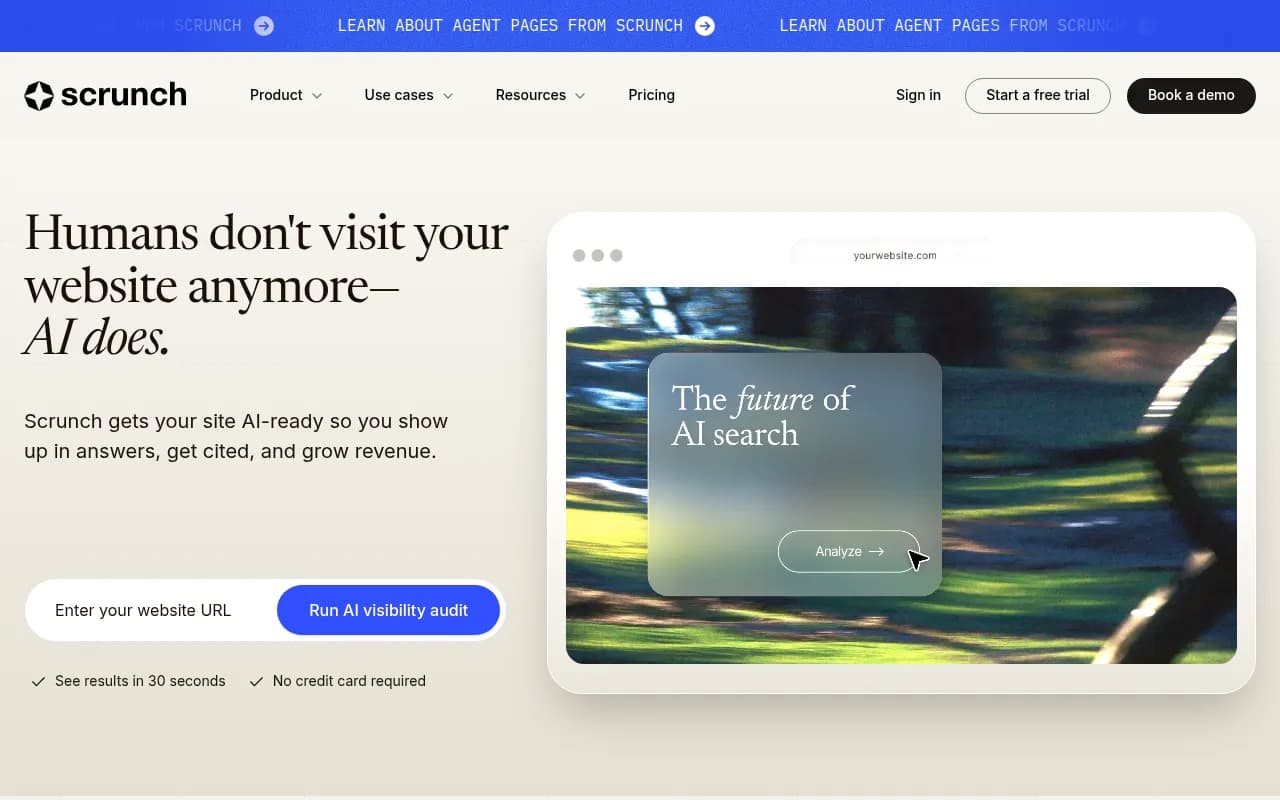
Scrunch (scrunchai.com, now also at scrunch.com) is an AI search visibility platform that started life as a monitoring tool and has since repositioned itself as an "AI Customer Experience Platform." The pitch on the homepage is blunt: humans do not visit your website as much anymore, AI does. So the product watches what AI systems say about your brand, audits how readable your site is for them, and then, in its most distinctive feature, delivers a separate, lighter version of your pages directly to AI agents.
The company drew early press, including a TechCrunch piece in March 2025 and an Axios Pro write-up in July 2025. It claims more than 500 brands and agencies as customers and lists Akamai as a flagship case study, with a claimed 364% increase in brand presence for non-branded prompts. The company's X profile bio now reads "Scrunch is now a @Sitecore company," which points to an acquisition, though I could not find a formal announcement, so treat that as something to confirm directly with the vendor.
The audience is clear from the pricing structure: enterprise marketing and web teams, plus agencies running AI visibility for clients. That focus shows both in what Scrunch does well and in where smaller teams will feel squeezed.
Key features
Prompt monitoring and citations. This is the core of the product. You define prompts, Scrunch runs them across supported models, and you see whether your brand appears, how it is described, and which sources AI cites. The Core plan gives you 125 unique prompts and 5,000 responses a month, with one country, one language, one persona and five competitors. Enterprise lifts those limits and adds unlimited countries.
- Sentiment analysis on how your brand is described
- Funnel-stage tagging so you can separate awareness prompts from purchase-intent ones
- A citations view showing which domains shape AI answers in your category
- Competitor benchmarking, five competitors on Core
- A reporting dashboard, with a Looker Studio connector on Enterprise only
Signals and insights. Scrunch auto-detects changes in your visibility and explains why they matter, with recommended actions. This is a useful nudge. Still, the recommendations stay at the level of guidance. Reviewers, including a Scalenut write-up, note that Scrunch shows you the gaps and leaves the fixing to your team. A dashboard, as Scrunch's own blog admits, is not a strategy.
AI Search Trends. A newer module that tracks what people are asking AI, approximate prompt volumes and topic-level share of presence. On Core it is limited to 3 topics. G2 reviewers say it is thin for niche industries, which is typical for a first-generation feature built on estimated demand.
Agent Traffic. Scrunch analyzes AI bot and agent traffic hitting your website, and this is included on Core. It is a genuine differentiator against pure prompt trackers, since it connects what AI says to what AI actually fetches. Depth matters here, and platforms built around IP-verified crawler logs with crawl-to-citation paths per page go further.
Site optimization and audits. Core gets 5 site audits a month and a 25-page sitemap limit. Enterprise gets full-site audits. The audits assess how well AI systems can consume your pages. Core also includes one page optimization per month and "Basic" content generation, which is a modest allowance. Enterprise gets "Advanced" content generation, but this is not a content pipeline with CMS publishing to Webflow, Framer or WordPress.
Agent Experience Platform (AXP) and Agent Pages. This is the headline. AXP detects AI agents visiting your site and serves them a token-light, semantically structured version of each page. The homepage demos it with token reductions above 90 percent on sample pages. The human version of the site is untouched. It is clever, and it is a different bet from most competitors, who focus on telling you what to change on your own pages. The trade-offs are that it is Enterprise-only and custom-priced, and the broader industry is still debating how much agent-specific delivery actually moves citations. Serving different content to bots also deserves a careful look from your SEO team.
Product Observability and shopping. Enterprise includes product-level AI search performance, useful for ecommerce and retail brands that want to see how products show up in AI recommendations.
Query fan-out. Limited on Core, fuller on Enterprise. Seeing the sub-searches an AI model runs behind a prompt helps with content planning. Competitors that put fan-outs and prompt difficulty on every tier make this easier to use day to day.
Data access. Query and Advanced API access, MCP access (custom) and CLI access via email and Slack are Enterprise features. Core users get none of them.
Who is it for
The sweet spot is a mid-market to enterprise brand with a dedicated web, SEO or digital strategy team. Think a director of web operations at a large software or infrastructure company who needs to report AI presence to executives, wants SAML SSO, and is happy to have a forward-deployed engineer help with onboarding. Scrunch's own enterprise pitch is built around SOC 2 Type II, role-based access and 6M+ citations and 1.5M+ prompts analyzed weekly.
Agencies are the second audience. Scrunch publishes an agency track, with Agency Core listed at $500/mo for 250 prompts, 10,000 responses and unlimited users (I could not re-verify the agency tab, so confirm current numbers). Agencies running 10 or more client brands will hit the per-brand structure quickly.
Who should skip it? Solo consultants and small teams. At $250/mo for one brand, 125 prompts and four models, it is expensive for what you get, a point Scalenut also makes. Teams who want a tool that writes and publishes content for them will also be disappointed. And anyone who needs Claude, Gemini, Grok or Google AI Mode coverage has to go through a sales conversation first.
Integrations and ecosystem
Integrations are thin on lower tiers. Core has Google SSO and a reporting dashboard. Looker Studio, API access, MCP and CLI are Enterprise only, as are SAML/OIDC SSO and Slack support. There is no official GitHub or Discord presence that I could find. The app lives at app.scrunchai.com, and the company publishes a Guide to AI search, how-tos and a research arm called Scrunch Labs.
Export is a recurring complaint. G2 reviewers say there is no SVG graphics export, no mass export, and that some features cannot be exported at all, which makes client reporting clumsy. Agencies in particular should test this during the trial.
The possible Sitecore tie-up could matter for the ecosystem, since deeper CMS and DXP integration would be a natural next step. Nothing is confirmed, so don't buy on that assumption.
Pricing and value
- Core (brand): $250/mo per brand. 125 prompts, 5,000 responses a month, 4 LLMs (ChatGPT, Perplexity, Google AI Overviews, Copilot), 1 country, 1 language, 1 persona, 5 competitors, 5 site audits a month, 5 user licenses, email support, self-serve onboarding. Extra seats are reported at $25/mo each or $75/mo for five.
- Enterprise (brand): custom. 9 LLMs (adds Claude, Gemini, Meta AI, Google AI Mode, Grok), unlimited countries, full audits, query fan-out, Product Observability, AXP, APIs, SSO, dedicated team.
- Agency: reported at $500/mo for Core and custom for Enterprise.
- Trial: 7-day free trial on Core, plus a free AI visibility audit with no credit card.
Annual discounts, reportedly two months free, appear to apply to prepaid Enterprise agreements only. Compare that with Promptwatch, which starts with a free tier and has Essential at $95/mo with all AI models, 50 prompts and 6,000 responses, Professional at $245/mo, and agency plans from $199/mo, with annual billing at roughly 17 percent off. On cost per tracked response and model coverage, Scrunch's entry plan is the weaker deal. Value only improves if you land Enterprise and make real use of AXP.
One G2 reviewer said model restrictions by tier were not clear upfront and described contract terms shifting during negotiation. That is one voice, but it is worth reading the order form closely.
Strengths and limitations
What it does well
- Agent Pages and AXP are a genuinely distinct idea, and the token-reduction demos are striking
- Agent traffic analysis sits on every plan
- Enterprise-ready security: SOC 2 Type II, SAML/OIDC, role-based access
- Strong brand-level case studies, notably Akamai
- Funnel-stage and persona tagging make prompt sets easier to organize
Limitations
- Core is restricted to 4 models, 1 country, 25 sitemap pages and limited fan-out
- Data depth: G2 users want historic data comparable to Semrush, and exports are limited
- A recent UI overhaul got mixed reviews, and removing old prompt tags is awkward
- Insights are advice, not action
What it lacks compared with Promptwatch
Scrunch is a direct competitor to Promptwatch, and the gaps are worth spelling out:
- No full content engine. Scrunch has basic content generation and page optimization allowances. Promptwatch has a Content Agent that plans, writes and publishes to Webflow, Framer or WordPress, plus Content Refresh and a Knowledge Base and Brand Book.
- No Action Board or Agent Chat. Promptwatch produces a prioritized GEO to-do list and has a conversational analyst over your live data.
- Narrower crawler and traffic analytics. Promptwatch offers IP-verified crawler logs with crawl-to-citation tracking and visitor analytics that tie AI traffic to conversions, alongside Google Search Console and Bing Webmaster data per page.
- No Reddit, YouTube and LinkedIn citation reports, and no offsite mentions tracking, as far as the public product pages show.
- No prompt volumes and difficulty scores on entry plans, and fan-outs are limited on Core.
- Less coverage at the entry tier. Promptwatch tracks 15+ engines including Amazon Alexa and coding agents such as Codex and Claude Code, with every model on its $95 plan.
- No ChatGPT Shopping or Ads Radar listed outside Enterprise product observability.

For research on how AI engines actually choose sources, Promptwatch's own data is worth a look, for instance its ChatGPT content type citation report (Sep 28 to Oct 4, 2026), which found product pages are cited most at 22.4%. Findings like this are the kind of thing that should shape what you optimize, with or without Scrunch.
Bottom line
Scrunch makes sense for enterprise brands that want monitoring and a sales-led relationship, and that are curious about delivering agent-specific pages through AXP. The security posture and the case studies are credible, and the agent-delivery concept is something few rivals attempt.
If your goal is to find gaps, write the content that closes them, publish it, and verify that AI crawled, cited and sent traffic, Promptwatch is the stronger choice and costs less at the entry level. To browse alternatives, the GEO software directory at bestgeosoftware.com is a good starting point.
Best use case: a large brand with a web operations team that wants AI monitoring plus an experimental agent-delivery layer, and is comfortable buying through sales.
Tags:
Frequently asked questions
What is Scrunch?
How much does Scrunch cost?
Which AI models does Scrunch track?
What are Agent Pages?
How does Scrunch compare to Promptwatch?
Is there a free plan for Scrunch?
Similar and alternative tools to Scrunch