Key takeaways
- Enterprise readiness is mostly about SSO, role-based access, brand isolation, exports and API access, a documented security model, and support terms. Answer coverage alone does not qualify a tool.
- Many vendors do not publish their SSO, audit log, or residency details. "Not publicly verified" is a normal finding, so ask for the security pack in writing.
- Ownership matters. Scrunch became a Sitecore company on 3 June 2026, so buyers outside Sitecore should get the standalone roadmap and renewal terms in writing.
- Run the same 30-day pilot for every vendor: same prompts, same markets, one restricted brand, one controlled content change, and an exit test.
- Promptwatch is the strongest fit if you want monitoring, execution, crawler logs, and traffic attribution in one place with ISO/IEC 27001 certification.
What enterprise-ready actually means
Most AI visibility roundups rank tools by price and prompt counts. That is fine for a startup. It is not how a security team, a procurement lead, or a CMO with six regional brands will judge them.
The checklist that survives a procurement review is boring and specific. LightSite's enterprise guide puts it well: access control, brand isolation, export and API access, a documented security model and support terms matter alongside answer coverage. I would add one more, which is whether the tool can do any work or only report it.
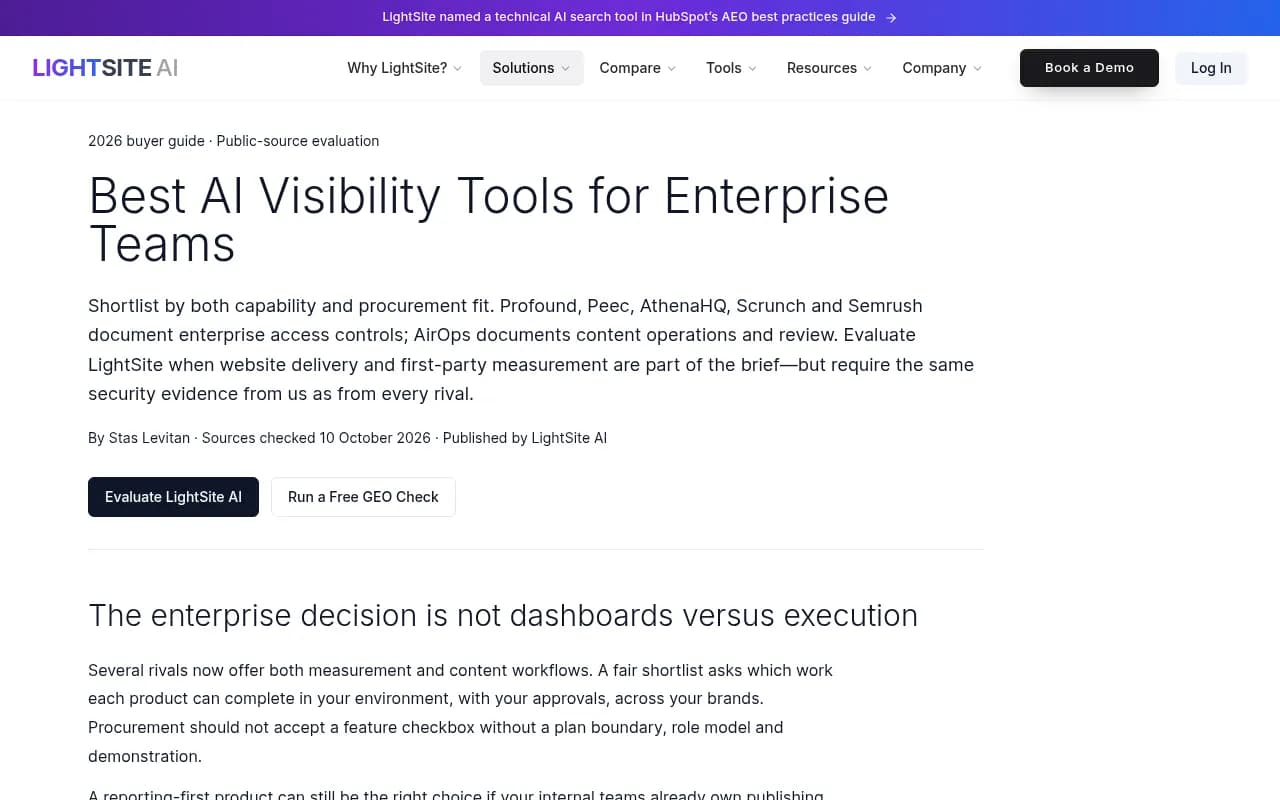
A caveat on sources. LightSite is a vendor, so its comparison table is self-published. To its credit, it marks many of its own entitlements "Not publicly verified" rather than inventing claims. I treat everything below the same way: where a vendor has not documented something publicly, I say so, and you should request it.
The requirements I scored against
- Identity: SAML or OIDC SSO, role-based access, project-level permissions.
- Isolation: can a user in one brand see data from another?
- Data access: API, MCP or connectors, exports with answer text and cited URLs.
- Security: SOC 2 or ISO 27001, DPA, residency, subprocessors, audit log.
- Evidence quality: real interface data versus API simulations, and per-engine reporting.
- Execution: can it take a finding to a published change?
- Measurement: does it connect to AI-referred visits and conversions in your analytics?
- Commercial terms: ownership, roadmap, SLA, renewal.
The 10 platforms compared
| Platform | Strongest at | SSO and security signals | Execution | Watch out for |
|---|---|---|---|---|
| Promptwatch | End-to-end monitor, fix, measure loop | ISO/IEC 27001, GDPR, SSO and audit log on Enterprise, EU-based | Content Agent, CMS publishing, Action Board | White-label and SSO need Enterprise |
| Profound | Large-brand monitoring and analytics | SAML/OIDC SSO, RBAC, SOC 2 Type II stated on its enterprise page | Content workflows, server-log integrations | Higher price point, API and multi-brand entitlements not publicly verified |
| Scrunch | Monitoring plus agent-ready pages | Request current security pack | Agent-ready site delivery | Sitecore ownership since 3 June 2026 |
| BrightEdge | Existing enterprise SEO programs | Typical enterprise suite procurement | Broad SEO workflows | AI is one module of a larger suite |
| Conductor | Organic marketing teams on one platform | Typical enterprise suite procurement | Content and SEO workflows | AI depth varies by package |
| seoClarity (Clarity ArcAI) | SEO teams adding AEO | Enterprise SEO vendor | SEO and AEO workflows | Verify per-engine reporting |
| Semrush AI Visibility Toolkit | Teams already on Semrush | Large vendor security program | Limited | Fixed prompt sets, shallow AI-specific data |
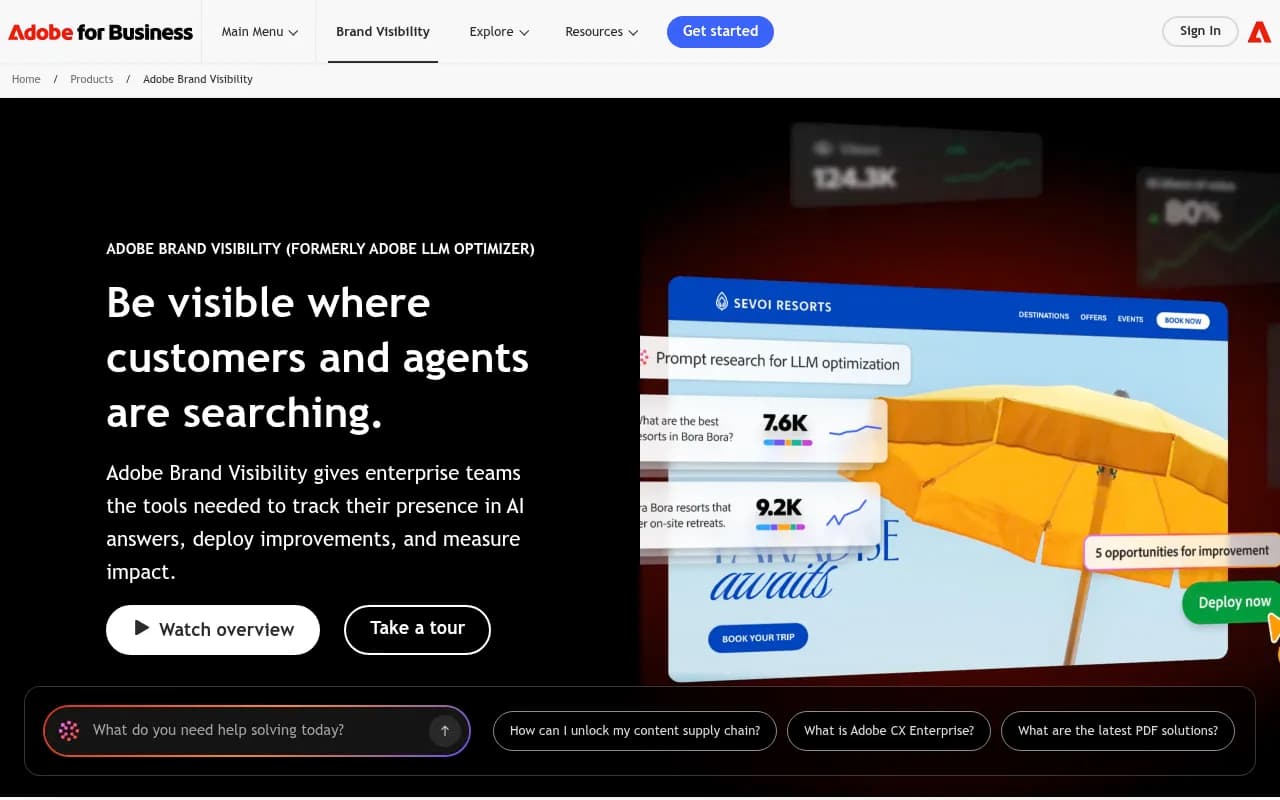
| Adobe LLM Optimizer | Adobe Experience Cloud shops | Adobe enterprise terms | Inside Adobe stack | Best only if you live in Adobe |
| Yext Scout | Brands with structured location and entity data | Enterprise vendor | Pairs with Yext data | Narrower than a full GEO platform |
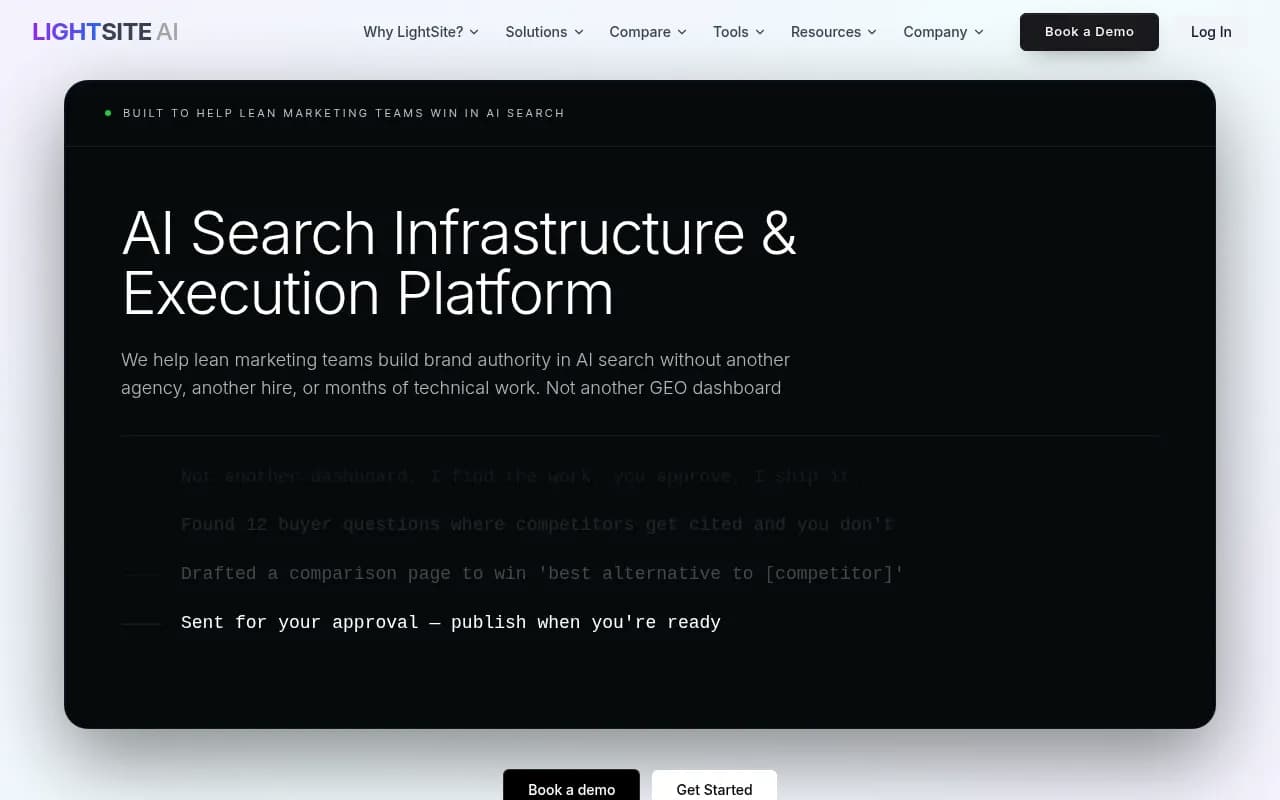
| LightSite AI | Website delivery and measurement | Enterprise SSO, roles, audit log, DPA, SOC 2: not publicly verified | Infrastructure-level changes | Request the full security pack |
1. Promptwatch
Promptwatch is the one I would put at the top of an enterprise shortlist, mostly because it is the only entry here that closes the loop from monitoring to published change to measured outcome. Many vendors stop at a dashboard. This one writes and publishes, then checks whether the page got crawled, cited, and clicked.

On the procurement side, it is ISO/IEC 27001 certified and GDPR compliant, with data handled by an EU-based company. Roles are owner, editor, and viewer with project-level access. The organization audit log (Business, Agency Scale, Enterprise) records every change and whether it came from the dashboard, the API, an MCP client, or Agent Chat. SSO, a white-label dashboard, and a client portal sit on Enterprise.
On the data side, it monitors the real interfaces of ChatGPT, Google AI Overviews, Google AI Mode, Copilot, Gemini, Perplexity, Alexa, and Meta AI by country and language, rather than relying on API outputs that can differ from what users see. IP-verified AI crawler logs let you tell an access problem from a content problem, which is a distinction most competitors cannot make. A hosted MCP server with 110+ tools and REST API v2 cover integration, and a Business plan allows 10,000 API/MCP requests per hour, with 50,000 on Enterprise.
Pricing starts at $95/mo for Essential, $245/mo for Professional, and $579/mo for Business, which is the first plan with the Content Agent, hourly tracking, local targeting at exact coordinates, Fact Check, and the audit log. Confirm everything at promptwatch.com/pricing. For enterprise tailoring, book a demo. If you want a head-to-head, see Promptwatch vs Profound.
2. Profound
Profound is the incumbent most enterprise buyers already know. Its features page lists SAML/OIDC SSO and role-based access control, and its enterprise page states SOC 2 Type II. It also documents server-log integrations with Cloudflare, AWS, and Vercel, plus content workflows.

The gaps are the usual ones. Exact API and multi-brand entitlements were not publicly verified in the sources I inspected, so ask. Compared with Promptwatch it costs more, has no Reddit tracking or ChatGPT Shopping, and has less agentic execution. See Promptwatch vs Profound for the full comparison.
3. Scrunch
Scrunch combines monitoring with agent-ready pages for your site. The big procurement fact is ownership: Scrunch has been a Sitecore company since 3 June 2026. That is not bad news by itself. It does mean buyers outside the Sitecore ecosystem should ask for the standalone roadmap, pricing commitments, and renewal terms before signing a multi-year deal.

4. BrightEdge
If your organization already runs BrightEdge for enterprise SEO, adding its AI search intelligence keeps vendor count down and procurement short. The tradeoff is depth. Suite vendors treat AI visibility as one module, so test per-engine reporting and exports during the pilot.
5. Conductor
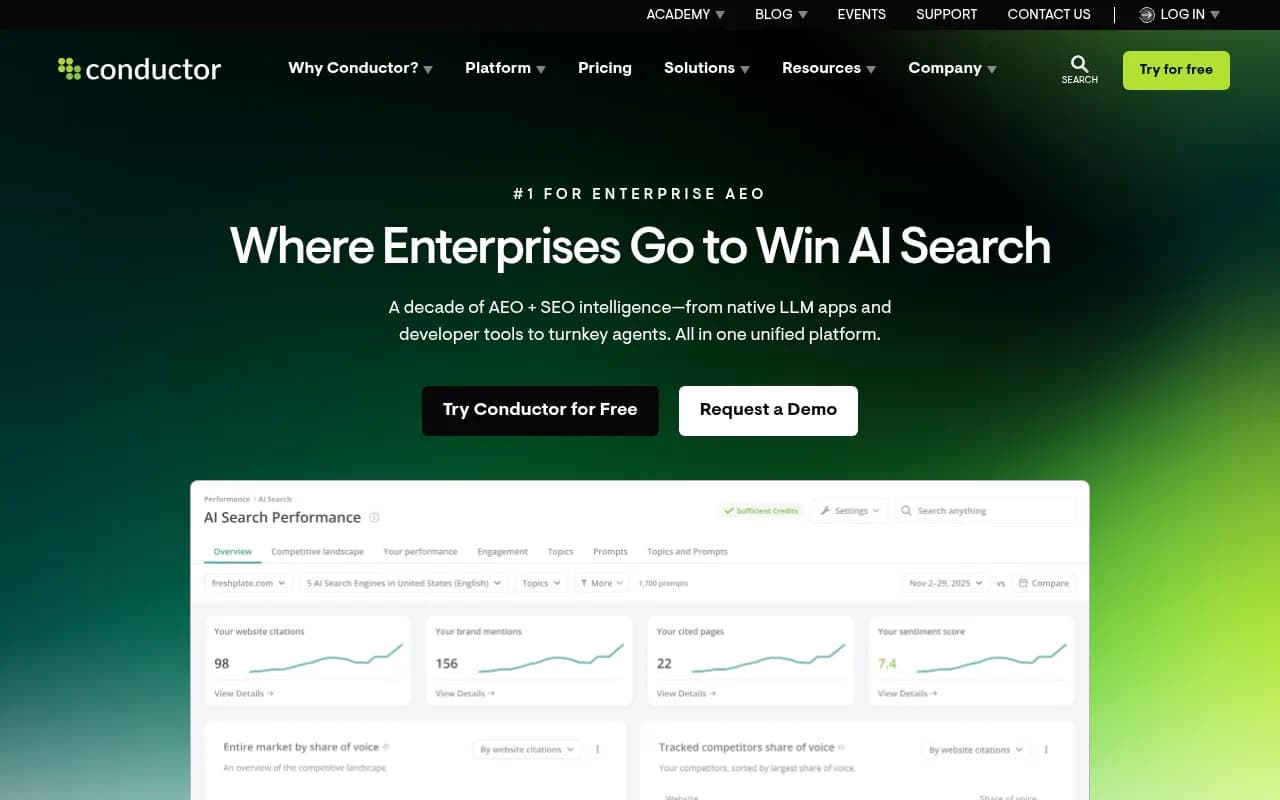
Conductor suits organic marketing teams that want content, SEO, and AI search insights in one workflow. It also shows up in several 2026 AI visibility service provider lists alongside Profound, Peec AI, and Scrunch. Ask for the exact engines covered and whether prompts are customizable.
6. seoClarity (Clarity ArcAI)
seoClarity extends a long-standing enterprise SEO platform into AEO with Clarity ArcAI. It fits SEO teams that want a single contract and existing data pipelines. As with BrightEdge, verify that AI data is separated by engine rather than blended into one score.
7. Semrush AI Visibility Toolkit
Semrush remains a reasonable choice for firms already deep in its system, and a Reddit roundup of enterprise tools calls it a top choice on exactly that basis. The limits are fixed prompt sets and shallower AI-specific data, with no crawler logs or AI traffic attribution.
8. Adobe LLM Optimizer
Adobe's offering lives inside Experience Cloud, which makes it a natural pick if Adobe already runs your content supply chain. Outside that stack, the integration cost probably outweighs the benefit.
9. Yext Scout
Yext Scout is competitive intelligence for enterprise brands, and it pairs well with Yext's verified brand data. It is a good fit for multi-location or data-heavy brands where the fix is often structured facts rather than new articles.
Yext Scout
10. LightSite AI
LightSite is infrastructure and analytics, not only reporting. Public technical documentation describes website delivery and measurement, and discovery endpoints exist. Its own guide marks SSO, granular roles, audit log, DPA, SOC 2, residency, and SLA as not publicly verified. That honesty is useful. It also means you must request the current security pack before anything else.
Why per-engine reporting matters
One requirement that most checklists miss is whether a platform reports each engine separately. Promptwatch Data on average sources per response shows how different the engines are. ChatGPT cites about 5 sources per web-search answer, while Google AI Overviews and Perplexity cite about 10. Microsoft Copilot swung from under 2 to nearly 17 sources within a few weeks before settling at the low end, so judge it on monthly trends, not weekly ones.
Social citations shifted even more. In Promptwatch's social citation report for Sep 28 to Oct 4, 2026, social platforms made up 0.46% of ChatGPT citations, versus 12.2% for Google AI Overviews. Reddit fell from 5.19% to 0.09% in ChatGPT, and the Reddit decline report dates the collapse to August 14, 2026. A vendor still selling Reddit as the core ChatGPT lever is measuring something that has largely disappeared. A blended score would hide all of this.
The 30-day pilot
The Zapier guide, which tested nearly 50 tools, is a good consumer-grade overview, but it was not written around procurement. Use a pilot instead, and run it identically for every vendor.
- Week 1, fix the test. Agree 50 to 100 prompts, the markets, and the engines in writing.
- Week 1, check access. Set up SSO, two roles, and one restricted brand. Confirm a user cannot see data outside their brand.
- Week 2, audit the evidence. Export answer text, cited URLs, and dates. Spot-check ten answers by hand against the live assistants.
- Week 3, ship one controlled change. Pick one page and have the vendor take it from finding to approved, published change. Record who did what.
- Week 4, measure the right thing. Report AI-referred visits and qualified inquiries in your own analytics, separately from visibility scores.
- Exit test. Disable the integration and confirm your site and data return to normal.
One practical note for week 4: ChatGPT stopped sending a referrer on October 8, 2026, so make sure the vendor can count visits tagged with utm_source=chatgpt.com, or your attribution will undercount.
Questions to put in writing
- Which SSO protocols are supported, and on which plan?
- Is there an audit log, and does it capture API and agent actions?
- Where is data stored, and who are the subprocessors?
- What are the API rate limits per hour on our tier?
- Is data collected from real interfaces or APIs?
- Who owns the company, and what does the roadmap look like for the next 24 months?
- What happens to our data on exit?
Which one should you pick?
If you want one platform to monitor, fix, and measure, start with Promptwatch. If you already own an enterprise SEO suite, ask that vendor to run the same pilot, then compare the results honestly. A reporting-first tool can still be the right choice when your internal teams already own publishing and engineering.
For more options beyond these ten, browse the GEO software directory at bestgeosoftware.com. If you want an agency to run the pilot and the program for you, 1001 SEO Media uses Promptwatch for exactly this kind of work.
The free AI visibility report is a low-effort way to get a baseline before you start vendor calls.