Key takeaways
- The most reliable free method is a repeatable manual prompt test. Same prompts, same account, same region, fresh chat each time, logged in a spreadsheet.
- Meta AI is poorly covered by general brand monitoring tools. Most listening platforms and many AI trackers don't mention it, so check before you pay.
- You can see Meta's crawlers in your own server logs for free. Meta-WebIndexer went from about 2.2% to 37.8% of AI crawler requests in Promptwatch's logs between mid-July and August 9, 2026.
- Single checks are noisy. Meta AI answers vary by app, account and region, so run each prompt several times and look at patterns.
- Free trials from dedicated tools are useful for a baseline, but confirm what the free tier actually includes.
Why Meta AI deserves its own check
Most brand-mention advice is written for ChatGPT, Gemini and Perplexity. Meta AI gets left out, which is odd given where it lives. It sits inside WhatsApp, Instagram, Facebook and Messenger, so a person asking a friend-style question like "where should I get dinner tonight" may get an answer from Meta AI without ever opening a search engine.
That makes it a different kind of surface. People ask short, casual, often local questions in a chat thread. Your brand either shows up in the answer or it doesn't, and you won't see it in Google Search Console.
A caveat before we start. I couldn't verify Meta AI's official web access or citation behavior, and it isn't available in every region. Vendor claims, such as FinSEO saying it has run on Meta's "Muse Spark" model since April 2026, are unverified. So treat what follows as a practical testing method, not a description of how Meta AI works internally.
Method 1: the manual prompt test (free, and the best option)
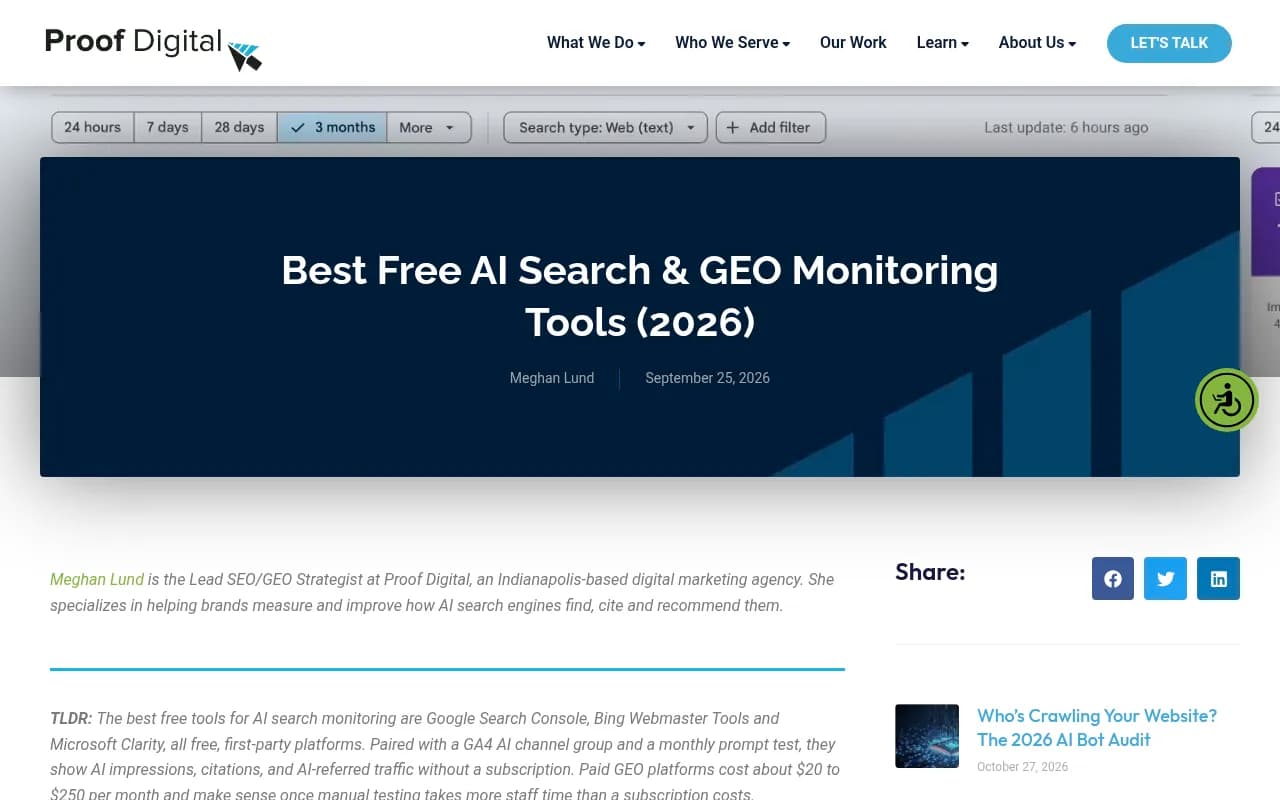
The boring answer is also the best one. A monthly prompt test with identical conditions each run is the most reliable free way to track brand mentions, according to Proof Digital's free monitoring guide. A popular answer on Quora says the same thing: check manually first, and use a fresh chat each time.
Build a prompt set
Write 15 to 25 prompts and split them into three groups:
- Category prompts that never name you: "best project management app for small agencies", "good accountant near me".
- Comparison prompts that name you and a competitor: "Brand A vs Brand B for freelancers".
- Brand prompts that name only you: "Is Brand A any good?", "What does Brand A do?".
Category prompts tell you whether Meta AI recommends you unprompted. That's the number that matters most, and it's usually the lowest. Brand prompts tell you whether it knows you exist and says something accurate.
Run it consistently
- Use the same surface each time. Meta AI answers can differ between WhatsApp, Instagram and the standalone app, so pick one and stick with it, then repeat on a second surface if you have time.
- Start a fresh conversation for every prompt so earlier answers don't leak in.
- Use the same account and the same country. Log out of anything that personalizes results if you can.
- Run each prompt three times. If your brand appears in one of three, that's a different situation from three of three.
- Screenshot the answer. Text-only logs miss formatting and any source links shown.
What to record
| Column | What to write down |
|---|---|
| Prompt | Exact wording |
| Date and surface | WhatsApp, Instagram, app |
| Mentioned? | Yes, no, or partial |
| Position | First, middle, last in a list |
| Competitors named | Who showed up instead of you |
| Sources shown | Any links or domains cited |
| Accuracy | Right, wrong, outdated |
| Tone | Positive, neutral, negative |
The sources column is the one people skip. Goodie AI suggests the same starting point in its Meta AI guide: run your target prompts and see which sites Meta AI already cites. Those sites are where you want to be mentioned.
Score it
Keep it simple. Mention rate is the share of runs where your brand appears. Compare it month to month, and compare it with the one or two competitors who show up most often. Don't build a fancy index from 20 prompts. The sample is too small.
Method 2: check your server logs for Meta's crawlers
This one costs nothing if you have access to server or CDN logs, and almost nobody does it.
Meta runs several crawlers, and one of them grew fast. In Promptwatch Data's Meta-WebIndexer report, meta-webindexer went from about 2.2% of all tracked AI crawler requests in mid-July 2026 to 37.8% on August 9, 2026. That's roughly 17x in under a month, and it made Meta-WebIndexer the heaviest AI crawler in the logs that day. The share stayed near 2% until July 17, spiked to about 23% on July 20 to 22, then surged from August 5.
The report links this to claims that Meta is building its own web search index so Meta AI doesn't depend on Google or Bing. That comes from a tweet on August 6, 2026 citing Meta staff, and it's unconfirmed, so don't treat it as fact. What the report does say is that the crawler exists to improve Meta AI search results and cite sources. For background on overall crawler mix, see Promptwatch's AI crawler traffic data, which shows OpenAI's share of verified AI crawler requests falling from 94.8% to 79.8% between June and early September 2026.
What to look for
Search your logs and robots.txt for these user agents:
Meta-WebIndexer
Meta-ExternalAgent
Meta-ExternalFetcher
FacebookBot
Three questions to answer:
- Are they visiting at all? If Meta-WebIndexer never touches your site, Meta AI may have little to work with.
- Are they getting blocked? A blanket disallow in robots.txt, or a firewall rule written to stop scrapers, may keep your content out of Meta's index. Promptwatch's own advice is to check this and budget for sustained crawl load.
- Which pages do they read? If they only hit your homepage, your product and help pages may be invisible to it.
A crawl isn't a mention. But a site that Meta can't read is unlikely to be recommended, so this is a cheap way to rule out the dumbest failure. Spoofed user agents are common, so verify against Meta's published IP ranges when you can. The free Agentic Readiness Check and the AI Crawler URL Inspector from Promptwatch can also show which AI crawlers can read a page.
Method 3: look for AI referral traffic
Chat interfaces are private, but clicks aren't. Web analytics shows referral sources, and AI tools leave recognizable ones such as perplexity.ai or gemini.google.com. A spike from one of them suggests the tool started citing you.
Here's the honest limit for Meta. I didn't verify how Meta AI shows up as a referrer. Links opened from inside WhatsApp or Instagram's in-app browser may land as direct traffic, or as the host app's referrer, or with no referrer at all. So:
- Filter GA4 for referrers containing
meta,facebook,instagram,whatsappandl.facebook.com, and compare against your normal social baseline. - Watch for sudden changes in traffic to pages that match your tested prompts.
- Treat anything you find as a hint, not proof.
If you want to cover the other assistants for free, the same analytics approach plus Search Console's AI reports, Bing Webmaster Tools and Microsoft Clarity gets you decent coverage, as Proof Digital explains.
Method 4: free trials and free checkers
Several vendors offer a free way in. Read the fine print, because "free" often means a trial, a one-off scan or onboarding rather than ongoing tracking.
| Tool | What's free | Meta AI coverage | Catch |
|---|---|---|---|
| Knowatoa | Free onboarding and a "Get Started Free" option | Dedicated Meta AI page covering Facebook, Instagram, WhatsApp, Messenger | I couldn't confirm what the free tier includes |
| LLM Pulse | Free trial | Meta AI tracking listed | Trial only |
| FinSEO | Free AI visibility check | Meta AI appears sales-led | Demo dashboard numbers aren't real data |
| Frase AI Visibility Checker | Free, no card, reads your domain | Names engines citing you | Not confirmed for Meta AI |
| Manual test | Free forever | Whatever you can reach | Your time |
Knowatoa is the one with a purpose-built Meta AI page, so it's the first place I'd look.

LLM Pulse lists Meta AI tracking with a free trial.

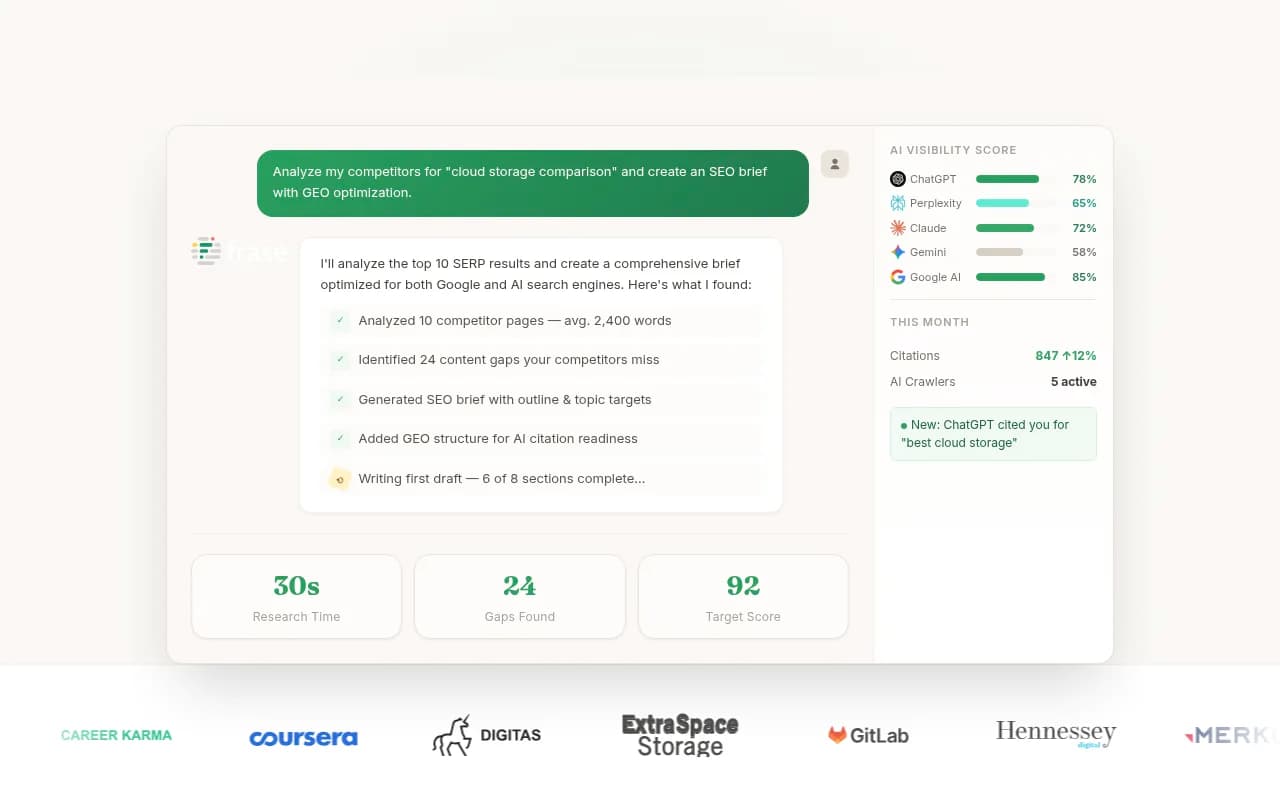
Frase has a free AI Visibility Checker that reads your domain and names engines citing you.
For a broader free look, Promptwatch has a no-login Free AI Visibility Report that scans how ChatGPT, Gemini and Perplexity talk about your brand. It doesn't cover Meta AI, but it gives you a baseline on the assistants that do tend to cite sources, and Promptwatch's paid plans track Meta AI through its real interface.

Otterly.AI is often named as the most accessible entry point among paid trackers, with a real free trial, though you should check its current model coverage.

What the general monitoring tools skip
It's tempting to assume the listening platform you already pay for covers this. Usually it doesn't. The Rework roundup of 15 AI brand monitoring tools (updated October 2, 2026) says Meltwater, Brand24 and Talkwalker have real AI-answer tracking, while Brandwatch, Sprout Social and Mention talk about the AI era without shipping a feature that tells you what ChatGPT says about you. The excerpt I saw doesn't mention Meta AI at all.
So before signing up for anything, ask the vendor one direct question: does it query Meta AI's actual interface, and in which countries? If the answer is vague, assume it doesn't.
If you want to browse options, the GEO software directory at bestgeosoftware.com lists tools by category and is a decent place to filter by what they cover.
Why single checks mislead
I've seen people ask Meta AI one question, get no mention, and conclude they're invisible. Or get one glowing mention and celebrate. Both are wrong.
Answers vary by surface, by account, by region and by the moment. Meta AI isn't available everywhere, so if you're testing from a country where it's limited, you may be seeing a different product than your customers do. The fix is volume and consistency: more prompts, repeated runs, one fixed setup.
It also helps to know that AI answers elsewhere cite a lot of sources. In Promptwatch's data, almost half of ChatGPT responses cited 10 or more unique domains (Sep 28 to Oct 4, 2026). I have no equivalent figure for Meta AI, and Promptwatch has no published report on its citation behavior, so don't assume it works the same way. But it's a reminder that being mentioned usually depends on being present across many sources, not just your own site.
What to do with the results
- Not mentioned at all: check crawler access first, then see which competitors and sites are named and whether you appear on them.
- Mentioned but wrong: fix your own pages, update your profiles on Facebook and Instagram, and correct third-party listings that carry old facts.
- Mentioned late or rarely: you have a prominence problem. Look at the sources shown in answers and work on getting featured there.
- Mentioned accurately: log it, keep testing monthly, and move on to the next assistant.
If you outgrow spreadsheets, the AI rank tracking directory at ai-rank-tools.com is a reasonable place to compare paid options. Paid GEO platforms run roughly $20 to $250 a month by Proof Digital's estimate, and they make sense once manual testing costs more staff time than a subscription.
A simple monthly routine
- Week one: run your prompt set on one Meta AI surface, three runs each, and log the results.
- Same day: pull Meta crawler hits from logs and confirm robots.txt isn't blocking them.
- Same week: check analytics for Meta-related referrers on your tested pages.
- Compare with last month and with two competitors.
- Pick one fix and ship it before next month's test.
That's about two hours a month, and it costs nothing. Start there, and only pay for a tool once you know what you'd want it to tell you.