Key takeaways
- The choice depends on capacity more than budget. Tools suit teams with people who can act on findings. Agencies suit teams who can't.
- Agency retainers typically run into the thousands per month, and most agencies publish no price. Tools range from under $100 to a few hundred dollars per month at entry level.
- AI visibility decays and shifts. Whichever route you pick, someone has to refresh content and watch the numbers every month.
- A hybrid is often the best answer: buy a platform for measurement and own the data, then bring in an agency for execution you can't staff.
- Most "best GEO agency" lists are written by agencies ranking themselves first. Read them with that in mind.
The real question: who does the work?
Everyone is asking about GEO right now. Conductor's State of AEO/GEO 2026 report says 94% of CMOs plan to increase AEO and GEO investment this year. That kind of demand is exactly why every content shop has added "GEO" to its homepage.
So you have two broad routes. Buy software that measures (and sometimes helps fix) your AI visibility, or pay a team to do it for you. The framing most buyers start with is cost. I think it's the wrong starting point. The better question is: after the tool tells you what's wrong, who will actually fix it?
A dashboard showing you're absent from ChatGPT answers for "best CRM for small businesses" doesn't change anything by itself. Someone has to write or update product pages, build comparison content, fix crawler access, and get mentioned on third-party sites. That's the work. Pepper's comparison of the two routes lands in the same place: it depends on capacity rather than budget.
What GEO tools actually do
GEO tools measure and, in some cases, improve how a brand shows up inside AI-generated answers from ChatGPT, Perplexity, Google AI Overviews, Gemini, and Copilot. Most do four jobs: mention tracking, citation tracking, sentiment, and share of voice.
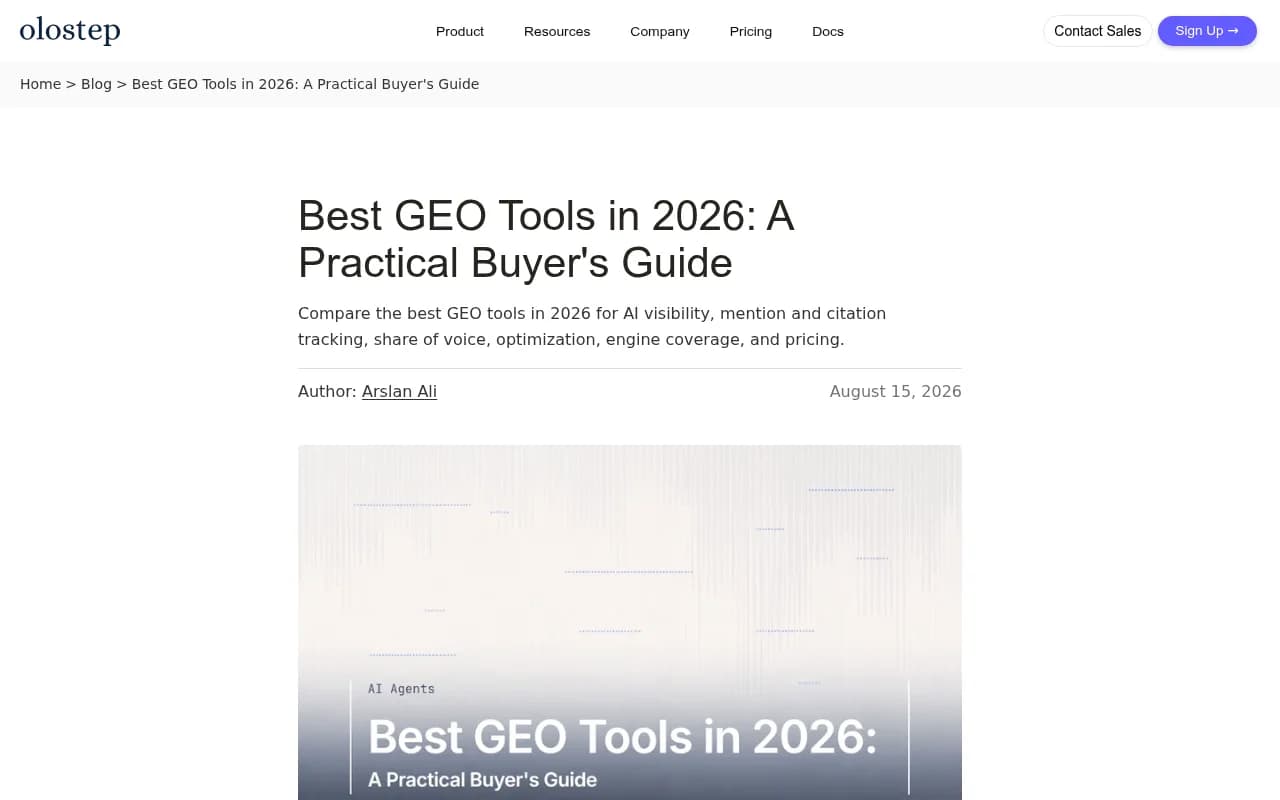
The category is wide though. At one end you have simple monitors. At the other are platforms that also tell you what to fix, write content, and publish it. A buyer's guide from Olostep makes the same point, noting the word "tool" spans monitors, content optimizers, and full platforms.
Monitoring-only tools
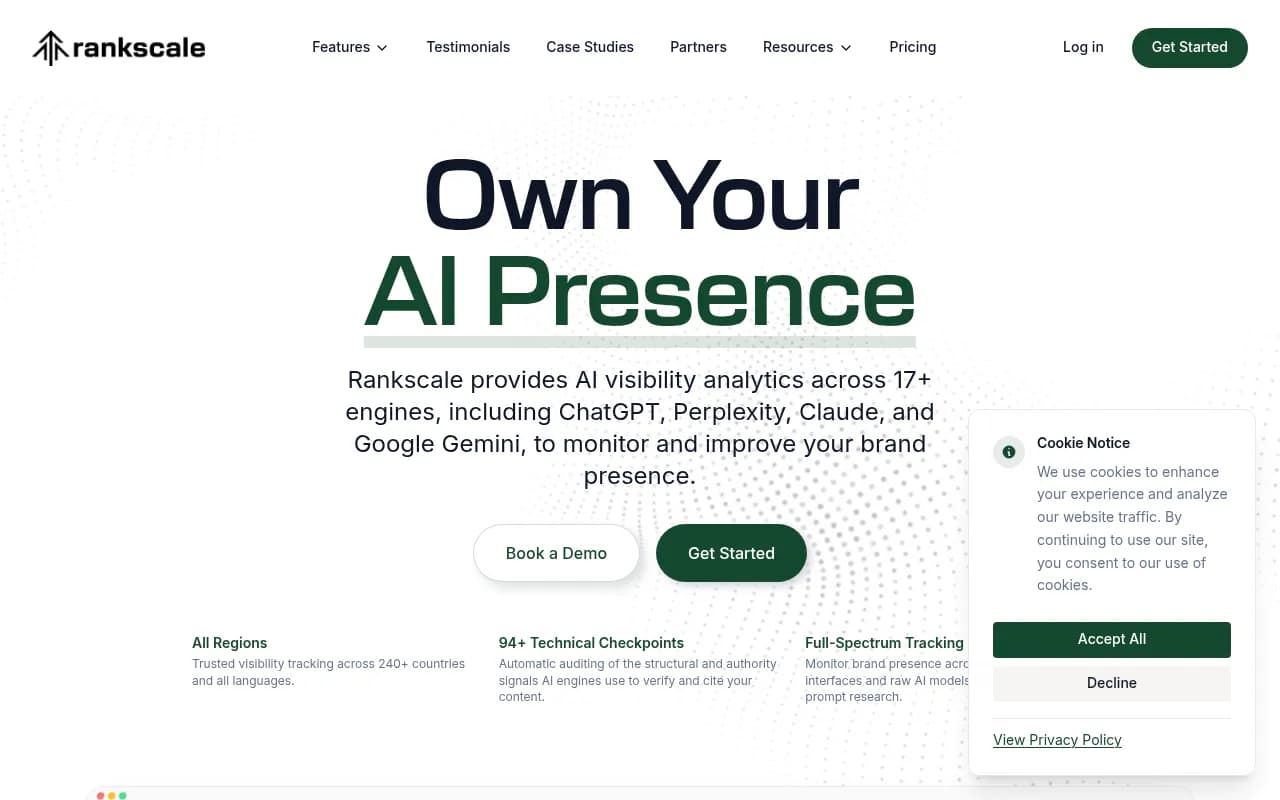
These run a set of prompts against AI engines on a schedule and report whether you were mentioned or cited. They're cheap and quick to set up. Options in this tier include Otterly.AI, Peec AI, and Rankscale.


The limit is obvious. You learn where you stand, then you're on your own.
Platforms that close the loop
The more useful platforms connect measurement to action. Promptwatch is the example I'd point to here. It tracks real user interfaces across ChatGPT, Google AI Overviews, Perplexity, Gemini, and more, then adds crawler logs, visitor analytics, content gap analysis, and a Content Agent that writes and publishes to Webflow, Framer, or WordPress. Underperforming pages come back as items on an Action Board.

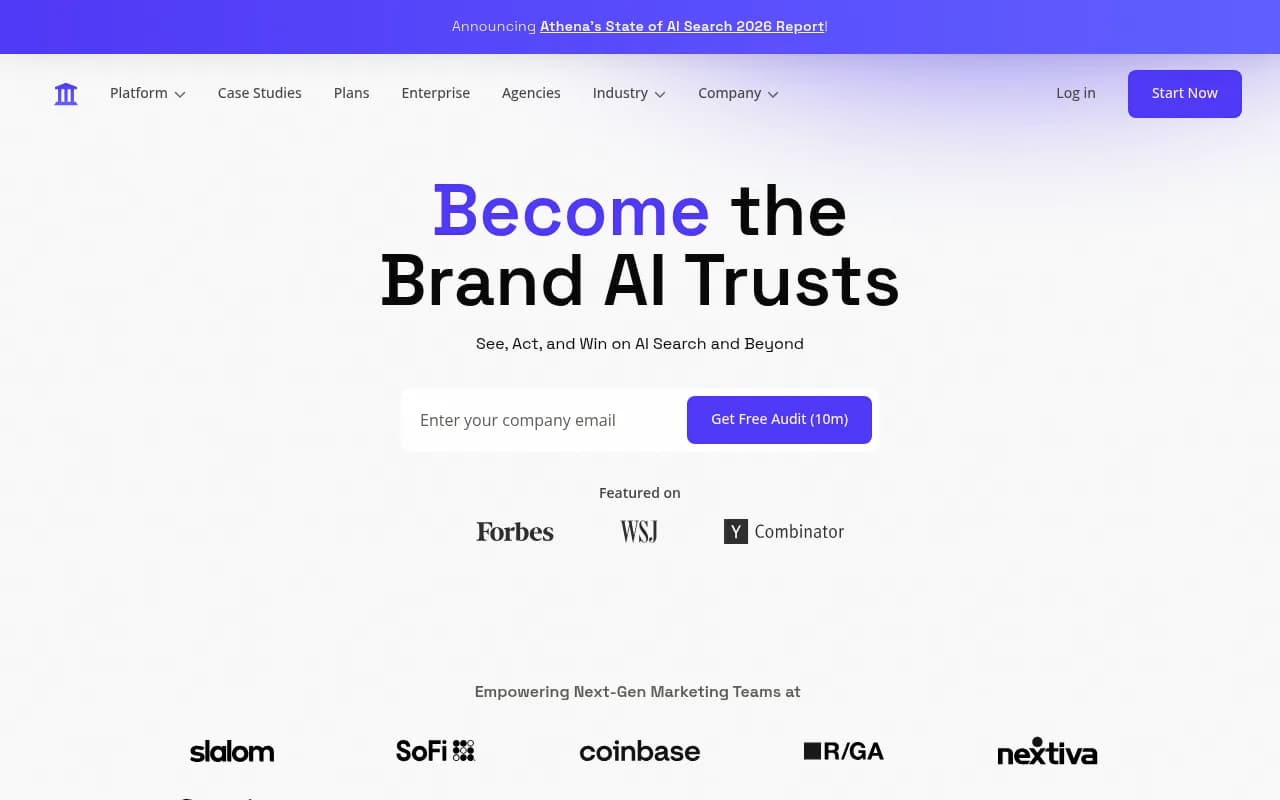
Other names worth a look in the same broader space are Profound for enterprise analytics, AthenaHQ, and Scrunch AI.


If you want to browse more options, the GEO software directory at bestgeosoftware.com lists a lot of them side by side.
Where traditional SEO suites fit
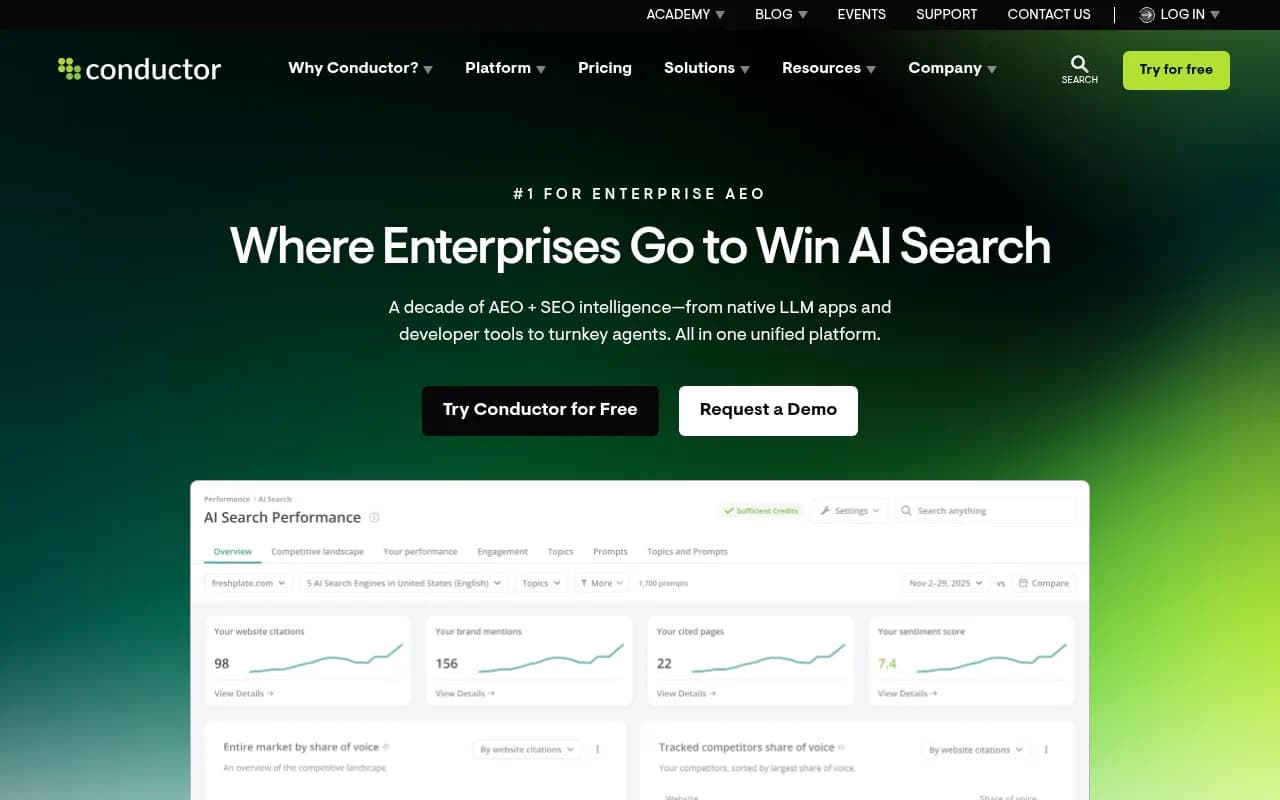
Semrush, Ahrefs, and Conductor have all added AI tracking. They're reasonable if you already live in those tools, though the AI-specific data tends to be shallower than what a dedicated platform provides.

What a GEO agency actually does
A GEO agency should handle strategy, content production, technical fixes, off-site mentions, and reporting. You review, approve, and hold them to a number.
That last part matters. According to the Outreach Bloom pricing guide, agency retainers typically cost thousands per month, and most agencies publish no figure at all. A few do publish. Optimist, for instance, lists audits and roadmap projects from $2,500 and ongoing AEO advising from $3,000 per month. I haven't verified those numbers independently, and Optimist is also the one ranking itself first in its own listicle, so weigh accordingly.
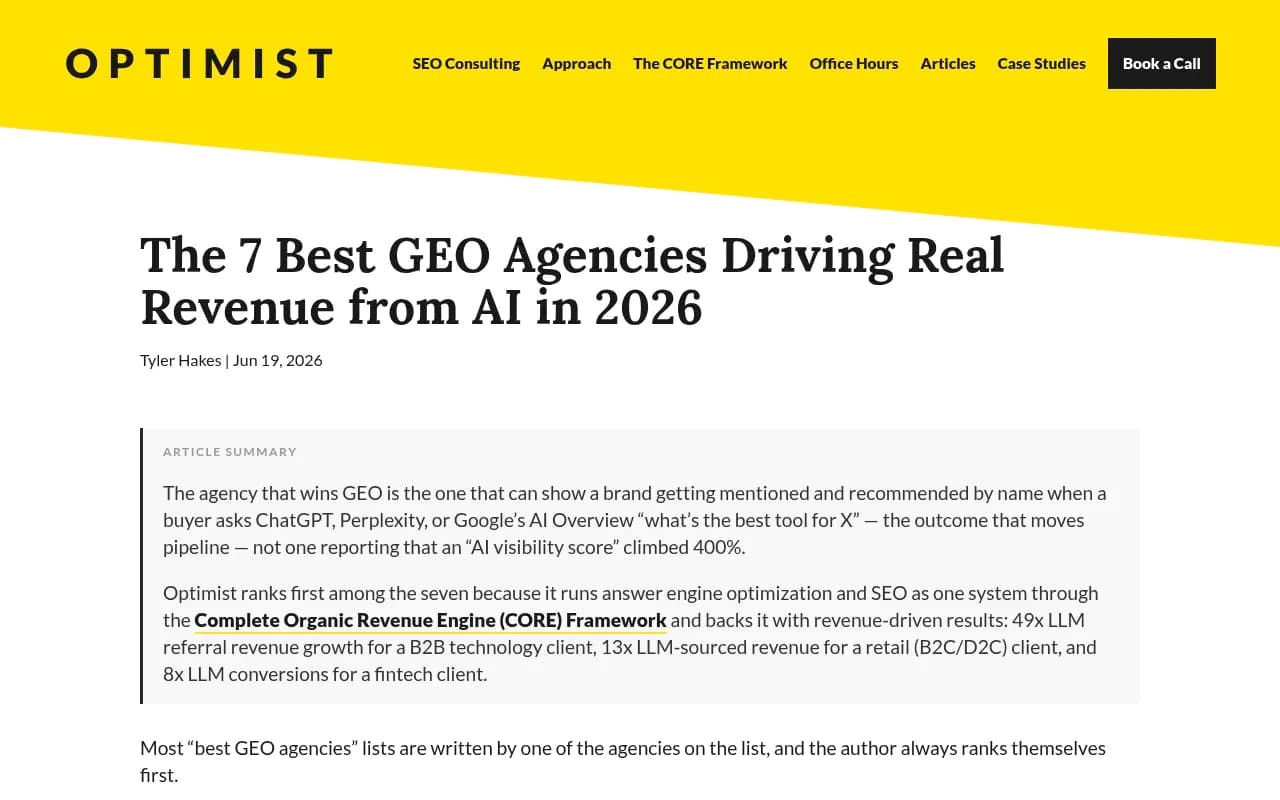
To its credit, that article is upfront about the bias ("Guilty") and it proposes a useful test: does the agency show a brand being named when a buyer asks an AI engine for recommendations, rather than reporting that an "AI visibility score" went up 400%? Revenue-linked proof beats vanity metrics.
The case for agency-first
Some argue that for B2B teams the discipline is too new for one in-house hire to have meaningful experience, so an agency first is the honest answer. There's something to that. Agencies see patterns across many clients, and a single hire sees one. But that argument also comes from an agency, so treat it as one view.
Done-for-you platforms
A third category sits between the two. Services like Voyage pitch done-for-you GEO, and some tools bundle managed services, such as Ranked AI. They're worth considering if you want a lower-touch option than a full retainer.

Cost comparison
The numbers below come from third-party sources and I haven't verified them. Prices change quickly, so confirm on each vendor's site.
| Route | Typical cost | What you get | What you still have to do |
|---|---|---|---|
| Monitoring tool | Roughly $25 to $100+/mo | Prompt tracking, mentions, citations | Everything else: analysis, content, fixes |
| Mid-tier GEO platform | Roughly $95 to $600/mo | Tracking plus audits, gap analysis, sometimes content | Review output, approve, own the roadmap |
| Agency retainer | Thousands per month | Strategy, execution, reporting | Review work, hold agency to outcomes |
| One-off audit project | From around $2,500 | Roadmap and recommendations | Implement all of it |
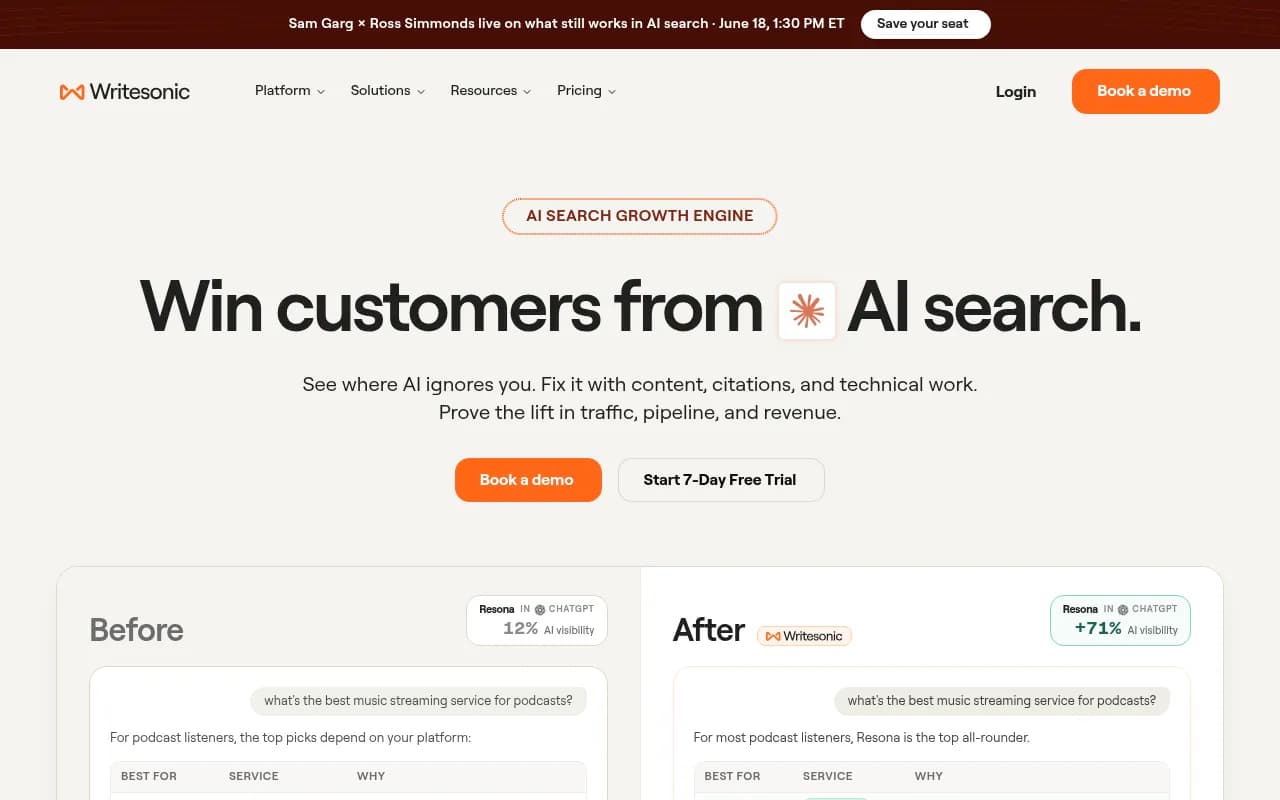
For reference points: Outreach Bloom lists Writesonic GEO at $79 per month billed annually and AthenaHQ at $295 per month. Promptwatch's published plans start free (10 prompts, ChatGPT only), then Essential at $95 per month, Professional at $245, and Business at $579, with agency plans from $199. Check promptwatch.com/pricing for current figures.
Why AI visibility needs ongoing upkeep
This is the part that complicates both routes. GEO isn't a project you finish.
Promptwatch Data tracked every page ChatGPT cited on July 6, 2026 for 90 days. In its content half-life report, landing pages and docs held up best: 78% of landing pages and 76% of docs were still cited after 30 days. Product pages, reviews, and how-tos each had 55% still cited after 60 days, with half-lives around 74 to 77 days. News was the worst: half of news pages were gone after 36 days.
Translate that into a staffing decision. Pages that win citations lose them unless someone keeps prices, specs, and positioning current and refreshes listicles and guides before they drop out. A one-off agency project won't cover that. Neither will a set-and-forget software subscription.
The platforms move too. Promptwatch's data showed ChatGPT starting to use the site: operator at scale on August 8, 2026, jumping from about 0.4% to about 17% of fanout queries overnight (report). And reddit.com's share of ChatGPT citations fell from roughly 4% to 0.5% on August 14, 2026 (report). Whoever runs your GEO program needs to notice that kind of shift in days, not quarters.
What to actually produce
Promptwatch's content type report (Sep 28 to Oct 4, 2026) gives a useful brief for either route. Product pages were the most cited type at 22.4% of ChatGPT citations, landing pages 16.8%, listicles 13.6%, how-tos 8.7%, and comparisons 5.9%. For commercial prompts like "best CRM for small businesses," product pages, landing pages, listicles, and comparisons made up almost 70% of citations.
So the work is mostly mapping content to prompt intent: product pages and comparisons for commercial prompts, guides and docs for informational ones, your own site, FAQ, and reviews for branded ones. Your in-house writer can do that with the right data. So can an agency. A tool alone can't.
When tools win
- You have at least one person who can write, edit, and publish weekly.
- You want to own the data and run your own experiments.
- Budget is tight and you need to prove the channel before spending more.
- You run many brands or markets and need coverage an agency retainer can't scale to.
- You're an agency yourself, and you need a platform with white-label reporting. Agency-focused options include Search Party and Promptwatch's Agency plans.
When an agency wins
- Nobody on the team has time, and nobody will in the next quarter.
- You need technical, content, PR, and off-site work coordinated, and you lack specialists in some of those.
- You're in a competitive category where earned mentions on third-party sites decide who gets recommended.
- Leadership wants an accountable partner with a named owner for results.
If you go this route, 1001 SEO Media is one example of an agency that combines technical SEO, content, digital PR, and GEO. It uses Promptwatch for AI visibility measurement, and it works without long-term contracts. Other firms exist; the evaluation criteria below apply to all of them.
When to combine both
The hybrid is what I'd choose for most mid-size teams. Buy the platform yourself so the data, prompts, and history belong to you. Then let an agency use that same platform to execute. You avoid the black-box reporting problem, and you can compare what the agency claims against what the crawler logs and citation data show.
Agentic features shift the balance a little. When a platform's Content Agent plans, writes, and publishes against your visibility gaps with a review inbox, the in-house workload drops enough that a small team can run a serious program. That makes tools-first viable for teams that would have needed an agency a year ago.
How to evaluate a GEO agency
The market looks a lot like SEO did fifteen years ago. A few agencies have real methods, and many have a rebranded service page. Ask these before signing:
- Can you show published case studies where AI-referred traffic or revenue went up, not just a visibility score?
- What does the first 90 days look like, week by week?
- Which AI engines do you track, and do you use real interface data or only API outputs?
- Who owns the tracking data and accounts if we leave?
- How do you handle content refreshes after launch?
- Do you treat GEO and SEO as one system or sell them separately?
- What will you not do? (Spun content, fake Reddit accounts, and mass AI-generated pages are red flags.)
- What's the contract length and exit process?
For a wider view of how citations work before you talk to anyone, the Promptwatch Data hub is a good free place to calibrate. Whatever agency pitches you, ask them to explain their approach in light of numbers like those.
How to evaluate a GEO tool
| Question | Why it matters |
|---|---|
| Does it track real AI interfaces or only APIs? | User-facing answers and citations can differ from API outputs |
| Does it show crawler activity? | Explains why pages are or aren't being read |
| Can it attribute traffic and conversions? | Mentions alone don't prove revenue |
| Does it help create or refresh content? | Otherwise you need a separate content workflow |
| Are prompt volumes and difficulty included? | Helps you pick what to track first |
| What's the cost per response? | Cheap seats with tiny response caps get expensive fast |
If you want a free sanity check before buying anything, run a free AI visibility scan and see how ChatGPT, Gemini, and Perplexity currently describe your brand. For other directories, AI Rank Tools covers rank-tracking options specifically.
A simple decision path
- Count your available hours. If you can dedicate 10 or more hours per week to GEO work, start with a platform.
- If you have fewer than that and the budget for a retainer, hire an agency, but require access to the underlying data.
- If you have neither time nor budget, start with a free scan and a low-cost tracker, fix your crawler access and core product pages yourself, and revisit in a quarter.
- Review every 90 days. Content half-lives are short enough that a quarterly checkpoint is the minimum.
Bottom line
Tools tell you what's happening. Agencies do the work. Platforms with agentic features narrow the gap, and a hybrid covers most situations. Pick based on who will have hands on the keyboard next Tuesday, and make sure whoever it is has a way to measure whether the pages they publish actually get crawled, cited, and clicked.