Key takeaways
- Semrush and Ahrefs were built for keyword rankings and backlinks. Their AI visibility modules are add-ons, and they mostly measure rather than fix.
- Backlink authority only loosely predicts AI citations. Promptwatch Data shows mid-authority domains (DR 46-75) earned about 46% of ChatGPT citations in August 2026, while DR 91-100 sites averaged 4.4%.
- Pricing is per-unit and messy. Semrush charges per domain and prompt pack, Ahrefs charges per check, and the pages disagree with each other. Model your prompt, domain, and seat counts before you buy.
- Most teams in 2026 run both: a classic suite for keywords and links, plus a specialist GEO platform for prompts, crawlers, and content action.
Why this comparison matters now
For about fifteen years, "SEO tool" meant a keyword database, a backlink index, and a rank tracker. That still covers a big chunk of the work. But a growing share of your audience asks ChatGPT, Gemini, Perplexity, or Google AI Mode and gets an answer that names brands directly. No ten blue links. No position 3.
Semrush and Ahrefs saw this coming and bolted on AI modules. Specialist GEO platforms were built from scratch for it. The interesting question isn't which is "better." It's what each one measures, what it ignores, and what you end up paying once you scale it up.
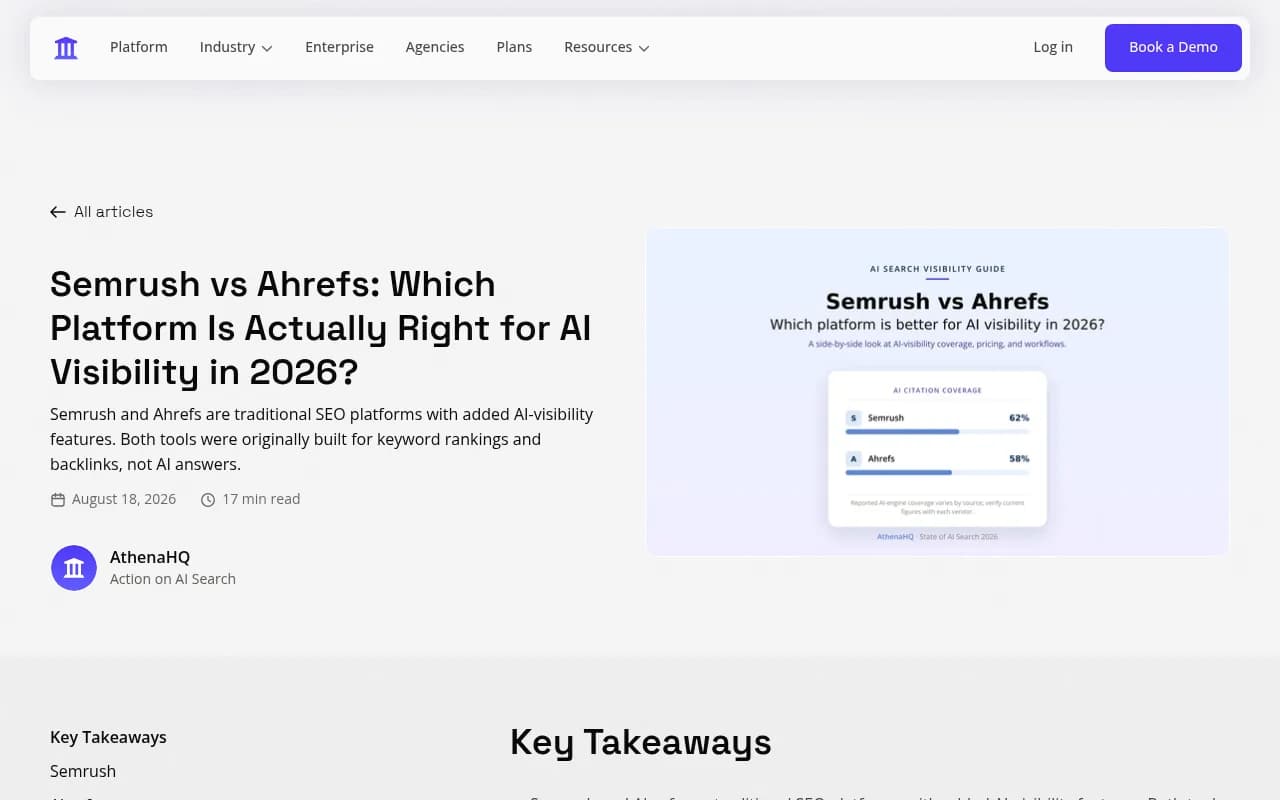
A caveat on sources: several of the comparisons I read (AthenaHQ, Otterly, Ryze) are published by vendors who sell competing products. I've leaned on their numbers where nothing else was available and flagged it each time.
What traditional suites are actually good at
Let me be fair to the incumbents first. They are excellent at what they were built for.
Semrush is the broad one: keyword research, PPC data, content tools, site audits, and a wider marketing toolkit under one login.
Ahrefs is the search-first one, with a strong backlink index and deep search data. Technical SEO specialists tend to favor it.
None of that goes away. Fan-out queries are the proof. ChatGPT breaks a prompt into smaller web searches, and Promptwatch's query fanout data shows the average fanout query length dropped from about 117 characters in December 2025 to roughly 53 characters from April 2026. Those are short, keyword-like queries. So keyword research still feeds GEO: headings that read like short queries, plus focused pages for "X vs Y", pricing, and alternatives. That is classic suite territory.
Where the AI add-ons fall short
Both suites treat AI visibility as a module. That shapes everything about it.
Semrush AI Visibility Toolkit
The standalone toolkit is $99 per month per domain, billed annually, with 1 project, 25 prompts, and AI search checks in Site Audit for up to 100 pages. There is no free trial. Extra domains or locations are $99 each, and 50 extra prompts cost $60 per month. Semrush One bundles it: the Pro+ tier includes 100 prompts and 15 monitored sites, Advanced includes 200 prompts and 40 sites.
The upside is real: zero new vendor and a side-by-side view of classic and AI data. The downsides show up with scale. Per-domain pricing means an agency pays $99 for every client domain, and reaching around 125 prompts costs about $219 per month ($99 plus two $60 packs), per Otterly's pricing comparison (a competitor, so treat it as a vendor claim). Reviewers have also noted there's no crawler analytics or prompt volume data. Rankability's verdict is that it suits established brands already inside Semrush, and that many users feel it falls short in its current form.
Ahrefs Brand Radar
Ahrefs plans run Starter $29, Lite $129, Standard $249, Advanced $449, and Enterprise $1,499. Lite includes 5 tracked AI prompts, Standard 10, Advanced 20. Brand Radar is the separate AI product, and this is where I'd slow down: Ahrefs' own pages don't agree. The pricing page says "Brand Radar AI from $199/mo". A competitor's blog reports $398 for select platforms and $699 for all platforms, with custom prompts and 2,500 checks per month. Verify on ahrefs.com/brand-radar before budgeting.

One correction worth making, since it circulates: the "$129/mo" figure sometimes attached to Brand Radar is actually the Lite plan price. Brand Radar prices by checks, with overage packs from $0.020 down to $0.010 per check. Reviewers describe the AI tracking as centered on Google AI Overviews more than the full set of answer engines, though I couldn't verify engine coverage per tool independently.
The shared limitation
Both are measurement tools. They tell you a brand was or wasn't mentioned. They don't write the content, publish it, or confirm the fix worked. Budget separate time and tooling for that.
Why backlink metrics don't predict AI citations
This is the part that changes how you should think about your stack. If you're used to judging success by domain rating, ChatGPT will confuse you.
Promptwatch Data's ChatGPT citation share by domain rank report covers August 1-31, 2026:
- DR 61-75 took 23.4% of citations and DR 46-60 took 22.6%, together about 46%.
- DR 76-90 took 18.9%.
- DR 91-100 domains averaged just 4.4%, less than DR 0-15 at 6.3%.
- The DR 91-100 share fell from about 7% in the first week to about 3% from August 14, the same day Reddit's ChatGPT share collapsed (see Promptwatch's Reddit citation data).
Promptwatch's own takeaway is to skip waiting for a top-tier domain rank and aim PR at DR 61-90 sites, which held about 42% of citations. I'd add a hedge: this is one month of one engine. But it's enough to say authority metrics from a link index are, at best, a loose proxy.
Other evidence points the same way. Otterly cites The Digital Bloom's 2025 report claiming only 11% of cited domains overlap between ChatGPT and Perplexity, and roughly 80% of LLM citations don't rank in Google's top 100 for the same query. Vendor-sourced, so hold it loosely, but the direction matches the first-party data.
What specialist GEO platforms add
Specialists differ a lot from each other, so it helps to split them into trackers and optimization platforms.
Trackers
These answer "was my brand mentioned?" Reported entry prices (vendor-reported, mixed independence): Otterly from $29/mo for 15 prompts, Peec from $95/mo for 50 prompts, Profound from $99 billed annually, Scrunch from $300, and AthenaHQ with a free tier.




They're cheaper per prompt than the suite add-ons and cover more engines. Many have no crawler logs, no visitor analytics, and no content generation. They are still monitors.
Optimization platforms
This is the category I think matters most. Promptwatch is the clearest example: it tracks real interfaces of ChatGPT, Google AI Overviews, AI Mode, Gemini, Perplexity, Copilot, and others, and then goes past monitoring. IP-verified AI crawler logs show which bots hit which pages and what errors they hit. Visitor analytics attribute actual traffic and conversions from AI platforms. Content gap analysis maps your pages against the prompts AI answers, and the Content Agent writes and publishes to Webflow, Framer, or WordPress, then tracks whether the page gets crawled, cited, and clicked.

Two features have no real equivalent in the suites. Crawler logs tell you why you aren't cited (a blocked bot, a 403, a page never fetched). And closed-loop tracking tells you whether a published fix worked. One customer example from Promptwatch: Crisp reported 2x higher conversion from AI traffic than traditional channels. That's a vendor case study, but it's the kind of outcome attribution a pure tracker can't show.
Pricing is also lower per response than you might expect: Essential is $95/mo (50 prompts, 6,000 responses, all models, site audit, 360 Insights, MCP and API), Professional $245/mo, Business $579/mo with the automated Content Agent. Confirm current numbers at promptwatch.com/pricing.
Enterprise-suite hybrids
A third group sits in between: enterprise SEO platforms that added AI search modules, such as BrightEdge, Conductor, and seoClarity.
They suit large teams that want one governed workflow, though depth on AI-specific data varies. I haven't verified their engine coverage.
Side-by-side comparison
| Semrush AI toolkit | Ahrefs Brand Radar | Prompt trackers (Otterly, Peec) | Optimization platform (Promptwatch) | |
|---|---|---|---|---|
| Built for | Keywords, PPC, content | Backlinks, search data | AI mention monitoring | AI visibility plus action |
| AI pricing model | $99 per domain, plus prompt packs | Per check, tiered | Per prompt tier | Per plan, responses included |
| Crawler logs | No | No | Mostly no | IP-verified logs |
| AI traffic attribution | Limited | Limited | Mostly no | Visitor analytics |
| Content creation | Separate SEO tools | Extra $99/mo content tools | No | Content Agent, CMS publishing |
| Fixes the problem | No | No (reports only) | No | Action Board, agents, tracking |
| Keyword and backlink data | Excellent | Excellent | None | Search Console and Bing overlay |
Pitfalls to watch before you buy
- Per-unit surprises. Semrush bills by domain and prompt pack; Ahrefs by check. An agency with 20 clients at $99 each is at nearly $2,000 a month before extra prompts. Each added Semrush user reportedly needs their own AI Visibility license too.
- Pricing pages disagree and move. Treat every figure in any comparison, including this one, as a starting point. Verify at checkout.
- Small prompt counts. Five or ten bundled prompts in an Ahrefs plan is a sample, not a monitoring program.
- Dashboards without owners. A tracker nobody acts on is shelfware. Decide who turns insight into pages before you subscribe.
- No independent accuracy benchmarks. I couldn't find any. Run a trial on the same 20 prompts across two tools and compare before committing.
How to build a stack that works
Here's what I'd do depending on where you are.
You already live in Semrush or Ahrefs
Keep it. It covers keywords, links, and technical audits, which still feed AI visibility. If AI is a side experiment, the bundled module is a low-friction way to start. If it's becoming a channel, add a specialist rather than upgrading your suite tier, since the suite add-ons are the weaker half of those products.
AI visibility is a priority this year
Start with a specialist optimization platform, and keep a lean suite plan for keyword and backlink research. You'll get engine coverage, crawler data, and content action, and you'll pay less per response than you would stretching a suite add-on.
You run an agency
Per-domain pricing punishes you. Look for plans with unlimited projects and white-label reporting. Promptwatch's Agency plans start at $199/mo with unlimited projects and prompts, 10 seats, and branded client access.
You're enterprise
Shortlist on security and workflow: ISO 27001, SSO, audit logs, and API or MCP access. Then test whether the vendor actually helps you ship content or just reports.
If you want to browse more options by category, the GEO software directory and AI rank tracking tools directory list dozens of alternatives.
A quick test for any tool in this space
Ask four questions of every vendor:
- Does it track the real interfaces of the engines my buyers use, or only API outputs?
- Can it show me whether AI crawlers can read my site?
- Can it connect AI visibility to traffic or conversions?
- When it finds a gap, what happens next?
Suites mostly answer yes to a partial version of the first and no to the rest. Trackers answer the first and sometimes the third. Only optimization platforms answer all four.
The bottom line
Semrush and Ahrefs aren't going anywhere, and you probably shouldn't cancel either one. They remain the best places to do keyword research and link analysis, and short fan-out queries mean that work still pays off in AI answers. But the evidence says authority metrics alone won't explain your AI citations, and neither suite fixes what it finds. Pair your suite with a GEO platform that handles crawlers, content, and attribution, and check pricing pages the day you buy.
For more first-party numbers on how AI engines pick sources, see Promptwatch Data.