Key takeaways
- ChatGPT uses approximate user location for local answers, so the same prompt can name different businesses a few miles apart. A country-level tracker averages that away.
- A third-party test cited by GMBapi (Peec AI's Malte Landwehr, lawyer prompts) found New York and Chicago results barely overlapped, with a rank correlation of about 0.1. Two spots a 15-minute walk apart only reached 0.8.
- Country-level monitoring tells you nothing about whether your Tuesday-morning shopper in one suburb sees you, while a competitor shows up for the next suburb over.
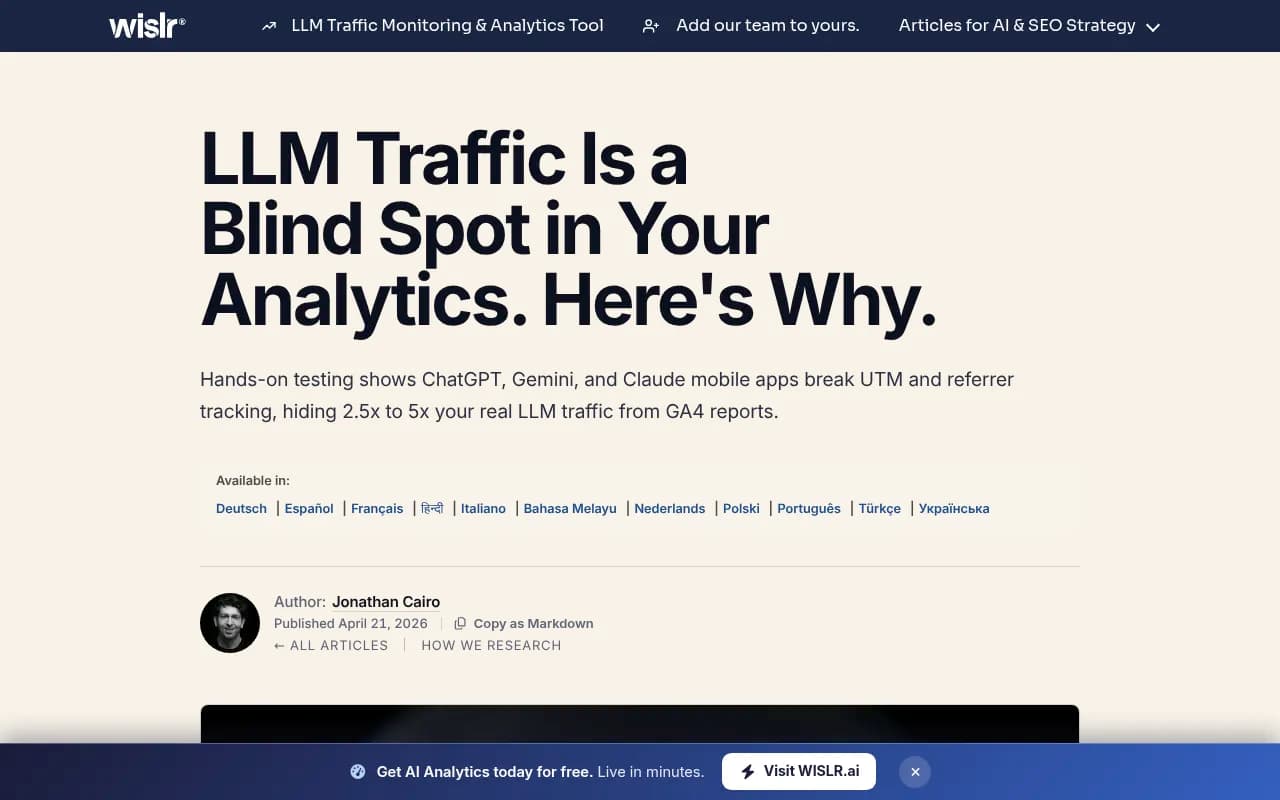
- Your analytics undercount the visits that do happen. Wislr's testing says mobile app tracking breaks, hiding 2.5x to 5x of real LLM traffic from GA4.
- Pick a tracker that pins prompts to coordinates or city level, then pair it with crawler logs and location pages that search engines have indexed.
The problem with one answer per country
Most AI visibility reports start the same way. You pick a set of prompts, choose a country, and the dashboard says you appear in 34% of answers. Nice number. It is also nearly useless if you run twelve stores.
That figure is an average across wherever the tracker happened to send its queries from. Maybe a data center in Virginia. Maybe a generic US location. Your store in Leeds, Tampa or Utrecht never gets asked. And a customer standing outside your shop, asking ChatGPT for "best running shoes near me," gets an answer shaped by where they are.
This guide explains why local ChatGPT answers vary so much, what that means for measurement, and how to set up tracking that matches how store traffic actually happens.
Why ChatGPT answers change by location
OpenAI says ChatGPT uses your approximate location to improve local results. Community threads suggest the most likely mechanism is IP-based geolocation, the same thing any web service does, plus whatever location the user shares in the app. You do not need to know the exact plumbing. You need to know the outcome: the prompt is the same, the answer is not.
For local queries, ChatGPT also runs web searches behind the scenes (query fan-outs) and builds its recommendation from what it finds. Promptwatch's data on ChatGPT query fan-outs shows how short and keyword-like those searches have become, with queries shrinking from about 117 characters in December to around 53 characters once fan-outs returned in April. See the ChatGPT query fan-outs report. Short keyword searches with a place name or implied location are exactly what pulls in local directories, review sites and your location pages.
What the Peec AI test showed
The GMBapi page summarizes a test by Malte Landwehr of Peec AI. He ran the same lawyer prompts dozens of times per location in ChatGPT, then compared how similar the rankings were.
| Location pair | Rank correlation |
|---|---|
| New York vs Chicago | about 0.1 |
| Two Brooklyn neighborhoods, two miles apart | 0.6 |
| Two spots a 15-minute walk apart | 0.8 |
I have not verified this against Peec's original write-up, so treat the exact numbers as a third-party claim. The direction is hard to argue with, though. Even a short walk changes the answer a little. A different city changes it almost completely.
ChatGPT is not Google Maps
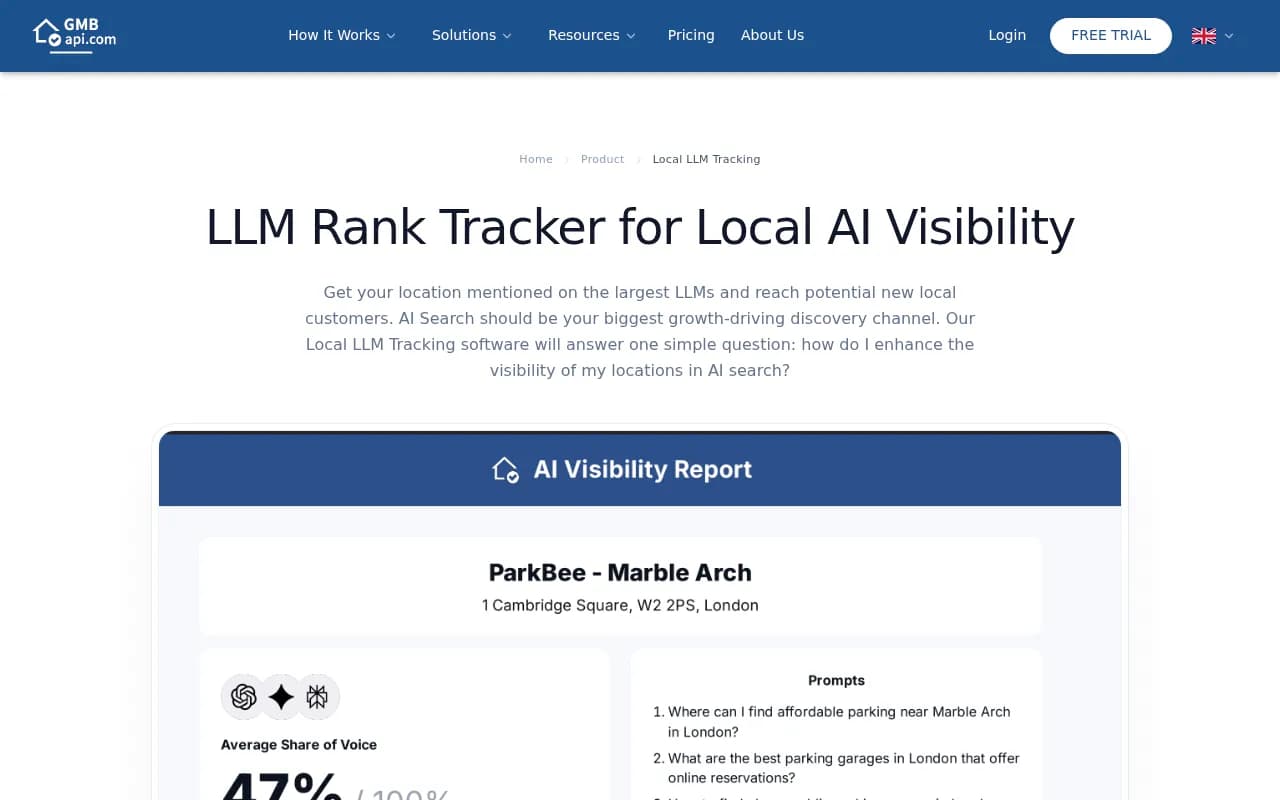
GMBapi also makes the point that ChatGPT lacks Google's access to opening times, reviews and live user location. That is a vendor claim, and ChatGPT's access to data is changing, so I would not build a strategy on it. But the practical consequence matters: ChatGPT leans on whatever it can find on the open web, such as your site, listings, review platforms and local press. If those sources are inconsistent or thin, you lose the recommendation to a competitor whose data is cleaner.
The same page says ChatGPT recommends only a small share of locations (the figure, 1.2%, is cut off against its comparison number, so I will not lean on it). Whatever the exact ratio, the shortlist is short. Local AI answers name a handful of businesses, not ten blue links.
What country-level monitoring actually misses
Here is where the averages hurt.
Store-by-store variance
You may rank first in your flagship city and be invisible in two others. Country-level tracking blends both into one mediocre average. You will never find out which stores need work.
Competitor differences by area
Your national competitor list is not your local competitor list. In one suburb the threat is a chain. In another it is an independent with 600 great reviews. A country report shows neither.
Near-me and implied-location prompts
Prompts like "where can I get this fixed today" have no city in them. The location is implied. A tracker that does not set a location will return a generic answer, or none that resembles what a real nearby customer sees.
Rankings up, calls down
GMBapi notes that rankings can rise while calls and clicks fall, as AI Overviews and AI answers absorb the decision. It cites Nozzle data across 15 million local queries, in which only 23% of desktop AI Overviews and 8% of mobile ones showed a cited URL. Again, unverified, but consider what it implies: even when you are in the answer, the visit may never come through as a click. Which brings us to analytics.
Your analytics are also undercounting store traffic
Local tracking tells you whether you appear. Analytics should tell you what happened next. Right now, it is probably telling you less than the truth.
Wislr tested ChatGPT, Gemini and Claude across mobile apps, mobile browsers, Mac and Windows. Their headline: mobile apps break UTM and referrer tracking, hiding roughly 2.5x to 5x of your real LLM traffic from GA4. Their ChatGPT results:
| Platform | Device | Interface | UTM present | Referrer present | Trackable |
|---|---|---|---|---|---|
| ChatGPT | Mobile | App | Yes (utm_source=chatgpt.com) | No | Partial |
| ChatGPT | Mobile | Browser | Yes | Yes | Yes |
| ChatGPT | Mac / Windows | App | Yes (utm_source=chatgpt.com) | No | Yes |
| ChatGPT | Mac / Windows | Browser | No | Yes | Yes |
Now think about who asks ChatGPT for a nearby store. Mostly people on phones, often in the app. That is the weakest row in the table. Local intent skews toward exactly the traffic that is hardest to attribute.
There is another wrinkle. An Inc. piece described a ChatGPT tracking bug in October that made AI referral traffic look like a drop in demand. If your ChatGPT sessions dipped and your store visits did not, check for measurement problems before you cut anything.
And many store visits never touch your site. Someone reads the recommendation, then walks in or calls. That conversion is invisible to GA4 regardless. So the realistic goal is a range, not a precise number. Wislr says it plainly: the goal is not false precision but a reasonable range of what you are missing.
How to set up local ChatGPT tracking
1. Build a prompt set around real local intent
Start with how customers actually ask:
- Category plus place: "best pediatric dentist in Brooklyn Heights"
- Near-me phrasing: "coffee shop open now near me"
- Problem-led: "who can fix a cracked phone screen today"
- Comparison: "[your brand] vs [local competitor]"
Keep a mix of explicit-location prompts and implied-location prompts. The second group is where location settings matter most.
2. Pin each store to its own location
One monitor per store or per service area. You want the tracker to ask as if from that spot, not from a national default. Some tools use city-level targeting, others use exact coordinates. For dense cities, coordinates are better, given the Brooklyn example above.
3. Read the right metrics
GMBapi's metric list is a decent baseline for any local tracker: visibility (share of answers naming you), average position, brand mentions, sentiment, rank against competitors, and citations. Citations matter most locally. They show which directories and review sites ChatGPT is pulling from, which tells you where to fix your data.
4. Make location pages crawlable and indexed
On August 8, 2026, ChatGPT started using the site: operator at scale. Promptwatch Data shows site:-scoped fan-outs jumped from 0.37% to 16.8% of fan-out queries in one day, and average fan-outs per response rose from about 1.08 to about 1.83. Read the site: operator report. The report notes such queries can only surface pages search engines have indexed from your domain. For a multi-location business, that means each store needs its own indexable page with real content, not a store-locator widget that renders client-side.
5. Re-run continuously
That same report points out that platform search behavior can change overnight. A quarterly audit of ten prompts will miss it. Daily or weekly runs across stores will not.
6. Estimate the traffic you cannot see
Filter GA4 for chatgpt.com referrals and utm_source=chatgpt.com, then treat the number as a floor. Apply a range using the Wislr multiplier as a rough guide, not gospel. Add a "how did you hear about us" field to forms and ask at the till. Crude, effective.
Tools for local AI visibility tracking
Coverage of location-level tracking varies a lot. Many AI visibility tools track by country or language only. Here is how the relevant options sort out.
| Tool | Local angle | Best for |
|---|---|---|
| Promptwatch | Pins monitors to exact coordinates (20 m to 5 km radius), plus state and city tracking | Multi-location brands wanting tracking plus action |
| Birdeye Search AI | Location-level AI visibility | Brands already using Birdeye for reviews |
| BrightLocal | Local rankings, listings, reviews, now with AI visibility | Agencies and local SEO teams |
| GMBapi | Local LLM tracker alongside a Map Pack tracker | Local SEO reporting |
| Yext | Verified listings and brand data across AI channels | Fixing the source data AI reads |
| SOCi / Chatmeter / Synup | Listings, reviews and local pages | Operating the local presence itself |
Promptwatch
Promptwatch lets you pin a monitor to exact coordinates, so ChatGPT, Google AI Overviews and Google AI Mode answer as if asked from that place. Local GEO/SEO targeting is on the Business, Agency Scale and Enterprise plans, and state and city tracking starts at Business. It tracks the real ChatGPT interface rather than only the API, which matters here because user-facing answers can differ from API outputs. IP-verified crawler logs and AI visitor analytics help close the loop: you can see whether ChatGPT's crawlers actually reach your location pages, and what traffic comes back. Check promptwatch.com/pricing for current plans.

Birdeye Search AI
Birdeye describes its offering as local AI visibility with location-level tracking. It makes most sense if reviews and listings already live in Birdeye.
BrightLocal
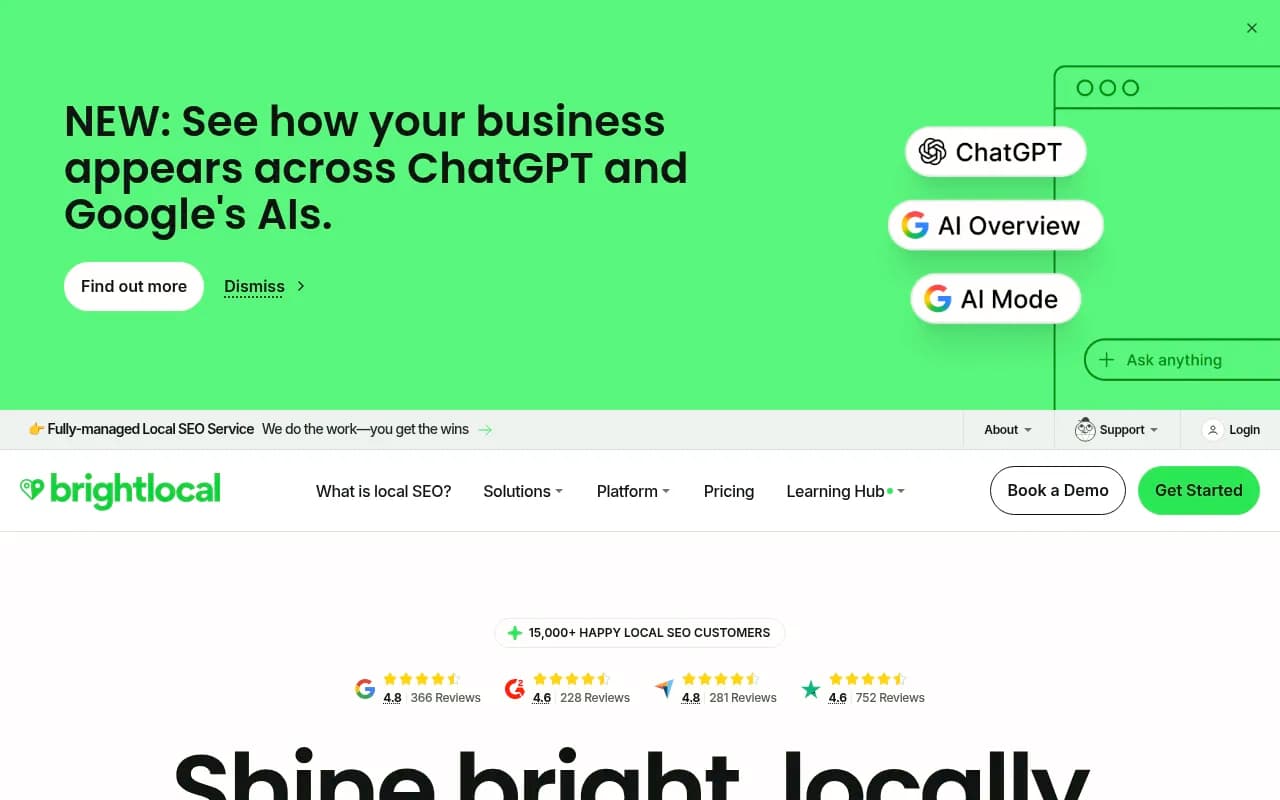
BrightLocal added AI visibility to what was already a staple for local rankings, listings and reviews. A natural fit for agencies that already report Map Pack data.
Yext, SOCi, Chatmeter and Synup
These are less about measuring AI answers and more about the data underneath them. Consistent listings and reviews feed the sources ChatGPT reads. Yext, in particular, positions itself around verified brand data for AI channels.
Country-level trackers
Peec AI, Otterly.AI and Profound are well known AI visibility trackers. Check each vendor's documentation for location targeting before relying on them for store-level answers; I did not find a side-by-side comparison of local features, so verify before you buy.



For a wider list, the GEO software directory at bestgeosoftware.com is a good place to compare options.
Fixing what the tracker finds
Tracking is the cheap part. Once you see a store missing from its local answers, the usual causes are boring:
- The location page is thin, duplicated across stores, or not indexed.
- Listings disagree on hours, phone or address.
- Reviews are sparse compared with the competitor ChatGPT names instead.
- ChatGPT's crawler is blocked or erroring on your site.
- Your citations come from a source you do not control and have never looked at.
Check crawler access first, since nothing else matters if the bots cannot read the page. Then fix listing consistency. Then build out each location page with specifics: services, neighborhood, staff, real photos, local FAQs.
If you would rather hand off the strategy, an SEO and GEO agency such as 1001 SEO Media works on local and AI search together. It is optional; the steps above are doable in-house.
A quick checklist
- One monitor per store, pinned to its location
- Prompts include both named-place and near-me phrasing
- Visibility, position and citations reviewed per store, not just in aggregate
- Each location has its own crawlable, indexed page
- Listings and reviews consistent across platforms
- GA4 chatgpt.com traffic treated as a minimum, with offline attribution questions added
- Monitoring runs continuously, since ChatGPT's search behavior can change in a day
The short version
A country-level number tells you how the brand does in general. Store traffic is decided one neighborhood at a time, by an answer that two people a short walk apart may not even share. Track at the location level, read citations to find the fix, and assume your analytics are showing you a fraction of what is really coming through the door.