Key takeaways
- Running a prompt from a city is not the same as tracking whether ChatGPT recommends your business there. Look for tools that report a score per location, not one blended brand number.
- BrightLocal, SE Ranking's SE Visible, Radarkit, Birdeye and Promptwatch all handle city-level tracking in different ways. Neighborhood-level granularity is the claim you should test in a trial.
- One prompt is one sample. ChatGPT answers vary from run to run, and almost half of responses cite 10 or more domains, so track many prompts over time.
- A single-location business with fewer than 20 target prompts can start with manual checks and a cheap tool. Multi-location brands need per-location reporting.
Why local ChatGPT tracking is its own problem
Brand-level AI visibility tracking answers "does ChatGPT mention us?" Local tracking asks something harder: "when someone in Leeds, or in Williamsburg, asks for the best dentist, does ChatGPT name this specific location?"
The difference matters because a multi-location business can look fine on a brand-wide average while three of its twelve locations are invisible. A blended score hides that.
Consumers are already doing this. BrightLocal's 2026 consumer survey (vendor data, n=1,164) found 58% of consumers have used AI to find or get a recommendation for a local business, and 75% go to Google afterward to verify. Only 18% contact an AI-recommended business directly. So AI is a discovery layer, and your Google Business Profile and reviews still do the closing.
There is also a reality check. SE Ranking's local AI page cites SOCi's 2026 Local Visibility Index, which found ChatGPT recommended 1.2% of locations, against 35.9% for Google's local 3-pack. That is a third-party figure shown on a vendor page, so verify it at the source, but the direction is worth knowing: ChatGPT is far stingier with local recommendations than Google Maps results are.
What to look for in a local tracker
Before comparing tools, settle on what you need it to do.
Location-level scores, not brand-wide scores
Some tools let you run prompts "from" a country, state or city. That is geo-targeting. It is useful, but it is not the same as measuring whether your business at 14 Main Street gets recommended. Ask whether the dashboard gives each location its own visibility score, competitors and answer history.
Prompt control
Local intent shows up in a few shapes: "best plumber in Austin", "emergency plumber near me", and neighborhood versions such as "plumber in East Austin". You want to write your own prompts, not just accept a list.
Repeated sampling
ChatGPT does not give the same answer every time. Promptwatch's data on unique domains per response (Sep 28 to Oct 4, 2026) shows 47.6% of ChatGPT responses cite 10 or more domains, and for organic prompts, the type that covers "best dentist in X" queries, it is 52.5%. The report's own advice is to measure citations across many organic prompts, not one. Any tool that checks once a week and shows a rank is giving you noise.
Query fan-out visibility
ChatGPT breaks a prompt into web searches behind the scenes. Promptwatch's query fan-out data shows queries have gotten shorter, from around 117 characters in early December 2025 to about 53 characters from April. I did not find a local-specific fan-out cut, but the practical takeaway holds: the searches are keyword-style, so city and neighborhood terms belong in your page titles and headings, with the business category up front.
Source and citation data
For local prompts, the pages ChatGPT draws on are usually directories, review sites and listicles, not your own website. A tool that shows which domains get cited for your category tells you where to get listed or reviewed.
The tools, compared
| Tool | Local approach | Engines | Starting price (verify) | Best for |
|---|---|---|---|---|
| BrightLocal | Per-location score, up to 20 prompts per location | ChatGPT, AI Mode, AI Overviews | From $31/mo (included in all plans) | Local SEO agencies and small multi-location brands |
| SE Ranking Visible | User-defined cities, each with own prompts and score | ChatGPT, Gemini, AI Mode, AI Overviews | Plus tier from $355, $284/mo annual | Teams already in SE Ranking |
| Radarkit | Local Radar for business recommendations, 50+ locations | Multiple, UI-based | From $29/mo (vendor-reported) | Small businesses wanting recommendation tracking |
| Promptwatch | Monitors pinned to exact coordinates, plus country, state and city tracking | ChatGPT, AI Overviews, AI Mode and more | Essential $95/mo; local targeting on Business $579/mo | Brands that want to fix visibility, not only watch it |
| Birdeye Search AI | Location-level tracking inside a reputation platform | AI search engines | Quote-based | Multi-location brands with reviews already in Birdeye |
Prices come from vendor pages and vendor-authored comparisons. Check each pricing page before buying.
BrightLocal Local AI Visibility Tracker
BrightLocal launched its Local AI Visibility Tracker on September 10, 2026, and it is the most natural fit if you already live in local SEO.
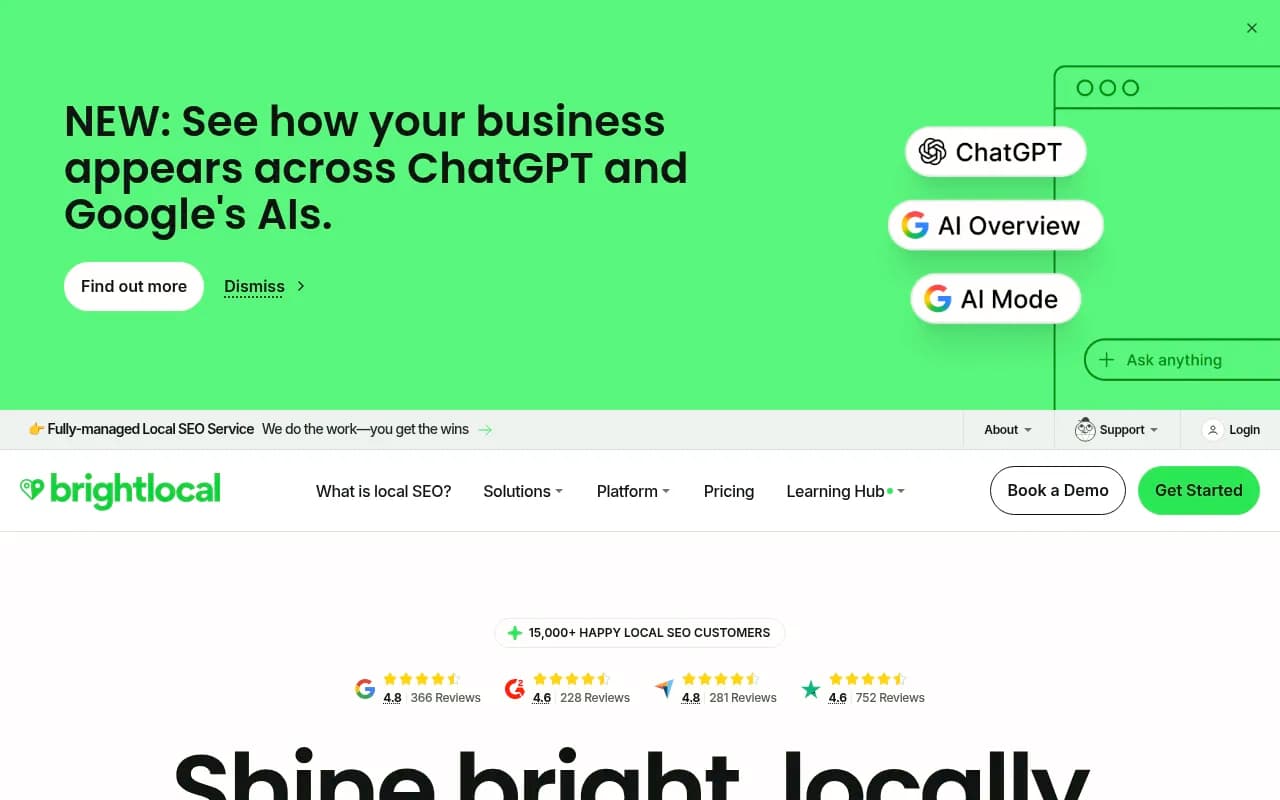
Setup is three steps. You add a location, BrightLocal suggests prompts based on your business category, you edit them (up to 20 per location), and you get a 0 to 100 visibility score broken down by platform and by prompt. Each location gets its own score rather than a blended average.
Other things it does: branded and unbranded prompt results with sentiment and recommendation strength, competitor auto-detection with mention rate, share of voice and average position, and an AI sources leaderboard showing which domains get cited for your category. Citation gaps feed into its Citation Builder, which is a sensible workflow since local visibility often comes down to being listed in the right places.
It covers ChatGPT, Google AI Mode and AI Overviews. It is included in all plans from $31/month with a 14-day free trial and no card. The 20-prompt cap per location is the main limit. For a dentist in one town, it is plenty. For an enterprise tracking hundreds of prompt variants, it is not.
SE Ranking's SE Visible
SE Visible takes a similar per-city approach. You define the cities, and each is tracked as its own set of prompts per answer engine, with its own score and answer history. Locations can be grouped into regions, brands or franchise groups, which helps if you manage a franchise.
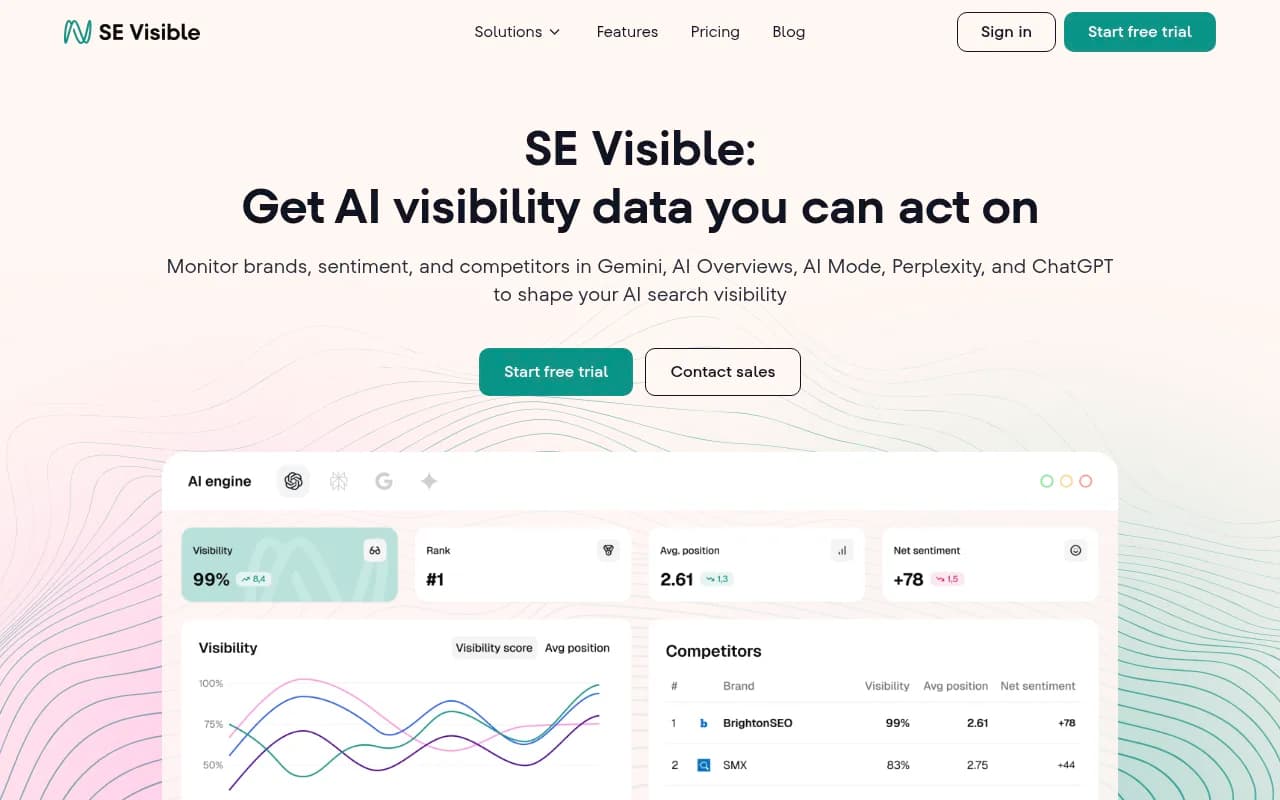
It covers ChatGPT, Gemini, AI Mode and AI Overview. The pricing tiers on the page are partly garbled in the source I reviewed. The Plus tier (1,000 prompts, 10 projects) starts at $355, shown as $284/month on annual discount, with a 10-day trial. Smaller tiers run 200 and 450 prompts. It is pricier than BrightLocal's entry point, but you get more prompt capacity.
Radarkit
Radarkit pitches itself around actual business recommendations rather than just website citations. Its Local Radar feature is designed to show whether an AI answer recommends your business for local prompts, including city, neighborhood and "near me" searches.
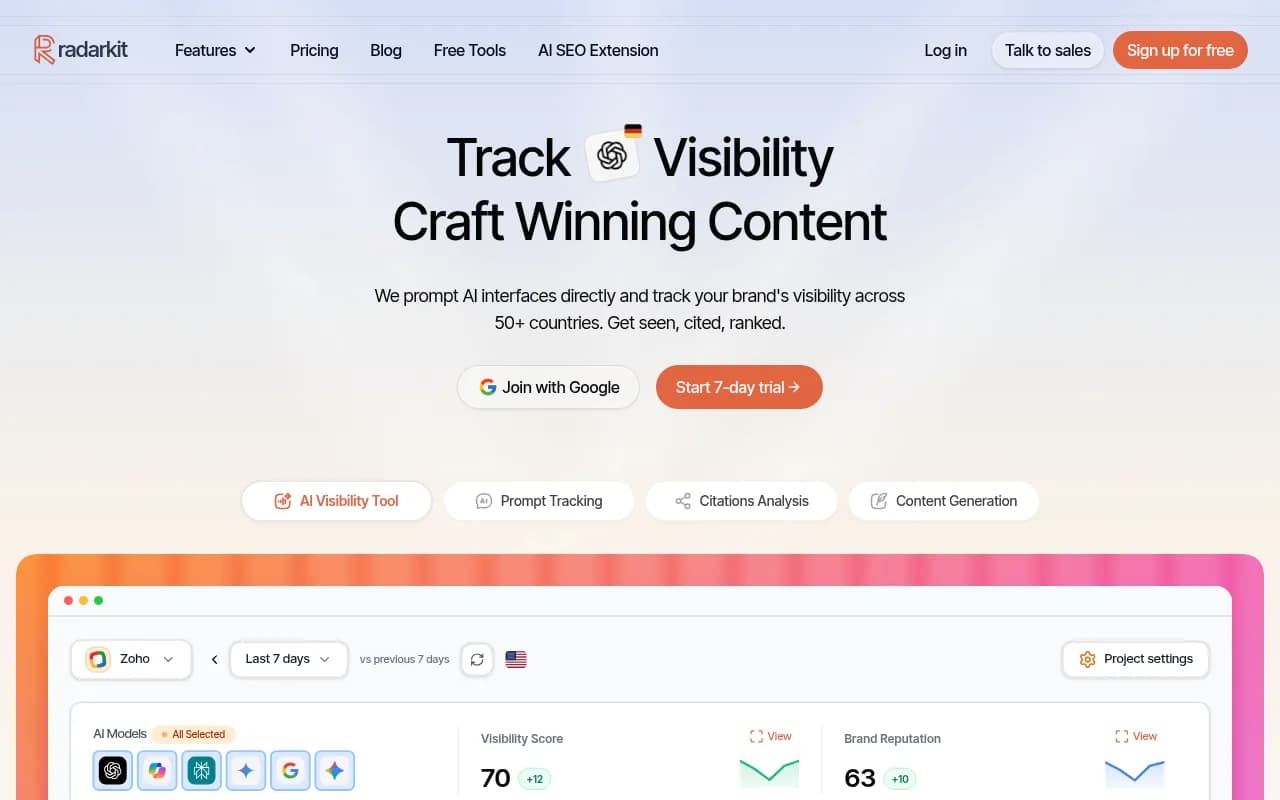
Two caveats. First, the best source on it is Radarkit's own blog, which ranks Radarkit first, so treat its comparisons as biased. It also lists starting prices for competitors that I could not verify, and another source gives a very different figure for one of them. Second, I could not confirm the neighborhood-level claim in the product itself. It starts at $29/month and tracks 50+ locations, which makes it worth a trial if neighborhood-level prompts are your priority. Test it with three or four neighborhoods you know well and see if the answers actually differ.
Promptwatch
Promptwatch approaches local from the monitoring side and the fixing side. Monitors can be pinned to exact coordinates (you search a place or drop a pin, with an accuracy radius from 20 m to 5 km), so ChatGPT, Google AI Overviews and Google AI Mode answer as if asked from that spot. That is the closest thing in this list to a verified neighborhood-level setup, because you control the pin rather than relying on a city name.

The catch is plan level. Country tracking is on every paid plan, but state and city tracking and local GEO/SEO targeting at exact coordinates start on Business ($579/mo). Agency Scale ($799/mo) also includes local targeting. Essential at $95/mo does not. Radarkit's blog describes Promptwatch as having city and state-level prompt tracking, which is accurate but undersells the coordinate pinning.
What sets it apart for local work is what happens after you spot a gap. Its IP-verified crawler logs show whether AI bots can read your location pages, Citation Trends and source reports show which review sites and directories AI leans on, and the Content Agent can draft and publish pages against the gaps. If your problem is "we are invisible in three cities and I need to know why," that diagnostic chain is useful. If you only want a scoreboard for one shop, it is more than you need.
Birdeye Search AI
Birdeye is a reputation and listings platform that added local AI visibility with location-level tracking. It makes the most sense if you already manage reviews there, since review volume and sentiment feed directly into what AI engines pick up.
Other local suites worth a look
Several local marketing platforms in our catalog are moving into AI visibility. I have not verified their local AI tracking depth, so check demos before assuming parity with the tools above.
- SOCi runs local search, reviews and social for multi-location brands, and publishes the Local Visibility Index cited earlier.
- Chatmeter, Reputation.com and Synup cover listings, reviews and local pages.
For general-purpose trackers where you can add city names to your prompts manually, such as Otterly.AI, Peec AI or Searchable, you can approximate local tracking, but you are doing the geography yourself.



If you want to browse more options, the GEO software directory lists dozens of trackers by capability.
What the research shows about getting recommended locally
Tracking is the measurement half. A few patterns from Promptwatch Data are useful for the fix half.
- Citations come from many places. With nearly half of responses citing 10 or more domains, you are rarely competing for one slot. You are competing to show up across review sites, listicles and directories.
- Brand-specific prompts behave differently. For those, only 21.3% of responses cite 10 or more domains and the most common count is 5. If someone asks about your business by name, ChatGPT looks at fewer sources, so your own pages and profiles matter more.
- Social is a weak channel in ChatGPT. Promptwatch's October 2026 social citations report found ChatGPT got only 0.46% of citations from social platforms (Sep 28 to Oct 4), while Google AI Overviews got 12.2%. For local, that means Reddit and Facebook posts help more on Google surfaces than in ChatGPT.
- Reddit citations in ChatGPT collapsed on August 14, 2026, from roughly 4% to 0.5% of citations, per Promptwatch's report. If your local strategy leaned on Reddit threads, revisit it.
- ChatGPT now uses the site: operator heavily. Promptwatch's data shows it jumped from about 0.4% to about 17% of fan-out queries on August 8, 2026. It is a sign ChatGPT increasingly goes straight to named sites, so being present on the domains it trusts for your category matters.
For industry-specific benchmarks, Promptwatch has travel and automotive reports. In automotive, marketplaces like Autotrader and Cars.com outrank every car brand. The same logic usually applies locally: aggregators beat individual businesses, so get listed on them.
If you are comparing general-purpose trackers beyond local, that Searchable roundup scores tools on ChatGPT surface coverage, sampling frequency and price per prompt. It is vendor-authored, but the criteria are a good checklist.
How to set up a local tracking plan
Step 1: Build a prompt set per location
For each location, write 10 to 20 prompts. Mix these:
- Category plus city: "best family dentist in Denver"
- Category plus neighborhood: "dentist in Capitol Hill Denver"
- Near me: "emergency dentist near me"
- Comparison: "Smile Co vs Mile High Dental"
- Brand: "is Smile Co Capitol Hill any good"
Step 2: Test neighborhood sensitivity before paying
Run the same category prompt for two neighboring areas by hand in ChatGPT. If the recommended businesses are basically identical, neighborhood-level tracking will mostly show you duplicates. If they differ, you have a case for finer granularity. I did not find confirmation that any tool tracks true neighborhood differences beyond what the prompt text and location pin provide, so this manual test is worth ten minutes.
Step 3: Pick a tool that matches your scale
| Situation | Reasonable choice |
|---|---|
| One location, under 20 prompts | Manual checks monthly (about 20 minutes), or a $29 to $31 tool |
| A few locations, local SEO focus | BrightLocal |
| Franchise or regional groups | SE Visible, or BrightLocal at scale |
| Multi-location plus fixing content and crawl issues | Promptwatch Business or Agency |
| Reviews-heavy multi-location brand | Birdeye or SOCi |
One source I read argues against paying $499/month for an enterprise tool to track 10 local prompts. I agree. Start small.
Step 4: Track over weeks, not days
Look at the trend over four or more weeks. One run tells you almost nothing. Searchable measured an average of 1.74 underlying searches per ChatGPT response across 6.9M responses, which is another reason a single check is a sample, not a result.
Step 5: Act on the sources
When the tool shows which domains ChatGPT cites for your category, go get listed, reviewed or mentioned there. Make sure your location pages put the city or neighborhood and the category in titles and headings, since fan-out queries are short and keyword-like. Keep your Google Business Profile current, because 75% of consumers verify on Google anyway.
Common mistakes
- Treating geo-targeted prompts as location tracking. Check for per-location scores.
- Tracking one prompt per city and calling it done.
- Ignoring Google's AI surfaces. AI Mode and AI Overviews are part of local discovery, and they cite different sources than ChatGPT.
- Trusting vendor comparison tables. Several of the price lists I found were written by competitors. Confirm on the vendor's pricing page.
- Buying for neighborhood granularity without testing whether answers differ by neighborhood.
Bottom line
For most local businesses, BrightLocal is the cheapest credible start, with real per-location scoring. SE Visible suits grouped locations and bigger prompt volumes. Radarkit is worth a trial if you want recommendation-focused tracking at a low price, as long as you check its neighborhood claims yourself. Promptwatch is the pick when you need coordinate-level targeting and want to diagnose and fix why locations are missing, with the caveat that local features sit on its Business and Agency plans. For tracker options beyond local, the AI rank tracking directory is a handy next stop.
Whatever you choose, run a trial on three real locations with ten real prompts each. The tool that shows you something you did not already know is the one to keep.